
Mobile App Security 2026: 83% Attack Surge & Protection Guide
Need quick insights? Summarize with AI & save time
 ChatGPT
 Perplexity
 Claude
 Google AI Mode
Table of Content
- Why Mobile App Security Matters More Than Ever in 2026?
- The 2026 Mobile App Threat Landscape
- Key Security Concerns in Mobile Apps
- Best Practices in Mobile App Security in 2026.
- Cost of Mobile Data Breaches and Business Impact
- Mobile App Security: Privacy and Compliance.
- Conclusion
- FAQs
Summary
In 2026, mobile app security has moved beyond traditional firewalls to a model where applications must be inherently self-defending. As AI-driven attacks and supply chain vulnerabilities become more sophisticated, the focus has shifted toward Runtime Application Self-Protection (RASP) and Zero-Trust architectures to protect applications from within.
As the security gap between iOS and Android narrows, businesses must integrate robust security protocols directly into their development pipelines. This proactive approach is essential not only to defend against session hijacking and automated reverse engineering but also to ensure seamless compliance with evolving global regulations, such as the EU AI Act and GDPR.
You may have confidence in your code, but can you have confidence in your whole supply chain? Your mobile application will be as secure as the weakest link in an ecosystem powered by third-party SDKs and API integrations. According to recent statistics, 95% of companies are now operating APIs with open security vulnerabilities, which have provided a backdoor to hackers, who have been using session tokens and sensitive PII against the businesses.
From “Browser-in-the-Middle” attacks to the silent data leaks of local storage, the 2026 threat landscape is invisible to traditional monitoring. It’s time to stop looking at the perimeter and start looking inside the app itself.
In 2026, mobile app security has become more than just a checklist. As the attack surface expands, the rules of defense have fundamentally changed.
This guide dissects that new reality, exploring:
- How are AI-driven attacks and supply chain vulnerabilities bypassing traditional firewalls?
- Why are security failures existential risks costing millions per breach?
- How to adjust to the shift towards AI-based security risks?
- How to navigate the complex maze of the EU AI Act, GDPR, and PCI DSS 4.0?
The question is no longer if your app will be targeted, but how it will defend itself when the attack comes from within.
Why Mobile App Security Matters More Than Ever in 2026?
Imagine a day without mobile applications in the current era? That’s how important apps have become. So, as a business, focusing on mobile apps is not an option anymore. But what’s more important is to maintain the security of your app.
And why is that?
Mobile apps power most of the digital interactions today, which include financial transactions, too. And securing the financial data exchanges across your apps is not just good for business but also crucial to ensure compliance with data standards like HIPAA, GDPR, and PCI DSS.
Plus, mobile apps have become a primary target for most cyber attackers these days.
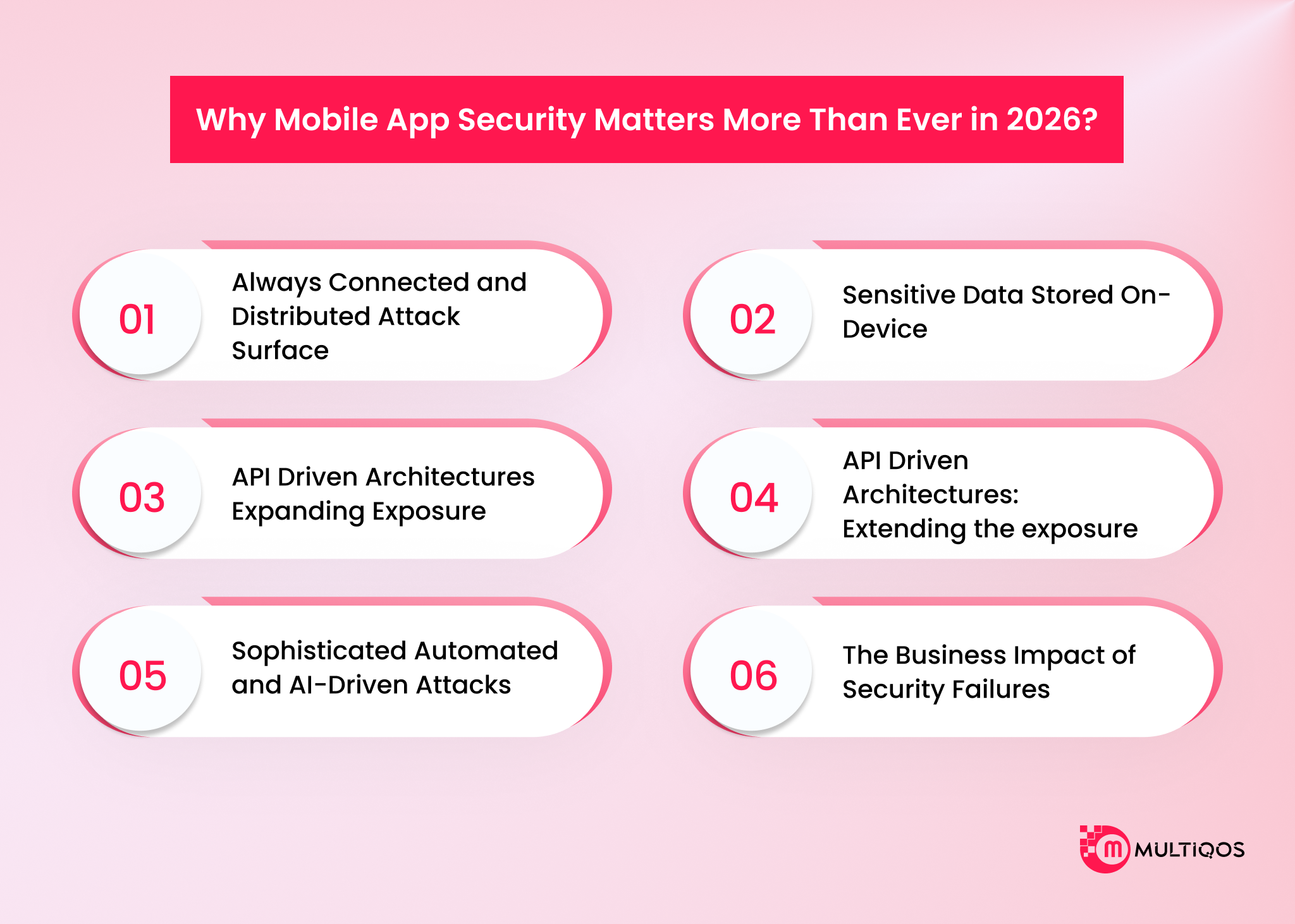
Some of the key reasons why mobile apps are primary targets for cyber attackers are,
Always Connected and Distributed Attack Surface
Mobile devices are always in a state of switching networks. What this means is mobile devices switching between WIFI, mobile networks, and public hotspots. This leads to a wider attack surface, which attackers exploit.
While websites often have the protection of corporate firewalls, mobile apps don’t have such a level of protection. Plus, many users use sideloaded apps or are often using devices with outdated operating systems.
Sensitive Data Stored On-Device
Web apps process data on secure servers, but mobile apps often store sensitive information like authentication tokens, PII, and biometric data. In fact, a survey from Zimpperium suggests that 77% of mobile apps expose PII through insecure data practices.
Apart from the native data storage risks, mobile apps often fall prey to biometric-based attacks. For example, sophisticated malware types like GoldPickaxe have shown the ability to create deepfakes and bypass authentication, exploiting facial recognition features.
API Driven Architectures Expanding Exposure
Web applications usually enjoy the security of corporate firewalls, but mobile applications do not have this kind of security. In addition, lots of users have sideloaded applications or regularly work with outdated operating systems. Along with all the above, the attack surface has already been extended by widespread 5G adoption and massive integration of the Internet of Things.
API Driven Architectures: Extending the exposure.
APIs are central to mobile apps, which interact with the backend services, and this has grown to become an area of critical vulnerability. Prime targets of business logic attacks, APIs are currently experience 95% of organizations in production reporting security problems.
BOLA, which is a vulnerability, permits the attacker to alter the API calls to gain access to data that they are not supposed to, a situation that has been aggravated by the fact that in most organizations, they are not fully aware of their active APIs.
Sophisticated Automated and AI-Driven Attacks.
As AI becomes increasingly integrated into mobile applications, developers must also understand how these technologies affect app architecture, functionality, and security. Learn more about AI in Mobile App Development.
The increase in scams and phishing reports is due to the creation of hyper-realistic, multi-linguistic phishing campaigns that can circumvent filters despite traditional filters, facilitated by generative AI. This is further enhanced by the fact that there have been increasing free, AI-assisted reverse-engineering tools that enable threat actors to simply decompose apps and logic.
The Business Impact of Security Failures.
In 2026, mobile security crashes cease to be technical inconveniences and become existential business risks. The average cost of breaches involving mobile apps is now $4.44 million per case, while supply chain breaches can exceed $4.9 million.
In addition to financial losses, organizations may incur more than $300,000 in operational downtime per hour due to such attacks.
The 2026 Mobile App Threat Landscape
The mobile threat environment has shifted from a secondary concern to a primary battleground. Code vulnerabilities are no longer the sole concern in the entire mobile ecosystem. It is about protecting against a highly organized, industrialized cybercrime economy, where the security of mobile apps is paramount.
Reverse Engineering and Code Tampering.
The entry obstacle in analyzing app binaries has been broken down. Reverse-engineering tools, which are free and AI-assisted, have become easier for threat actors to use to decompose apps, examine proprietary logic, and discover vulnerabilities at scale. This has compelled all mobile app development firms to redefine how they protect mobile apps at the core.
What is so worrying?
You can now reverse-engineer your app faster than an attacker. They are reading your business logic, identifying weaknesses in your mobile API security standards, and coordinating attacks.
Credential Stuffing and Session Hijacking.
The onslaught attackers have shifted focus from stealing passwords to stealing session tokens. Attackers can use techniques such as “Browser-in-the-Middle” (BitM) to obtain valid session tokens after authentication and bypass Multi-Factor Authentication (MFA) entirely.
It represents a paradigm shift in mobile application security. Conventional authentication methods, such as passwords, PINs, and biometrics, have become ineffective because attackers can hijack active sessions.
Unsecure APIs and Backend Exposure.
Business logic exploits have also become the most common target of APIs, with 99% of organizations experiencing API security issues in production. Attackers use Broken Object-Level Authorization (BOLA) to modify API calls and access data for which they are not authorized.
You should know that in the case you have a mobile application, it is as safe as your least secure API endpoint. When contracting secure mobile app developers, having them adopt strong mobile API security standards should be their major role. This is where zero-trust mobile architecture can be negotiated out of existence, as opposed to being aspirational.
Malware Injection and Overlay Attacks.
Overlay attacks are introduced by such mobile-specific malware families as BingoMod and Coper, which show fake login windows over legitimate banking applications to dupe users into providing credentials. These are not unsophisticated phishing campaigns. They are pixel-to-pixel copies that are difficult even for tech-savvy users to differentiate between the legitimate interfaces and them.
The sophistication here demands more than traditional mobile app security best practices 2025. It requires Runtime Application Self-Protection (RASP) that can detect and prevent overlay attacks in real-time, before user credentials are compromised. For financial services apps, especially, this represents a critical gap between iOS vs Android security comparison considerations.
Supply Chain Risks
Third-party breaches have been increasing twice a year, and thirty percent of data breaches are now associated with supply chain problems. Incidents of such breaches, such as the SalesLoft/Drift one, show that the downstream organizations could be exposed by the very compromise of a single third-party integration.
This cascading vulnerability model implies that having your own internal mobile app protection measures that are impregnable, a single SDK or third-party service failure will roll the ball game.
The answer does not lie in not integrating with third parties. But to implement DevSecOps mobile integration practices that treat every external dependency as a potential attack vector. This includes regular penetration testing of mobile apps that specifically target supply chain vulnerabilities, not just your proprietary code.
Key Security Concerns in Mobile Apps
Since there are security tools that are highly advanced, there are still basic gaps that are slipping through the whirlwind of development. A great proportion of mobile applications do not provide basic protection mechanisms, and they are vulnerable to attacks.
And the consequences? They are harsher than most organizations expect.
Insecure Local Storage: The data leakage occurs silently.
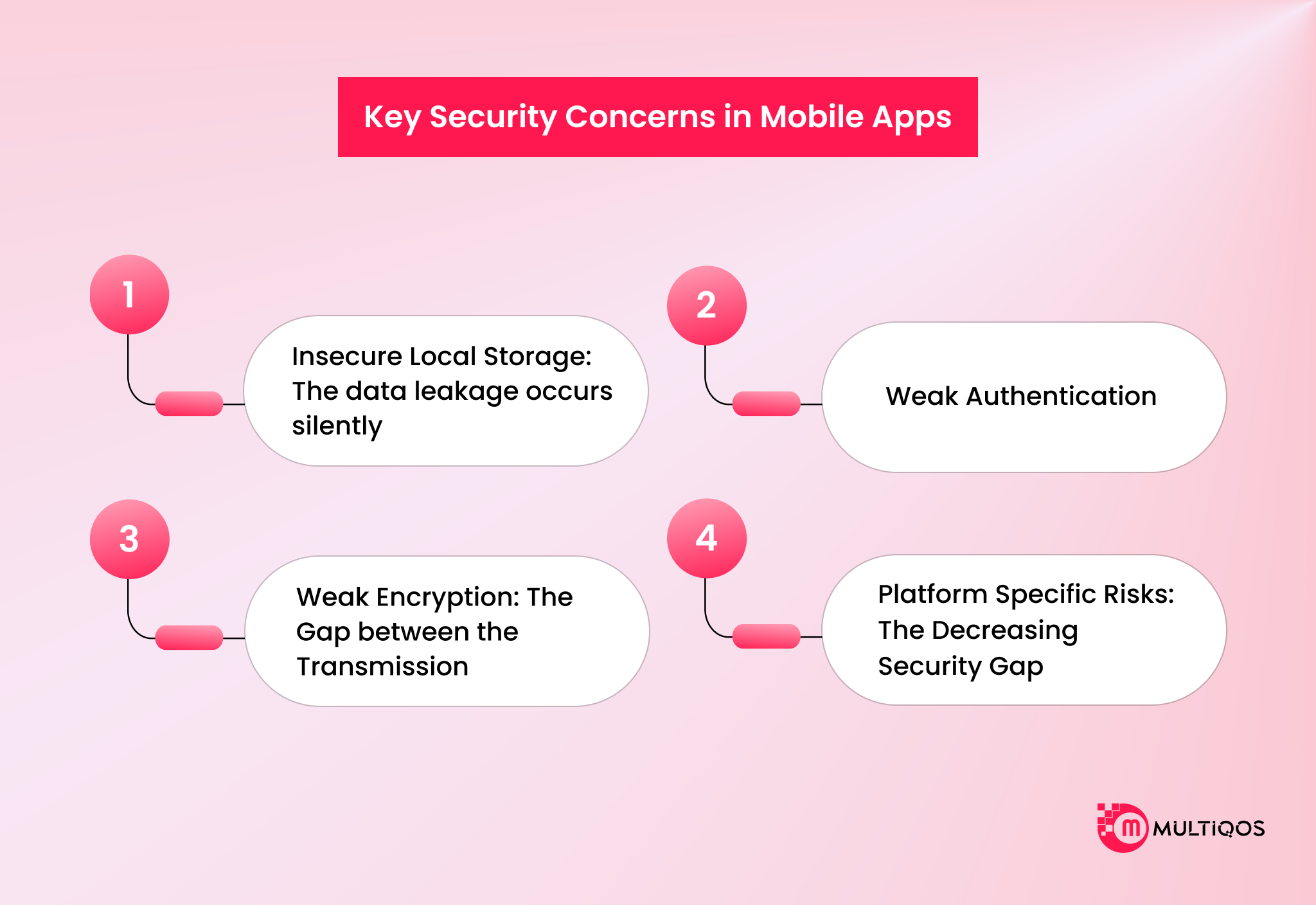
Desktop applications store sensitive data on secure servers, whereas mobile applications usually save key information such as authentication tokens, personal details, and biometric data to devices. Mobile applications lack the proper protection of such information, and sometimes sensitive data like passwords or financial data is left in their plaintext or in easily manipulated files.
The native data storage risks are not the only challenge that mobile apps have compared to web applications. It is associated with unlimited storage on the local drive that cannot be tracked or regulated by the users. Even though your backend is distributed with enterprise-grade encryption, that authentication token in the unencrypted local storage is nothing but a master key that can be stolen.
This is also further complicated by the fact that most users are using devices with old operating systems that do not have modern information security measures in the form of storage.
Weak Authentication
Passwords that are weak or those that have been reused continue to serve as the cause of most data breaches. Moreover, the use of SMS as a two-factor authentication method is becoming more and more unsafe as the practices of SIM swapping and interception are becoming more common.
What is so worrying about this?
SMS based 2FA gives an illusion of security, even with the best mobile app security practices 2025 in place by the users. Attackers have made SIM swapping attacks in industries, and there are criminal groups that do tens of SIM swaps in a month. The authentication technique you believed was securing your users is, in fact, a known vulnerability that is being exploited by advanced threat agents on a regular basis.
Weak Encryption: The Gap between the Transmission.
Although HTTPS is standard, inappropriate implementation is one of the significant risks. Application of HTTPS is not equivalent to application of HTTPS correctly. Attackers take advantage of certificate pinning failures, downgrade attacks to compel older versions of TLS, and man-in-the-middle attacks.
As 5G is vastly deployed and massive IoT is increasing the attack surface, these transmission vulnerabilities have been the most common targets of business logic attacks.
Further, the cases of the breached third-party SDKs indicate that one incorrectly encrypted API connection could reveal thousands of downstream organizations. As strong as your weakest point of integration is, your encryption is.
Platform Specific Risks: The Decreasing Security Gap.
The security difference between Android and iOS is closing in a manner that caused a paradigm shift in thinking. Computer attacks on iOS have blown up; however, in the past, Android has been more targeted since attackers run all the jailbreaking and sophisticated exploitation methods.
Android is also vulnerable to sideloading, and those users who sideload have a 200% chance of being exposed to malware. This will produce a distributed attack surface that corporate MDM solutions are not able to manage.
On the other hand, the phishing traffic is more pronounced among the users of iOS, and almost twice as many interactions with malicious web content involve them.
What this implies for your iOS vs Android security comparison planning: neither is immune anymore. The rise of cross-platform attack tools has democratized mobile cybercrime, enabling low-skilled actors to launch large-scale, sophisticated attacks without platform-specific expertise.
Best Practices in Mobile App Security in 2026.
In order to fight this hostile threat environment, organizations should go beyond compliance checklists to embrace a zero-trust mentality where they theorize that apps are used in a hostile environment.
And why is that?
Since they do not have to break through your perimeter anymore, but can just use the app itself, which operates on devices that are not under your control, and are connected over networks that you cannot protect.
Security by Design: Shifting Left Before it’s Too Late.
The concept of security should be incorporated at the first stage of architecture. This encompasses moving left so as to incorporate security checks within the CI/CD pipeline so that no code gets out without passing automated security gates.
This is what most mobile app development firms get wrong: they consider security as the last phase check, but not as a requirement. Remediation costs are 15 times greater to fix the problems during production, compared to the cost of fixing during development. DevSecOps mobile is no longer a buzzword. It is the distinction between offensive defense and damage control.
Other than the financial consequences, late security interventions build technical debt, which grows with time. Your security architecture, not your feature roadmap, has to be the first question for mobile app developers that you are hiring.
Runtime Application Self-Protection: The Self-defending App.
The integration of self-defending features within the app is essential since the RASP identifies reverse engineering and debugging, as well as tampering in real-time, and enables the app to close down or restrict functionality on the detection of a threat.
What is the strength of RASP in 2026?
Conventional mobile application protection strategies work beyond the application perimeter, including firewalls, network scanning, and endpoint detection. But RASP is installed within your application, so it makes decisions when an attack occurs. In scenarios where an attacker tries to decompile your code with the help of AI-based reverse engineering software, RASP does not wait until your security staff reacts. It responds immediately.
Testing the Battlefield.
The integrity of the device where the apps are run must be checked. Rooted/jailbroken status and emulator checks. Attestation checks of rooted phones or jailbroken phones and emulators will prevent the app from executing in a compromised environment.
Besides, device attestation also solves one of the core issues in the comparison of the security of iOS and Android: you cannot manage the devices that are used by your users. Enterprise MDM solutions are useful, but the same cannot be said of consumer-facing apps.
Attestation of devices establishes a security boundary by denying access to the environment where the security risk in mobile apps is considered high, including rooted Android devices, jailbroken phones, or emulators to run automated attacks.
Platform-level security is no longer feasible with sideloading on Android and the advanced jailbreaks on iOS. Your iOS app development should take on the initiative to ensure that it is within a working environment.
API Security: Protection against the Nervous System.
Install powerful API gateways that implement rate limiting, authentication (OAuth 2.0 or JWT), and input validation to avoid injection attacks.
Mobile apps, involving APIs, interface with backend services, and this has become a focus of severe vulnerability. There is no longer a choice to follow mobile API security standards.
What compounds this problem?
The majority of organizations do not know their active APIs completely. Shadow APIs introduced by development teams, legacy endpoints that have not been properly degraded, and third-party integrations provide an attack surface that cannot even be enumerated by security teams, much less hardened.
The number of cases with breached API connections proves that one poorly secured endpoint may reveal thousands of organizations down the line.
Recurring Testing: Discovering Weaknesses Before Hackers.
Penetration testing of mobile apps should be done regularly, and automated vulnerability scanning should be done to find the weak points before attackers can do so. This involves the constant check of 3-rd party SDKs on known vulnerabilities.
Automated scanners probe billions of exposed mobile services every month, searching for exploitable weaknesses. If your testing cadence is quarterly or annual, you’re already operating at a fundamental disadvantage.
Continuous testing must also extend to GDPR compliance for mobile apps and other regulatory requirements. Compliance isn’t a one-time certification. It’s an ongoing validation that your mobile app security posture hasn’t degraded as new features ship and dependencies update.
Zero-trust mobile architecture demands zero trust in your own security assumptions, constantly verifying and trusting nothing by default.
Cost of Mobile Data Breaches and Business Impact
In 2026, mobile security failures are not just about technical development challenges but are existential business risks. And the numbers tell a story that most organizations aren’t prepared to hear.
Operational Costs: The $300,000 Per Hour Problem
Operational downtime resulting from cyberattacks can cost organizations over $10,000 per hour. It loses customer transactions, erodes market confidence, and creates opportunities for competitors to capture displaced users.
User Churn and Trust Erosion
Privacy concerns are a major driver of user behavior because users often delete an app due to privacy worries. In an era of instant social media amplification, a single security incident becomes a viral reputation crisis within hours. For mobile app development companies, this means that security concerns in mobile apps directly translate to user acquisition costs that skyrocket while retention rates collapse.
Regulatory Penalties: The 4% Global Revenue Threat
Violation of laws such as GDPR or the new EU AI Act may attract hefty fines. In the case of the secure mobile app developers you are outsourcing to, the knowledge of regulatory landscapes must be a given consideration, rather than a post hoc consideration.
The control climate has turned out to be a patchwork quilt of enforcement, punishing reactive security positions. Mobile app GDPR compliance is not a question of fines. It is concerning how to show that the principles of privacy-by-design were incorporated during the early stages of the architecture.
Mobile App Security: Privacy and Compliance.
The regulatory environment is now complicated, and international regulations demand stringent data control.
US State Laws: 20 States challenge compliance.
The state of the US actively carries out the laws on privacy in 20 states. The rules have formed a diverse compliance landscape, where the rights of consumer data (access, deletion, opt-out) must be enforced by apps depending on the jurisdiction.
Why is this especially complicated?
The requirements are slightly different in each state, which makes the compliance matrix unable to be solved with just one technical solution.
The best practices in mobile app security should consider the jurisdictional differences in consent procedures, data retention procedures, and rights management of users.
High Risk Classifications: EU AI Act.
This law prohibits certain practices by AI, like emotion recognition in workplaces, and provides strong conformity evaluation of risky apps. Failure to comply may make an app unlawful in the European market.
The EU AI Act not only regulates AI features that are obvious, such as chatbots or recommendation engines. It questions any automated choice-making that impacts users, such as ostensibly innocent operations, such as automated content moderation or behavioral analytics.
PCI DSS 4.0: Standards of security of payments.
This standard takes full effect on March 2025 but requires tough security measures on apps that process payments, such as Web Application Firewalls (WAF) and regular vulnerability scanning.
Furthermore, the mobile API security standards are supported by PCI DSS 4.0 and go way beyond traditional payment processing. Any application that accesses payment information, including one merely handing tokens to a third-party processing vendor, qualifies as such.
Developing In-House vs Outsourcing Mobile App Security.
The issue of whether to develop security capabilities internally or engage the services of external specialists is a strategic governance choice. And the false alarm does not merely affect your security stance, but it also defines the ability to react to the threat earlier than the attackers can use it.
The skills shortage reality: in-House Expertise.
The internal team is the controlling option, but it is difficult to create such a team, as there is a severe shortage of skills. Numerous organizations find it difficult to recruit and retain security experts who would be able to handle highly bizarre AI-powered threats and cloud native security solutions.
Why is this especially challenging in 2026?
The security environment changes more rapidly than the conventional training programs. The knowledge of DevSecOps mobile integration, as well as penetration testing of mobile applications.
Incorporation and Tool Integration.
Collaboration with managed security service providers or having integrated AppSec platforms may be a source of specialized skills (such as RASP and advanced threat intelligence) and expedite compliance preparedness.
Furthermore, tool consolidation resolves the underlying issue of mobile app protection security teams being overwhelmed by alert signals on different systems, which cannot make use of them to prioritize threats.
Once each tool produces its dashboard, the most significant weaknesses are lost amongst the noise. By connecting threats on the attack surface, it is possible to respond more quickly and efficiently.
Conclusion
The security of mobile apps has become a business risk in the first line. As the number of attacks increases and the cost of breaches rises, the price of not doing something is unsustainable. Mobile-first approach to attacks embraced by cybercriminals is aimed at attacking the most reliable gadgets that the employees and clients utilize.
To survive in this adversarial environment, organizations need to determine their mobile attack surface, such as third-party SDKs, API endpoints, and define the key risks, especially in session management and data storage, and implement security by design by addressing automated testing and RASP into the development lifecycle.
It is here that the services of a professional mobile app development firm such as MultiQoS would come in. Having extensive experience in developing secure and enterprise-grade mobile applications, MultiQoS is integrated with security throughout all layers of the app lifecycle in terms of architecture, code, and deployment and run-time protection.
They have their teams auditing SDKs, APIs, and data flows by third parties, hardening session management, and securing sensitive data with best practices of secure storage and encryption.
MultiQoS can assist organizations in minimizing mobile attack surfaces, achieving compliance, and producing applications that are resilient through design by implementing automated security testing, secure DevOps workflows, and RASP-ready designs.
FAQs

Get In Touch

Get Stories in Your Inbox Thrice a Month.
Mobile App Development Cost in 2026: What to Budget and Why
iPhone Duo App Development: The Hidden Cost of Not Adapting Your Enterprise App
Why Upgrading Your iOS Architecture for Foldables Protects Your Brand Impression