Table of Content
- Introduction
- Why Power Apps Are Crucial for Your Business?
- Top 12 Power Apps Use Cases For Your Business
- How Experts At MultiQoS Help You Scale Power Apps Across the Enterprise
- FAQs
Summary:
Business winners will be characterized by operational agility in 2026. With the increase in the scale of the organizations, innovation is hampered by manual development cycles, legacy tooling, and fragmented workflows. Power Apps is a technology that can be used to remove these bottlenecks by allowing teams to develop low-code applications that are secure and scalable to automate processes in HR, finance, operations, and field service, among others.
The top 12 examples of Power Apps use cases that organizations are embracing to minimize inefficiencies, make the workforce more productive, and enhance the pace of enterprise-wide digital transformation are covered in this guide.
Introduction
The year 2026 will be the year of digital agility. The processes of the companies become increasingly complicated, their development demands increase, and the existing systems create an additional burden on the operations of the companies. Manually developed and paper-based workflow teams have major delays, increased cost, and scalability constraints.
It is at this point that Power Apps will be a strategic advantage. It also enables organizations to no longer rely on fixed systems and manual processes but instead on custom, low-code applications that are fast to build. It would be logical to use it, especially when 70% of enterprises will be accepting low-code platforms by the end of 2025.
However, to use Power Apps successfully, it is necessary to not simply select the platform but also know the appropriate scenarios where it will help to enhance the work of different functions.
In the case of business leaders, CIOs, CTOs, operations managers, and digital transformation teams, an understanding of the use cases of Power Apps can define:
- Which areas would get the most ROI out of automation?
- What processes are the ones that need modernization?
- Scaling low-code departmental adoption?
This guide describes the best Power Apps use cases that companies are prioritizing in 2026 and how the solutions would be incorporated with Power Automate, Power BI, Dataverse, and Microsoft Copilot to achieve enterprise-wide performance benefits.
Why Power Apps Are Crucial for Your Business?
Power Apps delivers speed, governance, and measurable ROI to businesses of all sizes. That is why companies need to understand the right Power Apps use cases to boost efficiency quickly. Especially the benefits it offers your specific business become vital before investing in Power App consulting services.
Plus, understanding the limitations of conventional architectures becomes easier when evaluating popular software development tech stacks and the cost they introduce.
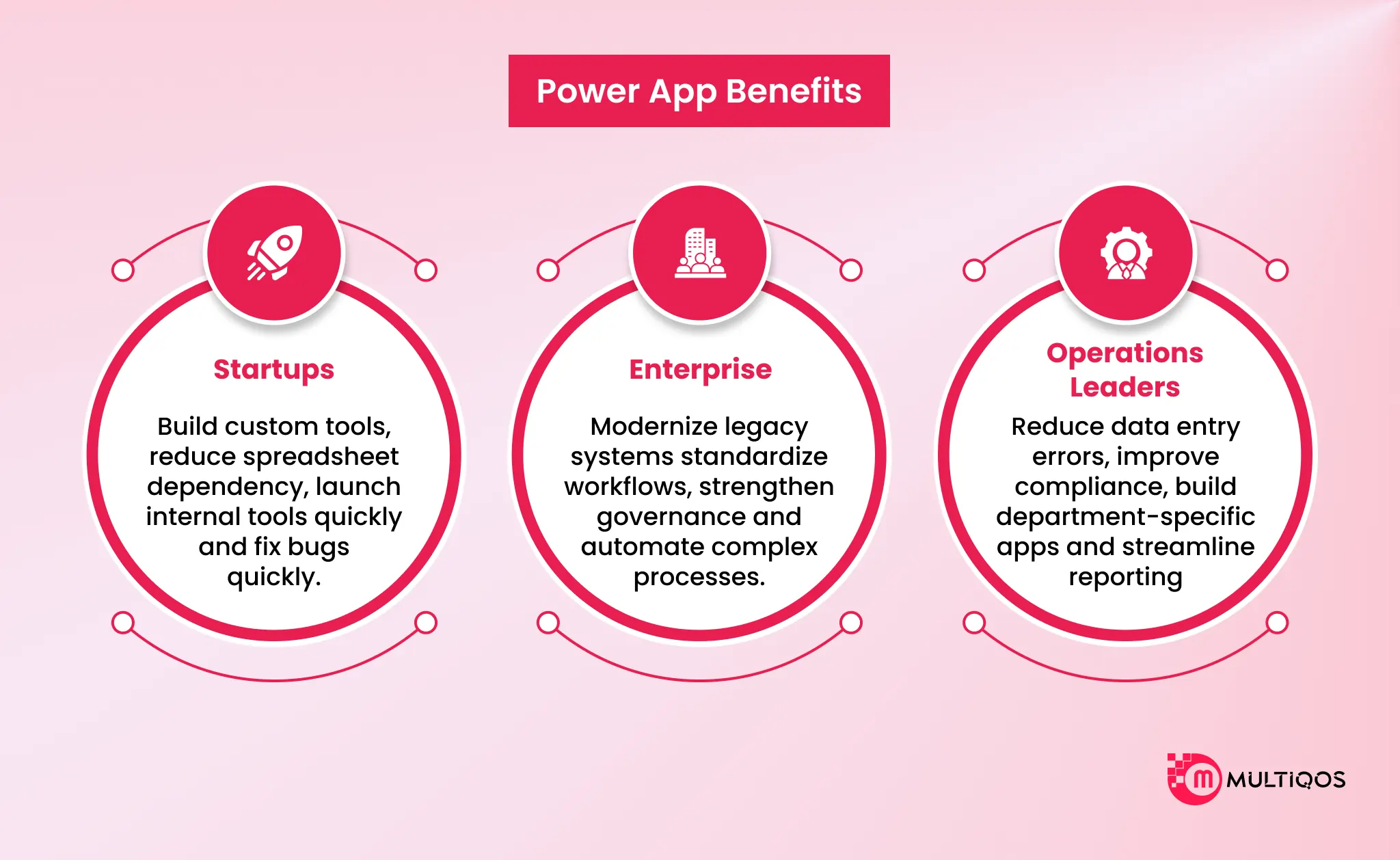
Key Benefits for Startups
- Build custom tools without hiring large dev teams.
- Reduce dependency on spreadsheets and manual processes.
- Launch MVP internal tools quickly.
- Ensures a quick turnaround to fix the bugs quickly
Key Benefits for Enterprises
- Modernize legacy systems without disruptions.
- Standardize workflows across global teams.
- Strengthen governance with Dataverse.
- Automate complex business processes with Power Automate.
Key Benefits for Operations Leaders (HR, Finance, Supply Chain)
- Reduce data entry errors.
- Improve compliance.
- Build department-specific apps.
- Streamline reporting through Power BI.
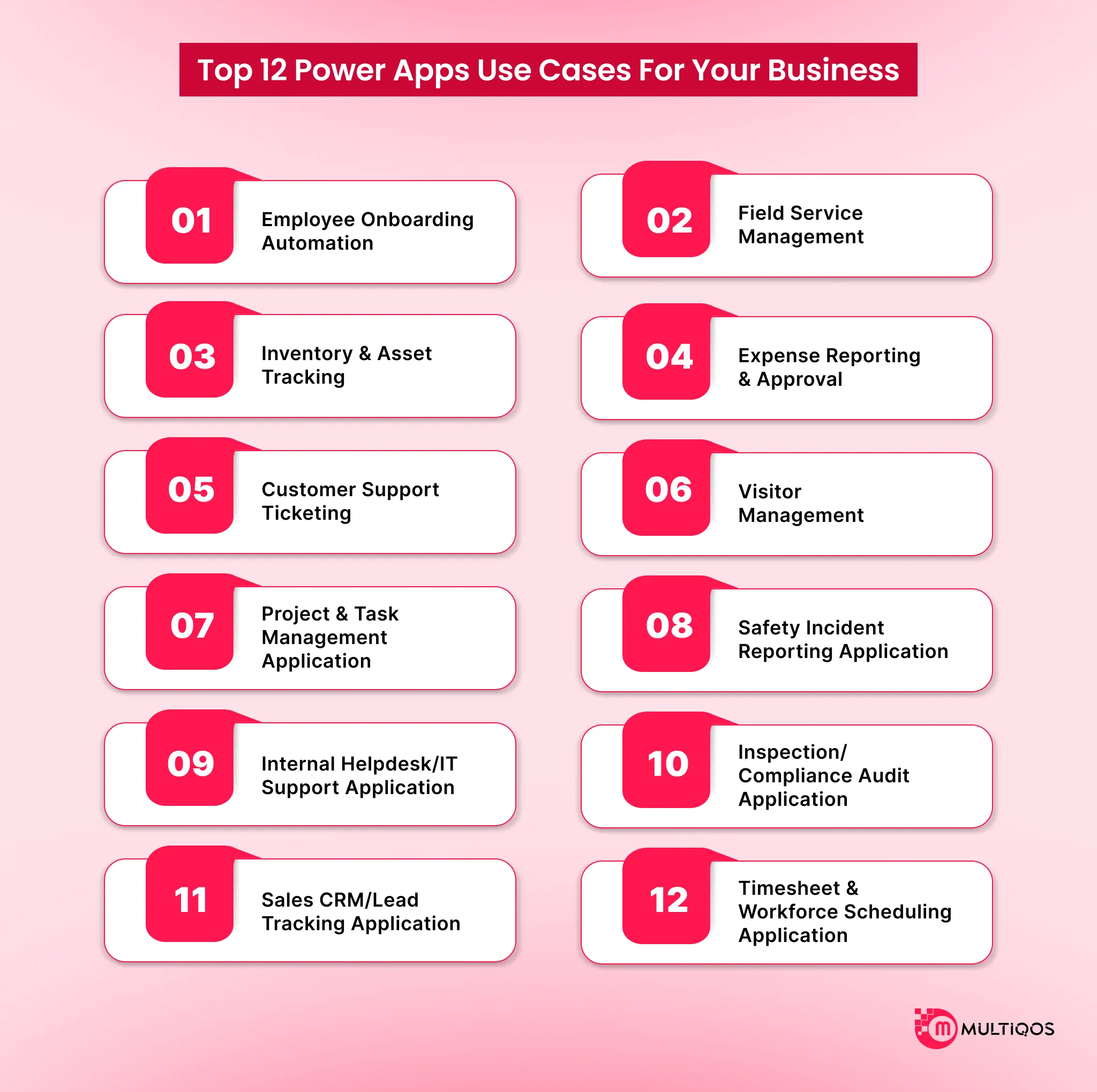
Top 12 Power Apps Use Cases For Your Business
Organizations across industries are using Microsoft Power Apps more often to create custom business apps with no code, simplify business processes, and grow the digital transformation with Power Apps. These Power Apps use cases are indicative of how enterprises use low-code application development platforms to modernize operations and empower citizen developers with applications.
It also helps develop scalable Power Apps business applications seamlessly integrated with Dataverse and other Microsoft solutions. The following are the top Power Apps applications that businesses will be implementing in 2026, and they will be backed up by practical business process automation with the Power Platform.
1. Employee Onboarding Automation
The onboarding process is fully automated from start to finish. The method includes checklists, document uploads, IT approvals, and user account setup. Power Apps Automate integrates all aspects of the HR, IT, and administrative functions related to employee onboarding in real time.
Key Benefits
- Elimination of paper-based, manual processes by HR
- Improved compliance with policies
- Improved experience of new hires
- Easy to scale using Power App usage reports
This is one of the Power App use case examples commonly built during citizen developer programs.
2. Field Service Management
Field technicians log service issues on their mobile devices, attach photos of the equipment, scan equipment barcodes, and update job status in real time using Power Apps. Many organizations share Power Apps projects and GitHub repos for similar field service scenarios.
Key Benefits
- Real-time reporting
- Reduction of downtime
- Accurate service records
3. Inventory & Asset Tracking
The tracking of tools, parts, machines, and inventory will be easy through QR or RFID scanning devices. Once an item is scanned, Power Apps can trigger an automatic request for reordering of the product. This is ideal for teams exploring Power Apps project ideas.
Key Benefits
- prevention of stock-outs
- reduction of loss of assets
- centralization of history for all company assets
4. Expense Reporting & Approval
The expense report application is designed to provide employees with the ability to easily upload receipts for all expense-related transactions and then track the status of those expenses. Upon approval by their supervisor, the employee will receive instant notification. The application is integrated with ERPs and Power BI dashboards.
Key Benefits
- Faster reimbursements
- Seamless ERP integration
- Power BI dashboard visibility through Power BI consulting
These apps help reduce manual finance work while improving auditability.

5. Customer Support Ticketing
The Customer Support Ticketing application has automatic functions of recording support tickets, assigning service level agreements (SLA), and automatically assigning support tickets.
Key Benefits
- Faster resolution of support tickets
- Visibility into compliance with service level agreements (SLAs)
- Seamless integration with Power BI Consulting Insights
6. Visitor Management
The Visitor Management application is used to computerize all the procedures relating to visitor entries, such as identification scanning and notifying hosts when a visitor arrives.
Key Benefits
- Automated sign-in
- Security compliance logs,
- Audit trails
7. Project & Task Management Application
An alternative to high-priced PM applications that is customizable and tracks deadlines, documents, tasks, and milestones. Cross-functional teams, start-ups, and agencies get benefits from this Power App.
Key Benefits
- Tailored workflows
- Document and milestone tracking
- Cost-effective alternative to enterprise PM tools
8. Safety Incident Reporting Application
Employees immediately (via a picture) identify safety hazards at their worksite. Also includes GPS coordinates of the hazard.
Key Benefits
- Increased Compliance with EHS
- Immediate Alerts
- Rules for Automated Escalation.
9. Internal Helpdesk/IT Support Application
This Power App use cases involves an integrated Microsoft Power Apps that will enable the employees to order the devices, install the software, and gain access without having to address the IT department via email.
Key Benefits
- Quick turnarounds
- Ability to track SLAs
- Better Management of IT Governance
10. Inspection/Compliance Audit Application
Digital checklists that can be completed when a facility inspection occurs, complete with an automatic scoring system and timestamps of inspection completion.
Key Benefits
- Standardized inspections
- Real-time scoring
- Compliance-ready documentation
11. Sales CRM/Lead Tracking Application
A lightweight CRM explicitly designed for the new entrepreneur who does not want an extensive CRM application. This app will track leads, opportunities, activities, and follow-ups. Create a new version of this application by combining it with the latest Microsoft Copilot Consultant and Power BI application. This will enable trend prediction using predictive analytics.
As businesses integrate Microsoft Copilot and AI-powered analytics into lightweight CRM systems, understanding how modern AI platforms operate becomes essential. Tools listed in this guide to top generative AI platforms showcase how similar technologies drive predictive insights inside enterprise CRM workflows
Key Benefits
- Cost-effective CRM
- Real-time pipeline visibility
- Predictive insights with Microsoft Copilot Consultant Power BI
12. Timesheet & Workforce Scheduling Application
Employees will enter the daily hours worked, and once approved by a supervisor, the employee manager will log into the application to view the daily, overtime, and shift insights regarding that employee.
Key Benefits
- Accurate time logging
- Automated approvals
- Workforce analytic
How Experts At MultiQoS Help You Scale Power Apps Across the Enterprise
Power Apps provides companies with a distinct advantage in automating operational processes and catalyzing digital transformation. The top Power Apps use cases listed above offer a clear path for developing high-value solutions.
However, being familiar with the right Power Apps is not the only solution. It takes strategic alignment, cross-system integration, and enterprise-level governance to be successfully implemented. At this point, it is necessary to cooperate with seasoned Power Platform consultants like MultiQoS.
With our Power Automate consulting services, you get,
- Create safe, expansive, and conformant low-code applications.
- Upgrade legacy processes without interrupting normal business processes.
- Develop long-term low-code governance structures.
- Combine CRM, ERP, HR, and finance, as well as custom systems, with workflows.
- Scale automation and AI intelligent insights.
FAQs
Manufacturing, logistics, finance, healthcare, retail, and IT services benefit significantly due to heavy manual processes and workflow complexity.
Not entirely, but it can significantly reduce development load and accelerate delivery for 70–80% of internal tools.
Power Automate handles back-end automation like approvals, notifications, triggers, and system integrations for Power Apps.
For enterprise-scale apps, governance, Dataverse integration, or cross-system architecture, professional consulting ensures scalability and security.

Get In Touch

Get Stories in Your Inbox Thrice a Month.
Power Automate Integration with Power Apps, Power BI, and Microsoft 365 for End‑to‑End Automation
Power Apps Modernization: How to Reduce Technical Debt by Modernizing Legacy Apps?