
Digital Transformation Trends: 8 Ways Enterprises Are Being Reshaped
Need quick insights? Summarize with AI & save time
 ChatGPT
 Perplexity
 Claude
 Google AI Mode
Table of Content:
- Introduction
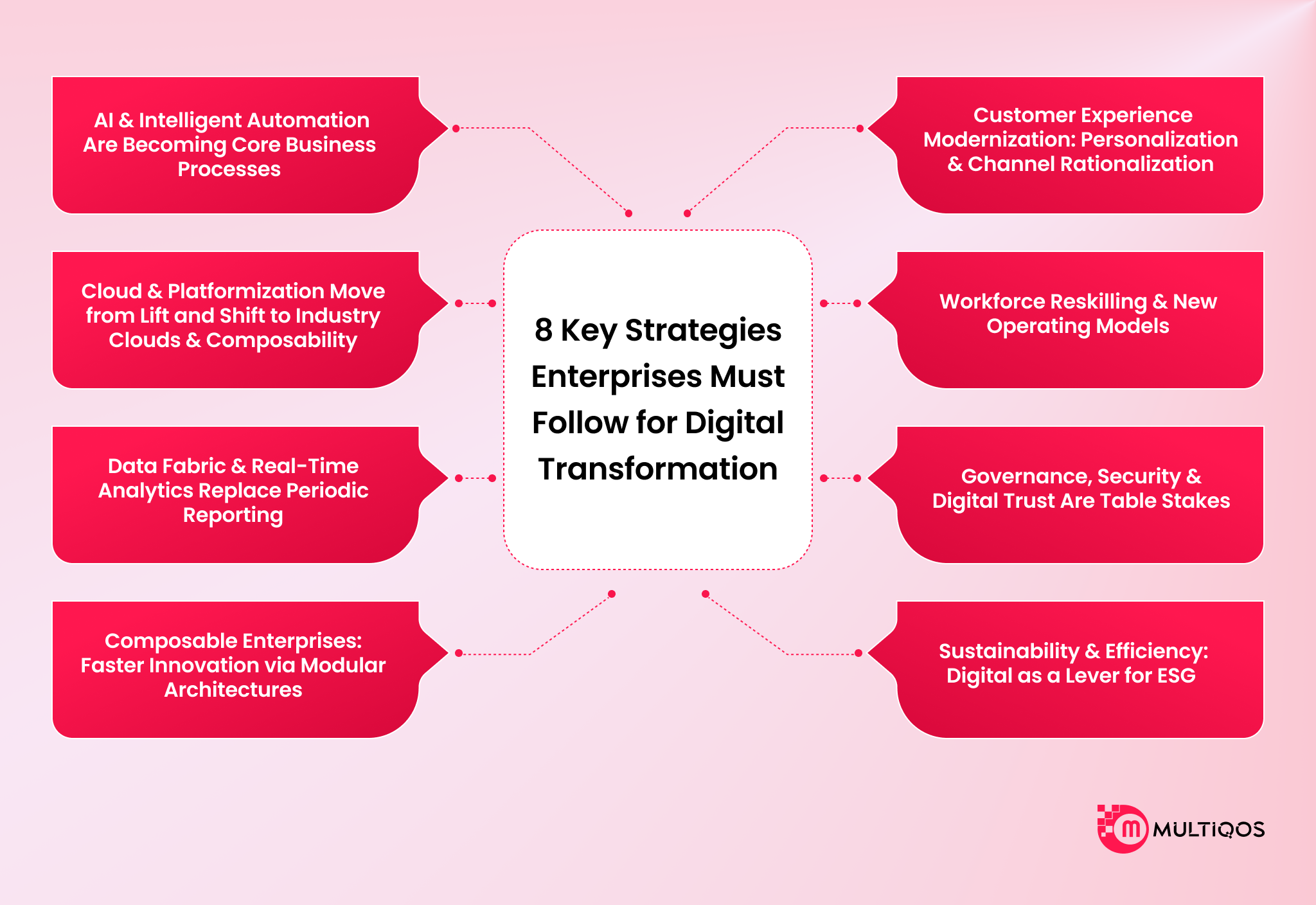
- 1. AI & Intelligent Automation Are Becoming Core Business Processes
- 2. Cloud & Platformization: Move from Lift and Shift to Industry Clouds & Composability
- 3. Data Fabric & Real-Time Analytics Replace Periodic Reporting
- 4. Composable Enterprises: Faster Innovation via Modular Architectures
- 5. Customer Experience Modernization: Personalization & Channel Rationalization
- 6. Workforce Reskilling & New Operating Models
- 7. Governance, Security & Digital Trust Are Table Stakes
- 8. Sustainability & Efficiency: Digital as a Lever for ESG
- How Digital Transformation Delivers Business Value?
- How MultiQoS Helps You Navigate Digital Transformation
- FAQs
Summary:
The digital transformation seen in 2026 will be a necessity for businesses. The building blocks of modern enterprise strategy will be digital trends of automation with AI, automation of cloud platforms, real-time analytics, composable architecture, and customer experience modernizations. By adopting such trends, companies will enjoy shorter innovation cycles, reduced downtimes, improved customer retention, and reduced total cost of ownership.
Introduction
Your business exists on both cloud, legacy, physical, and online operations. However, as is common with most organizations, you find it hard to integrate strategy in these areas. The result? Scattered efforts, lack of visibility of ROI, and lost competitive advantages. Moreover, you have to operate within a fast-changing environment.
Digital transformation provides the answer by matching technology to business impacts, allowing them to make decisions in real-time and providing them with quantifiable growth. That is why the trends of digital transformation in 2026 are more than ever. As the majority of the CIOs and CTOs already focus on agent-based AI, it might be too late to lose your business to your competitors.
However, what is the motive of successful digital transformation? What is the difference between it and IT modernization or cloud migration? And what can it do to change your operations and customer experience?
This blog will provide all the information you will need on digital transformation trends that will change enterprises in 2026. It examines the nature of these trends, their functionality, high benefits, and how to implement them in your business.
1. AI & Intelligent Automation Are Becoming Core Business Processes
The field of AI is changing digital transformations across industries. The integration of AI into mission-critical processes in enterprises will be one of the most important components of digital transformation in 2026.
Through agentic assistance, companies will enhance decision-making and decision intelligence platforms and improve hyperautomation for their operations.
Such AI assistance can handle complex multi-step tasks with minimal human intervention, giving businesses across sectors a competitive edge.
In fact, 89% of surveyed CIOs consider agent-based AI a strategic priority in their digital transformation planning. That is why it will be among the most significant digital transformation trends in 2026.
What Do CTOs/CIOs Gain From This Digital Transformation Trend?
Applying this digital transformation trend can transform your operations in many different ways if you are a CTO.
- Customer Experience – AI is used to deliver hyper-personalization of businesses to drive better CX. Consider the case of Starbucks, which relies on AI to provide customers with personalized products and rewards according to their individual preferences.
- Finance & HR- Hyperautomation with AI agents is used by companies where repetitive and rule-based, automated tasks are implemented. Use the example of Unilever, which applies AI-based applicant screening tools.
- Supply Chain/ Logistics- Predictive maintenance utilizes AI/ML to minimize the downtime of equipment in supply chain companies. The application of AI/ML algorithms helps Amazon control the products in its warehouses.
What Actions CTOs Need For Such Digital Transformation?
- Identify two high-value workflows where decisions are bottlenecked on manual review.
- Pilot agentic AI with mandatory observability dashboards and human-in-the-loop escalation.
- Start with customer support ticket resolution or financial document processing.
2. Cloud & Platformization: Move from Lift and Shift to Industry Clouds & Composability
Firms are shifting towards platform strategies as opposed to ad hoc cloud projects in organizations. Internal developer platforms, industry clouds, and composable building blocks are used to speed up delivery and reduce the cost of integration. The majority of businesses use an API-first and microservices strategy as a means of faster delivery.
Lift-and-shift migration transforms the applications to the cloud infrastructure with minimal adjustment. Platform modernization transforms the organizational structure of building, integrating, and scaling digital capabilities.
Cloud native platforms enable what monoliths cannot,
- Independent scaling
- Isolated failures
- Team autonomy
Microservices architecture allows organizations to scale bottleneck services without scaling everything. API-first approaches define contracts before implementation, so teams can design, test, and evolve independently.
What Do CTOs/CIOs Gain From This Digital Transformation Trend?
Leveraging the industry cloud and composability, CTOs can optimize business modernization. It packages vertical-specific compliance, workflows, and data models as platform services.
This means,
- FinTech businesses can embed KYC, risk scoring, and regulatory reporting.
- Healthcare platforms can ensure HIPAA compliance, HL7 integration, and optimal clinical workflows.
What Actions CTOs Need For Such Digital Transformation?
- Build a platform roadmap covering cloud migration, platform governance, and API strategy.
- Define your internal developer platform requirements, including service catalog, deployment automation, and developer experience standards.
- Prioritize composability over feature completeness in early releases.
3. Data Fabric & Real-Time Analytics Replace Periodic Reporting
Real-time analytics, data mesh patterns, and event-driven architectures enable faster, outcome-oriented decisions. And this needs to be in your digital strategy if you are a CTO or CIO.
You can process and analyze streaming data instantly with
- Real-time dashboards
- AI-powered anomaly detection
- Automated alerts.
This capability was previously limited by batch processing delays. Now you can monitor key performance indicators and react to market changes as they happen.
Take an example of Microsoft Fabric’s Real Time Intelligence. You can use it to centralize all streaming data in Real Time Hub. This offers easy data access, process automation, and actionable insights. The data it provides is based on detected patterns and events.
The platform processes data from IoT systems, application logs, database changes, and cloud streams without requiring custom integration.
What Do CTOs/CIOs Gain From This Digital Transformation Trend?
Real-time analytics reduces downtime through proactive issue resolution. It improves forecasting by incorporating live signals rather than historical snapshots. CTOs can leverage this real-time data to personalize customer experiences.
Data mesh complements this by treating data as a product with clear ownership.
What Actions CTOs Need For Such Digital Transformation?
- Invest in data products and ownership by assigning domain data owners.
- Prioritize high-impact data flows in sales, supply chain, and customer operations.
- Implement real-time dashboards for critical KPIs rather than waiting for monthly reports.
4. Composable Enterprises: Faster Innovation via Modular Architectures
Composable enterprises use API-first systems and modular systems to drive innovation without the dangerous and risky rewrites of monoliths. This digital transformation direction allows teams to do independent iteration and converge on the time-to-market of new services.
The core principle is modular design. Functionality comprises multiple independent building blocks that assemble in different ways to satisfy specific business requirements. Each capability is encapsulated, exposed via APIs, and managed as an independent product.
What Do CTOs/CIOs Gain From This Digital Transformation Trend?
Leveraging composable enterprises and microservices architecture delivers measurable business outcomes:
- Reduced Operational Downtime – FinTech platforms based on API-first microservices for onboarding, KYC, risk rating, and payments experience lower operational downtime.
- Business Agility – The same payment API supports web, mobile, and partner integrations, as well as embedded finance, without requiring a rebuild of core systems.
What Actions CTOs Need For Such Digital Transformation?
- Start with a composable pilot targeting payments, identity management, or order fulfillment
- Establish observable SLAs for each service, including latency, error rate, and availability
- Build a contract first using OpenAPI specifications, so dependent teams work in parallel
5. Customer Experience Modernization: Personalization & Channel Rationalization
Customer experience modernization in enterprises is being applied on digital channels, personalization engines, and conversational AI. CX pays commercial dividends in digital strategy investments. The transformation has a multilayered operation. Channel rationalization brings together the disjointed touchpoints into a common experience.
Personalization engines create such personalized content and offers through action and forecasted intent. Conversational AI processes the less challenging questions and directs complicated cases to experts. This is an AI-based transformation of customer touchpoints, which directly influences the increase in revenues.
What Do CTOs/CIOs Gain From This Digital Transformation Trend?
Modernization of customer experience leads to physical results of modernization of the business:
- Better Retention – A higher retention rate through personalized digital experiences and greater Net Promoter Scores are directly related.
- Increased Conversion – When recommendations work based on click-through rates, they depend on maturity in implementation.
- Lower service costs – The low response and resolution times reduce service costs and enhance satisfaction.
What Actions CTOs Need For Such Digital Transformation?
- Draw customer end-to-end customer journeys, which include friction points and drop-off stages.
- Add one to two points of digital personalization, which are the most visited interactions, including onboarding portals.
- Measure the effect of these journeys on the conversion, retention, and satisfaction scores.
6. Workforce Reskilling & New Operating Models
Effective digital transformation initiatives introduce technology in tandem with organizational change in the form of reskilling, product-focused teams, and platform engineers. The challenge is structural. New technologies demand new skills, yet they cannot be closed in the quickest way by hiring only. Organizations need to up- and re-skill their personnel and redesign their team around product-based, rather than project-based, team structures.
The training offered as part of digital upskilling is based on new technologies, such as AI, cloud computing, and process automation, as well as enhanced project management. This labor change is made possible to scale the modernization of enterprises.
What Do CTOs/CIOs Gain From This Digital Transformation Trend?
Skilling of your workforce is compounding benefits to your digital strategy:
- Enhanced Workforce Nimbleness – Organizations indicate enhanced participation and execution when they invest visibly in worker progression.
- Swift AI Implementation – A multi-functional product unit takes the place of the solo departments. Platform engineering functions are created to manage the complexity of infrastructure and deliver faster.
What Actions CTOs Need For Such Digital Transformation?
- Develop a 12-month reskilling roadmap with specific goals that are based on particular technologies and business results.
- Apply AI-based skills evaluation to discover the gaps and create a unique development plan.
- Integrate AI and automation functions and responsibilities into product teams instead of concentrating them in distinct innovation teams.
7. Governance, Security & Digital Trust Are Table Stakes
With more systems being connected to each other and platformized, governance becomes fundamental, not reactive, as enterprises incorporate AI. Preemptive cybersecurity, AI security, and the architecture of digital provenance have to be designed at the beginning.
The threat landscape is changing at a rate beyond control. Artificial intelligence creates novel attack points. These systems are interconnected and increase the blast radius of security incidents.
Preemptive cybersecurity mitigates attacks through anticipating and countering them before they hit the target, unlike detected attacks after the hack. Digital provenance can be used to confirm the authenticity of the data and media created by AI. Confidential computing puts sensitive workloads and seals them in hardware-based trusted execution environments.
What Do CTOs/CIOs Gain From This Digital Transformation Trend?
Powerful governance and online confidence bring strategic prospects to business modernization:
- Increased Customer Confidence – Companies that exhibit good governance are differentiated based on reliability, compliance, and not only features.
- Regulatory Compliance – AI security platforms give guardrails to AI native risks. They control the behavior of models, provide usage policies, identify abnormal output, and provide audit trails.
- Risk Mitigation – Policy-as-code embeds governance rules directly into deployment pipelines rather than checking them manually after the fact.
What Actions CTOs Need For Such Digital Transformation?
- Implement policy as code, integrating security and compliance checks directly into CI/CD pipelines.
- Install continuous compliance tooling that does not validate controls on a quarterly basis but on a real-time basis.
8. Sustainability & Efficiency: Digital as a Lever for ESG
Digital change is becoming more connected with sustainability via cloud modernization, energy reduction, waste reduction, and emission reporting in the form of digital twins and telemetry. This trend of modernization of enterprises equates the investment in technologies with the environmental benefits.
The connection is direct. In its efficiency designs, cloud modernization decreases the data center footprint and energy usage. Application optimization reduces carbon emissions and computer requirements. Supply chains and manufacturing processes can be identified as wastes, which real-time analytics can detect.
Organizations test energy consumption, emissions, and consumption of resources prior to changing their infrastructure. The trend towards automation helps in supporting the environmental and economic goals.
What Do CTOs/CIOs Gain From This Digital Transformation Trend?
Digital transformation that is guided by the ideas of sustainability brings about two advantages:
- Cost Reduction – are any of the costs that are reduced as a result of minimizing energy use. Optimizing logistics will minimize emissions and delivery costs through process mining and optimization.
- ESG Compliance – Digital systems bring the instrumentation and traceability required to fulfill the regulatory requirements. ESG requirements require verifiable data regarding emissions and resource consumption.
What Actions CTOs Need For Such Digital Transformation?
- Track emissions at the system level, starting with data center usage, cloud consumption, and application efficiency metrics
- Implement low-hanging energy optimizations, including cloud rightsizing and workload scheduling during off-peak hours.
- Establish baseline measurements before launching optimization initiatives to demonstrate progress.
How Digital Transformation Delivers Business Value?
Digital transformation extends beyond tech stack upgrades. It delivers faster innovation, operational resilience, revenue growth, and cost reduction.
Faster Innovation Cycles
Composable architecture and API first design shorten build times compared to monolithic approaches. Teams ship features in days rather than weeks. Parallel development and automation significantly accelerate time-to-market.
Operational Resilience
Automated processes and real-time monitoring reduce downtime and mean time to recovery. Event-driven architectures isolate failures, preventing cascade effects. Proactive issue resolution through real-time analytics minimizes operational incidents.
Revenue & Customer Impact
Personalized experiences increase customer retention and conversion rates. Recommendation engines significantly improve click-through rates when properly implemented. Customer experience modernization drives measurable uplift in Net Promoter Scores and lifetime value.
Cost Optimization
Cloud modernization and process automation reduce the total cost of ownership when paired with governance. Elastic scaling eliminates overprovisioned infrastructure. Platform consolidation cuts licensing costs while shifting resources from reactive support to value creation.
How MultiQoS Helps You Navigate Digital Transformation
Understanding digital transformation trends is just one part. Successful execution requires strategic alignment and risk-aware deployment. This is where MultiQoS helps. With 14+ years of experience across 40 industries and 700+ delivered projects, we offer end-to-end digital transformation services.
Our Expertise:
- AI & Automation – Agentic AI systems with governance frameworks for scalable operations
- Cloud Modernization – Platform-first architectures and composable systems that accelerate delivery
- Data & Analytics – Real-time platforms and event-driven systems turning data into advantage
- CX Modernization – Personalized experiences driving measurable conversion and retention
We combine strategy, architecture, and execution to build sustained transformation capabilities. Digital transformation is continuous, not finite. Organizations that act now will lead their industries through 2030 and beyond.
Partner with MultiQoS to assess your transformation maturity and build a roadmap aligning technology with business outcomes. Build a roadmap today.
FAQs
Digital transformation in 2026 focuses on AI-driven automation, composable architectures, real-time analytics, and platform-based delivery models that enable continuous innovation rather than one-time technology upgrades.
AI automation handles complex multi-step workflows autonomously, reducing operational costs by 30 to 50%, accelerating decision-making, and enabling organizations to scale without proportional headcount growth.
Composable architecture enables teams to develop, test, and deploy independently using modular building blocks and APIs, reducing feature delivery timelines by 40-60% compared to monolithic systems.
Organizations executing deliberate transformation programs report 40 to 60% faster innovation cycles, 50 to 70% reductions in downtime, 15 to 25% improvements in customer retention, and 30 to 40% lower total cost of ownership.
Critical. Technology adoption without organizational change fails to scale. Successful programs pair platform investments with structured reskilling, cross-functional teams, and new operating models that embed digital capabilities across the organization.

Get In Touch

Get Stories in Your Inbox Thrice a Month.
Digital Transformation Roadmap 2026: A Practical 6‑Step Guide for Mid‑Market Enterprises
Proven Legacy System Modernization Strategies for Digital Transformation
Top Must-Have Digital Transformation Tools for Business Growth in 2025