The Future of AI for Customer Experience: How to Build Predictive Customer Journeys
Table of Content
- Evolution of AI for Customer Experience
- Core Pillars of a Modern AI-CX Strategy
- Strategic Use Cases of AI for CX Across Ecosystem in 2026
- How MultiQoS Helps Enterprises Build Predictive AI for Customer Experience?
- FAQs
Summary
AI for customer experience has come a long way. What started as scripted, rule-based chatbots has evolved into systems that can anticipate needs and step in before a customer even reports an issue.
The real shift is not just technical. It is strategic. Earlier waves of generative AI focused on producing responses. The newer wave is about taking action. Enterprise CX is moving from reacting to tickets toward anticipating friction, powered by unified data, predictive journey orchestration, and personalization that operates at the individual scale.
In 2026, the companies that get this right will not be the ones with the flashiest bots. They will be the ones who invest in solid AI-CX architecture. Warehouse-native data foundations. Agent-driven resolution systems. A copilot model that pairs humans and AI.
The payoff is not just faster support. It is stronger customer trust, higher retention, and revenue that compound over time.
Most enterprises will tell you they’ve already adopted AI for customer experience. There’s a chatbot on the website. Tickets are auto-routed. Maybe there’s even a virtual assistant in the app. And yet customers are still irritated.
Because in many cases, those systems are just upgraded FAQ pages. They respond when a user asks something. They trigger when a ticket is created. The logic is reactive, not intelligent. That is the real issue. Enterprise AI often waits for the customer to complain.
And every time it waits, it risks churn. Predictive customer experience works differently. It analyzes historical patterns and real-time behavior to detect friction early. It intervenes before a support ticket is filed. Before a renewal is at risk. Before frustration turns into attrition.
In this blog, we explore how AI in customer experience has evolved from scripted bots to more autonomous systems, what a modern AI-CX strategy actually requires, and how predictive orchestration, unified data foundations, and warehouse-native platforms are reshaping enterprise CX in 2026.
Evolution of AI for Customer Experience
The application of AI for customer experience has been developed over the years. Here is how AI for CX personalizations have evolved.
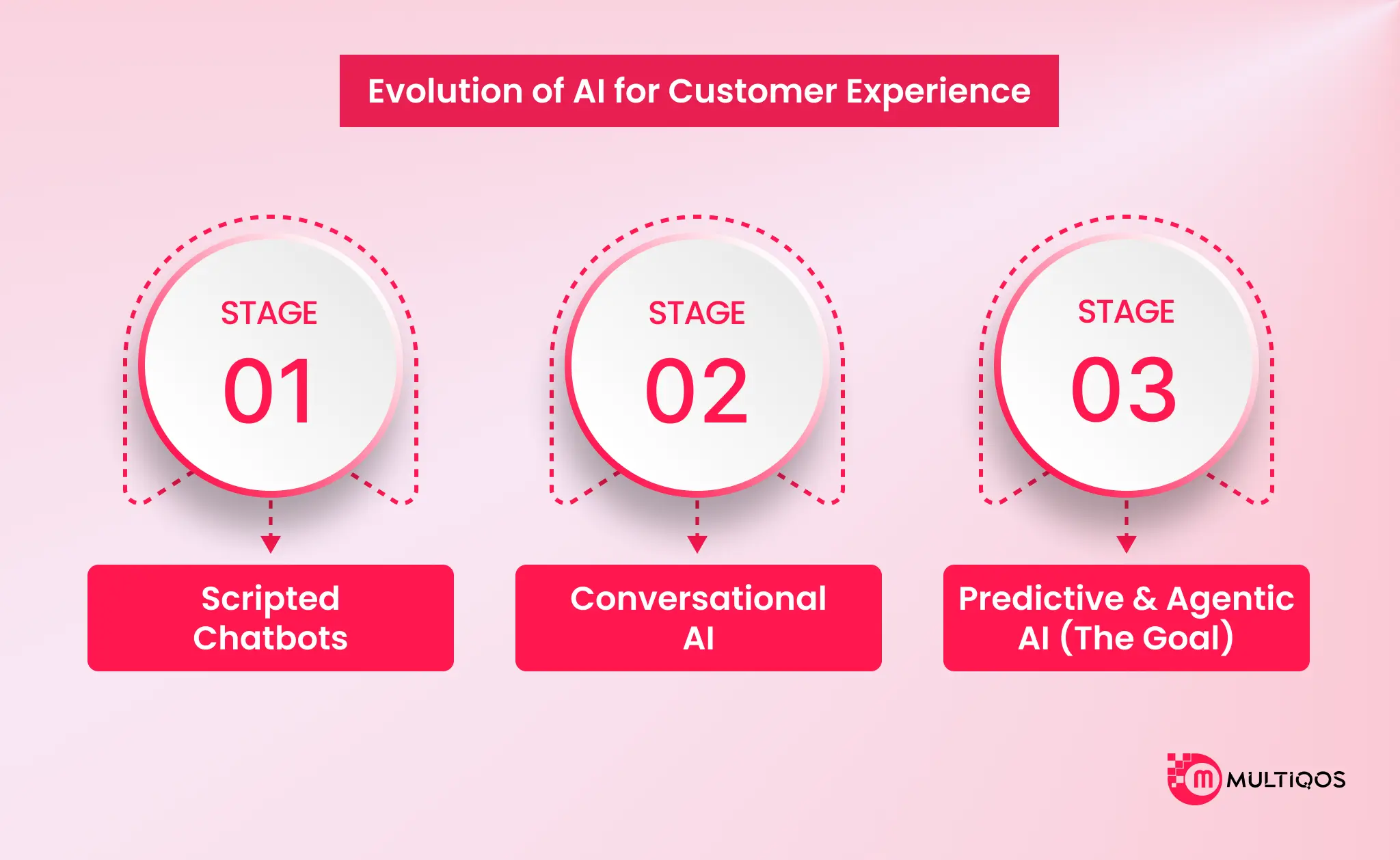
Stage 1: Scripted Chatbots
The earliest integration of AI for customer experience was in the 1960s, named ELIZA, created by Joseph Weizenbaum (MIT). However, major integration across businesses came in the 1990s. Companies implemented,
- IVR systems (“Press 1 for billing”)
- FAQ bots
- Rule-based website chat widgets
- Ticket routing systems
The objective was to reduce human workload. This traditional, reactive model often failed to meet modern consumer expectations, as the systems could not deviate from their rigid programming because they were only equipped to respond after a customer reported an issue, and often provided.
Stage 2: Conversational AI
As customer support systems modernized, the focus shifted toward Conversational AI powered by Natural Language Processing (NLP). Moving away from rigid scripts, companies implemented:
- Smart virtual assistants
- Sentiment-aware chat interfaces
- 24/7 automated resolution systems
The objective was to deliver natural, human-like conversations and resolve basic issues around the clock. However, despite being a significant upgrade over scripted bots, this approach still operated under a largely reactive model.
Stage 3: Predictive & Agentic AI (The Goal)
The highest level of maturity transforms AI from a reactive conversationalist into a proactive, autonomous actor. Instead of waiting for a support ticket to be filed, companies are now implementing:
- Autonomous resolution agents
- Predictive churn prevention workflows
- Proactive engagement systems
The objective is to anticipate customer needs and independently execute complex tasks to resolve them. The capabilities these advanced systems have are:
- Predictive Analysis: It predicts the presence of friction points, needs or churn risks on the basis of real-time and historical data.
- Action on their own: A number of activities in the different enterprise systems (authentication of users, records updating, refunding, or rescheduling).
Proactive Outreach: Trying to contact the customer beforehand to realize that something is wrong.
Core Pillars of a Modern AI-CX Strategy
2026 will be the year when companies will focus on proactive AI CX personalizations. This approach differs from the conventional reactive one, where companies spam customers with pre-defined promotions.
Using the modern approach, companies can ensure hyper-personalization at scale.
Here are some of the key pillars of this strategy.
-
Unified Data and Memory-Based Context
Centralized data is one of the fundamental pillars of the customer experience strategy of AI. Companies that have data silos have to dissolve them and establish a system. This strategy should be adopted in sales, marketing, and customer care departments.
Here are two important aspects to consider,
- CDPs or Customer Data Platforms serve as the connective link between data infrastructure and AI execution. In fact, 92% of CDP users achieve their business goals. So, if you are an organization looking to centralize data, structuring CDPs into your architecture becomes crucial.
- Memory-Based Services ensure integration of AI for customer experience is seamless. AI with persistent memory offers context each time a user connects across all channels, timeframes, and teams.
-
Predictive Journey Orchestration and Next-Best-Action (NBA)
Conversational AI platforms offer live and measurable customer journey management. Analyzing the behavioral patterns of customers, sentiment shift, and intent signals, AI systems can forecast what a customer needs. NBA engines are your orchestrators. It evaluates the real-time context for each data point and automatically constrains to recommend the most valuable action.
-
Hyper-Personalization and Segmentation
In 2026, AI-based enterprise chatbots will be personalized and automatically interact with customers. These chatbots will transcend the bigger demographics buckets and allow micro-segmentation.
This will imply that it will assist enterprises to find specific pain points of each customer, not a large number or a segment of numerous customers. Adobe says that 87% of companies increase customer interaction using AI-based personalizations.
It identifies these minor behaviors and alterations in the micro-interactions that AI-based systems can provide context in real-time.
-
Agentic AI in CX and Human Collaboration
Agentic AI in CX has been transitional for enterprises looking to automate customer support activities. It acts as a strategic digital entity that plans and completes complex tasks across enterprise systems. This can include processing refunds, authenticating users, or even offering replacement product recommendations.

Strategic Use Cases of AI for CX Across Ecosystem in 2026
Here are some of the important use cases of AI for customer experience based on key pillars.
-
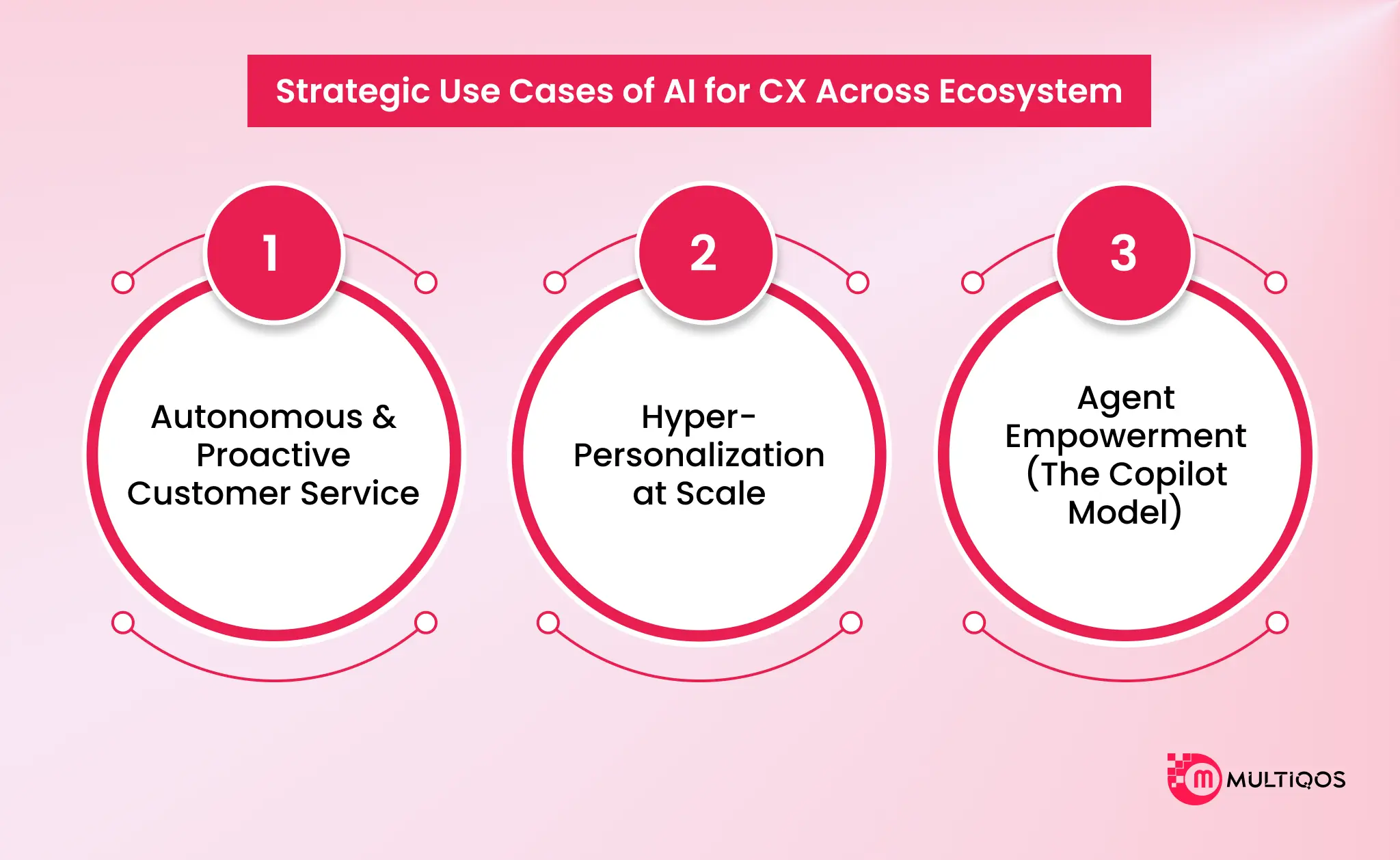
Autonomous & Proactive Customer Service
AI agents can analyze the context, make inferences, and take multi-step decisions without human intervention. These agents no longer wait for a customer to raise an issue. Instead, they perceive behavioral and sentiment signals from customer interactions and take the initiative.
Cisco 2025 world survey indicated that by mid 2026, more than 56% of all customer support will have been resolved by agentic AI, and by 2028. This means agentic AI for customer experience improvement will be one of the key AI trends in 2026.
Some of its core use cases in action are,
- Predictive churn prevention- AI identifies customers with the first signs of dissatisfaction, such as frequent visits to the help center, a negative mood in their emails, and sends them to an automatic and personal intervention, before they defect, to a senior human agent.
- Automated alerts about service disruptions- AI alerts to possible outages, and provide a workaround to the problem automatically notify customers of the disruptive situation, and offer workaround solutions, transforming points of friction into trust.
- Proactive fraud and anomaly notifications- Artificial intelligence in banking and fintech can provide customers with alerts prior to them detecting any anomaly, which changes the service paradigm into a more proactive protection approach rather than a reactive one
- Multi-step troubleshooting agents- AI agents will inspect system logs, diagnose failures, and suggest solutions independently of a human engineer, and act as self-driving engineering assistants.
-
Hyper-Personalization at Scale
In 2026 usage of AI for customer experience will move beyond generalized personalization to entity-based personalization. This means every customer will be treated as a unique entity. And based on the specific data of the customer, the product or service will be fine-tuned in real-time. This capability is possible through advanced AI systems.
Some of the key use cases of hyper-personalization at scale using AI are,
|
Use Case |
AI Mechanism |
|
Real-time product recommendations |
Browsing behavior inference + predictive engine |
| Geo-contextual promotions |
Location + weather + time signals |
|
Dynamic email optimization |
Self-optimizing send time + content by individual |
| Personalized support routing |
Sentiment + history-aware routing models |
| Predictive next-best-action |
ML models analyzing behavior + CRM + sentiment |
-
Agent Empowerment (The Copilot Model)
While fully autonomous AI is great for managing routine Tier 1 tasks, the true potential of the “Copilot” model lies in empowering human agents to tackle complex, high-stakes cases that require genuine emotional intelligence.
Think of these Copilots as a real-time intelligence layer that works alongside the agent. They’re designed to lighten the mental load by instantly pulling in context and recommending the best course of action right when it’s needed most.
A Copilot is handling some background work during a live interaction. It may immediately convert issues of interest into articles, policies, or historical cases, so the agent is not forced to search or waste time finding the information in front of a customer. It also tracks the emotional color of the conversation and translates in real time, which makes support for multiple languages feel like a continuation.
Instead of having to write the drafts by hand, the agents can have AI-generated drafts to review and modify, thus saving a major portion of handling time. It is also proactive; the system can suggest next best action, an offer to retain, or an escalation route, which can help the agents to take strategic decisions in real-time.
Once the conversation is finished, Copilot does the busy work of auto-summarizing the conversation and updating CRM records, therefore, allowing the team to proceed to the next customer instead of being bombarded with manual wrap-up events.
How MultiQoS Helps Enterprises Build Predictive AI for Customer Experience?
AI gets added to the CX stack. The demo looks sharp. Early metrics look promising. Then real-world complexity hits, and the cracks start to show. Customers feel it before dashboards do. That usually happens when AI is treated as an add-on rather than as part of the operating model.
Our approach starts with your existing reality, your data pipelines, CRM, support workflows, and compliance requirements, designing predictive AI to sit inside that ecosystem rather than disrupt it. We focus is on those use cases, the results of which can be measured and tied to the impact on business, so that your AI can be as dependable in production as it was in the case of the demo.
You don’t need another vendor who can build a pilot; you need a partner who can engineer the reality. If you are ready to move from experimental features to a sustainable operating model, let’s discuss your AI-CX strategy.
FAQs
The chatbots using AI can only react to the questions or raise of a ticket by a customer. Predictive AI is used to analyze the behavior to eliminate problems before the customer even contacts the service in the future.
The agentic AI performs complicated operations, such as refund processing and user authentication, automatically. It takes into consideration situational awareness and goal-oriented reasoning to address problems immediately.
The Customer Data Platform (CDP) is what is needed to ensure successful AI personalization by combining behavioral and support data. This source of truth alone allows AI models to work on a full and real-time context.
The AI Copilots cooperate with human agents and surface knowledge articles, monitor sentiment, and write responses instantly. They remove manual CRM updates to allow the agents to work on complex, high-value communication completely.
Indirectly, those enterprises that implement AI as part of the current workflow usually experience a quantified reduction in handle times and CSAT in 90 days. The improved customer retention and lifetime value are normally seen within six months to one year.

Get In Touch

Get Stories in Your Inbox Thrice a Month.
AI E-Commerce Personalization: Creating Customer Experiences That Convert