AI Implementation Roadmap: From Pilot to Production in 90 Days
Table of Content
- Why Selecting the Right AI Partner Matters?
- What “Production-Ready AI” Actually Means
- The 90-Day AI Implementation Roadmap
- Governance, Security & Risk Mitigation Built Into the Roadmap
- When to Partner vs Build In-House for AI Implementation
- Why Enterprises Choose MultiQoS for AI Implementation?
- Conclusion
- FAQs
Summary:
While enterprise investment in Generative AI has surged, failure rates are spiking, with 42% of projects scrapped before production. This article outlines the “GenAI Divide,” the gap between pilot experimentation and true operational ROI. It introduces MultiQoS’s military-grade, 90-day AI Implementation Roadmap designed to bridge this gap.
The guide details a three-phase approach: establishing a data foundation, engineering the system (not just the model), and ensuring production governance. It emphasizes that success requires treating AI not as a science project but as a systems engineering challenge that demands robust MLOps, security, and scalability.
The gap between AI ambition and AI execution is becoming a graveyard for capital. While global enterprises poured an estimated $40 billion into generative AI last year, S&P Global reports that 42% of projects were scrapped entirely before reaching production in 2025, a dramatic spike from just 17% the previous year.
For the survivors, the path is equally complex. Gartner data reveals that the average enterprise now spends 18 months operationalizing a single model, with nearly 50% of “innovation time” lost to retroactive compliance fixes rather than value creation.
You do not have 18 months to waste. This guide unpacks the four pillars of production readiness, from forensic data audits to Day 2 governance. It presents the exact 90-day architectural roadmap required to turn a stalled pilot into a scalable revenue engine.
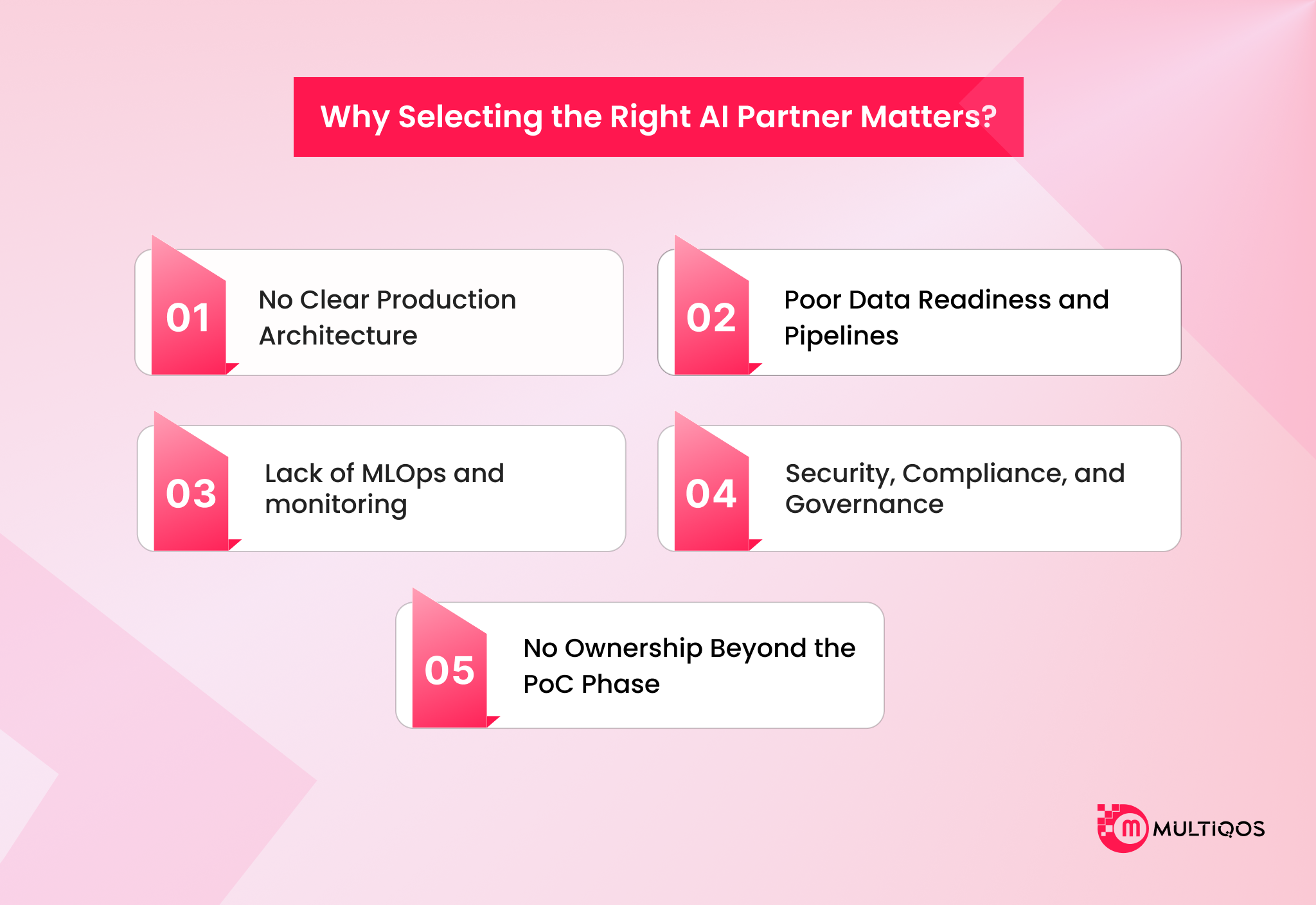
Why Selecting the Right AI Partner Matters?
If you are a CTO or an enterprise product leader, what’s the most significant AI adoption bottleneck? The “GenAI Divide” – a gap between businesses that are successfully scaling generative AI for ROI and those stuck in pilot phases, failing to deliver tangible returns.
Especially when 95% of the AI pilots fail, the gap is wider. This means your chances of success drop to 5%, and even then, you need a reliable AI consulting service.
But before you choose a partner, understanding why you need one is essential. And for that, you have to understand the reasons for AI projects’ failure.
-
No Clear Production Architecture
Organizations often treat AI as a standalone project. It needs to be the core operational system, aligned with organizational goals and outcomes. And if you are an organization seeking the maximum ROI, a modular, cloud-native architecture makes more sense. Without it, your AI implementations become fragile and technical debt accumulates over time.
-
Poor Data Readiness and Pipelines
You cannot run a Ferrari on sludge. Yet, enterprises routinely attempt to force-feed high-performance foundational models with unstructured, siloed, or poorly governed data. The reality is that most of AI’s success is data engineering, not model tuning.
If your data strategy lacks robust ETL (Extract, Transform, Load) pipelines that sanitize and vectorize your information in real-time, your expensive GenAI pilot is merely a hallucination engine waiting to happen.
-
Lack of MLOps and monitoring
Software code is static; AI models are organic. They decay. Without a mature MLOps infrastructure, you are vulnerable to model drift, the silent killer, where changes in real-world data degrade your model’s accuracy weeks after deployment. The “GenAI Divide” is populated by companies that treated deployment as a finish line rather than a starting line, failing to implement the automated retraining pipelines required to keep intelligence sharp.
-
Security, Compliance, and Governance
Speed is irrelevant if you hit a wall. Treating governance as a “Day 2” problem is the fastest way to accumulate massive technical debt. We see teams paralyzed, spending 50% of their “innovation” time retroactively patching holes to meet GDPR or internal compliance standards. A true partner builds guardrails, PII redaction, prompt injection defense, and audit trails into the architecture, not on top of it.
-
No Ownership Beyond the PoC Phase
Who feeds the model when the consultants leave? The most common reason for post-pilot failure is the Accountability Vacuum. A Proof of Concept (PoC) is easy because it lives in a vacuum; production requires a P&L owner.
When AI is treated as a “science project” rather than a core operational asset with defined ownership for lifecycle management, it inevitably becomes an orphaned system, technically impressive, but commercially worthless.
What “Production-Ready AI” Actually Means
To bridge the gap from AI PoC to production, leaders must understand that “working code” is only 20% of the equation. The remaining 80% is the infrastructure that keeps that code alive, secure, and accurate in the real world.
The Anatomy of Enterprise-Grade AITo survive outside the lab, your enterprise AI implementation must satisfy a rigorous architectural standard. It is not enough to simply “deploy.” You must engineer for survival. Scalable Data Pipelines: Your model is a high-performance engine; without fuel, it stalls.
Production-ready AI requires robust, automated pipelines that ingest, clean, and vectorise data in real-time, ensuring your system handles peak loads without latency spikes.
- Model Versioning and Retraining: Models rot. Without a solid MLOps implementation, AI model deployment becomes a liability as data drift erodes accuracy. You need automated version control and retraining triggers that act as an immune system for your algorithms.
- Monitoring for Drift and Accuracy: You cannot fix what you cannot see. A viable AI implementation strategy includes deep observability to detect hallucination, bias, and performance degradation before your customers do.
- Secure Deployment (Cloud/Hybrid): It is time to go beyond the black box. A defensible AI governance framework should be embedded in the enterprise AI architecture, which guarantees compliance, data sovereignty, and strong mitigation of AI risks in cloud or hybrid computing.
- Business KPIs Linked to Model Output: You cannot measure the impact of P&L, and you are not prepared for production. The effective roadmaps of AI implementation have the technical metrics (latency, F1 score) directly connected to the business ones (revenue lift, churn reduction).
The MultiQoS Position: Systems Engineering vs. Model Training
This is the core of the GenAI Divide. Many vendors offer AI development services that focus solely on the algorithm. They hand you a model and wish you luck.
At MultiQoS, we recognize what the AI delivery model training precisely delivers.
AI delivery = systems engineering + ML.
As your strategic AI delivery partner, we solve the AI scalability challenges that sink 95% of pilots.
We don’t just train models; we architect the AI production deployment pipelines that ensure your investment evolves from a cool demo into a core operational driver.
Whether you need AI consulting services to diagnose the bottleneck or end-to-end engineering to fix it, you need to understand that AI success is not about the sophistication of the model. It is about the reliability of the system.
The 90-Day AI Implementation Roadmap
Speed is a weapon, but only if you are aiming in the right direction.
Most enterprise initiatives die a slow death because they treat AI adoption as an R&D experiment rather than a capital project. To cross the chasm from AI PoC to production, you do not need a “hackathon”; you need a military-grade execution plan.
We compress what often takes nine months of hesitation into a 90-day AI implementation roadmap. This is not about cutting corners. It is about removing the friction between “data science” and “business value.”
Phase 1 (Days 1–30): Strategy, Data & Architecture Foundation
The Objective: Stop Building on Quicksand.
The first 30 days are not for coding; they are for calculating. Many vendors skip this, rushing to fine-tune a model on dirty data. The result is an expensive toy that solves the wrong problem.
- KPI-Led Use-Case Validation: We reverse-engineer the technology from the business outcome. A viable AI implementation strategy does not ask, “What can this model do?” It asks, “Which P&L line item are we moving?”
- Forensic Data Audit: Your model is only as capable as your data pipeline. We conduct a brutal assessment of your data readiness, identifying silos, unstructured noise, and latency issues that will kill inference speed.
- Target Enterprise AI Architecture: We decide the “Build vs. Buy vs. Fine-tune” question immediately. Whether it requires a secure on-premise setup or a hybrid cloud architecture, we design for the constraints of enterprise AI implementation security, cost, and compliance before a single line of code is written.
This phase is not led by junior data scientists eager to experiment. It is led by AI consulting services experts and seasoned Solution Architects who understand that a model without a business case is just technical debt waiting to happen.
Phase 2 (Days 31–60): Model Development & System Integration
The Objective: Bridge the Gap Between “Model” and “Machine.”
This is the kill zone for most projects, the “GenAI Divide.” A model running in a notebook is useless if it cannot talk to your ERP.
- Engineering Over Experimentation: Our AI development services focus on the rigorous construction of feature engineering pipelines. We don’t just “train” the model; we engineer the inputs to ensure consistent performance.
- API and Application Integration: The model is the brain, but the application is the body. We integrate the intelligence directly into your existing workflows via robust, versioned APIs, ensuring the user experience is seamless.
- Day 0 MLOps Implementation: We do not wait for production to think about operations. Our teams establish CI/CD pipelines for your models (CT/CD) during development, ensuring that retraining is an automated process, not a manual fire drill.
Phase 3 (Days 61–90): Production Deployment & Governance
The Objective: Deployment is Not the Finish Line. Stability Is.
Going live is easy. Staying alive is hard. AI production deployment introduces risks that do not exist in a test environment: drift, injection attacks, and hallucination.
- Production-Grade Deployment: We promote the system to your production environment, ensuring high availability and low latency under load.
- Drift Detection and Monitoring: We implement “always-on” observability. If the model’s accuracy dips below a threshold due to shifting market data, our alerting systems trigger immediate intervention. This addresses the core of AI scalability challenges.
- Security and Compliance: We wrap the model in a rigid AI governance framework. From PII redaction to AI risk mitigation strategies against prompt injection, we ensure your AI is safe for public or internal consumption.
MultiQoS owns the outcome. We do not sign off until the system achieves production stability. We hand over a living, documented system complete with AI deployment best practices that your internal teams can manage and scale.
Governance, Security & Risk Mitigation Built Into the Roadmap
In the rush to deploy, many enterprises treat security as the “Department of No,” a final hurdle to clear before launch. This is a fatal architectural flaw. When you treat governance as a final checkbox, you invite “Shadow AI,” data leakage, and regulatory collapse.
At MultiQoS, we do not bolt security onto a finished product. We create a robust AI governance framework directly into the enterprise AI architecture from Day 1.
- Data Privacy & Zero-Trust Access: The days of flat data access are over. We implement granular Role-Based Access Control (RBAC) and automated PII masking within the data pipeline itself. Your model should never know more than it needs to.
- The End of the “Black Box”: An answer is useless if you cannot trace its origin. We prioritize model explainability and auditability, ensuring every output has a data lineage trail. This plays a critical role in the AI risk reduction in regulated areas.
- Human-in-the-Loop (HITL) protocols: Re-engineering, not offloading. Our workflows are such that the low-confidence model products are automatically sent to human review. This will guarantee that you reap the benefits of saving efficiency without loss of accuracy or brand name.
- Compliance as Code: SOC2, HIPAA, or GDPR, we do not see compliance as a manual process of auditing. We formalize these restrictions into the deployment pipeline, whereby non-compliant code can literally not be deployed.
Most vendors view governance as a barrier to delivery. At MutiQoS, we view it as the foundation of AI deployment best practices.
We don’t just hand you a working model; we give you a compliant system. By integrating security into every sprint of the AI consulting services engagement, we ensure that when you are ready to scale, your risk profile is already managed. You cannot scale what you cannot control.
When to Partner vs Build In-House for AI Implementation
For many CTOs, the “Build vs. Buy” debate is framed as a cost question. This is a mistake. It is a velocity question. In the current market, speed is the only currency that matters. The decision to partner for your AI implementation strategy isn’t an admission of defeat; it is a strategic calculation to bypass the 18-month learning curve that kills momentum.
The “In-House” Trap Building entirely in-house is seductive. It promises control. But without a mature MLOps implementation, that control is an illusion. Your internal teams are brilliant as they are likely experts in your domain, not in the chaotic, shifting landscape of AI model deployment.
When Partnering is the Only Logical Move
- Internal Teams Lack MLOps Maturity: If your team thinks “deployment” means uploading a model to a server, you are not ready. Production-ready AI requires automated retraining, drift monitoring, and complex versioning. An AI delivery partner like MultiQoS brings this infrastructure pre-built, turning a 12-month R&D struggle into a 90-day execution sprint.
- Speed-to-Market is Critical: Your competitors are not waiting for your data scientists to figure out vector databases. If you need to move from AI PoC to production in a single quarter, you cannot afford the luxury of trial and error. You need an accelerator.
- AI is Core to Product or Ops: When AI moves from “nice-to-have” to “mission-critical,” the cost of failure skyrockets. You need the assurance of AI consulting services that have seen and solved the AI scalability challenges you are about to face.
- Risk Tolerance is Low: If a hallucination triggers a lawsuit or a data leak triggers a fine, the project is over. We bring a battle-tested AI governance framework that mitigates these risks by design, not by accident.
Partnering with MultiQoS doesn’t mean giving up control. It means accelerating capability. We handle the heavy lifting of AI development services, the data engineering, the pipeline architecture, and the security hardening, so your internal leaders can focus on the business logic that drives ROI.
Why Enterprises Choose MultiQoS for AI Implementation?
Most organizations do not lack AI ambition; they lack AI completion. They are drowning in slide decks and stalled pilots, searching for a way to cross the chasm from “experiment” to “enterprise asset.” Leaders choose MultiQoS because we are the AI delivery partner that ships code while others are still polishing their pitch.
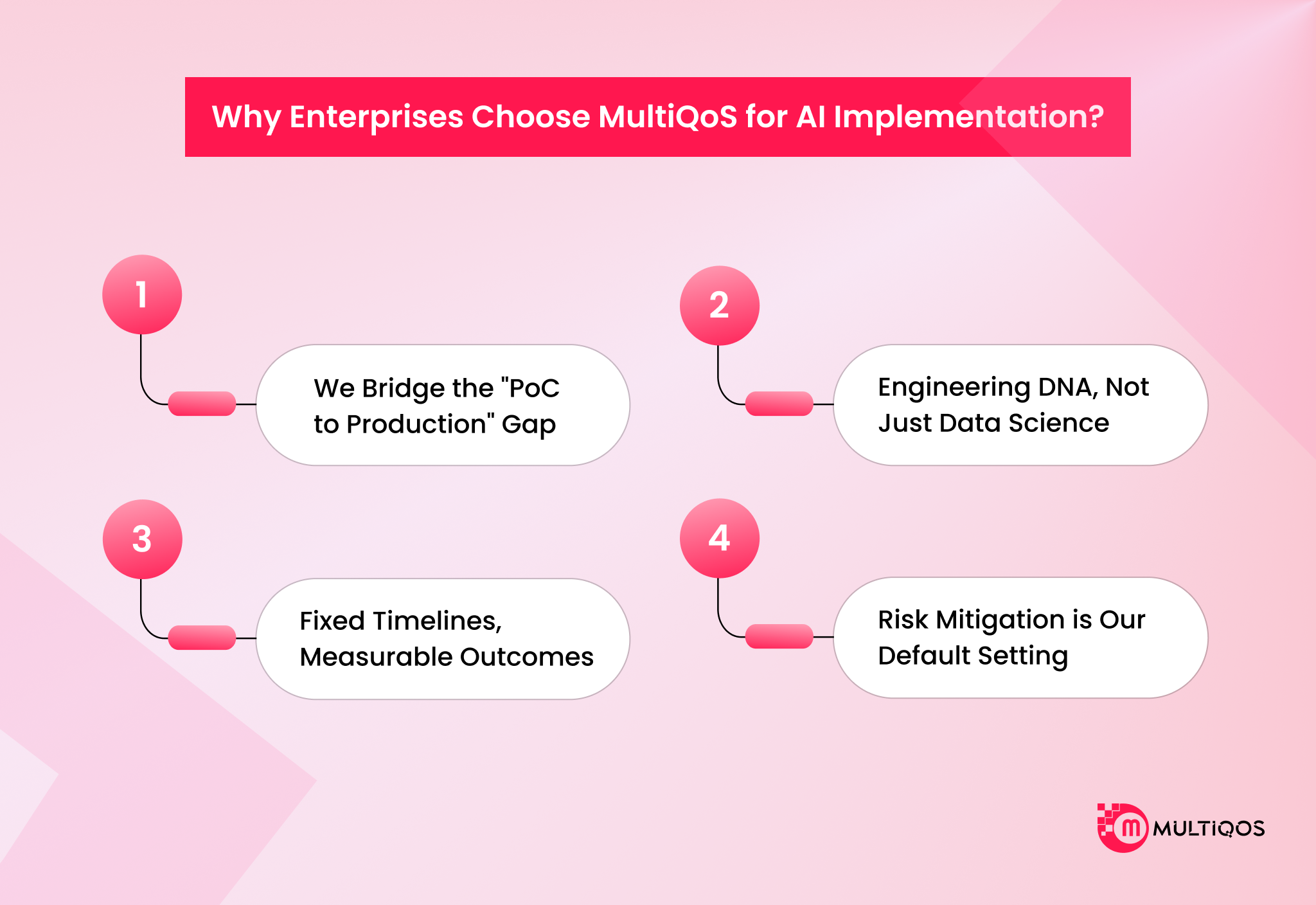
- We Bridge the “PoC to Production” Gap
The hardest mile in enterprise AI implementation is the one between the lab and the live environment. While traditional agencies celebrate a successful Proof of Concept (PoC), we treat it as a starting line. We specialize in the complex mechanics of AI PoC-to-production transitions, hardening your models against the chaos of real-world data and user behavior.
- Engineering DNA, Not Just Data Science
A great model in a bad system is a failure. Unlike firms that focus solely on the algorithm, we approach AI development services as a systems engineering challenge. We don’t just tune hyperparameters; we architect the entire AI production deployment ecosystem from MLOps implementation to API latency management.
- Fixed Timelines, Measurable Outcomes
We reject open-ended “transformation” engagements that bleed budget without delivering value. Our AI consulting services are structured around high-velocity, 90-day sprints. We define success metrics upfront, aligning our AI implementation roadmap with your fiscal quarters.
- Risk Mitigation is Our Default Setting.
We understand that for an enterprise, a hallucination is a liability. We embed a rigorous AI governance framework and AI risk mitigation protocols into the architecture itself. We deliver production-ready AI that satisfies your CISO as much as your CTO.
Conclusion
The “GenAI Divide” is not a separation of those who have ideas and those who don’t. It is a ruthless separation of those who treat AI as an experiment and those who treat it as infrastructure. If your organization is stuck in the cycle of endless pilots, you do not have a technology problem. You have an execution problem.
Success requires more than a model; it requires a machine. It demands a production-ready AI architecture, a defensible AI governance framework, and a relentless focus on ROI.
MultiQoS is the difference between a stalled pilot and a scalable asset. We stop the experimentation and start the engineering. If your AI pilot is stuck or about to start, the difference between success and stagnation is having the right delivery roadmap and execution partner. Schedule a consultation with our experts now.
FAQs
The industry average is a paralyzing 9 to 18 months, often referred to as “pilot purgatory.” At MultiQoS, we reject this timeline. By leveraging our pre-built MLOps implementation frameworks and focusing on systems engineering, we typically compress the AI PoC to production cycle into a high-velocity 90-day sprint.
The risks are invisible until they are catastrophic. Beyond financial loss, the primary threats are model drift (degrading accuracy), “Shadow AI” (ungoverned usage), and security vulnerabilities like prompt injection. Our AI implementation strategy prioritizes an AI governance framework from Day 1, ensuring AI risk mitigation is built into the code, not added as an afterthought.
No. In fact, building a team before you build the system is often a mistake in AI delivery model training. You need systems engineers, cloud architects, and MLOps specialists who are hard to hire and retain. MultiQoS acts as your elite engineering unit, providing end-to-end AI development services so you can deploy immediately while your internal capabilities mature.
We develop the enterprise AI architecture based on cloud-native (Kubernetes, Serverless) and automated systems. This consists of real-time drift checking, retraining pipelines, and load balancing. This will make sure that your AI production deployment has low latency and is highly accurate, even during spikes in user demand.
We tend to operate under high-pressure, controlled conditions where we do not compromise on quality. Our AI consulting services are industry-neutral, but we are profoundly experienced engineers in FinTech, Healthcare, Logistics, and Retail. These industries require strict data-readiness and compliance requirements that are characteristic of the MultiQoS delivery model.

Get In Touch

Get Stories in Your Inbox Thrice a Month.
AI in Healthcare Compliance: Building HIPAA-Compliant Intelligent Patient Care Systems