In-House vs. Outsourced AI Development: The 2026 TCO & ROI Guide
Table of Content
- The Maintenance Iceberg: A TTA Framework for the “Build vs. Buy” Decision in 2026
- The “Buy” Reality: Outsourcing & Consulting Models
- Segmenting the Market: Which Model Fits?
- In-House vs Outsource AI: Hidden Costs & TCO
- In-House vs. Outsourced AI Development: Strategic Risks: IP, Security & Talent
- How MultiQoS Operationalizes “Governance-as-Code” For Your AI Projects?
- FAQs
Summary:
By the end of 2026, static AI budgets will fail. Gartner predicts 30% of GenAI projects will be abandoned due to escalating costs—a phenomenon we call the “Maintenance Iceberg.” This guide introduces a new framework based on Test-Time Adaptation (TTA).
Just as machine learning models must adapt to data drift during inference, your organization must adapt to financial drift. We analyze the Total Cost of Ownership (TCO) of in-house vs. outsourced models, proving that dynamic “liquid talent” pods (outsourcing) offer the agility required to survive the “talent liquidity crisis” and GPU scarcity of 2026.
In 2026, businesses across the industries will face a reckoning. According to Gartner, at least 60% of Generative AI development projects will be abandoned due to a lack of AI-ready data, primarily because of poor data quality, inadequate risk controls, and, most critically, escalating costs exceeding business value.
This is the paradox for most businesses, which means even if you have successfully built an AI model, you cannot afford to run it. Most organizations finalizing their AI development cost 2026 roadmap are making a fatal calculation error.
They are budgeting for writing code and training models rather than focusing on drift, scaling, and compliance. They view AI as a static asset to be built, like a warehouse. This phenomenon is called the “Maintenance Iceberg.” To help you manage this volatility, we have applied the Test-Time Adaptation (TTA) concept. In machine learning, TTA enables a model to update its parameters in real time to adapt to “distribution shifts” in the data.
In this guide, we apply TTA to your organizational structure, proving how a dynamic outsourced strategy provides the “inference-time” agility required to survive.
The Maintenance Iceberg: A TTA Framework for the “Build vs. Buy” Decision in 2026
If you are currently finalizing your AI development cost 2026 budget, you are likely modeling on “clean training data” that ignores the volatility of real-world deployment. We call this the “Maintenance Iceberg.” The visible costs of inference account for only 15% to 20% of the financial commitment, while the vast majority is submerged in data engineering, operational entropy, and human oversight.
To prevent your budget from collapsing under these hidden costs of AI implementation, we are applying the principles of Test-Time Adaptation. In machine learning, TTA allows a pre-trained model to update itself during inference to handle “distribution shifts” without expensive retraining. In the business context, this framework exposes why static in-house vs outsourced AI development models fail when the market shifts.
1. The Distribution Shift: Static Budgets vs. Dynamic Reality
A model trained on yesterday’s data fails on today’s inputs. Similarly, an in-house team built on 2024 assumptions is “overfitted” and cannot adapt to the aggressive financial distribution shifts of 2026 without massive AI technical debt.
- The Shift: The gap between “The model runs in the lab” (Training) and “The model drives value at scale” (Test Time).
- The TTA Solution: You need an operating model that adapts during execution. Relying solely on internal hires creates a rigid structure that breaks under pressure.
The build vs buy decision must prioritize adaptability. By leveraging Outsource AI partners, you introduce “inference-time updates,” the ability to scale resources up or down based on real-time signal, rather than being locked into fixed overheads.
2. Parameter Updates: The Talent Liquidity Crisis
In TTA, the model parameters are fine-tuned on the fly. In your organization, your “parameters” are your engineers. The cost of hiring AI engineers vs outsourcing has mutated into an “extreme compensation war,” making permanent “parameter weights” (full-time employees) a liability.
- The Gradient Explosion: The “war for talent” has pushed base compensation for Senior Machine Learning Engineers to $150,000–$350,000. Machine learning engineer salary benchmarks for top-tier researchers now hit $400,000–$600,000.
- The Adaptation: If you cannot sustain these fixed costs, your internal model will fail to converge. The build vs buy AI decision guide now favors AI staff augmentation vs managed services. This approach allows you to access “liquid talent”—updating your team’s capabilities instantly without the friction of recruitment, effectively stabilizing dedicated AI development team rates.
3. Entropy Minimization: Infrastructure & Compute
TTA often uses entropy minimization to reduce uncertainty in unlabeled data. In 2026, the highest uncertainty lies in computing costs. The Total cost of ownership of AI models is no longer predictable due to the scarcity of NVIDIA H200 GPUs.
- The Noise: AWS breaking a 20-year trend with price hikes creates a “Cloud Premium.” A GPU cloud cost comparison reveals that attempting to “build” your own private cloud requires massive CapEx to achieve the same hardware integrity as large providers.
- The Prediction: Unless you are a hyperscaler, your internal infrastructure lacks the robustness to handle these spikes. Outsourcing shifts the burden of hardware entropy to the vendor, converting variable, volatile costs into fixed, predictable AI development services ROI.
4. The Decision Boundary: Classifying Initiatives
Just as TTA distinguishes between reliable samples and outliers, you must classify your AI initiatives to determine the correct delivery model.
Low-Variance Tasks (Utility AI)
- Context: Standard predictive models, receipts, and alerts.
- Strategy: Here, AI consultant hourly rates 2026 often undercut full-time headcounts. While you could build in-house, the outsourcing AI projects risks and benefits analysis suggests that commoditized tasks should be offloaded to preserve internal bandwidth for core IP.
High-Variance Shifts (Agentic & GenAI)
- Context: Complex Agentic AI development pricing, LLMs, and “Cold Outreach” bots.
- Strategy: These projects suffer from “Model Collapse” and high failure rates. The Enterprise AI governance costs required to monitor autonomous agents are staggering.
- The TTA Verdict: Do not build a permanent team for an experimental distribution. Use a vendor to run the pilot. If the “data drift” is too high and the project fails, you can sever the contract without severance pay. This minimizes the sunk cost of AI Amnesia, where internal models lose relevance and accuracy over time.
The “Buy” Reality: Outsourcing & Consulting Models
The “Buy” model is the strategic hull that keeps you afloat. Moving to an outsourced or consulting model shifts your AI strategy from a fixed Capital Expenditure (CapEx) to a flexible Operational Expenditure (OpEx).
This shift isn’t just about saving money; it’s about Agility. In the TTA framework, this is the “Instruction” pillar, giving your organization a clear manual for scaling resources up or down without the friction of HR protocols.
Here is the market reality for AI development services, ROI, and rate structures in 2026.
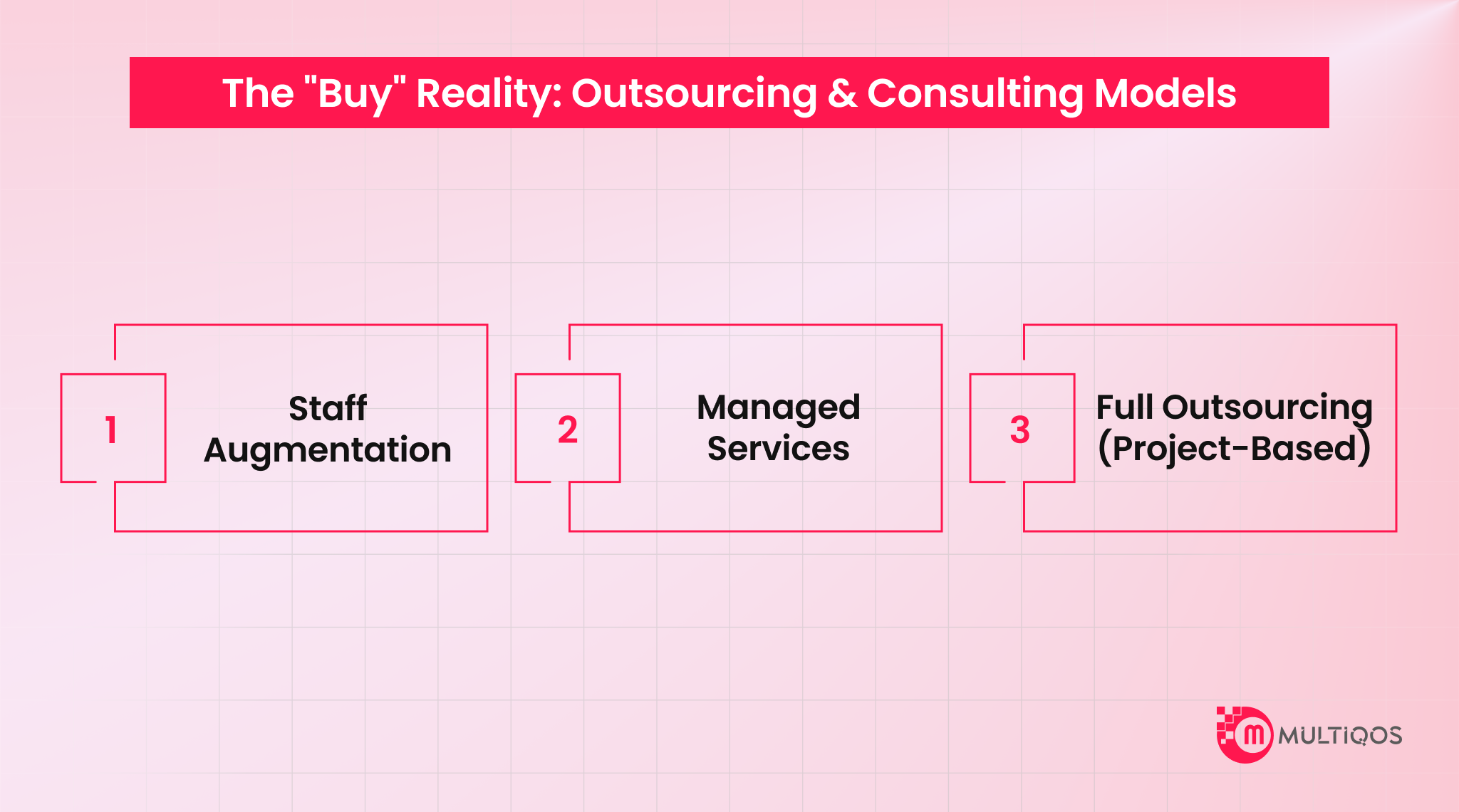
1. The Rate Card: Generalists vs. Niche Experts
The “War for Talent” has created a bifurcated market. You don’t pay for “hours”; you pay for impact.
- Junior/Mid-Level: Standard implementation (cleaning data, basic API integrations) costs $100-$150/hour.
- Niche Experts: The cost of verified expertise spikes dramatically. For architects capable of designing Agentic AI systems or fine-tuning LLMs, rates command $300-$500/hour.
2. Global Arbitrage: The Geo-Economic Advantage
The most immediate fix for the “Identity Triple-Threat” (specifically the Authorization cost) is looking beyond your zip code.
- The Math: Senior machine learning engineers in hubs like Eastern Europe, LATAM, or India are commanding $45,000-$70,000/year.
- The Impact: This offers a 70% savings compared to the US/Western Europe elite packages ($200k+).
- The Strategy: This allows you to secure “Senior” level authorization (talent) for the price of a local “Junior,” effectively hacking the machine learning engineer salary benchmarks.
3. Flexibility: OpEx vs. CapEx
The hidden killer of in-house AI is rigidity.
- In-House (CapEx): If a project fails or needs to pivot, you are stuck with severance packages, morale hits from layoffs, and unused infrastructure overhead.
- Outsourced (OpEx): You possess the ability to scale down teams instantly. This aligns with the “Instruction” pillar. If the market changes, your instruction changes. You turn the dial down, and the cost disappears.
Segmenting the Market: Which Model Fits?
To apply Intent-Based Filtering (The Scrutiny Scale), you must match the engagement model to the criticality of the task. You wouldn’t use a high-security courier to deliver a pizza, and you shouldn’t use a $500/hr consultant to label data.
Staff Augmentation
Cost: $25 – $60/hour
Best For: This model fits best when you have a strong internal “Instruction” manual (clear management) but lack the “Authorization” (headcount) to execute. It works for standard engineering tasks, data labeling, and backend integration.
Why it fits: You are renting raw labor power. Because the Visibility Gap is low (the tasks are well-defined and standard), you don’t need to pay a premium for external project management. You retain the brain; they provide the hands.
Managed Services
Cost: $50 – $90/hour
Best For: This is the “Integrity” pillar. It fits best for ongoing model monitoring, RAG pipeline maintenance, and infrastructure updates.
Why it fits: This shifts the liability of the “Maintenance Iceberg” to a partner. Instead of paying for hours, you are paying for an SLA. If the vector database goes down at 3 AM, it is their problem to fix, not yours. This is the only way to cap the hidden costs of “AI Amnesia” and technical debt.
Full Outsourcing (Project-Based)
Cost: $150,000 – $500,000 per project
Best For: This fits high-risk, high-reward initiatives like building a custom agentic workflow or a proprietary, fine-tuned model from scratch.
Why it fits: This is a risk transfer. GenAI projects have a high failure rate (high scrutiny). By outsourcing the entire project, you force the vendor to own the “Placement” (the business outcome) rather than just the “Delivery” (writing code). If the pilot fails to meet the requirements (business value), the financial risk sits with the vendor’s fixed-bid contract, protecting your internal budget from volatility.
In-House vs Outsource AI: Hidden Costs & TCO
Both in-house and outsourced models frequently fail due to the “Maintenance Iceberg,” where organizations underestimate AI project costs by 500% to 1000% when scaling from pilot to production. The visible costs of model inference and access represent only 15% to 20% of the total financial commitment, while the vast majority of expenses are submerged in data engineering, operational oversight, and infrastructure readiness.
Maintenance Multiplier
The true Total Cost of Ownership (TCO) shows that annual maintenance typically accounts for 15% to 30% of the original build cost. Over a multi-year lifecycle, this results in a massive financial burden; failing to account for these post-deployment costs, such as infrastructure scaling and security updates, is a primary reason why projects face budget overruns of 5x to 10x their initial estimates.
AI Amnesia
AI models are not static assets, and they suffer from “data drift” and performance degradation over time, requiring continuous retraining and tuning that accounts for 15% to 30% of total AI spend. Without this ongoing investment in a “continuous feedback loop” (MLOps), models lose relevance and accuracy, turning initial capital investments into operational liabilities.
Tool Sprawl
Unmanaged SaaS subscriptions and “Shadow AI” contribute significantly to financial leakage, with cloud waste (idle resources and over-provisioning) accounting for 28% to 35% of total cloud spend. To combat the “sprawl of applications” created during the initial AI boom, organizations must prioritize vendor consolidation and map all shadow AI assets to avoid redundant licensing and regulatory risks.
Comparison Matrix: When to Build vs. Outsource
This is your Instruction pillar, a clear, binary guide to decision-making. We use the Scrutiny Scale (Intent-Based Filtering) to decide where your money should go.
| Strategic Variable | In-House (The “Static” Build) | Outsource (The “Dynamic” Lever) | Hybrid (The “Adaptive” Recommended) |
| Core IP Sovereignty |
Absolute Control You own the “Black Box” and the weights. |
Contractual Gating
Protected via strict Indemnity & IP Transfer clauses. |
Partitioned Core
Strategic logic remains internal; utility layers are externalized. |
| Velocity to MVP |
Lagged (6-12 Months) Stalled by the “War for Talent” & onboarding friction. |
Accelerated (2-4 Months) Instant access to “liquid talent” pods. |
Optimized (3-6 Months) Parallel execution—Strategy in-house, Dev offshore. |
| TCO Impact (Year 1) |
Volatile CapEx ($1M+) High hidden costs (severance, infrastructure, drift). |
Predictable OpEx ($200k – $500k) Fixed monthly rates & outcome-based pricing. |
Value-Driven (~$400k) High spend on Architects, low spend on execution. |
| Scalability (TTA) |
Rigid Scaling requires expensive, slow recruitment cycles. |
Fluid “Inference-time” scaling—add/remove engineers on demand. |
Governed Elastic scalability with internal compliance guardrails. |
| Risk Profile | Single Point of Failure
“Key Person Risk” if your Lead Architect quits. |
Vendor Lock-In
Mitigated by owning the code artifacts & weights. |
Resilient Distributed risk ensures continuity if one node fails. |
In-House vs. Outsourced AI Development: Strategic Risks: IP, Security & Talent
Addressing the anxieties surrounding outsourced AI requires a fundamental shift from simple service delivery to rigorous, data-centric governance. In the modern build vs. buy calculus, the primary risks have shifted beyond mere service quality to “de facto vendor lock-in” and regulatory exposure.
The Governance Gap
Organizations navigating in-house vs outsourced AI development must recognize that effective risk management now hinges on securing “Project Data” and utilizing hybrid delivery models that ensure business continuity. Without this, the risk-and-benefit analysis of outsourcing AI projects skews heavily toward long-term dependency, where the client owns the interface but remains beholden to a vendor’s proprietary engine.
The Black Box Trap
In the era of generative AI, IP ownership is often an illusion; owning the “tool” is insufficient if you do not control the underlying neural architecture. To maximize AI development services ROI and avoid the “Black Box Trap,” contracts must guarantee rights to fine-tuned model weights and artifacts, rather than a transient license to access a model.
- True Ownership: The total cost of ownership of AI models often spikes unexpectedly when companies realize they cannot port their solution. Provisions must grant ownership of model weights to prevent platform dependency.
- Data Sovereignty: To avoid the hidden costs of AI implementation associated with data leakage, agreements must explicitly prohibit vendors from using your “Project Data” to train foundation models for competitors.
- Legal Indemnity: As enterprise AI governance costs rise, comprehensive NDAs must require indemnification for IP infringement claims related to both training data and AI outputs, bypassing standard liability carve-outs.
Talent Volatility
The “war for talent” has introduced extreme volatility into the cost of hiring AI engineers vs outsourcing equation.
- In-House Fragility: Relying on internal teams creates acute “Key Person Risk.” With tech giants offering compensation packages reaching $300 million for top researchers and machine learning engineer salary benchmarks topping $350,000, retaining a small team is financially perilous. The loss of a lead architect can stall projects indefinitely, turning AI development cost 2026 projections into immediate sunk costs.
- The Pod Model: To mitigate turnover, the market is pivoting from standard AI staff augmentation vs managed services toward “pods” and “microGCCs” (Global Capability Centers). These dedicated product squads retain institutional memory, stabilizing dedicated AI development team rates and reducing reliance on transient freelancers.
Regulatory Liability & Infrastructure
As the EU AI Act and US state laws enforce strict liability on “deployers,” the build vs buy AI decision guide must account for regulatory flow-down obligations.
- Compliance Costs: AI technical debt now includes regulatory non-compliance. Outsourcing partners must be contractually bound to GDPR and safety audits, effectively shielding the client from legal fallout.
- Hybrid Costs: While a GPU cloud cost comparison might favor offshore execution, compliance demands a hybrid model. Structures such as “Build-Operate-Transfer” enable companies to retain control over sensitive governance while leveraging global talent.
- Agentic Future: As organizations move toward Agentic AI development pricing models, where AI acts autonomously, the need for human-in-the-loop oversight becomes a cost driver. Navigating AI consultant hourly rates 2026 requires understanding that cheap hourly rates often mask the long-term expense of remediating unsupervised, non-compliant agents.
How MultiQoS Operationalizes “Governance-as-Code” For Your AI Projects?
Choosing between in-house and outsourced AI development is a strategic complexity. And it’s not just about a simple choice between A and B, but boils down to the right sourcing.
True optimization lies in decoupling strategy from execution. Allocating a permanent, 10-person dedicated AI development team to construct a commoditized chatbot or RAG pipeline is not an investment; it is operational bloating that ignores machine learning engineer salary benchmarks.
You must outsource the high-entropy utility tasks to stabilize AI development cost in 2026, while retaining the strategic architecture and core IP in-house. Don’t hire a standing army for a utility skirmish; outsource the mechanics, own the mind.
To capture the full ROI of AI development services without succumbing to the “Maintenance Iceberg,” you must embed granular controls directly into your model’s lifecycle. At MultiQoS, we help you transition from reactive “break-fix” cycles to proactive algorithmic resilience.
Secure AI deployment requires more than just code; it demands integrated automation. We help you automate secure Agentic AI development through “Governance-as-Code” integration, model-level firewalls, and real-time inference monitoring.
Our team employs AI governance operationalization, granular permission scoping, and just-in-time agency to ensure that your external AI workforce operates with the same fidelity as an internal team.
With MultiQoS, you get,
| Challenge | MultiQoS Solution | Result |
| Shadow AI & Sprawl | Granular Permission Scoping & Automated Discovery | 100% Asset Visibility |
| Agentic Hallucinations | Just-in-Time Agency & Human-in-the-Loop flows | Zero Unchecked Escalations |
| Regulatory Debt | AI Governance Operationalization (SOC2/GDPR) | Automated Compliance Audit Trails |
So, if you are looking to build future-ready AI solutions, connect with our experts now.
FAQs
We bypass the “Maintenance Iceberg” by embedding “Governance-as-Code” directly into the SDLC, ensuring your budget funds business value rather than operational entropy. This shifts AI development services’ ROI from a theoretical projection to a verifiable, audit-ready metric.
We solve “Key Person Risk” by providing “liquid talent” pods that adapt to your financial distribution shifts without the friction of recruitment or severance. This TTA-aligned model stabilizes dedicated AI development team rates while retaining the institutional memory often lost with freelancer churn.
We deploy “Just-in-Time” agency controls and zero-trust reverse proxies to prevent the “Black Box Trap” of data leakage and unauthorized training. This ensures Enterprise AI governance costs are minimized by automating compliance flow-downs directly into the inference layer.
Yes, we structure contracts to prevent “de facto vendor lock-in” by ensuring you retain full rights to the fine-tuned model weights and artifacts. This guarantees you own the “neural intelligence” required for long-term differentiation, rather than just renting a temporary API key.
We treat models as living organisms, applying “inference-time updates” and continuous monitoring to combat data drift before it degrades performance. Our managed services absorb the “Maintenance Multiplier,” ensuring your model remains calibrated to market reality without spiking your OpEx.

Get In Touch

Get Stories in Your Inbox Thrice a Month.
The Future of AI for Customer Experience: How to Build Predictive Customer Journeys