Table of Content:
- Introduction
- Top 7 AI Trends Business Leaders Should Watch in 2026
- Final Note
- FAQs
Summary:
By the year 2026, the use of artificial intelligence in the very fabric of operations of businesses will become common, and it will not be isolated pilot projects anymore. The implementation will establish agentic automation, domain-specific models, AI-native development, governance platforms, edge intelligence, responsible AI, and decision intelligence as the primary way organizations will write software, build secure systems, make decisions, and scale their operations.
The fundamental change is not only technological in nature, but also organizational in nature as well, and will require a strategy to lead change with strong ModelOps foundations and governance as it will be enterprise wide.
Companies that inculcate AI swiftly, strictly, and conformably are in a position to become category leaders at the upcoming phase of online transformation.
Introduction
Knowing the AI trends is not about gathering information on a few fancy tools or LLM versions. CTOs and CEOs need to focus on the shift that each AI trend brings on the operational front, technical, security and UI side.
With artificial intelligence now deeply integrated and pervasively adopted across the software development lifecycle, comprehending these dynamic trends and integrating them into operations becomes absolutely necessary.
The importance of this focus on AI escalates substantially heading into 2026. Considering 31% of enterprises will be actively scaling AI agents, knowing the essential trends and pinpointing the specific use cases upon which CTO need to focus to becomes paramount.Without a proper understanding of the trends, investments into AI integrations can lead to higher spending.
This article lists the 7 best AI trends that you can focus on for your organization, ensuring future-proof systems.
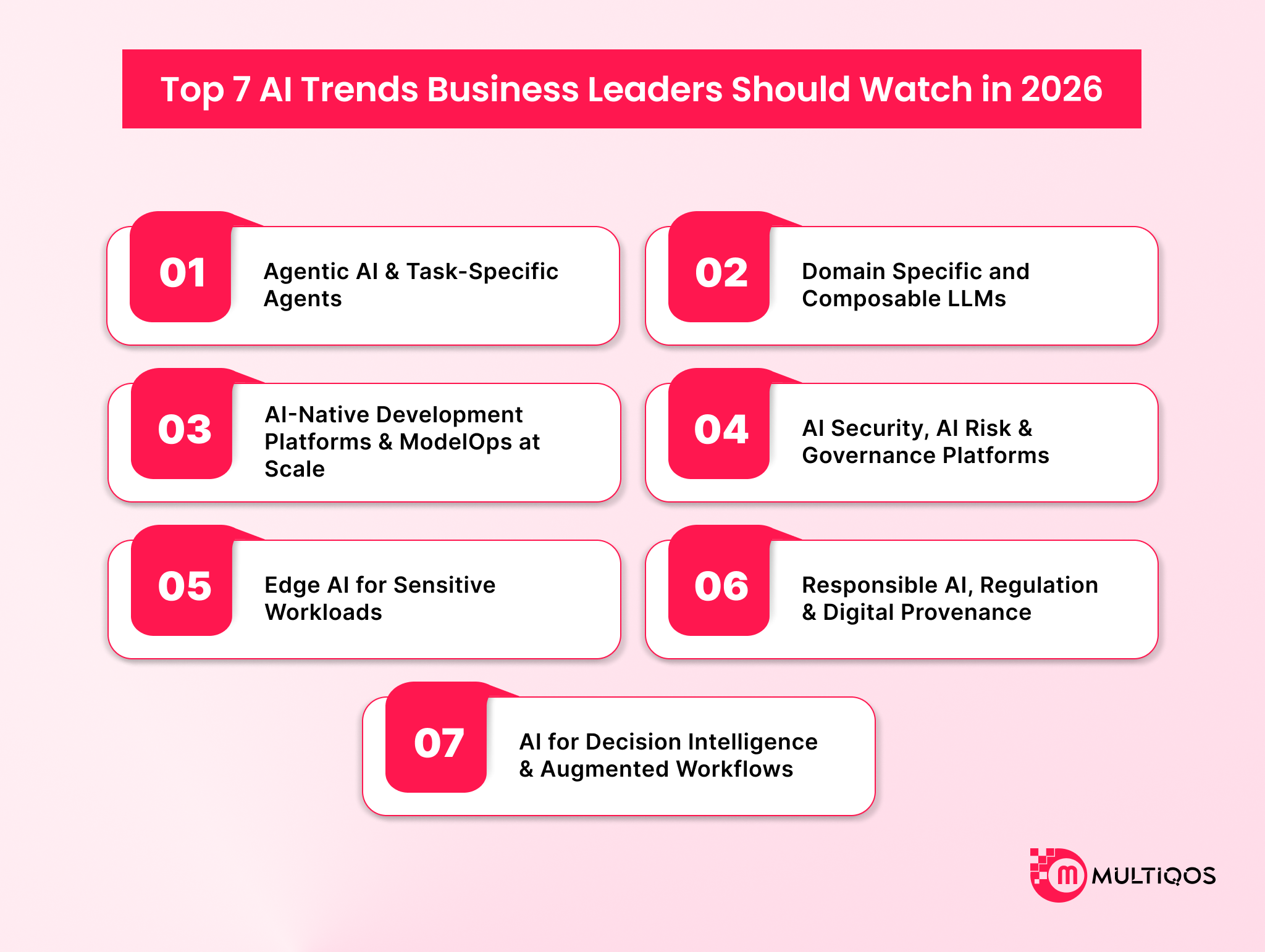
Top 7 AI Trends Business Leaders Should Watch in 2026
Here are some of the AI trends that CTOs and CEOs need to keep an eye on in 2026.
1. Agentic AI & Task-Specific Agents
A new form of automation called agentic AI is what businesses desire. It is a trend in AI that will be more prominent in 2026. In reality, Gartner projects that by 2026, 40% of enterprise applications will have task-specific AI agents. These agents assist businesses in scheduling their tasks, data collection, and workflow execution.
Why Does It Matter?
The agentic AI trend matters the most in 2026 due to changing customer demands. The dynamic market needs continuous improvements. This means businesses will need speed, flexibility, and most importantly, automation. Agentic AI can provide all this, reducing errors, time, and more.
What Should Be Your Action Plan?
- Evaluate your tech stack with expert agentic AI services to ensure seamless integration with AI agents.
- Launch a task-specific agent to validate performance and ROI quickly.
- Set clear guardrails to keep AI actions safe, accurate, and auditable.
- Scale to multi-agent systems as your workflows mature and adoption grows.

2. Domain Specific and Composable LLMs
Domain-specific and Composable LLMs represent a strategic shift away from “one-size-fits-all” giant models. It focuses on more specialized and modular systems. This AI trend will mature from experimental pilots in 2026.
According to projections from Gartner, over 50% of generative AI systems currently in use within businesses are expected to be deployed across various enterprises by 2028. It will focus exclusively on specialized niche domains.
Specialized deployments of this nature yield substantial operational advantages for firms. Take, for example, Med-PaLM 2, developed by Google. It is an advanced large language model focused on the medical domain.
This domain-specific LLM has demonstrated expert-level performance. It offers evidence-based answers for complex medical queries.
Why Does It Matter?
The operational structure supporting firms in 2026 will find its momentum originating with the newest domain-specific artificial intelligence models. This pivot is strategic. What this inflection point demands is a substantial institutional redirecting of both focus and capital away from the common, widespread utility of general-purpose Large Language Models (LLMs), favoring instead those meticulously refined, specialized niche implementations.
What Should Be Your Action Plan?
- Review workflows for high-risk tasks where standard large language models (LLMs) are not precise or compliant enough.
- Check Model Context Protocols (MCP) for smooth communication between specialized AI agents.
- Run a small-scale test in a specific area (like legal or HR) to prove superior accuracy compared to generic models.
- Set up rules to keep sensitive data on local, sovereign infrastructure (“geopatriation”).
Use a network of smaller, interacting models (SLMs) instead of one huge, all-in-one model.
3. AI-Native Development Platforms & ModelOps at Scale
The usage of AI agents is not only at the coding level but also starting at the very planning level. AI agents can be used in the planning, design, coding, testing, and deployment of software. They make it easier to automate the key repetitive processes by using an AI-native data platform as the core. This leads to automated control of data, which will guarantee velocity, regulation, and model training.
Moreover, ModelOps provides AI model training and deployment as per the needs of the organization. It allows the automation of the whole AI lifecycle, including data collection, training of the models, evaluation of the models, and deploying them.
Why Does It Matter?
Leveraging AI-native development ecosystems and large-scale ModelOps allows for substantially quicker and more dependable translation of conceptual designs into fully operational AI systems. Continuous AI delivery becomes the norm for organizations, effectively sidelining the previous reliance on discrete experiments and isolated proofs-of-concept.
What Should Be Your Action Plan?
- Focus attention on utilization scenarios where AI directly influences profit generation, drives cost efficiencies, or elevates the quality of customer interactions.
- An overarching ModelOps framework should be employed to mandate consistency throughout the entire AI lifecycle.
- Leverage observability in MLOPs for better model performance and improved response time.
- An AI-native data infrastructure requires bolstering through the deployment of autonomous, governed pipelines capable of real-time operation.
Shift workforces away from conventional, manual development practices toward AI-agent-guided processes for planning, subsequent coding, and rigorous testing.
4. AI Security, AI Risk & Governance Platforms
In 2026, AI risk will not be a technical issue but a core component of operational resilience. The CEOs and CTOs will feel the pressure of going beyond just cyber tourism and having an active oversight over AI decision-making. One of the key AI trends will be governance as a competitive advantage. What this means is that compliance will be different from what the EU and CTOs think about it.
It will not be just a cost center but a growth driver. Businesses need to understand that certified trustworthy AI will be the key factor in winning contracts and new projects over those who cannot prove that their models are safe for the clients.
Why Does It Matter?
In the eyes of Agentic AI and its use cases across the industry, 2026 will bring a new challenge for CEOs and CTOs across businesses. This challenge will be to maintain AI governance and ensure that their data is secure. So, in 2026, AI governance, risk management, and security will become a key trend.
What Should Be Your Action Plan?
- AI risk reporting is one of the core components of your security.
- To add a kill switch to any AI agent or model that ditches the ethical or safety guard.
- Deploy platforms that can inject security checks across the ML Ops pipeline.
- In the flow of continuous security audits, which are automated, at the end of every phase of software development.
5. Edge AI for Sensitive Workloads
Edge AI is the new AI trend that is transforming the way businesses process data. It works by embedding AI algorithms directly into the edge devices. Businesses get the ability to analyze data, recognize patterns, and make decisions in real-time using edge AI.
This is a transformative trend where, instead of processing the data by sending it to the centralized cloud infrastructure, most of the data is processed locally on edge devices.
Why Does It Matter?
Modern AI devices have hardware accelerators such as:
- Neural processing units
- Digital signal processors
- AI-enhanced microcontrollers
These components help businesses execute AI workloads with minimal power consumption, which is very good for companies that need high energy efficiency.
What Should Be Your Action Plan?
- Use sparsity to reduce the unnecessary parameters while training your AI model.
- Leverage AI software development solutions to deploy model pruning to remove redundant or less impactful connections during training.
- Faster computation on specialized hardware significantly reduces memory usage with quantization.
6. Responsible AI, Regulation & Digital Provenance
Responsible AI is going to be another key AI trend in 2026, with the new EU AI Act alongside the US state-specific laws like the Colorado AI Act and Texas Responsible AI Governance Act right around the corner.
Black box AI models are no longer acceptable, especially in regulatory industries. Organizations need AI models that can show interpretation, justify outputs, and provide better audit logs. This is where responsible AI will gain momentum.
Why Does It Matter?
With AI starting to affect the hiring process, the lending process, health conditions choices, insurance underwriting, and cybersecurity, there will be a direct hit on revenue, brand loyalty, and continuity of operations. The absence of explainability may cause compliance breaches, legal liability, biased results, and mistrust in the customers. By 2026, companies will no longer judge the level of AI deployment by its business intelligence, but rather the degree of its transparency, ethicality, and defendability.
What Should Be Your Action Plan?
- Consider explainability, bias detection, and auditability as a part of every AI system since its creation.
- Introduce AI governance boards that consist of legal, IT, security, and business leadership.
- Make sure that AI implementations are in line with the future international and regional codes of compliance.
7. AI for Decision Intelligence & Augmented Workflows
Artificial intelligence is evolving much faster than dashboards and predictive analytics, as it is demonstrating its role as the core of corporate decision-making. The real revolution will be the insertion of AI directly into business decisions, operating as what-if models, optimization agents, and real-time scenario preparation, and constant performance fine-tuning in operations, finance, supply chains, sales, and risk control.
Decision-intelligence systems will not only be used to tell leaders what has happened or what may happen; the systems will more and more suggest what should happen for them, with the help of simulation, constraints, probability, and predefined business rules. It is a phenomenon that is seeding enhanced workflows where human beings and AI are functioning within the same cycle of decision-making.
Why Does It Matter?
Competitive advantage will be defined in terms of speed and accuracy, decisions, and confidence. Companies that only forward their analysis through human analysis will fail to keep up with the fluctuating markets, dwindling margins, and the live customer demands.
However, there is a critical change in accountability brought along by this trend as well. Once AI starts to affect the pricing, inventory, hiring capacity, fraud levels, and financial projections, it is important that enterprises define the zone between automation and human judgment. Ungoverned decision intelligence has the potential to increase scale errors. With suitable guardrails, it has the potential of being a leadership force multiplier.
What Should Be Your Action Plan?
- Pinpoint those junctures in the decision-making lifecycle where deferred action precipitates tangible negative consequences across revenue streams, inherent risk profiles, or the totality of the customer journey.
- The incorporation of optimization methods and hypothetical scenario modeling, powered by artificial intelligence, must become integral to established enterprise operational procedures.
- Specific thresholds mandating human oversight and approval must be delineated for all mission-critical determinations.
- Rigorous validation protocols, metrics for assessing certainty (confidence scoring), and necessary mechanisms for manual override warrant immediate implementation.
Final Note
Simply grasping the current trajectory of artificial intelligence merely marks the inception. True competitive leverage emerges by harmonizing these sophisticated toolsets directly with organizational imperatives; execution demands impeccable architecture, robust governance frameworks, and intrinsic scalability. Precisely within this nexus, MultiQoS asserts its indispensable function.
With 14 plus years of experience, a presence across 40 industries, and more than 700 successful digital transformation projects delivered, MultiQoS helps enterprises move from AI vision to production-grade execution.
- Leveraging MultiQoS’s advanced AI and enterprise automation suite delivers:
- Focused advisory services ensuring AI initiatives directly advance core business objectives.
- Engineering comprehensive, intelligent workflows that deliver true end-to-end automation.
- Exclusive engineering resources committed to perpetual system refinement and peak performance tuning.
Is your organization gearing up for significant AI operationalization across 2026 and subsequent years? Connect directly with the MultiQoS specialists; we architect secure, scalable, and ultimately future-proof AI environments.
FAQs
Agentic AI and task-specific automation are embedded directly into business workflows.
Because regulations, explainability, and security will directly impact revenue, trust, and compliance.
AI that actively recommends actions instead of only reporting insights.
Yes, but domain-specific and composable models will dominate critical enterprise use cases.
By combining ModelOps, data governance, security frameworks, and leadership-driven execution.

Get In Touch

Get Stories in Your Inbox Thrice a Month.
AI E-Commerce Personalization: Creating Customer Experiences That Convert
The Future of AI for Customer Experience: How to Build Predictive Customer Journeys