Legacy Application Modernization: Meaning, Benefits, Approaches & Use Cases
- Introduction
- What Is Application Modernization?
- Why Application Modernization Is Critical in 2026 and Beyond
- Key Benefits of Application Modernization
- Popular Application Modernization Approaches (6R Model)
- Business Use Cases of Application Modernization
- Key Challenges in Legacy Application Modernization
- How to Build a Successful Application Modernization Strategy
- How MultiQoS Supports Application Modernization?
- FAQs
Summary
Application modernization acts as a way of assisting enterprises to come out of the chains of past systems by enhancing the elements of agility, security, scaling, and cloud readiness.
Through systematic strategies, gradual implementation, and cloud-native solutions, the organizations will be able to decrease the technical debt, allow relying on AI, and synchronize the technology with the dynamic business objectives.
Introduction
Across boardrooms and architecture review meetings, one realization has become a constant. Legacy applications are no longer a second thought. They are active constraints. Systems that once delivered stability now struggle to keep pace with the demands of modern businesses.
Release cycles stretch unnecessarily long. Integration requests become multi-quarter projects. Security patches seem more like a “fix” than a prevention. And while this is happening, the race of AI adoption gets intense. And the fact that 70% of Fortune 500 businesses still use software developed 20 years ago makes the adoption far more challenging.
Application modernization is the solution that can help businesses cope with them. Depending on the business needs, it is a modernization process of the old application to raise the agility, security, performance, and cloud competency.
But what is application modernization? Is it essential?
This article offers all the answers you need and explains how businesses of any size can benefit from it. Plus, it also discusses the advantages and drawbacks of application modernization, including when and how to apply it.
What Is Application Modernization?
Application modernization is the transformation of legacy apps built years ago to meet today’s customer needs. This includes creating a cloud-native experience, an API-driven architecture, robust security measures, and a user-friendly design.
A legacy application typically exhibits several telltale traits:
- A monolithic design
- Dependence on on-premises infrastructure
- Limited interoperability with external systems
- Outdated frameworks or unsupported runtimes
- Escalating maintenance effort relative to delivered value
The legacy application modernization combines cloud-native application development, adoption of microservices architecture, and automation across software development. However, before you plan to modernize your apps, determining the right approach is essential.
Often, CTOs and CIOs confuse modernization with cloud migration, especially with lift-and-shift. However, both of these approaches are different.
Modernization vs Lift-and-Shift Migration
A lift-and-shift migration actually relocates the apps to cloud infrastructure with minimal tweaks. This can actually reduce data center overhead by addressing architectural issues and tech debt. On the contrary, the modernization approach focuses on more than just migrating the systems to the cloud. It focuses on being cloud-native.
Here is a clear differentiation between modernization vs lift and shift Migration
| Aspect | Lift-and-Shift Migration | Modernization (Platform Modernization) |
| Definition | Moving applications to the cloud with minimal or no code changes | Redesigning applications using cloud-native architectures and modern patterns |
| Architecture Approach | Maintains existing monolithic architecture | Adopts microservices, API-first, and composable architecture |
| Long-term TCO | Higher due to inefficient resource utilization | 30-40% lower through elastic scaling and optimization |
| Performance Optimization | Limited; inherits existing performance constraints | Significant improvement through a distributed architecture |
| Scalability | Vertical scaling only (scale entire application) | Independent horizontal scaling of individual services |
| Deployment Speed | Slow; requires full application redeployment | Fast; deploy individual services independently |
| Failure Isolation | Single point of failure; downtime affects the entire system | Isolated failures; services fail independently |
| Cloud Cost Efficiency | Poor; overprovisioned resources run 24/7 | Optimized; pay only for resources actually used |
| Technical Debt | Carries forward existing technical debt | Reduces technical debt through architectural redesign |
| Compliance & Security | Manual compliance checks; quarterly validation | Policy-as-code; continuous compliance monitoring |
| Best For | Quick cloud migration with budget constraints, legacy apps nearing end-of-life, minimal business logic changes needed | Strategic applications requiring agility, high-growth products needing scale, and customer-facing digital experiences |
Why Application Modernization Is Critical in 2026 and Beyond
The actual concern is not the necessity of modernization, but how long the business can afford to delay it. The following are some forces:
- Regulatory requirements are becoming more visible, real-time, and auditable.
- Performance consistency between channels and geographies is desired by the customers.
- The technology systems are moving towards API-based, composable models.
Companies that are lagging behind in modernization are at compound risk. Innovation is slowed, maintenance is increased, vendor lock-in is increased, and maintenance periods are increased. This is the exact reason why the modernization of applications is a current rather than a future project.
But there is more to it.
With the advent of AI, organizations need to upgrade their systems. Why? Because most of these systems have data flaws. This can lead to 85% of the AI models failing. So, it’s not just about upgrading systems, but about creating a data infrastructure and processes that ensure high-quality data.
Key Benefits of Application Modernization
Here are some of the key benefits of application modernization for your business.
Agility and Time-to-Market
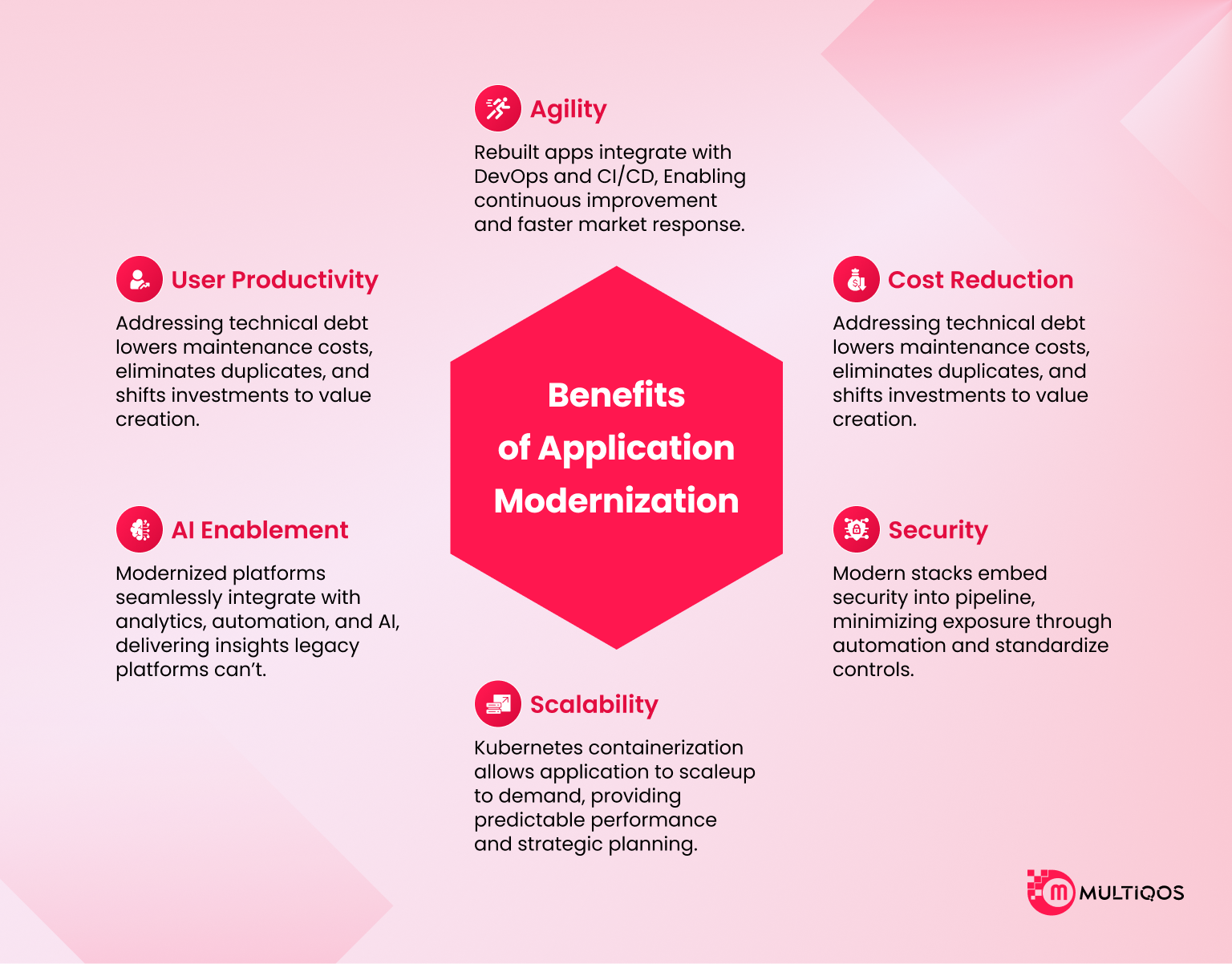
Rebuild apps play nicely with DevOps and CI/CD automation, enabling continuous uplift rather than leaving them sitting. This change alone can affect how quickly a company responds to market feedback.
Cost Justification and Reduction of Technical Debt
By addressing technical debt, organizations can lower their long-term maintenance overhead, eliminate duplicate entries, and shift their costs from reactive support to value-creation investments.
Security and Compliance Posture
Contemporary stacks embed security into pipelines rather than bolt it on later. Exposure is significantly minimized through automated testing, continuous monitoring, and standardized controls.
Elastic Scalability and Performance
With Kubernetes containerization, applications scale up to demand, not forecast. Performance becomes predictable. Now you have strategic capacity planning, not just speculation.
AI, Data, and Automation Enablement
Modernized platforms inherently and seamlessly integrate with the use of real-time analytics engines, automation tools, and AI services to deliver insights that legacy platforms are fundamentally unable to support.
User Understanding and Productivity of Employees
Much better responsive, reliable, and usable, which makes a big difference for customers who are depending on these systems.
Popular Application Modernization Approaches (6R Model)
Understanding how to modernize legacy applications requires a structured decision framework. The 6R model remains widely adopted for this reason.
- Rehost: Minimal change, infrastructure-focused; this approach is often paired with Lift and Shift migration.
- Replatform: Selective optimization without complete redesign. It helps you modernize apps by making minor tweaks.
- Refactor: This includes leveraging cloud-native application development to restructure the app’s internal code and architecture
- Rearchitect: Rebuild with microservices architecture and API-led integration.
- Replace: This approach is all about moving your existing systems to new SaaS solutions.
- Retire: Removing systems that are either obsolete or too costly to either refactor, replatform, or rehost.
These are good, and each has a reason in the toolbox; the trick is to use just one, and only one, at any given time.
Business Use Cases of Application Modernization
Some of the top business use cases with application modernization services are,
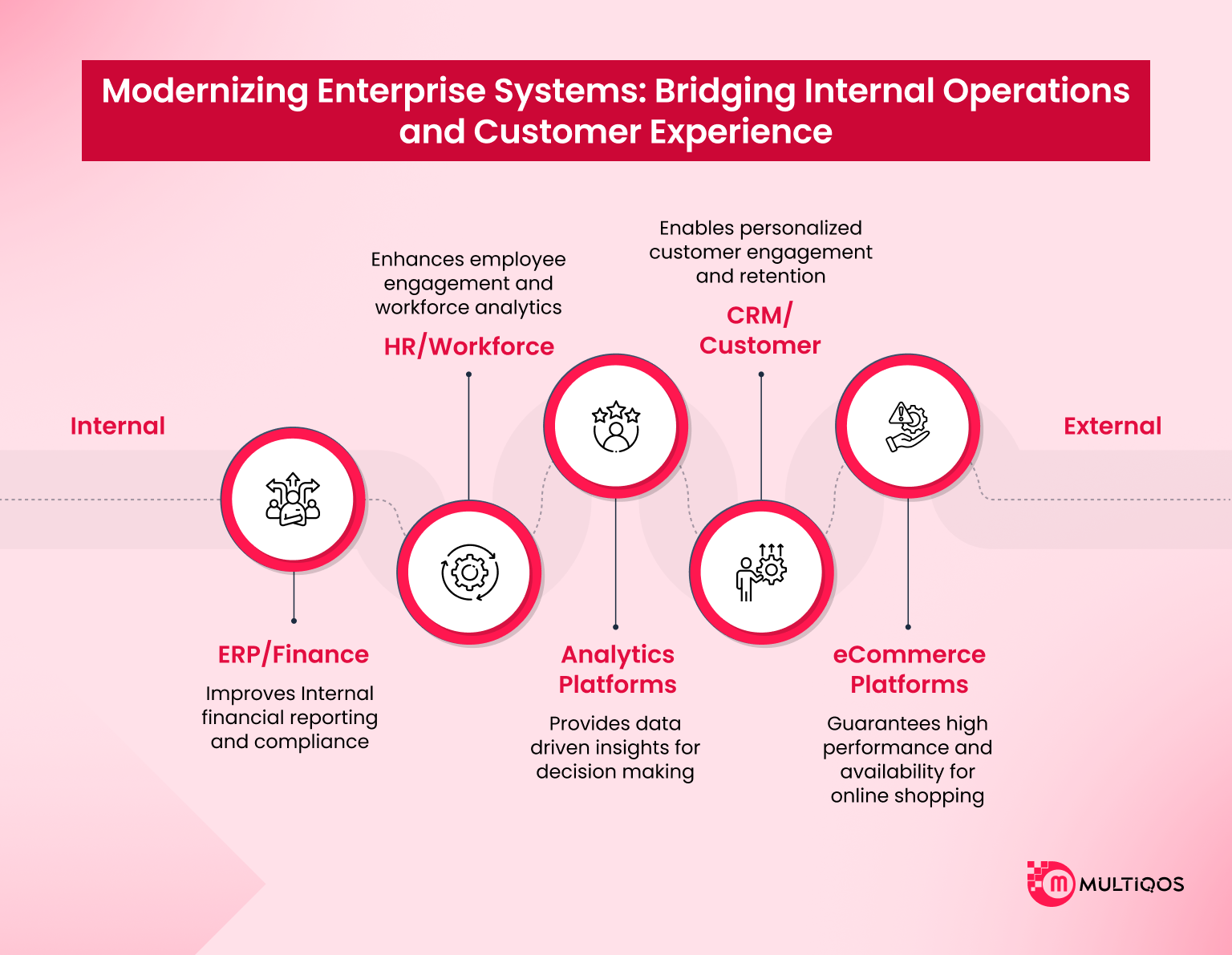
ERP and Finance Systems
Optimized systems provide real-time and accurate financial reporting and they easily scale as the business expands. Inbuilt compliance controls minimize audit risks and make the organization regulatory-ready.
CRM and Customer Platforms
Single, integrated customer data facilitates your CRM platforms to engage customers at the right time and in a personalized manner. The relevant interactions that enhance conversion and retention can be prompted at the appropriate time.
eCommerce Platforms
High performance and high availability guarantee store shopping without any problems during traffic congestion and sale periods. This decreases downtime, cart abandonment, and loss of revenue.
HR and Workforce Systems
High-technology analytics offer more details about the workforce trends, performance, and attrition. Smooth online experiences enhance the involvement of employees and cost-effectiveness.
Analytics Platforms
Mounted BI and AI/Ops offer more dependable and prompt insights on huge data volumes. Organizations can monitor and spot anomalies and make decisions based on data at scale.
These applications are also changing the digital world by modernizing the world and aligning tech with the new business model rather than the requirements of the old systems.
Key Challenges in Legacy Application Modernization
Executing the application modernization project requires more than just planning. It requires an understanding of the key challenges and then overcoming them.
Deeply Interwoven Technical Debt.
Lack of mature code, old architecture, and unknown dependencies slow innovation and raise maintenance expenses. In the long run, even minor modifications can become dangerous and costly.
Risk in Downtime Transitions.
Without careful planning, system migrations may cause serious problems in business operations. The unplanned outages directly affect the revenues, customer confidence, and productivity within.
Security Vulnerabilities
Legacy systems are not always updated with new security controls and patching. This subjects the organization to compliance risks, data breaches, and threat changes.
Integration Complexity
The latest platforms should not be used without the old tools, third-party systems, and sources of data. Inadequate integration design results in data silos, latency, and weak workflow.
Cost Overruns
Budgets can easily be inflated by unclear scope, rework, and underestimated dependencies. The process of modernization usually becomes untrusted by the stakeholders without financial guardrails.
Change Management Gaps and Skills.
Teams might not have experience in cloud-native, DevOps, or new data platforms. In the absence of organized change management, the adoption is delayed, and the resistance is enhanced.
Gradual Modernization Programs.
The stages of transformation lessen risk and provide quantifiable wins at an early stage. All phases are confidence-building and adjust technological changes in line with the priorities of the business.
Blue-Green and Canary Deployments.
The release strategies are controlled to reduce downtimes and provide safe rollbacks. A test production can be done on the new version without affecting all users simultaneously.
Automated Regression Testing
Automation ensures new changes don’t break existing functionality. It accelerates release cycles while maintaining system stability and quality.
Strong Architectural Governance
The short-term fixes are not allowed to convert to long-term problems due to clear standards, reference architectures, and review processes. This provides scalability, security and consistency.
Now that you have been informed of what the challenges are, this is what you can do to counter them with a well-defined application modernization strategy.
How to Build a Successful Application Modernization Strategy
Clarity and control, and not speed, is the start of a sound modernization strategy. It is meant to minimize risk in order to maximize long-term value.
Application Portfolio Evaluation
Evaluate all the applications to see what is really business-critical, redundant or outdated. This is a way of bringing attention by making what matters to be updated rather than taking things up carelessly.
Business vs. Technical Value Mapping.
Drive initiative through business impact and not architecture. Modernization is effective when the results of actions make decisions, rather than ideology.
Cloud-First Architecture Planning.
Think Cloud-native and API-based integration and modular services. This is to offer scalability, flexibility and readiness in the future even on the first day.
Design, Security and Compliance.
Integrate governance, security and compliance into the architecture as opposed to adding them afterwards. Governance when properly designed does not slow down delivery but can make it quicker.
DevOps and CI/CD Enablement
Standardize DevOps and automation, CI/CD pipelines. This increases the rate of release, reliability and inter-departmental co-operation.
Continuous Optimization and Incremental Execution.
Provide modernization in a structured step-by-step way with definite measures. Measurement and feedback, which should be continuous, will help make every step better in terms of performance, resilience, and business value.
How MultiQoS Supports Application Modernization?
The success of modernization requires action rather than mere intention. MultiQoS assists companies in upgrading old applications at low risk and with the greatest business impact. We have 14+ years of experience across 40 industries and 700 + projects to design cloud-native, API-led architectures to cut the technical debt, adopt AI, and enhance the scalability.
We have experience in the fields of application modernization, data and automation, DevOps, and security by design. Collaborate with MultiQoS to develop a transparent modernization roadmap that is consistent with the actual business results and long-term development.
FAQs
The structured process of upgrading old systems to enhance performance, security, scalability, and suitability to cloud computing is known as application modernization. It integrates current applications with the current business and technology requirements.
The legacy systems are impeding innovation, introducing risk into business, and limiting AI compliance and adoption. Modernization promotes responsiveness, flexibility and sustainable competition.
Modernization is optimal through gradual implementation, automation, and planning. This reduces downtimes and guarantees stability and quantifiable results.
Lift-and-shift can prove to be an initial move towards the minimization of infrastructure requirements. Nevertheless, scalability, security, and efficiency can only be achieved through re-architecting to be modernized.

Get In Touch

Get Stories in Your Inbox Thrice a Month.
Why Ethical Use of User Data in Software Matters More Than Ever
Managing Distributed Development Teams: Strategies to Improve Collaboration