How Automation Accelerates SME Growth: Business Automation Guide for Small and Mid‑Sized Businesses
Table of Content
- Introduction
- Why Automation Matters for SME Growth?
- 5 Major Business Automation Trends For SMEs.
- High Impact SME Workflow Automation Use Cases
- How Business Automation For SMEs Directly Accelerates Growth?
- How can MultiQoS help SMEs with Automation Solutions?
- FAQs
Summary:
Automation is no longer just an efficiency tool for SMEs but a strategic growth capability that enables faster execution, lower operational costs, better customer experiences, improved employee productivity, and stronger resilience during growth phases. This blog explains how automation compounds value over time, outlines a practical framework for starting the automation journey, and shows how SMEs can scale operations sustainably without operational overload by treating automation as an ongoing business capability.
Introduction
Manual processes are becoming outdated and are silently dragging down the growth of SMEs. As competitors implement automated, data-driven, and scalable workflows, small and midsize businesses continue to use spreadsheets, email, and manual follow-ups to run essential business processes.
They add expenses, cause delays, reduce visibility, and fail when strained by the growth. Such activities as invoicing, approvals, reporting, follow-ups with customers, and support coordination eat up precious time.
This equation is altered through automation. With fewer steps to follow, SMEs will be able to work faster, operate less, and grow without necessarily creating new positions. However, there are still practical questions.
- What is business automation for SMEs?
- What workflows are the ones to be automated initially?
- What are the growth achievements of automation?
- Can small businesses afford automation?
- What is the fastest payback period of automation?
This guide provides answers to these questions by discussing the cumulative effects and the systematic, risk-free business automation for SMEs.
Why Automation Matters for SME Growth?
If you are an operations or process manager, business automation for SMEs is not just a support tool anymore. It has become a central element for most SME operations, decision-making, and growth capability.
For most SMEs, a significant amount of time is still spent on repetitive, manual tasks. These tasks are necessary, but they slow teams down and introduce inconsistency. Automation directly addresses this challenge by improving speed, accuracy, and predictability across daily operations.
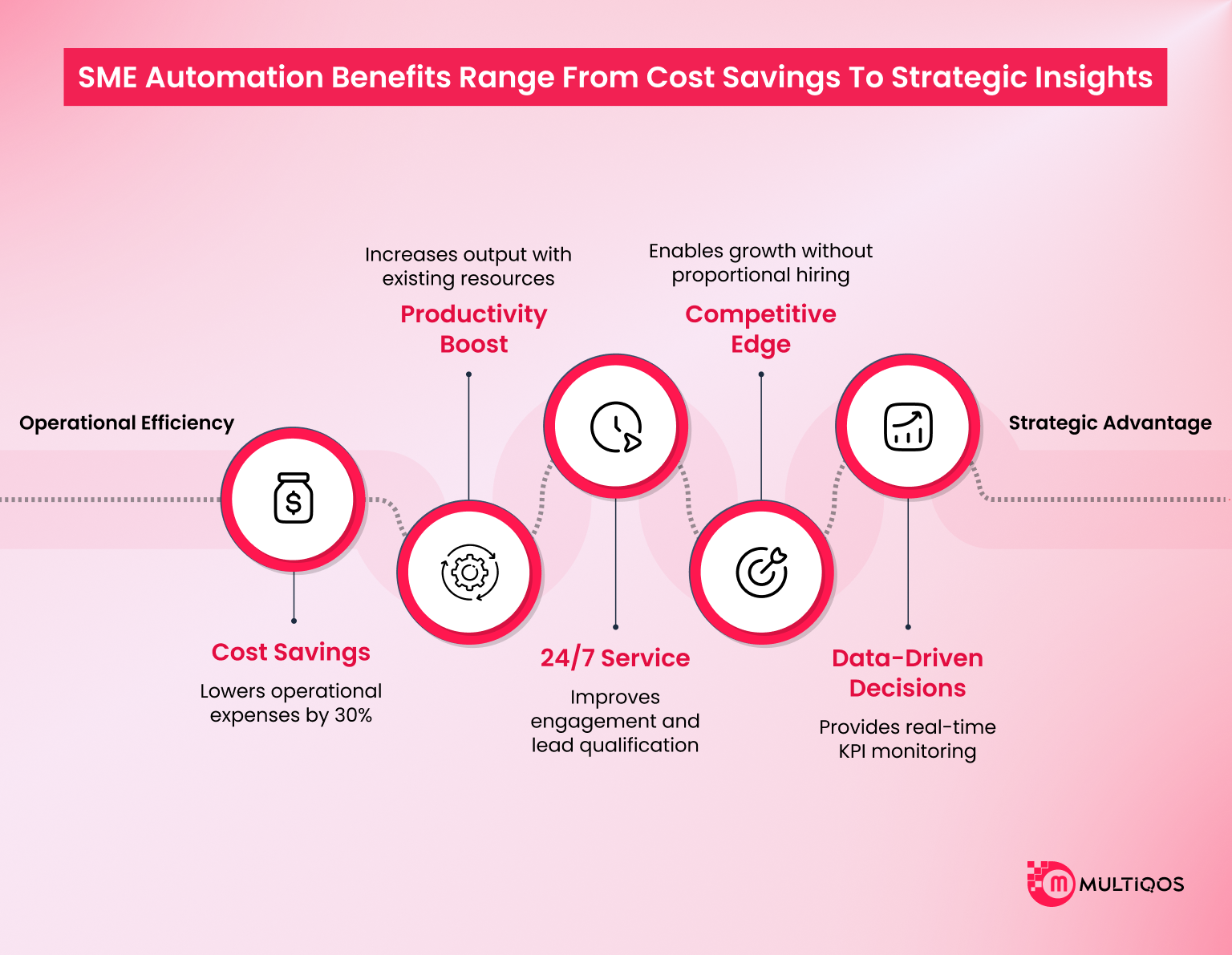
This ability to scale operations without linear hiring is one of the most significant advantages automation offers to SMEs. Business automation for SMEs is also crucial for reasons like
-
Reduction in Cost of Operation.
Cost efficiency is one of the greatest benefits of the business automation trends. SMEs can save up to 30% of their operational costs through enterprise software leveraging business process automation and robotic process automation (RPA).
By limiting the role of humans in the repetitive work processes, business minimizes errors, rework, and delays. This method of automating workflows within SMEs enables teams to look at more valuable work and systems to do the lower-value execution. In the long run, this results in regular savings and standard performance.
-
Productivity and Efficiency Needs
Digitization and digital transformations have been key to increased efficiency for SMEs. And not just productivity in numbers, as an operations manager, you can leverage automation to,
- Do more with the same resources.
- Use AI to reduce almost an hour per day
- Cut costs by streamlining operations
- Reduce manual data entries
Most importamntly it saves time for your employees increasing not just worklife balance but also offers more time to focus on upskilling and learning. According to OpenAI’s report, every employee can save around 40-60 minutes per day using the AI automation.
This means 60 minutes of opportunity for employees to learn new skills or just focus on health activities. This can help SMEs ensure better productivity, upskilling, and work-life balance for employees. This is the reason why AI-driven automation has often been termed as the catalyst for widespread adoption of automation across SMEs.
-
24/7 Customer Service and Interaction.
The examples of business automation for SMEs, especially for customer services, are AI-powered assistants and chatbots that can automatically address customer requests, screen leads, and book meetings. This does not give any chances of missing an opportunity because of workforce scarcity.
Companies have claimed an increase in the number of qualified meetings by 40% in three months after adopting automated customer engagement processes.
-
Greater Competitiveness and Scalability.
Cloud-based SME resource management solutions and automation tools enable small companies to have access to functions previously available only to large businesses. This allows it to scale operations without having to recruit in tandem with expansion.
The use cases of workflow automation are assisting the SMEs to maintain quality and minimize the turnaround times, even in the historically human-intensive industries. The change to digital operations of SMEs enables quicker reaction to market demands and client expectations.
-
Data-Driven Steering
By automating CRM, invoicing systems, and spreadsheets are tied to one dashboard. This allows operations leaders to monitor KPIs on the fly without having to use manual reporting or specific analysts. This focal understanding helps in enhanced planning, decisions, and a more resilient strategy of the SME digital transformation.
5 Major Business Automation Trends For SMEs.
As an operations or process manager, there is no longer a business case for future planning to keep up with business automation trends. These patterns are already influencing the way SMEs embrace automation, scale operations, and enhance day-to-day efficiency.
The adoption of business automation for SMEs is replacing complex IT solutions with simpler, results-oriented ones. It is about speed, simplicity, and a quantifiable effect with no interference with current teams or operations.
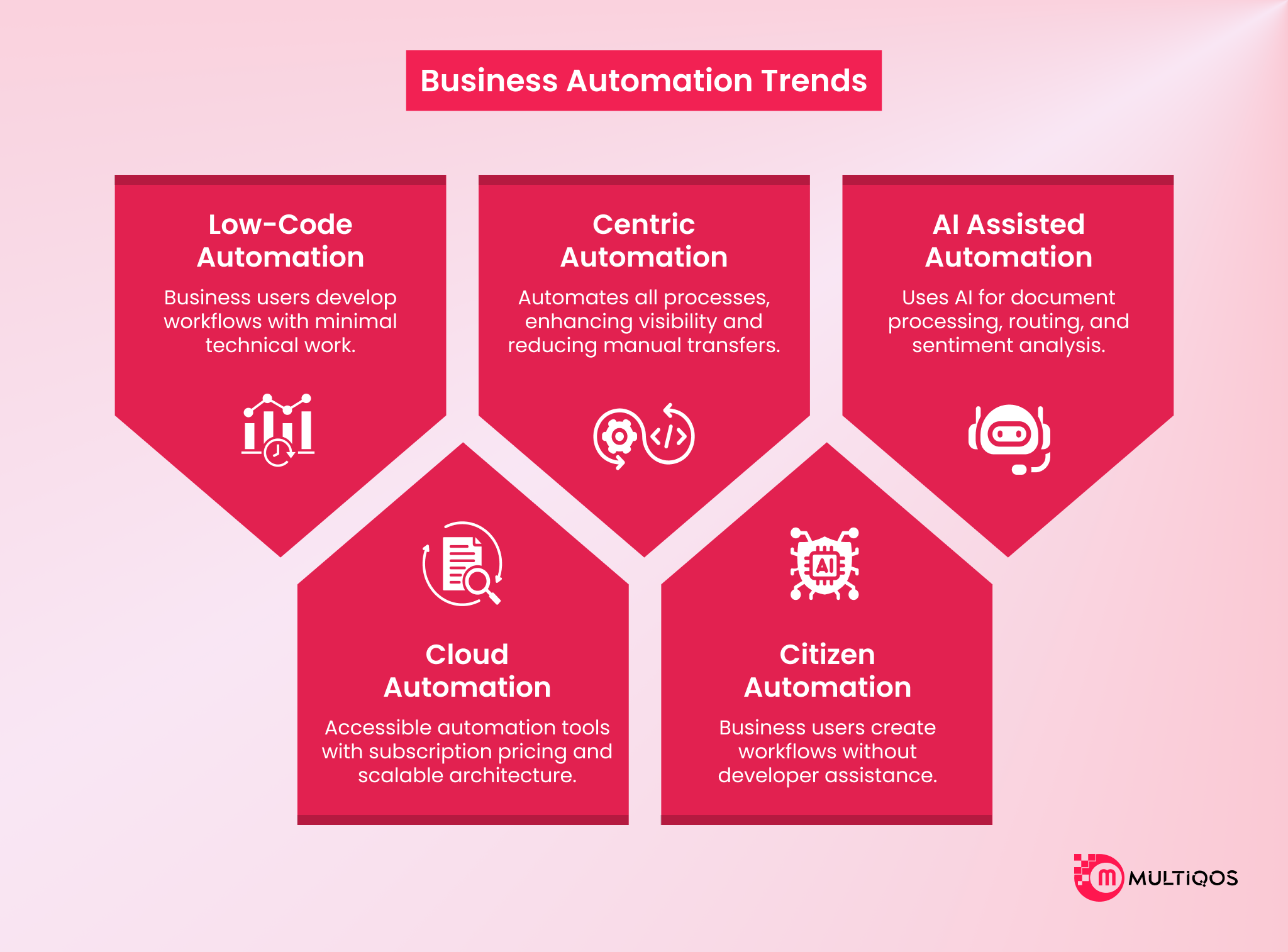
The major current trends that are influencing the automation of SMEs are:
-
Low-Code and No-Code Automation.
The accelerating adoption of low-code and no-code automation is eliminating the reliance on engineering teams. Business users are able to develop workflows, auto-approve, and integrate systems with minimal technical work.
The strategy facilitates the implementation process, reduces costs, and enhances suitability with actual operational requirements. Consequently, no-code and low-code automation has emerged as a building block of contemporary SME process automation.
-
Centric Automation of workflow.
SMEs are no longer automating individual tasks. It now targets workflow automation amongst small businesses, in which all processes are automated.
Workflow-based automation enhances visibility, decreases manual transfers, and provides predictability in areas like lead intake to invoicing and reporting. This facilitates actual operational effectiveness as a result of automation, as opposed to improvement in a piecemeal fashion.
-
AI Assisted Automation
The AI is a logical continuation of the automation of business processes. There is a key digital transformation trend, especially if you consider the application of AI-assisted automation by SMEs to document processing, intelligent routing, and sentiment analysis. These functions save time and human manpower, enhance precision, and accelerate decision-making among staff.
The trend enables companies to cope with increased volumes without having to add more headcount, which is a direct contributor to automation-based expansion.
-
Automation Software on the Cloud.
Automation among SMEs is becoming even more accessible due to cloud-based platforms. SMEs’ automation tools can be launched fast, with a subscription pricing model and scalable architecture without an extensive initial investment. Such flexibility helps in growth and makes operational costs predictable.
The adoption of cloud is also vital in the digital transformation of SMEs, as the automation systems can develop as the business requirements change.
-
Citizen Automation
The other significant change is the emergence of citizen automation. The business users are also able to create and operate workflows without the assistance of the software developer, with the correct guardrails implemented. This lessens reliance on IT departments and minimizes turnaround periods.
Citizen-led automation provides teams with power and control at the same time, and is therefore a viable solution to scale automation of workflows within SMEs.
High Impact SME Workflow Automation Use Cases
These use cases focus on everyday business activities where SMEs spend the most time. Automation here does not change how the business works. It simply removes manual effort, delays, and errors from routine processes.
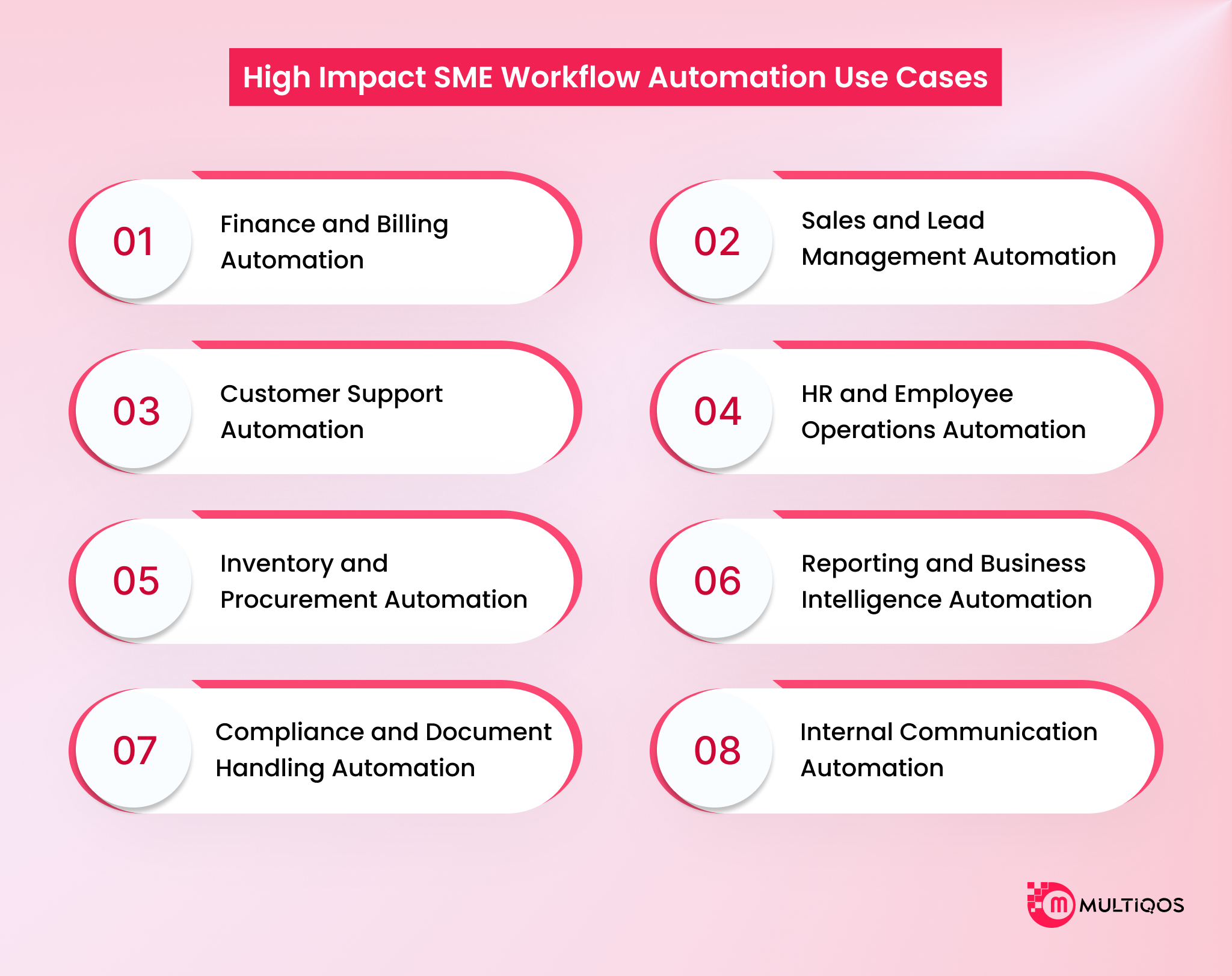
1. Finance and Billing Automation
Financing activities in SMEs are often repetitive and time-consuming, with manual handling of invoices, payment tracking, reminders, and cross-system reconciliation by teams. SME workflow automation allows invoices to be automatically issued upon reaching a milestone or delivering a service.
Regular payment reminders are automatically dispatched and do not need follow-ups. The process of reconciliation occurs in the backdrop as payments are received. This decreases missed invoices, overdue payments, and manual errors, and puts the business owners in real-time awareness of the cash flow without necessarily waiting till the end of the month reports.
2. Sales and Lead Management Automation
Leads in most SMEs are acquired through various channels, including websites, advertisements, email, or referrals. In the absence of SME workflow automation, the leads are left unattended or pursued after a long time. The automation will make sure that all the new leads are automatically allocated to the appropriate salesperson.
The emails or reminders are automatically activated. CRM systems are constantly updated, and a sales team does not require entering any data manually.
3. Customer Support Automation
Monotonous queries and requests are addressed by the customer support teams on a day-to-day basis. Handling of emails, tickets, and priorities manually slows down the responsiveness. SME workflow automation assists in that the support tickets are automatically generated upon receiving a request. Tickets are diverted depending on the urgency, category, or service level agreement. Customers are immediately confirmed and updated.
This guarantees that no request is overlooked, the response time is faster, and customers feel that they are supported even when the requests are high.
4. HR and Employee Operations Automation
Some of the processes that are commonly handled manually in SMEs by HR include onboarding, payroll coordination, and document storage. Automation also establishes formatted onboarding checklists to ensure that nothing is overlooked during the hiring process of a new employee. There is an automatic flow of payroll data between systems.
The documents on employees are maintained, accessed, and updated automatically through a custom HR software without the need to track them manually. This saves administration and enhances the experience of the employees, and records are kept in order as the company expands.
5. Inventory and Procurement Automation
The costly inventory scheduling frequently appears as stockouts or overstocking, which directly affect the revenues and costs. But automation, on the other hand, makes it possible to track the inventory in real-time.
This feature will send alerts or automatically create reorder requests in instances where the stock becomes low, as per set limits. Additional integration of approval processes is another guarantee of timely and cost-effective purchases.
6. Reporting and Business Intelligence Automation
Most of the SMEs use manual reports that are made by retrieving data through various tools. This is a lengthy and time-consuming process that has become obsolete before reports are prepared.
Automation aligns the data of the systems, such as CRM, finance, and operations, on a schedule. Dashboards are automated and display real-time performance indicators. The leaders can make quicker decisions because they never have to wait for reports before making a decision.
7. Compliance and Document Handling Automation
Compliance requirements increase as the number of SMEs grows. Approval management, document management, and auditing pose risks when handled manually. With SME workflow automation, documents are routed through specific approval procedures. The retention policies are automatic. Extra effort is not required to maintain the audit trails. This minimizes the risk of compliance and time wastage in reviews or audits.
8. Internal Communication Automation
With the growth in the number of teams, crucial messages and updates may be lost in emails and chats. Through automation, alerts, announcements, and task notifications are automatically sent to the appropriate individuals. Uninterrupted updates to the teams are not followed up on a regular basis. This enhances organization, lessens confusion, and keeps everybody on track.

How Business Automation For SMEs Directly Accelerates Growth?
SME workflow automation transforms the way organizations grow. It assists SMEs in growing in a controlled and predictable manner, as opposed to chaos caused by growth. The following is the way automation is directly related to actual business results.
Faster Execution and Turnaround Times
Waiting time is eliminated by SME workflow automation. The work that was previously based on approvals, manual handover, or follow-ups automatically shifts between one job and another.
For example, shortening cash cycles occurs when an invoice is automatically generated after a sale, dispatched to the customer, and pursued automatically without human intervention. Quick execution enables the SMEs to react to customers, partners, and changes in the markets faster.
Reduced Operational Costs
The manual work is not only costly in terms of wages but also in the number of mistakes, repeats, time wastage, and opportunities lost. Cost is also saved through automation, which minimizes human error, eliminates redundant administrative responsibilities, and reduces the necessity to hire more staff to manage the business expansion.
In fact, McKinsey research shows operational cost reductions of up to 30% when automation and standardization are applied to finance, HR, and operations. SMEs can employ automation to absorb growth instead of employing more individuals to cope with an increase in volume.
Improved Customer Experience
With automation, there is consistency in interactions with customers. Customers are served with prompt responses, correct invoices, updates on the orders, and support messages. Such trust is established by reliability. This results in more retention and referrals as the customers become more satisfied when making fewer errors and receiving quicker resolutions to their issues.
Higher Employee Productivity
Automation liberates the worker to do menial work like entering data, updating status, and reporting. Consequently, teams are problem-solving and customer-relationship oriented, managers are less involved in reporting, and employees are less burned and feel that they are given meaningful work. There is enhanced productivity since time is put to better use.
Better Cash Flow Visibility
Automated financial process offers up-to-date information on pending invoices, incoming payments, and expenditures. The visibility will enable SME leaders to make decisions on spending, investments, and growth planning faster without having to wait until the end of the month before such reports are provided.
Greater Resilience During Growth Spikes
Growth often breaks manual systems. Sudden increases in orders, customers, or support requests can overwhelm teams. Automation creates resilience by scaling instantly. Whether volume doubles or triples, automated workflows continue to function without stress, delays, or drops in quality.
How Automation Compounds Growth Over Time
The true value of SME workflow automation lies in compounding impact. Early SME workflow automation saves time. Saved time enables faster decisions. Faster decisions lead to better outcomes. Better outcomes justify deeper automation. Over time, SMEs build systems where each improvement strengthens the next. Growth becomes easier rather than harder as the business scales.
How can MultiQoS help SMEs with Automation Solutions?
MultiQoS helps SMEs turn automation into a scalable business capability, not just a tool rollout. We align automation with real operational goals to reduce manual work, improve visibility, and support growth.
Using Microsoft Power Automate and Power Apps, custom workflow apps on Azure, and secure integrations across CRM, accounting, and HR systems, we automate high-impact workflows across finance, sales, HR, and operations quickly and safely.
What SMEs can expect:
- Clear identification of automation-ready workflows
- End-to-end integration across core business systems
- Automation that scales without increasing complexity
Next steps:
- Automation assessment for 2–3 critical workflows
- Pilot implementation in 4–6 weeks with measurable outcomes
FAQs
SME Business automation entails the application of technology in the management of repetitive and rule-based work. This saves time and resources on manual work, accuracy, and delays, as well as enhancing efficiency and scalability.
SMEs are supposed to start with high-volume repetitive processes like invoicing, reminders of payments, lead follow-up, approvals, reporting, and customer support tickets.
Automation can be relatively cheaper than employing other people. Most of the tools have flexible pricing, which enables SMEs to begin small and expand as ROI is realized.
The measurable ROI has been experienced by many SMEs in a matter of weeks or a couple of months in the process of automating workflows that are time-consuming, such as billing, reporting, or lead management.
The tools that are often used are low-code and no-code solutions, CRM automation software, accounting software with automation capabilities, and SME workflow automation software that combines several business systems.

Get In Touch