
Chatbots vs AI Agents: Features Benefits and Real Business Use Cases
Need quick insights? Summarize with AI & save time
 ChatGPT
 Perplexity
 Claude
 Google AI Mode
Table of Content
- What is a Chatbot?
- What Is an AI Agent?
- Chatbots vs AI Agents: Key Differences
- Real Business Chatbot Use Cases Across Industries
- How Agentic AI Is Redefining What Enterprise Automation Can Actually Do?
- How to Choose Between Chatbots and AI Agents?
- How MultiQoS Accelerates AI Transformation?
- FAQs
Summary
This blog explains chatbots vs AI agents for teams that are already exploring AI automation and now need a sharper decision framework. It compares how each model works, where each one fits, and why the choice affects cost, integration effort, operating risk, and long-term ROI.
It also moves beyond surface-level definitions. The article covers the benefits of both approaches, practical industry use cases, and the point where simple conversational automation stops being enough. The conclusion shows how MultiQoS helps companies turn AI strategy into production-ready systems that fit real business constraints.
Chatbots vs AI agents is no longer a theoretical comparison. It is now a decision about budgeting, architecture, and operating models.
For years, chatbots were the default answer to business automation. They could handle FAQs, route conversations, and stay available around the clock. That still matters. But the market has shifted from tools that answer questions to systems that can plan, act, and complete work.
The chatbot market is growing quickly, but AI agents are expanding much faster, at a rate of CAGR of 19.6% from 2026 through 2033. However, when leaders compare chatbots vs AI agents, they are not only comparing interfaces. They are comparing task scope, autonomy, integration depth, and the kind of business value each system can realistically deliver.
In this blog, we break down the difference between chatbot and AI agent models, where each one performs best, and how businesses can decide what to implement next.
What is a Chatbot?
A chatbot is a type of software that is designed to mimic human interaction within a limited context. It is reactive to user inputs, often utilizing NLP models or an LLM layer integrated via specialized generative AI development services, which are based on particular rules and logic established by an organization to ensure the conversation is contained within existing pre-built flows and approved knowledge.
The core strength of a chatbot is focus. It does one conversational job well: answering standard questions, guiding users through a process, collecting details, or routing the interaction to a human team. Reactive by design. Not much more.
Common Chatbot Types
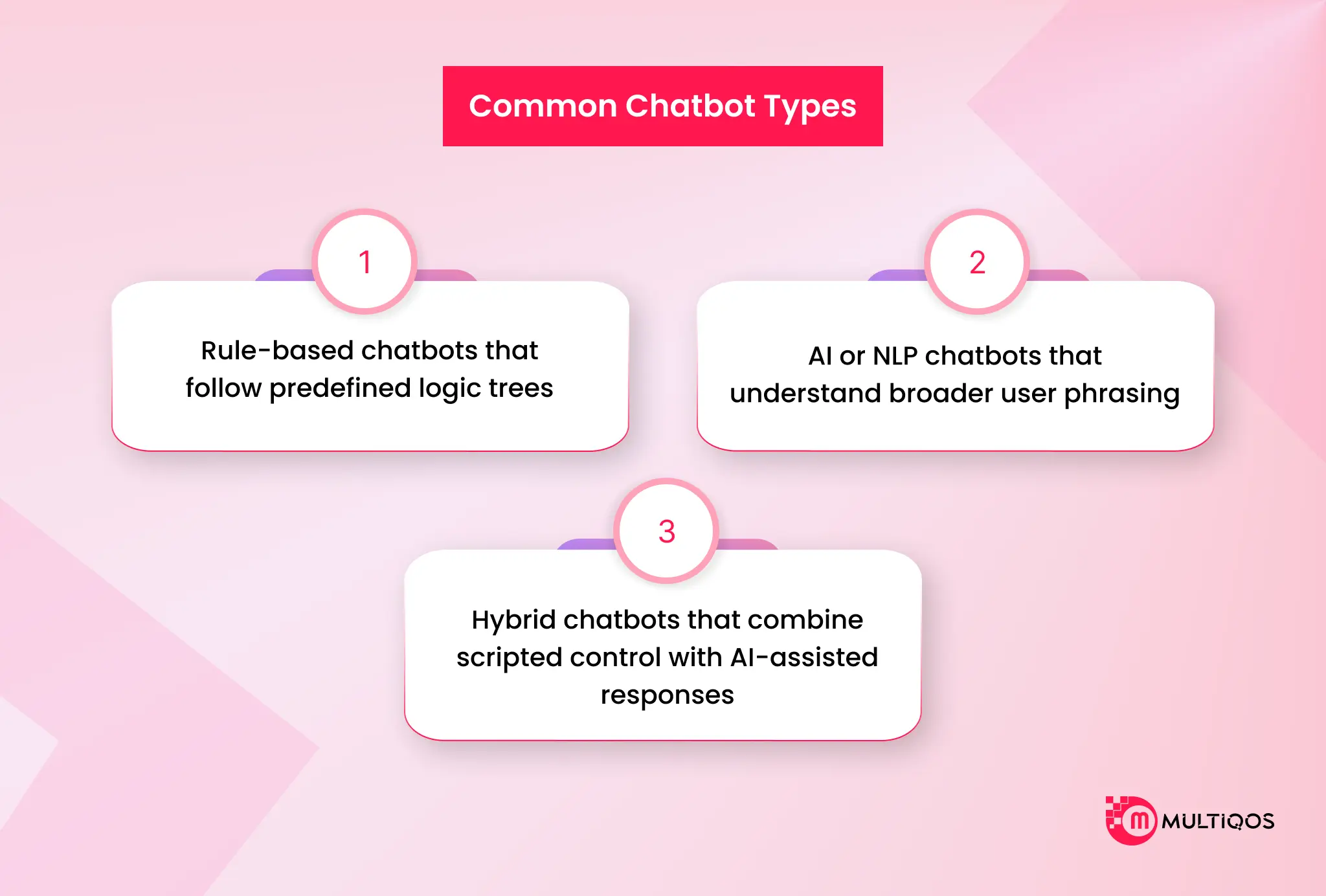
- Rule-based chatbots that follow predefined logic trees
- AI or NLP chatbots that understand broader user phrasing
- Hybrid chatbots that combine scripted control with AI-assisted responses
What Is an AI Agent?
An AI agent is a genuinely different animal. It can interpret goals, reason through next steps, pull from tools or data sources, and complete multi-step tasks with far less human hand-holding. Instead of just responding, it plans.
That changes the operating model entirely. When implemented through robust AI agent development services, business AI agents are built to work across workflows, not just across messages. They connect to enterprise systems, hold context across sessions, and coordinate actions.
Chatbots vs AI Agents: Key Differences
The easiest way to understand chatbots vs AI agents is to compare them across the dimensions enterprises actually buy against.
Here is a table indicating the differences between a chatbot and an AI agent
| Dimension | Chatbots | AI Agents |
| Primary role | Answer questions and guide conversations | Complete goals and advance workflows |
| Interaction style | Mostly reactive | Reactive and proactive |
| Logic model | Rules, scripts, or constrained NLP | Reasoning, planning, and dynamic decision paths |
| Memory | Usually session-based | Can support persistent and cross-session context |
| Tool access | Rare or tightly limited | Core capability |
| Workflow scope | Single-step or short flows | Multi-step workflow automation |
| Autonomy | Low | Medium to high, based on governance |
| Human handoff | Common and often required | Used for oversight or exception handling |
| Integration depth | Often surface-level | Typically deeper across systems and data |
| Best use case | FAQs, routing, simple support | Orchestration, research, fulfillment, analysis |
| Business value | Efficiency in high-volume interactions | Efficiency plus execution and redesign potential |
Choose Chatbot when :
- The process is conversation-first and built around answering questions quickly.
- User requests are repetitive, predictable, and easy to categorize.
- The workflow follows clear rules and does not require judgment across multiple steps.
- The main goal is reducing support volume, improving response time, or offering 24/7 assistance.
- Human handoff is acceptable for exceptions or complex cases.
- The system only needs limited integration with backend tools or databases.
- Governance requires tightly controlled responses and low autonomy.
- Common use cases include FAQs, order tracking, appointment booking, lead capture, and first-line support.
Read More: AI Chatbot Development Cost
Choose AI agents when :
- The process requires reasoning, planning, and action across multiple steps.
- The workflow depends on memory, context retention, or coordination across systems.
- The system needs to retrieve information and then act on it.
- The business goal is not just answering queries, but moving work forward.
- The use case includes document handling, decision support, orchestration, or follow-through.
- Backend integration is essential for execution, not just information lookup.
- Human oversight is still needed, but mainly for approvals, exceptions, or governance checkpoints.
- Common use cases include underwriting support, KYC workflows, service operations, code modernization, sales orchestration, and internal task automation.
Read More: AI Agent Development Cost
If your team needs cross-system action, memory, and multi-step execution, a chatbot will start to break.
Real Business Chatbot Use Cases Across Industries
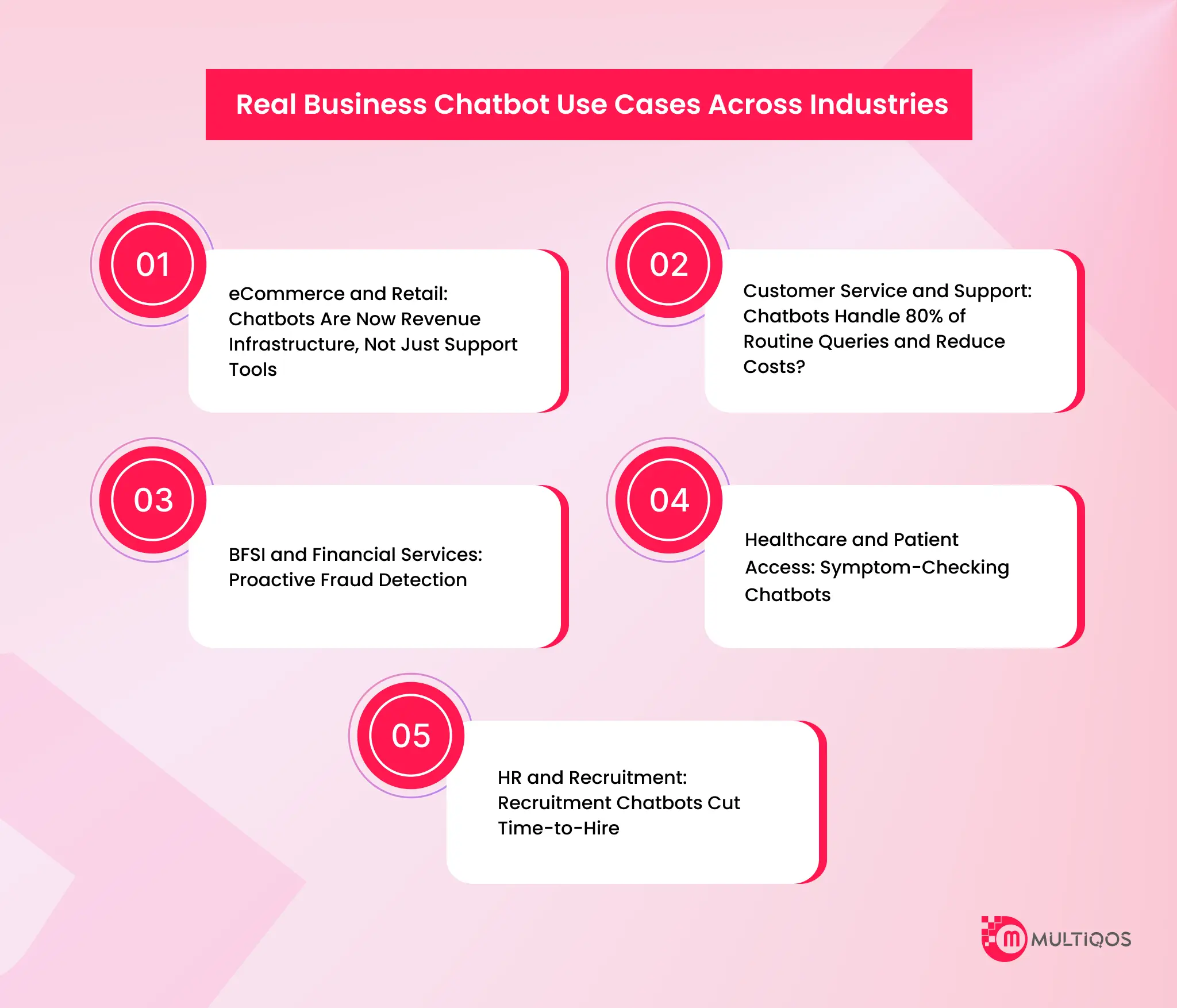
Real Business Use Cases for AI Chatbots Across Industries That Actually Move the Needle
1. eCommerce and Retail: Chatbots Are Now Revenue Infrastructure, Not Just Support Tools
The most persistent mistake retail operators make is treating chatbots as a cost-reduction play. The more commercially defensible case is demand generation. This is where chatbots can help by reducing churn rates and improving demand.
How Chatbots Reduce Abandoned Cart Rates?
The most measured revenue leak in the sector is cart abandonment, and chatbots respond to this issue at the point of leaving. Retailers who applied or developed AI chatbots have had lower abandonment rates by implementing real-time exit-intent triggers along with strategic incentives.
The process is important, but not the measure: the bot is being triggered over the session, presents a certain obstacle (cost of shipping, size ambiguity, delivery schedule) and solves it without referring the customer to a human operator.
How Post-Purchase Automation Handles WISMO Queries and RMA Processing?
The relationships of customers are consolidated or eroded post-purchase. “Where is my order?” The disproportional ratio of the volume of inbound support is due to (WISMO) queries, and chatbots address most of them without agent interaction by linking directly to order management systems.
The same reasoning applies to return merchandise authorization (RMA) processing: bots are integrated with the warehouse management systems to create a return shipping label and ensure its validity, and automatically start a refund.
The latter is the place where the operational leverage grows the most since it eliminates the human-in-the-loop delay that would otherwise increase the turnaround to resolve the operations to days and weeks.
Key Takeaways From This Use Case:
- In retail, chatbot ROI usually comes from protecting conversion and reducing post-purchase service drag at the same time.
- The value increases when the bot is integrated with checkout, OMS, and returns workflows instead of operating as a standalone FAQ layer.
2. Customer Service and Support: Chatbots Handle 80% of Routine Queries and Reduce Costs?
The analysis of enterprise applications of AI chatbots demonstrates that they address up to 80% of the typical customer service questions. Such a deflection rate can be directly translated to the cost of support reduction: according to the Gartner study on customer service, organizations implementing conversational AI in their service functions achieve about 30% of the total support costs reduction.
How Sentiment Analysis Enables Warm Transfers to Human Agents?
The feature that prevents chatbot deflection from turning into customer frustration is known as intelligent escalation. In case sentiment analysis notices mounting dissatisfaction or a query that falls outside the parameter of the bot to resolve, the system will start a warm transfer to a human agent and automatically send the entire conversation history.
The customer does not re-enact his/her situation. The agent doesn’t start blind. That continuity is operationally very easy to execute and is valued disproportionately in the reduction of the resolution friction that leads to churn following a bad service experience.
How Automated Triage Routes Incoming Tickets to the Right Department?
Triage Automated, automatic triage takes place at the intake layer, reading ticket intent and sending it to the correct specialized queue, without being touched by a human agent. It is not a classical categorization that is rule-based.
Natural language understanding enables the system to distinguish among a billing dispute, a technical fault, and a product return request. That routing accuracy determines whether the downstream resolution experience is smooth or circular.
Key Takeaways From This Use Case:
- The best chatbot support programs reduce cost without increasing customer effort.
- Sentiment analysis, warm handoff, and accurate triage are what keep deflection from turning into frustration.
Turn your AI strategy into a production-ready system that fits your real business constraints.
3. BFSI and Financial Services: Proactive Fraud Detection
Basic transaction inquiry automation is table stakes in financial services. The function that’s generating genuine competitive differentiation is proactive fraud detection and account monitoring. Banking chatbots now scan transaction histories in real time, flag duplicate charges and anomalous activity patterns, and alert customers via mobile notifications or SMS before they notice the problem independently.
Bank of America’s virtual assistant Erica, which processes millions of customer interactions monthly, delivers monthly spending snapshots, surfaces recurring charge patterns, and tracks FICO score changes across the relationship.
How Chatbots in Banking Must Comply With GDPR and PCI DSS Requirements?
The implementation of chatbots in controlled financial settings is never a plug-and-play activity. In order to comply with GDPR and PCI DSS, all communications of account data must be encrypted both in transit and at rest, any personally identifiable information must be processed under defined retention policies, and full audit trails must be stored to allow examination by the regulator.
How Real-Time Fraud Alerts Allow Customers to Block Cards Immediately?
The operational advantage of real-time fraud alerting is the intervention window it provides. When a chatbot flags suspicious activity and sends an instant alert, the customer can block their card through the same interface in under 60 seconds, before the fraudulent transaction clears. That response speed is structurally impossible in a human-agent model operating standard support hours.
Key Takeaways From This Use Case:
- In banking, the strongest chatbot value comes from fast, secure action around routine service and early fraud response.
- Compliance architecture is part of the product, not an add-on later.
4. Healthcare and Patient Access: Symptom-Checking Chatbots
Healthcare chatbots are addressing two distinct problems simultaneously: administrative overload at the provider level and access gaps at the patient level.
These tools cause adaptive questioning to guide patients toward the appropriate level of care, directing low-acuity cases away from emergency departments and toward primary care or telehealth. The ER diversion effect has direct cost implications for health systems operating under capacity pressure.
How AI Medication Reminders Achieve Higher Adherence Rates?
Non-adherence to medication is among the most measured areas of failure in the management of chronic diseases, and chatbots have delivered some of the most understandable effectiveness data in the industry.
In a published study of stroke recovery, the medication adherence of patients using an AI reminder application was 100%, as compared to 50% in the control group, which is large enough to show a difference in outcome measures with clinical significance.
It does not mean that chatbots can substitute clinical oversight, but suggests that they help bridge the gap between clinical sessions as far as adherence to chronic disease programs is concerned.
Key Takeaways From This Use Case:
- Healthcare chatbots work best when they reduce access friction and administrative burden without pretending to replace clinicians.
- Boundaries matter more here than in most sectors, because safety and escalation rules define the acceptable use case.
5. HR and Recruitment: Recruitment Chatbots Cut Time-to-Hire
Time-to-hire is a competitive indicator, as well as a cost measure in talent acquisition. Applicants with too long waiting times before getting the schedule confirmation take other offers. Chatbots are concrete solutions to the problem of the scheduling bottleneck, namely, the integration with the calendar systems to organize the interviews independently in the case of organizations on a large scale.
It is not necessarily the maximum possible number, but a kind of limit in case the main source of delay (scheduling coordination) is offloaded from the human burden altogether.
How HR Chatbots Manage Employee Onboarding and Policy?
After recruitment, HR chatbots play the role of employee lifecycle self-service portals. Conversational interfaces are used to deliver policy documents, benefits explanations, and compliance acknowledgment to the new hires instead of using static intranets.
Password reset requests and access provisioning requests go through the bot without creating a helpdesk ticket. The amount of low-complexity HR requests that are managed independently increases with the number of staff members, implying that the operational leverage increases with scale as firms evolve.
How Agentic AI Is Redefining What Enterprise Automation Can Actually Do?
Agentic AI systems monitor their surroundings, decompose a complex task into a series of tasks, perform the tasks within live enterprise systems, assess the outcome, and correct themselves.
The difference between chatbots and AI agents is quite practical. For example, a chatbot informs a loan officer of what is missing in the package, but an agentic system gathers it, checks it against the KYC standards, and proceeds with the application automatically.
Key Takeaways From This Use Case:
- In HR, chatbot value shows up in faster cycle times, cleaner self-service, and less coordination overhead for hiring and onboarding teams.
- The operational leverage rises with company size because the request volume compounds as headcount grows.
Financial Services and Loan Operations: Multi-Agent Orchestration
The adoption of agentic AI services is restructuring credit and lending operations at the workflow architecture level, not just the task level. Oracle’s Agentic AI Platform deploys purpose-built agents for qualitative analysis, complex scorecard evaluation, and credit decisioning, with specialized agents collaborating through parallel processing rather than sequential handoffs.
That multi-agent orchestration model compresses underwriting timelines because agents running simultaneously don’t accumulate the waiting time that linear workflows do.
How AI Agents Manage Long-Term Financial Goals Beyond Account Queries?
An AI agent managing a mortgage savings goal doesn’t retrieve a balance on request; it analyses monthly cash flow, configures automatic transfer rules, monitors progress against a target date, and adjusts the transfer amount when discretionary spending patterns shift.
Whether this level of autonomous account management builds or erodes customer trust over time depends heavily on how clearly financial institutions communicate what the agent is doing and why.
How KYC Automation Accelerates Loan Application Processing?
In loan origination, agents handle the documentation collection workflow that has historically consumed the most manual effort.
The agent authenticates the applicant, identifies which Know Your Customer (KYC) documents are required under the specific loan type, sends collection requests, and validates submissions against format and completeness requirements.
Key Takeaways From This Use Case:
- In lending, AI agents create value by shrinking the coordination layer around underwriting, KYC, and document-heavy review.
- The agent does not just answer questions about the process. It helps advance the process itself.
Software Engineering and Legacy Modernization: Agents Are Closing the Technical Debt Gap!
Engineering teams carrying significant technical debt face a compounding problem: the debt accumulates faster than sprint capacity allows teams to address it. Agentic AI changes that ratio.
Agents generate unit tests against existing codebases, flag refactoring opportunities in legacy algorithms, and document code behaviours that have never been formally captured, all without interrupting active development work.
How Agentic CI/CD Pipelines Reduce Deployment Failures and Mean Time to Recovery?
Agents in the CI/CD pipelines do not simply execute automated test suites in the DevOps setup. A failure in a behavior environment by a deployment is isolated by the agent to a defined element of a build, opens a rollback of the broken release, and sends an alert to the engineering team as a summary of the diagnostic information before a human has even logged into the dashboard.
The autonomous recovery loop directly minimizes mean time to recovery (MTTR), the reliability measure that best characterizes the impact of deployment failure on end users.
Key Takeaways From This Use Case:
- Engineering agents are most useful when the work spans analysis, action, and verification across live delivery pipelines.
- They help close the technical debt gap by expanding what can be handled between normal sprint priorities.
How to Choose Between Chatbots and AI Agents?
The best decision starts with workflow complexity, not trend pressure. Choose a chatbot when the job is conversation-first, the process is well defined, and governance requires tight response boundaries. That usually includes FAQs, lead capture, appointment booking, status checks, and first-line support.
Choose an AI agent when the job requires reasoning across steps, memory, tool use, or orchestration across systems. That includes underwriting support, service operations, modernization analysis, research workflows, and internal task coordination.
Some businesses will need both. In real chatbot vs AI agent decisions, a chatbot can own the user-facing entry point, while an AI agent handles the backend workflow once intent is clear. In many enterprise architectures, that hybrid model is the practical answer.
How MultiQoS Accelerates AI Transformation?
The problem with most AI programs is not the pilot. It is everything that comes after the pilot.
Projects usually slow down in the gap between idea and production. Enterprises often know they need better automation, but they do not always have the internal clarity, architecture, or delivery capacity to move from concept to a system that works reliably at scale. Systems are fragmented. Governance is unclear. Teams need something that fits into existing workflows instead of forcing a reset. That is where MultiQoS comes in.
MultiQoS combines product engineering, AI/ML expertise, and human-centric design to help businesses make the right decision in the chatbots vs AI agents debate and then build around the way the business actually operates.
Our teams work with modern AI stacks including Azure OpenAI, AWS Bedrock, Python, and React Native to design solutions that move from strategy to implementation without losing sight of business constraints, compliance needs, or user experience.
Through our AI consulting services, MultiQoS can assess the reality of value and develop the next step in the automation roadmap with certainty, whether you are considering AI agent use cases in business, reconsidering the chatbot use case, or need to create a broader automation strategy.
- MultiQoS can help you decide between a chatbot and an AI agent by mapping your real workflows across support, sales, operations, and internal service functions, then identifying where simple conversational automation is enough and where agentic execution will deliver stronger ROI.
- MultiQoS can also help define the architecture, governance, integrations, and rollout path needed to move from pilot ideas to a production-ready automation roadmap that fits your actual systems and operating constraints.
Schedule an AI strategy session with MultiQoS to map your chatbot vs AI agent roadmap across support, sales, and operations.
FAQs
Chatbots are mostly rule-based and instruction-driven, focusing more on answering specific questions within predefined parameters. At the same time, AI agents offer a more proactive and autonomous approach to customer interactions. Select a chatbot in situations where the process is focused on a narrow, repetitive, and spoken process. Select an AI agent when the process needs reasoning and memory in addition to accessing the system and performing multiple steps.
Autonomy is the primary distinction. A chatbot is mostly reactive in a limited set of responses, but an AI agent can plan, remember, utilize tools, and follow more extensive workflows.
Usually, yes. More integration, greater governance, and expanded system design are often needed in AI agents. They are also capable of producing more value when the workflow is complicated enough to warrant that kind of investment.
Yes. The front-end conversational layer of chatbots and the workflow engine behind the interaction are often the same agents, AI, used by many companies. The hybrid model is effective when companies need to have both utility and execution.

Get In Touch

Get Stories in Your Inbox Thrice a Month.
A Comprehensive Guide on How Machine Learning is Transforming the Factory Floor
MultiQoS Technologies Named an OpenAI Select Partner