
6 Ways to Use Generative AI for Enterprise for Maximum ROI
Need quick insights? Summarize with AI & save time
 ChatGPT
 Perplexity
 Claude
 Google AI Mode
Table of Content
- Top Revenue-Generating Use Cases of Generative AI for Enterprises
- Generative AI for Enterprises: Strategic Revenue Decision Matrix
- Implementation Roadmap: From Pilot to Production
- How MultiQoS Helps Enterprises Implement gen AI revenue use cases?
- FAQs
Summary
This article addresses the skepticism surrounding Generative AI’s ROI, citing reports of high pilot failure rates. It outlines 7 strategic use cases where enterprises are successfully generating revenue, including Hyper-Personalized NBE, Revenue Intelligence, Autonomous Agents, and Legacy Modernization. It concludes with a decision matrix for selecting use cases and a phased roadmap for moving from pilot to production.
Generative AI has been pivotal for enterprises. Especially, the kind of automation that generative AI has been offering has transformed most enterprises’ functions. However, a key question still remains- “Does generative AI increase revenue?” This question became a talking point following MIT’s report that 95% of AI pilots failed. What this report has done to CEOs and CFOs is create an environment of scepticism around gen AI revenue use cases.
This article clears all the scepticism around some of the best gen AI revenue use cases for enterprises. It also covers a phased approach to implement and a decision matrix to choose the right use case.
Top Revenue-Generating Use Cases of Generative AI for Enterprises
Revenue generation needs a multi-faceted approach. Organizations need to boost conversions and, at the same time, improve cost savings to maximize revenues. And generative AI for enterprises has been at the forefront of technologies, helping businesses with higher cost savings. A Gartner survey shows 81% of organizations citing cost savings as a major outcome of implementing generative AI technologies.
However, it differs from organization to organization based on the type of use cases their implementations align with. For example, the same report shows some organizations showing 81% of cost savings due to higher productivity gains. However, there are others as well, with 54% of cost-saving generation due to lower productivity gains. This is why understanding the use cases becomes important.
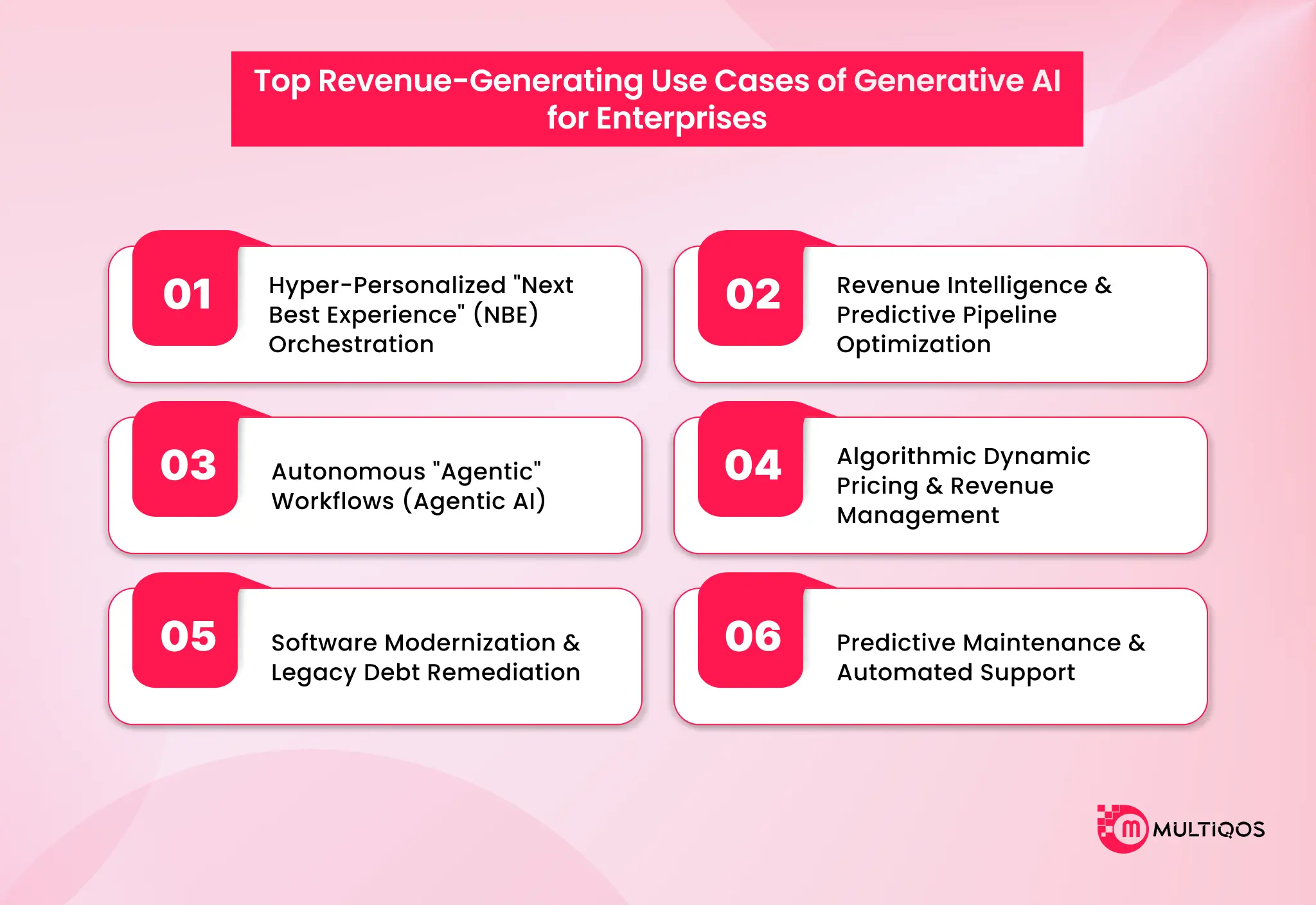
1. Hyper-Personalized “Next Best Experience” (NBE) Orchestration
Hyper-personalized Next Best Experience (NBE) orchestration is currently the most significant use case of generative AI for enterprises. It is helping companies move from reactive support to proactive value creation. Hyper-personalized NBE is an AI-driven, real-time customer engagement strategy. NBE engines synthesize real-time data to determine the precise moment and method to engage a customer, effectively creating a “digital twin” of customer interactions.
Unlike static segmentation, this approach uses dynamic data (transaction history, weather, social interactions) to trigger engagement. For instance, Starbucks utilized its “Deep Brew” AI to align offers with inventory and weather, generating 4 million additional visits in early 2024.
How to Plan for the Implementation of NBEs for Your Enterprise?
Applying NBEs requires an understanding of how they work. NBEs need a unified infrastructure, a trigger mechanism, and automation configuration.
- Unify Unstructured Data- Connect unstructured data streams (social sentiment, service call transcripts) with your structured CRM data to give the AI full context.
- Implement Real-Time Triggers- Move away from calendar-based campaigns. Set up dynamic triggers that deploy messaging based on immediate user behavior and localized events.
- Automate Omnichannel Delivery- Deploy an AI engine that autonomously sequences touchpoints across the optimal channels (email, app, SMS) without requiring manual campaign setups.
Strategic Value of NBEs for Enterprises
- Margin-aware personalization – The system recommends offers only when incremental profit outweighs the discount cost.
- Churn interception – Behavioral anomalies trigger proactive retention plays before customers disengage.
- Cross-sell precision – AI sequences complementary products based on usage patterns, not static personas.
- Experience orchestration – Every interaction contributes to a coherent journey rather than isolated campaigns.
2. Revenue Intelligence & Predictive Pipeline Optimization
Revenue Intelligence turns sales into a forensic science. It is a move away from the old “spray and pray” outreach method, using AI to pull together every signal available from the tone of a prospect’s email to global economic shifts into one clear picture.
Unlike old-school forecasting that relies on a sales rep’s optimism, this approach doesn’t care about hunches. High-performing teams are handing off grunt work to AI so they can focus on closing.
The result? Leaders are seeing an increase in conversions simply by catching buying signals that humans often miss.
How to Plan for the Implementation of Revenue Intelligence for Your Enterprise?
Revenue Intelligence requires clean data, behavioral signal capture, and predictive modeling infrastructure.
- Unify Revenue Data Streams- Integrate CRM, marketing automation, call recordings, email systems, and financial systems into a centralized intelligence layer. Eliminate manual updates that distort forecasting accuracy.
- Implement Deal Scoring Models- Deploy machine learning models that assess deal health using engagement frequency, sentiment analysis, stakeholder involvement, and historical close patterns.
- Automate Forecast Validation- Replace static quarterly forecasts with continuously updated probability-weighted projections. Enable leadership dashboards that flag at-risk deals and stalled opportunities in real time.
Strategic Value of Revenue Intelligence
- Forecast precision– AI-generated projections reduce bias and improve board-level planning accuracy.
- Pipeline acceleration– Early detection of buying signals shortens sales cycles and increases conversion velocity.
- Revenue leakage prevention– Automated alerts identify stalled deals, inactive champions, and competitive threats.
- Performance optimization– Sales coaching becomes data-driven through call analysis and engagement metrics.
3. Autonomous “Agentic” Workflows (Agentic AI)
Autonomous “Agentic” workflows mark the shift from using AI as a passive “copilot” to an active employee. While a copilot waits for you to type a prompt, an agent just goes and does the job.
Unlike basic automation tools, these AI agents act like “blended team members” that can handle messy, multi-step tasks like sorting out a shipping error or reordering stock without human intervention. Salesforce’s “Agentforce” is already processing trillions of actions, which proves this isn’t just a theory anymore.
How to Plan for the Implementation of Agentic AI?
Agentic deployment requires governance, system integration, and well-defined boundaries of scoped autonomy.
- Define Task Boundaries- Identify repeatable, high-volume workflows suitable for autonomous execution, such as returns processing or compliance checks.
- Integrate System Access- Connect agents to ERP, CRM, ticketing, and inventory systems through secure APIs to enable action, not just analysis.
- Establish Human-in-the-Loop Controls- Implement escalation protocols and override mechanisms to manage risk in edge-case scenarios.
Strategic Value of Agentic Workflows
- Operational scale – Agents handle thousands of concurrent tasks without workforce expansion.
- Cycle-time reduction – Multi-step workflows execute instantly without departmental handoffs.
- Cost optimization – Automation reduces repetitive manual labor across operations and services.
- Decision augmentation – Human teams focus on high-value exceptions rather than routine execution.
4. Algorithmic Dynamic Pricing & Revenue Management
Algorithmic Dynamic Pricing has moved way beyond airline tickets; it’s now a standard survival tool for retail, SaaS, and logistics. It is a real-time strategy to stop losing money when the market gets shaky, automatically adjusting rates based on inventory, what competitors are doing, and how much customers are willing to pay in the moment.
Unlike fixed pricing, which leaves money on the table, this approach captures value when demand is high and keeps you in the game when it drops. In SaaS, there has been a huge shift to “output-based” pricing, charging for the work done (like code written) rather than just a login.
How to Plan for the Implementation of Dynamic Pricing?
Dynamic pricing requires elasticity modeling, real-time data feeds, and governance oversight.
- Build Demand Elasticity Models- Analyze historical purchase behavior to understand price sensitivity across segments.
- Integrate Competitive Intelligence- Monitor market rates and adjust pricing dynamically without triggering race-to-the-bottom scenarios.
- Implement Guardrails- Define minimum margin thresholds and compliance rules to prevent unintended pricing volatility.
Strategic Value of Algorithmic Pricing
- Revenue maximization – Prices adjust to real-time demand signals to capture peak value.
- Margin protection – Guardrails prevent erosion during aggressive market shifts.
- Competitive agility – Enterprises respond instantly to competitor moves without manual intervention.
- Customer alignment – Pricing reflects perceived value and usage intensity rather than arbitrary tiers.
5. Software Modernization & Legacy Debt Remediation
Software Modernization is the only realistic way to fix technical debt without breaking the company. It is a strategy for tackling those ancient systems like banking cores written in COBOL forty years ago, where the original developers are long gone.
A manual rewrite is expensive and risky. At the same time, “AI assistants” can read that old legacy code, figure out the business logic, and rewrite it into modern languages like Python or Java. You can leverage software modernization services to reduce tech debt and modernize your systems, integrating AI assistants for efficient automation.
How to Plan for AI-Assisted Modernization?
Modernization requires risk assessment, phased migration, and automated code intelligence.
- Audit Legacy Systems- Identify high-risk systems with maintenance bottlenecks and security exposure.
- Deploy AI Code Analysis- Use AI models to reverse-engineer business rules embedded in legacy applications.
- Adopt Phased Refactoring- Transition modules incrementally to modern architecture while maintaining operational continuity.
Strategic Value of Software Modernization
- Risk reduction – Reduced dependency on outdated infrastructure and scarce expertise.
- Operational agility – Modern codebases enable faster product innovation cycles.
- Cost containment – Lower maintenance overhead and infrastructure expenses.
- AI readiness – Modernized systems integrate more effectively with analytics and automation platforms.
6. Predictive Maintenance & Automated Support
Predictive Maintenance is about fixing problems before they hit the P&L. It connects sensor data from your products directly to your support team, allowing you to solve an issue before the user even knows it exists. It is the industrial version of good customer service.
Unlike the old “break-fix” model that bleeds revenue, this keeps things running and customers happy. Home Depot used this to boost associate productivity by 14%. With major customer support interactions expected to be handled by AI, companies are reducing service costs and, more importantly, giving customers fewer reasons to leave.
It is one thing to know the use cases and another to make decisions on whether to use AI to implement it or not. In that way, you must possess a decision matrix prior to investing in a particular use case of enterprise-grade generation AI implementations.
How to Plan for the Implementation of Predictive Maintenance?
Predictive systems require telemetry integration, anomaly detection modeling, and response automation.
- Integrate IoT Telemetry- Capture continuous equipment and usage data through connected sensors.
- Deploy Anomaly Detection Models- Identify deviation patterns that indicate potential system failures.
- Automate Service Workflows- Trigger maintenance scheduling or support ticket generation automatically upon risk detection.
Strategic Value of Predictive Maintenance
- Downtime reduction – Early detection prevents costly operational interruptions.
- Cost efficiency – Maintenance is scheduled based on condition, not arbitrary timelines.
- Customer retention – Fewer service disruptions increase satisfaction and loyalty.
- Productivity lift – Employees focus on optimization instead of crisis management.
It is one thing to identify high-impact enterprise AI use cases and another to determine investment readiness. Enterprises should develop a decision matrix evaluating business impact, implementation complexity, data maturity, and governance risk before committing to large-scale generative AI initiatives.
Generative AI for Enterprises: Strategic Revenue Decision Matrix
The decision-making process to invest in AI implementation for a specific use case involves multiple factors, such as what your strategic goal is, how it will impact the operational shift, and specific financial and strategic outcomes.
|
GenAI Use Case |
Primary Strategic Goal | Best Suited For | Expected Financial & Strategic Outcome |
|
Hyper-Personalized “Next Best Experience” (NBE) |
Top-Line Growth (Customer Engagement) | Retail, Hospitality, and B2C brands require high-frequency engagement. |
Increased Visit/Purchase Frequency- Helps boost specific conversion metrics like checkouts and downloads. |
|
Revenue Intelligence & Pipeline Optimization |
Conversion Efficiency (Sales) | B2B Sales organizations and Enterprise teams with long sales cycles. |
Higher Conversion Rates- Identifies buying signals humans miss to close deals faster. |
|
Autonomous “Agentic” Workflows |
Operational Efficiency | High-volume operations, Supply Chain, and complex Logistics. |
Labor Cost Reduction & Speed- Handles messy tasks without human intervention. |
| Algorithmic Dynamic Pricing | Margin Maximization | Retail, SaaS (Output-based pricing), and Logistics/Travel. |
Revenue Capture & Loss Prevention- Maximizes yield during high demand; protects volume during low demand. |
| Software Modernization & Legacy Remediation | Technical Agility (Innovation Speed) | Banks, Insurance, and GovTech with heavy technical debt (“Ancient Systems”). |
Accelerated Time-to-Market- Fixes technical debt without the high cost/risk of manual overhaul. |
| Predictive Maintenance & Automated Support | Customer Retention (Churn Reduction) | Manufacturing, Hardware, Utilities, and IoT-enabled services. |
Reduced Service Costs & Churn- Lowers support overhead and gives customers fewer reasons to leave. |
With the decision made, it’s time to plan the implementation of generative AI initiatives.
Implementation Roadmap: From Pilot to Production
The application of generative AI for enterprise projects should be gradual. Pilot testing should be properly validated, audited, and refined for full-scale execution. The following roadmap can be adopted to deploy gen AI revenue use cases.
|
Phase & Timeline |
Objective |
Key Activities |
|
Phase 1: Foundation (Months 0-3) |
Create the technical and strategic basis of AI adoption. |
Get governance defined properly before rolling anything out.
Failure to do this will cause you to waste time in the future when the law or security comes to your rescue. |
|
Phase 2: Pilot & Validate (Months 3-9) |
Deploy controlled pilots and validate business value. |
Do not begin with the finest idea you have in mind. Select one or two high-impact, manageable use cases, like
Something that can be seen, measured, and bound. The goal here is credibility. You would like to see sooner than you can imagine that AI can add value within your environment, and not just in theory. |
|
Phase 3: Scale & Optimize (Months 9-18) |
Expand successful initiatives and integrate AI into core operations. |
It is best to first define what success looks like before you launch anything.
Be specific. Connect pilots to a set of measures that the leadership is already concerned about. When reviews of the budget begin, you will not be able to justify it since you have not measured it. |
|
Phase 4: Innovate & Differentiate (Months 18+) |
Leverage advanced capabilities for competitive advantage. |
The problem with AI activity is that it becomes ineffective when it is owned by everyone and by no one in particular.
|

How MultiQoS Helps Enterprises Implement gen AI revenue use cases?
Generative AI for enterprises will be a strong revenue source, particularly considering the ROI it has. You must, however, make sure that it is aligned with your business objectives. You must also see whether the use of these generative AI applications can provide a quantifiable financial benefit. It is not the case that revenue growth comes as a result of using AI. It is the result of applying AI strategically, using the appropriate governance and execution model.
And where MultiQoS can assist is in execution. We assist companies to shift their AI ambition into AI implementation safely, strategically, and on scale. Our team evaluates your business model, business bottlenecks, and revenue drivers to determine high-impact GenAI opportunities against quantifiable ROI. Therefore, in case you are interested in using the generative AI in your business, reach out to our professionals.
FAQs
Generative AI enhances revenue by boosting conversions, personalization, optimized pricing, churn reduction, and efficiency in the operating costs–eventually leading to an uptick in top-line growth and margin expansion.
The ROI of retail, SaaS, FinTech, Healthcare, Manufacturing, Logistics, and B2B sales-driven organizations is high because data availability and performance metrics can be measured.
It is achievable to demonstrate the positive outcome of well-defined pilots within 3-9 months. The transformation process is usually full-scale and implemented in 12-18 months.
The most common drivers of failure are poor governance, no KPIs, inadequate databases, no executive ownership, and trying to roll out on a large scale without validating pilots.

Get In Touch

Get Stories in Your Inbox Thrice a Month.
A Comprehensive Guide on How Machine Learning is Transforming the Factory Floor

MultiQoS Technologies Named an OpenAI Select Partner