
Application Modernization Strategy vs Rebuild vs Replace: How to Pick the Right Path?
Need quick insights? Summarize with AI & save time
 ChatGPT
 Perplexity
 Claude
 Google AI Mode
Table of Content
- Why Legacy Applications Have Become a Business Liability?
- Application Modernization Strategy vs Rebuild vs Replace: An Overview
- Application Modernization Strategy vs Rebuild vs Replace: Cost, Risk, and Time Compared
- How MultiQoS Helps Your Modernize Applications?
- FAQs
Summary
Running legacy systems in 2026 is a costly financial drain that actively hinders enterprises from integrating modern innovations like AI and cloud-native architectures. This blog explores the three primary avenues for overcoming outdated infrastructure: modernizing by incrementally upgrading existing applications, rebuilding a modern, AI-ready system from the ground up, or replacing custom apps entirely in favor of SaaS or commercial off-the-shelf (COTS) solutions.
By comparing the cost structures, risk profiles, and implementation timelines of each approach, this guide helps businesses make a data-driven decision on which path will deliver the best return on investment and long-term operational efficiency.
Running legacy applications in 2026 is like renting an old house. There is always a need to fix leaks, repair walls, and even hire specialists to fix outdated infrastructure, but the costs keep piling up. Businesses allocate a large share of their IT budgets simply to sustain these outdated systems, which, in turn, still hinder overall performance.
As soon as efforts are directed toward integrating contemporary technologies, including artificial intelligence, the existing infrastructure tends to become a direct barrier, negatively affecting user experience, conversion rates, and profitability.
The optimistic thing is that there is a solution. Modern businesses have three avenues to overcome legacy applications: updating the existing application, creating a new one, or simply replacing it with a modern SaaS product. The different strategies include a cost structure, a risk profile, and a timeline, and choosing one that is not suitable will cause as much damage as continuing to use the old system.
This blog outlines three strategies regarding cost, risk, and time, helping you make a sound decision for your enterprise.
Why Legacy Applications Have Become a Business Liability?
Legacy systems do the job even in 2026 for many businesses, and yet it’s slow, often resistant to new technologies, and makes your user experience suffer. Maintaining outdated applications is getting expensive, especially when it consumes a major part of the organization’s IT budget. According to a report, enterprises spend 60-80% of their IT budget on maintaining the legacy infrastructure.
If you consider the modern innovations like AI, which require specific types of infrastructure and system requirements, the legacy systems are becoming a blocker for many enterprises to actually integrate such innovations. This causes a blockade for user experience as well.
Not just on the IT budget but also on the conversion part, AI integration becomes important, and legacy systems are basically a roadblock for most of the enterprises. This is why the financial drain due to legacy systems is actually causing great concerns for many enterprises.
Financial Burden of Legacy Systems
The financial burden of keeping a legacy system running often outweighs the cost of replacing it. If you consider the maintenance and operating cost of any legacy system, it outweighs the cost of replacing it. What this means is that the technical debt often takes years of quick fixes to create a new system, which eventually creates a fragile code that is difficult to remember.
Need for Specialized Hardware
Plus, the legacy apps also require outdated specialized hardware, which is expensive and often consumes massive power. Another key aspect of maintenance and operating cost is vendor lock-in, which is created over time while you are working on a legacy system with so much technical data.
Now that you know why legacy systems are a liability, it is important to understand what your strategy should be, whether it should be:
- An application modernization strategy
- Rebuild the entire legacy system
- Replace some of its components
Application Modernization Strategy vs Rebuild vs Replace: An Overview
It is necessary to understand the peculiarities of each of these methods before deciding to modernize, rebuild, or replace your application, as they vary significantly in cost, risk, and business impact.
|
Strategy Path |
Enterprise Definition | Best Use Case | Risk & Effort Profile |
|
Modernize |
A spectrum of upgrades (Rehost, Re-platform, Refactor, Rearchitect) to existing code. | Functional apps needing cloud scale, security, or performance boosts. | Low to High (depending on the chosen “R”). |
| Rebuild | Discarding legacy code and rewriting the application from scratch using modern technologies. | Core systems with unmanageable technical debt are blocking business goals. |
Very High cost, effort, and execution risk. |
| Replace | Retiring the custom app in favor of a SaaS or COTS vendor solution. | Standardized, non-core workflows (CRM, HR). |
Moderate; shifts focus to data migration and vendor lock-in risks. |
Application Modernization Strategy: An Overview
Application modernization strategy is not a simple binary choice, but it is a spectrum of incremental and structural changes that are frequently categorized within different frameworks.
These frameworks are often known as the 6 Rs, including:
- Rehost
- Re-platform
- Re-factor
- Re-architect
- Rebuild
- Replace
In this technique, the associated idea is to upgrade the current software, modernize the integration of technology, but maintain the essence of the business impact, so that you are able to enhance the business impact.
- Rehosting an application is a strategy in which you transfer your system to a new cloud infrastructure without changing the code.
- Re-platform is an approach in which you do some minor configuration and get your system to use services in the cloud that are native.
- Refactoring is a reorganization technique in which you reorganize the internal code base to remove inefficiency, increase mobility without altering or modifying the external behavior.
- Re-architecturing is a technique in which you redesign the system, essentially breaking the knowledge down into individual micro-services.
Rebuilding Strategy: Rewriting The Legacy Codebase
The rebuilding approach is one around discarding the legacy code name, core base, and tile. This approach allows you to develop a new application from scratch using modern trend blocks, languages, and cloud media architectures.
In the context of the current market, you can use the rebuild approach to create an application that is AI-first and that supports features and infrastructure. Plus, it can integrate an AI-based capability easily. While this part does reserve the original business scope and specificity, it will help you reduce the entire technical gap that is created over time.
Replace Strategy: Repurchase/SaaS
Replacing an application is an approach where you basically retire the existing legacy system and substitute it with a functional commercial off-the-shelf product or a SaaS solution. It reduces the ongoing maintenance and innovation burdens and shifts them to a third-party vendor. Basically, you are focusing more on the business aspect and not on maintaining a legacy system.
Right now, you have an overview of all three approaches. Deciding which approach is best for your enterprise requires a thorough investigation of different aspects. Here is a decision matrix that you need to use to decide which is the best approach for your business.
Application Modernization Strategy vs Rebuild vs Replace: Cost, Risk, and Time Compared
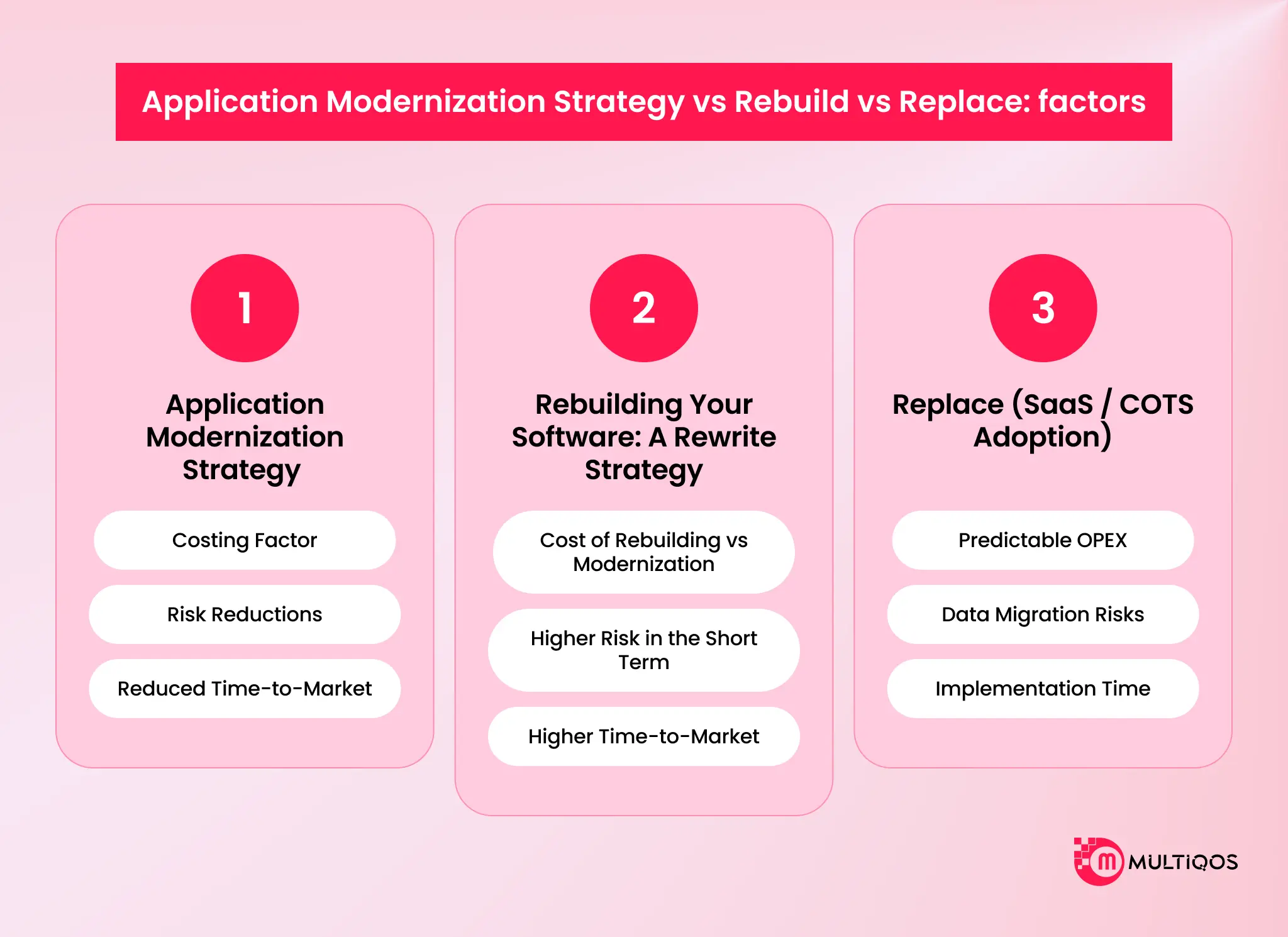
You must consider each of these methods based on the most important parameters, such as the financial investment level, the risk of operations, and the schedule to actualize the real business value, before choosing the application modernization strategy to use in your enterprise.
-
Application Modernization Strategy
When you consider the application modernization roadmap, one of the critical factors is cost. As an enterprise, you need to ensure that you have a cost-effective strategy so that, in the short term and in the long term, you have better ROI.
Costing Factor
What this means is that it should have a lower upfront investment compared to a complete rebate at the same time. It should also have long-term business value. If you are choosing an application modernization strategy,
An application modernization approach will allow you to have an incremental cost structure. What this means is that you will have a pay‑as‑you‑go, incremental investment model. It will steadily reduce the technical debt and lower the long-term maintenance cost over time.
Risk Reductions
Legacy application modernization can help you lower the execution risk. Such changes are made incrementally, leveraging the agile approach to a functioning system. What this means is organizations can avoid the dangers of a massive release, which can disrupt the entire system and create a lack of proper user experience.
Plus, app modernization is a phased rollout process. What this means for an enterprise is that the disruption of the system is minimized on a daily basis.
Reduced Time-to-Market
When you leverage legacy software modernization, the time to market gets reduced, and you have better business value. How does this happen? The incremental and phased approach of the application modernization strategy helps you reduce the time to market by simply leveraging light modernization efforts. So, if you consider an approach like re-hosting or refactoring, it can be executed anywhere between 2 and 8 months.
-
Rebuilding Your Software: A Rewrite Strategy
When you look at the Modernization versus Rebuild comparison, the entire focus shifts from just refactoring or rehosting specific elements or specific parts of your system to entirely rebuilding the system from scratch.
Cost of Rebuilding vs Modernization
Rebuilding as a strategy is one of the most expensive strategies when you think about the upfront cost, because you will require the highest initial capital investment. It will also need higher resource allocation because you are building the entire system from scratch, so you have to create the entire code base from scratch.
However, an advantage that you get here, when you compare it with the cost and the resources that you are providing, is that you will get a fresh system that is free of any technical depth. Ultimately, the total cost of ownership can be lower, but it is in the long term.
Higher Risk in the Short Term
The building strategy, compared to the application modernization strategy, has a very high-risk profile. Software rewrites frequently suffer from budget overruns, scope creep, and implementation delays.
This can lead to issues with the user experience. Plus, transitioning to a completely new system can introduce security threats as well. It can also lead to business disruptions as you will need your team’s time to build a new codebase.
Higher Time-to-Market
You are building the entire system from the ground up, so basically, you will need more time. That is a plus if you consider the time that will be needed to test the entire code base for different scenarios and then make it live for the audience to experience.
Then you will understand that it is a far more time-intensive option compared to others. Typically, it can require anywhere from 12 to 24 months.
-
Replace (SaaS / COTS Adoption)
Replacing your system with a SaaS solution or a COTS is the modern cloud modernization strategy that many enterprises adopt, and this can have its advantages.
Predictable OPEX.
Replacing a custom application with a third-party product can help you shift your financial model from custom development capital expenditure to a predictable subscription-based operational expense.
However, you may have to invest in initial licensing and integration costs, which are medium to high. Plus, the overall maintenance burden is also uploaded to a vendor, so in that way, you do save on the maintenance cost.
Data Migration Risks
The replacement strategy has a modest risk level. Enterprises that replace their system components with an off-the-shelf solution. The risk shifts from internal engineering failures to data migration complexities. Keep in mind the integration complexities with existing internal systems and long-term vendor lock-in problems.
Implementation Time
The implementation is quite fast and usually takes 3 to 9 months. Since the underlying software is already made, the schedule is largely determined by how fast the platform is configured, users trained, and historical data migrated.
How MultiQoS Helps Your Modernize Applications?
Application modernization requires strategic planning and proper execution. Making the wrong choice of approach for modernization can lead to budget overruns. Whether to modernize, rebuild, or replace depends solely on your technical debt and business goals.
Plus, you need to understand the differences among the approaches, the business risks, the technical challenges, and their business impacts. This is where an experienced partner like MultiQoS can help. We offer application modernization strategies that remove uncertainty, providing a clear roadmap with detailed costs, risks, and timelines. Contact our team today for an assessment.
FAQs
This time will be determined by the strategy taken. Lightweight projects, like rehosting and even refactoring, may finish in two to eight months, whereas projects that need structural changes have a higher chance of taking more time.
The most frequent pitfalls include scope creep, incompatibility with current systems, impact on normal operations, and the exaggeration of the scope of technical debt in the current codebase.
Start with a mapping of current maintenance costs, where the system is slowing down business goals, and the projection of long-term payback of modernizing the system compared to the cost of continuing to use the legacy system.

Get In Touch

Get Stories in Your Inbox Thrice a Month.
Mobile App Development Cost in 2026: What to Budget and Why
iPhone Duo App Development: The Hidden Cost of Not Adapting Your Enterprise App
Why Upgrading Your iOS Architecture for Foldables Protects Your Brand Impression