
What Is AI Visual Inspection? A Beginner’s Guide
Need quick insights? Summarize with AI & save time
 ChatGPT
 Perplexity
 Claude
 Google AI Mode
Table of Content
- Introduction to AI visual inspection
- What is AI visual inspection?
- Key benefits of AI visual inspection for manufacturers
- How does AI visual inspection work?
- What types of defects can AI visual inspection detect?
- AI visual inspection Implementation
- AI Visual Inspection vs. Machine Vision in Manufacturing
- Conclusion
- FAQs
Summary:
AI visual inspection helps manufacturers move beyond fatigue-prone manual checks and inflexible rule-based vision systems. It combines industrial imaging, computer vision, and machine learning to detect defects at production speed with consistent accuracy, stronger traceability, and less shift-to-shift variation.
This guide explains how AI visual inspection works, what kinds of defects it can detect, and why manufacturers are adopting it across quality-critical environments. It also shows why the engineering setup matters as much as the model, and what a practical implementation path looks like for teams evaluating the technology for the first time.
Introduction to AI visual inspection
A production line can run at full speed, output looks fine at a glance, and defects still slip through. Human inspection struggles under those conditions. Eyes get tired, attention drifts, and borderline defects start passing as acceptable somewhere into the second hour of a shift. That is not a training gap. It is a system limitation, and no amount of SOP refresh will fix it.
This is where AI visual inspection comes into the picture. It provides a method for manufacturers to check all parts, all shifts, at line speed without imposing a strain on human stamina or brittle threshold limits, written years ago by an engineer who is no longer with the company. The integration of computer vision in quality inspection has transformed the plant floor.
What is AI visual inspection?
AI visual inspection is a system that involves industrial cameras, computer vision, and machine learning to automatically scan goods as they progress through the production cycle. The idea is to identify defects as quickly, consistently, and without decreasing the speed of the line.
Manual inspection works in some settings. It breaks down when line speed increases, defect patterns vary, or the line runs 24/7 without room for human fatigue.
The cost of getting this wrong adds up fast. ASQ estimates quality-related costs consume 15% to 20% of annual sales for the average manufacturer, and up to 40% in organizations with poor quality discipline. Once a defect reaches a customer, the cost to resolve it is 10 to 100 times higher than catching it during production.
Key benefits of AI visual inspection for manufacturers
1. Traceability of defects
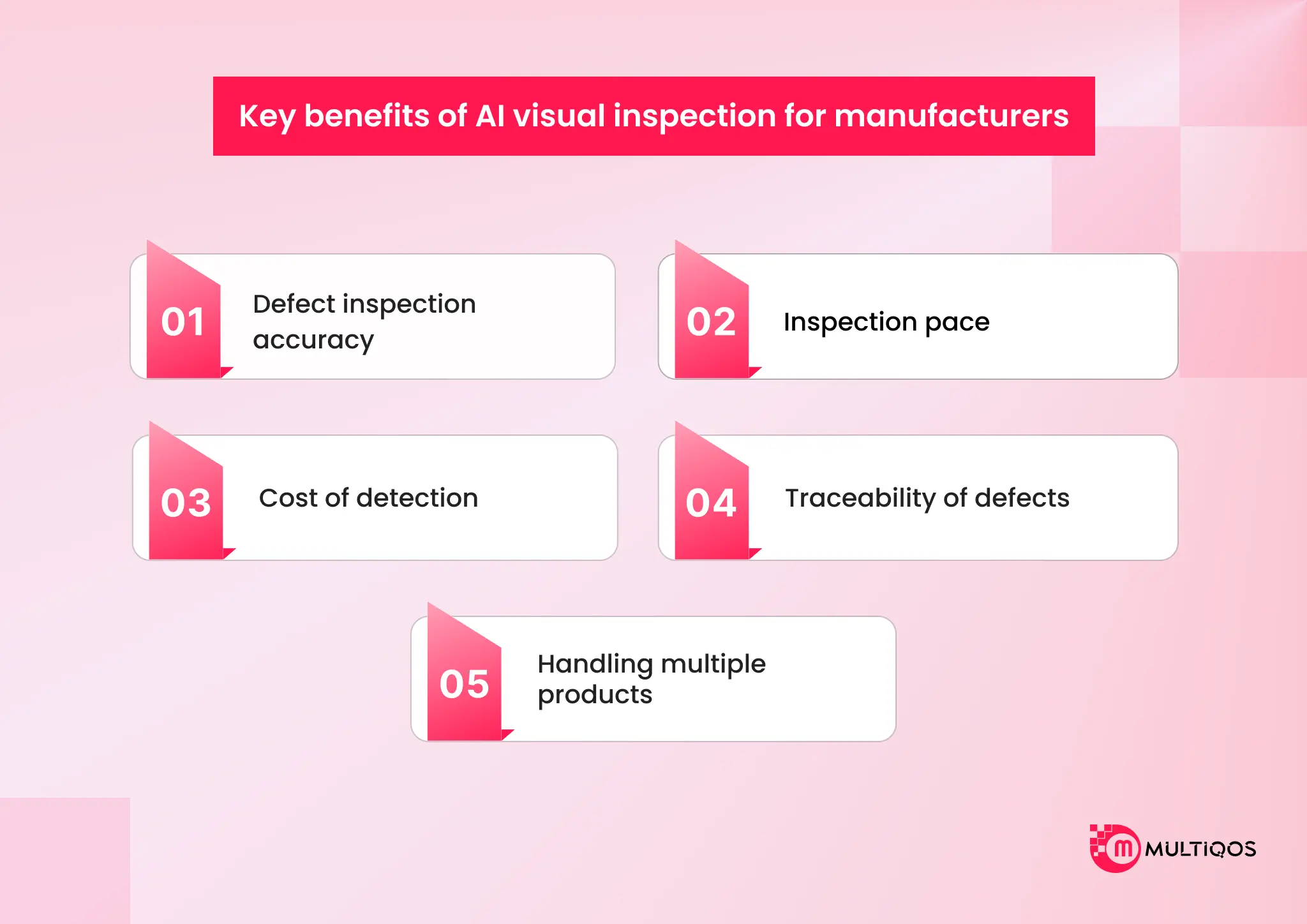
Traceability is the least-discussed benefit that matters a lot to QA teams. Every image, decision, and timestamp is logged, which produces a cleaner audit record than paper trails and manual sign-off. Engineering teams also get actual defect pattern data to trace upstream process drift rather than working from memory and incident reports.
2. Cost reduction
The cost case is where most organizations pay attention. McKinsey data shows up to 50% reduction in defect rates and up to 30% lower defect-related costs when digital validation is combined with operator feedback.
3. Defect inspection accuracy
McKinsey research puts AI-based visual inspection at up to 90% improvement in defect detection rates versus traditional human inspection. What’s worth noting is that neither number degrades because the night shift ran long or someone’s been at the same station for six hours. The performance doesn’t fluctuate the way human inspection does.
4. Inspection pace
Speed follows directly from edge inference. Decisions happen in under 100 milliseconds, keeping quality from becoming a production constraint. Gartner projects 50% of companies with production operations will use AI-enabled vision systems by 2027, which is a signal that this is moving from specialized deployment to baseline expectation.
5. Handling multiple products
AI inspection handles multiple product types more flexibly than rule-based systems. Setup is still required for each product, but rewriting logic from scratch for every SKU is no longer the starting assumption. Plus, accurate defect detection is vital for the pharmaceutical industry. Real-time computer vision defect detection ensures that contaminated products never reach the consumer.
How does AI visual inspection work?
A camera captures the part. The model analyzes the image, often in under 100 milliseconds. The system flags, classifies, and logs the result. Good parts continue down the line. Bad parts get diverted or flagged for review.
The workflow is straightforward enough. What determines whether a deployment actually works is the engineering underneath.
The shift toward visual inspection automation helps solve labor shortages on the assembly line. Investing in an AI visual inspection solution pays for itself through reduced scrap and provides the data needed for continuous process improvement.
1. Image acquisition
Cameras and lighting are the foundation. Poor image quality gives the model nothing to work with, and an algorithm can’t detect what the camera can’t see. Lighting design matters more than most teams expect. Raking light exposes surface defects. Backlighting helps with subsurface or edge issues. Diffuse lighting controls glare for cosmetic inspection. Camera positioning is equally important: a poorly framed part can hide the exact defect the system is trying to find. For production engineers, this tends to be the decision that affects everything else downstream.
2. Computer vision turns images into data
Computer vision techniques translate visual information into numerical patterns that the model can process. Edges, textures, colors, shapes. This is where raw pixels become inspection decisions. What manufacturers need here isn’t generic image recognition, but specialized computer vision solutions that reliably separate real defects from acceptable variation under actual line conditions.
3. The model learns defect patterns
A deep learning model, usually a convolutional neural network, is trained on labeled images of parts that are acceptable and defective. The system is able to learn to identify patterns: scratches, cracks, assembly errors, and finish problems. Transfer learning means manufacturers often don’t need massive datasets to get started. Fine-tuning a pre-trained model on a modest set of labeled examples has made pilots viable for teams that assumed this was out of reach.
4. Edge computing keeps inspection fast
Most deployments run inference locally at the inspection station rather than routing images to the cloud. This keeps latency low and decisions fast, which matters when parts are moving and rejects have to happen in real time. AI vision deployments now run on localized edge hardware, reducing latency.
What types of defects can AI visual inspection detect?
Surface defects
These are a common starting point: scratches, dents, stains, pitting, and finish irregularities. These are hard to catch consistently when the line is running fast, and parts look similar.
Dimensional inaccuracies
Dimensional inaccuracies reveal process drift by comparing parts against reference geometry.
Assembly errors
Assembly errors, including missing components, misplaced parts, and wrong orientation, can be caught before bad units move downstream.
Color inconsistencies and coating issues
Color inconsistencies and coating issues expose finish deviations that operators would judge differently across shifts. Structural flaws, including cracks, holes, and voids, often signal deeper process or material problems. Some systems detect down to 50 microns, a consistency level no human inspector sustains across a full shift.
An AI-powered quality control framework provides a comprehensive view of production health. Unified AI-powered quality control connects different stages of the line, and the benefits extend to improved customer satisfaction.
AI visual inspection Implementation
Timelines depend on the inspection problem, existing infrastructure, and integration complexity, which is why many organizations partner with AI consulting services to navigate the initial phases. The pattern across working deployments is consistent: start narrow, get the imaging right, prove value, then expand.
Start with a defect class that’s costly, visually detectable, and hard to inspect consistently by hand. Narrow scope produces cleaner data and lower integration risk, and gives the team clear ROI signals before committing to broader rollout.
Camera placement, optics, and lighting have to be locked in before model tuning becomes the focus. Most projects that stay frustrating are frustrating because of imaging problems, not model problems.
Transfer learning reduces data requirements substantially, so pilots are feasible for manufacturers without large labeled datasets. Once the model is in place, it has to connect to PLC, MES, and QMS infrastructure often requiring custom manufacturing software development, for defect decisions to trigger real actions and feed into improvement workflows.
After one deployment holds up, scale to additional SKUs, lines, or facilities with actual knowledge of what the imaging and data flow requirements look like in practice. The teams that skip this sequence tend to find problems multiplying faster than wins.
AI Visual Inspection vs. Machine Vision in Manufacturing
Many manufacturers think they understand this category because they’ve worked with older machine vision tools. Worth clarifying.
Machine vision refers to camera-based inspection with predefined logic. AI visual inspection builds on that imaging layer and adds learning-based decision-making. Cameras, optics, and lighting still matter. The difference is in the inspection logic, which can now adapt to complex patterns instead of binary pass-fail rules.
Computer vision is the broad field of interpreting visual data. Machine vision is an industrial application: image capture and hardware. AI visual inspection uses machine learning on top of both to handle defect detection across variable conditions that rule-based systems struggle with.
Specialized AI defect-detection models are trained to detect cracks in automotive parts. Effective AI defect detection reduces the need for expensive manual sorting. Reliable AI defect detection is key to maintaining high-yield production goals.
Conclusion
Getting AI visual inspection past a demo and into production is an execution problem. Line speed, product variation, defect economics, traceability, and the systems already running on the floor all have to be accounted for. When any part of that is misaligned, the deployment doesn’t hold up past the pilot phase.
If your team is exploring AI visual inspection, start by identifying where visual defects create the most business risk, what imaging conditions are required, and how the inspection layer connects with what you already have.
FAQs
Transfer learning has reduced this obstacle to a great extent. With a relatively small labeled dataset, pre-trained models can be fine-tuned to specific products and defect types. Pilots are more available to most teams than they had imagined prior to seeking the information.
Typically, but still, every product requires an adequate imaging configuration and authentication. The flexibility issue over rule-based inspection is a reality, but that does not negate setup work.
It is determined by the complexity of inspection, integration needs, and the infrastructure of the plant. A step-by-step process beginning with a single inspection issue will yield more credible results than attempting to roll out everything at once.
The primary adopters are automotive, electronics, and FMCG, where the line-speed inspection, traceability, and compliance requirements make manual inspection difficult to maintain.

Get In Touch

Get Stories in Your Inbox Thrice a Month.
A Comprehensive Guide on How Machine Learning is Transforming the Factory Floor

MultiQoS Technologies Named an OpenAI Select Partner