


AI Visual Inspection Solution to Catch Defects Legacy Cameras Miss
MultiQoS deploys an AI visual inspection for defect detection directly on your production line, delivering 99% detection accuracy, reducing scrap rates, and running quality checks at scale.
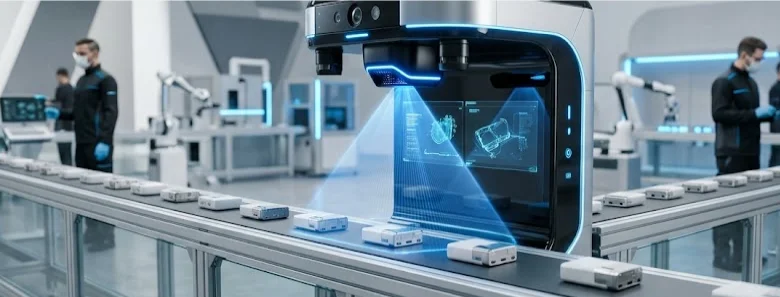
Automated defect detection routes confirmed defects directly to the appropriate process team with image evidence, defect classification, and production context attached. The cases that need a human decision arrive with everything needed to make it, rather than requiring the inspector to reconstruct what happened from raw image folders.
Solution Overview
An AI Quality Inspection System Built for the Production Floor, Not the Lab
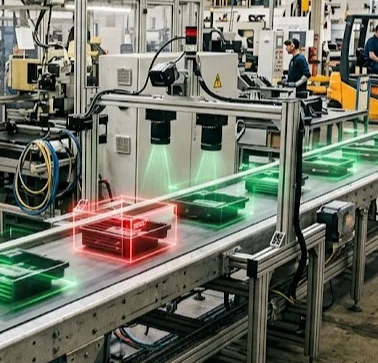
MultiQoS brings a computer vision solution to the quality inspection process at every stage of your production process. The system captures images using your existing line cameras or custom-deployed hardware. Our AI quality inspection system processes each frame against a trained defect model and flags anomalies in milliseconds.
What makes this different from traditional automated optical inspection tools is how the models are trained. Rather than relying on rigid templates or pre-programmed defect libraries, the AI defect detection engine continuously learns the specific surface characteristics. This includes dimensional tolerances and defect morphologies.
Features
Core Capabilities of Our AI Visual Inspection Solution
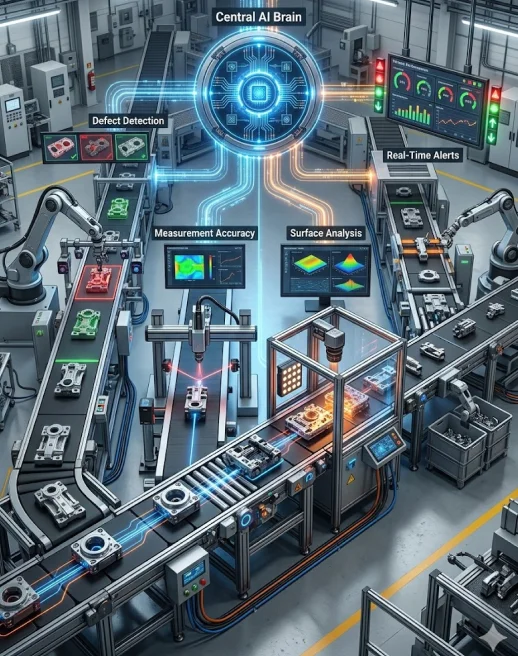
The AI defect detection engine processes inspection images in milliseconds, keeping pace with high-throughput production lines without introducing cycle time delays that hurt OEE.
Multi-Class Defect Recognition
All types of defects surface scratches, dimension tolerances, and assembly mistakes can be detected and classified in one sweep, not serially queued up.
Inspection with 2D or 3D Imaging
We provide 2D imaging for planar parts and structured light-based 3D scans for more complicated shapes and their deeper inspection.
Connectivity With Line Cameras and PLCs
MultiQoS integrates with the existing camera, conveyor triggering, and PLC systems through industrial standard interfaces – nothing needs to be swapped if it works fine.
Custom Model Development
Our models will be trained on real pictures of the defective objects you manufacture and the specific defects you are interested in.
Automated Defect Tracking and Routing
All identified defects are automatically logged, complete with an image and defect type information, and immediately sent off for review.
Real-Time Quality Report Dashboard
The real-time dashboard provides all necessary quality data, defect rates, yields, and distribution during production, not when it stops.
Industry Challenges
Why Traditional Quality Inspection Don't Work?
Manual inspection and legacy vision systems were built for a production environment that no longer exists. Line speeds have climbed, product complexity has multiplied, and customer tolerance for escapes has dropped to near zero.

Poor Defect Detection Consistency
Miss rate goes up over the course of a shift, spikes during changeover periods, and compounds further if both shifts work from the same inspection station since fatigue is a biological limitation rather than an issue with skill.
Unable to Handle Complex Geometries
Changeover speeds exceed camera configuration times, leaving blind spots in the inspection and passing defective components through the line without detecting them in the process.
Too Many False Rejects
Strictly pattern-matching AOI views natural variations between individual parts as defects, causing non-defective pieces to be loaded into the rework queue and slowing down the line.
Siloed Quality Information
Inspection data remains in the log files of standalone vision systems and is not communicated to the MES/ERP/SPC systems used by process engineers.
Lack of Defect Classification
The engineer learns that the component failed the test, but not whether there was a specific defect, what its location was, and how bad it was.
Undetected Scrap and Rejected Components
The spike in scrap components shows up only at the end of the day, by which time hundreds of defective parts have already made their way through the assembly line.

Pain Points
What Inconsistent Quality Inspection Is Actually Costing Your Operations
The cost of poor quality is rarely a single visible number. It accumulates across scrap bins, rework queues, field returns, and customer complaints that each look unrelated until you see the inspection data behind them.

Persistent High Scrap Rates
Adding more inspectors to a process that fundamentally relies on human pattern recognition does not solve the underlying detection problem. It adds labor cost to a system that still misses defects.
Rework Loops Driven by Defects
When surface defects or dimensional errors pass incoming or in-process inspection, they typically surface at final assembly or in the field. Rework at final assembly costs 8-10 times more than catching the same defect at origination.
Good Parts Rejected and Scrapped
False reject rates above 10% mean your production team is pulling a good product and sending it to re-inspection.
No Data for Root Cause Analysis
You require data on defect rate by type, by location on the part, by shift and by machine in order to be able to diagnose the surface finish issue. Without this structured breakdown, the root cause stays hidden, and defects persist.
Escape-related Returns
Escaped defects result in warranty claims and return handling costs, eroding customer confidence and damaging brand reputation while generating significant operational disruptions and downstream financial consequences.
In-Line Inspection Impact
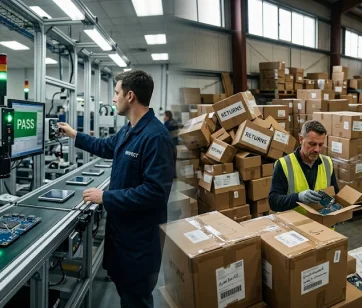
Manual inspections represent a physical throughput constraint on your line, especially if you run mixed products, where the inspector has to refer to instructions.
Identify Production Line Defects Early With MultiQoS!
MultiQoS deploys a production-ready AI visual inspection solution in 6-8 weeks on a pilot line, using your existing hardware where possible, so you can see the detection improvements rapidly.
Connect Now
Key Benefits
What Manufacturers Gain From Deploying Our AI Visual Inspection Solution
AI visual inspection solutions ensure better defect detection, reduce scrap costs, and ensure improved ROI.
Higher Detection Accuracy
Unlike human inspectors, AI-based quality checks do not have variable performance depending on the time of the day, number of items produced or shifts.
Adaptability to Mixed-SKU Production
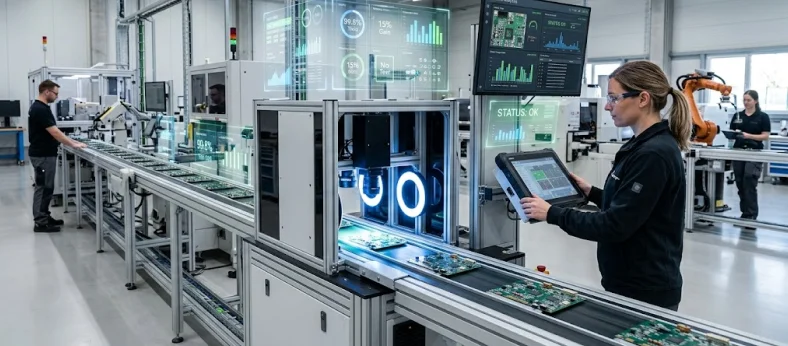
The AI model is quickly retrained and switched out during product changeovers, eliminating the manual camera reconfiguration and inspection gaps.
Significant Reduction of Re-work & Scrap Costs
Detecting defective parts sooner in the production process, during in-line inspection rather than during final assembly or after sale, saves manufacturers 10X their cost of quality.
False Rejection Rates Improvement
AI models that can adjust to learn your unique parts and surfaces eliminate false rejection rates.
Quality Data Available in Real Time
Defect classification, location data, and production context are logged automatically for every inspected part, giving process engineers the data granularity.
Throughput Maintained at Line Speed
Automated defect detection runs at machine speed rather than at inspection bottleneck speed, removing quality inspection as a constraint on production throughput.
How It Works
From Image Capture to Defect Decision in Milliseconds
From advanced computer vision solutions being embedded for your operations to capture assembly images to AI-based defect detection and classification, our teams offer end-to-end visual inspection efficiency
Use Cases
Where AI Defect Detection Is Delivering Results Across Manufacturing
Automotive Weld Quality Inspection
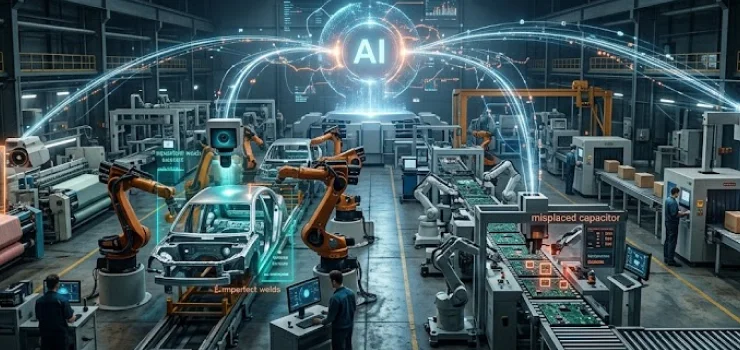
Pre-trained convolutional neural network models for weld quality detection can be used to inspect acceptable versus unacceptable weld bead appearance to detect weld porosity, undercutting, and lack of fusion in real-time.
Electronic Component Inspections
AI defect detection software checks for acceptable solder joints, electronic component placement accuracy, solder paste residue, and trace quality of the PCB, ensuring reliability, consistency, and fewer manufacturing defects.
Pharmaceutical Inspections
AI quality assurance solution inspects solid oral dosage form drugs for physical defects including cracks, chips, color anomalies, and dimensional non-conformances.
Package Inspection and Labeling Accuracy
Automated quality inspections confirm accurate packaging seals, package label placement and accuracy, print legibility, and fill level.
Injection Molded Part Quality Inspection
AI vision system inspects composite lay-up and injection-molded polymer component quality for delamination, fiber misalignment, surface voids, and dimensional deviations in difficult-to-inspect parts with non-uniform surfaces.
Final Assembly and Quality Inspection
Automated visual inspection validates the presence of fasteners, proper alignment, and dimensional tolerances on complex final assemblies, improving production accuracy, compliance, and overall product quality.
Turn visual data into real-time quality insights.
Let's ConnectBusiness Impact
Measurable Results Manufacturers See With Our AI Visual Inspection Solution
AI-powered visual inspection solution from MultiQoS catches defects humans miss, cuts quality failures, and improves your ROI within 18 months.
Defect Detection Accuracy
Accuracy rate in defect detection eliminating faulty products before they reach the production line.
Reduced Detection
Miss Rates Reduction in detection miss rates cutting costly oversight and downstream quality failures.
Lower Defect Rates
Reduction in overall defect rates driving higher yield and consistent product quality at scale.
ROI Payback Period
Average payback period from deployment to full return on investment across manufacturing operations.

Integration
How MultiQoS Deploys Inside Your Existing Production Environment
Your production line infrastructure does not need to be replaced to deploy the AI defect detection solution. MultiQoS integrates with your existing cameras, control systems, and data platforms through standard industrial protocols, minimizing implementation scope and protecting your prior equipment investments.
Existing Line Camera and Industrial Vision Hardware
MultiQoS connects to installed line cameras from major industrial imaging vendors, adding the AI inference layer on top of your current hardware
PLC and Conveyor Control System Integration
The inspection decision output integrates directly with your PLC or conveyor control logic through standard I/O, OPC-UA, or MQTT protocols.
MES and ERP Platform Connectivity
Defect data, inspection results, and first-pass yield metrics export to your manufacturing execution system and ERP platform in real time.
SPC and Quality Management Systems
Statistical process control tools receive defect frequency and classification data directly from the AI visual inspection solution.
Why Choose Us
Why MultiQoS Is the Right Partner for Your AI Quality Inspection Implementation
MultiQoS models are trained specifically for industrial AI defect detection use cases, with domain knowledge covering surface finish classification, dimensional tolerance interpretation, and specific lighting.
Deployment on Lean Training Datasets
Our team ensures production-ready accuracy with 20-40 labeled images per defect class, enabling faster go-live on new parts and new defect types without waiting for defect accumulation.
Works With Your Existing Line Hardware
MultiQoS has deployed AI quality inspection on production lines running cameras from over a dozen major industrial imaging vendors.
Ongoing Model Support
Our AI defect detection solution adapts with your manufacturing operation rather than requiring a new implementation cycle for each change.
KPIs Co-Designed with Leadership
We co-design KPIs with quality, automation, and maintenance leaders to keep the solution aligned with business priorities.
FAQs
Frequently Asked Questions
How much training data does the system need before it can go live on our production line?
The MultiQoS AI defect detection solution reaches production-ready accuracy with 20-40 labeled images per defect class, which is substantially lower than traditional machine learning approaches that require hundreds of examples.
Will this work with the camera hardware we already have installed?
In most cases, yes. MultiQoS has deployed the computer vision solution on production lines running cameras from over a dozen major industrial imaging vendors. The integration requires compatibility with standard industrial image formats and trigger protocols, which the majority of installed line cameras support.
What differentiates our approach from others in the market? What sets us apart?
The AI-based quality inspection platform can load an appropriately trained model for each SKU within seconds. Thus, unlike older automated optical inspection systems, there are no changeover times associated with loading new SKUs into your system due to the need to reprogram cameras.
What do you do if you find a defect in a product type you have never inspected before?
Images of low confidence detection cases will be sent to a labeling queue for manual verification. Your QA team then reviews the image, classifies the defect, and that label becomes part of the training data set.
Model then trains on this newly created dataset which continues expanding its coverage of new defect types each time it receives human input.
How long will it take to roll out this solution?
An implementation at a single inspection station takes 6-8 weeks from project kick-off to operationally ready in production. This includes the camera selection and integration study, data collection, training data development, model training and testing, system integration with your PLC and MES, and concurrent validation.