AI Supply Chain Optimization Solution That Moves Inventory as Fast as Demand Does
MultiQoS deploys an AI supply chain optimization solution directly into your operations, delivering demand forecast accuracy, eliminating stockouts, and overstock.

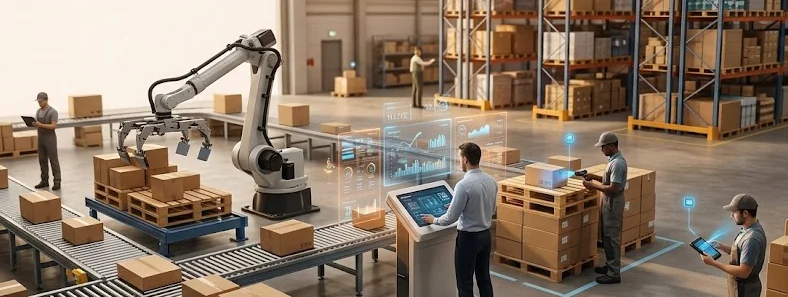
AI logistics optimization routes replenishment orders, reorder triggers, and safety stock adjustments directly to the relevant procurement and warehouse teams. It offers full context on forecasted demand, current stock position, supplier lead time, and carrying cost data attached.

Solution Overview
An AI Inventory Optimization System Built for the Distribution Floor, Not the Spreadsheet
MultiQoS brings AI supply chain analytics into the inventory and planning process at every node of your supply network. The system ingests data from your ERP, WMS, POS, and supplier feeds. Our AI supply chain optimization solution continuously models demand patterns, lead-time variability, and service-level targets.
What differentiates this from traditional demand planning software is how the models learn. Rather than relying on fixed seasonal curves or manually maintained planning parameters, the AI demand forecasting solution trains on your actual historical sales data. This includes operational velocity, promotion lift, channel mix, and external signals.
Features
Key Capabilities of Our AI Supply Chain Optimization Offering
The AI demand forecast engine analyzes thousands of SKU-location combinations per second, providing replenishment signals and inventory balancing plans.
Multi-Echelon Inventory Optimization
Safety stock, order points, and replenishment quantities are optimized at each level of your supply chain network with our AI supply chain optimization solution.
Custom Demand Model Building
Our proprietary demand models are calibrated using historical sales data, considering promotion calendars, distribution channels, seasonality, and NPI curves unique to your product category.
Probability-Based Demand Forecasting
We create probabilistic forecasts, allowing your planners to see both the positive and negative scenarios for each SKU prior to making their replenishment decisions.
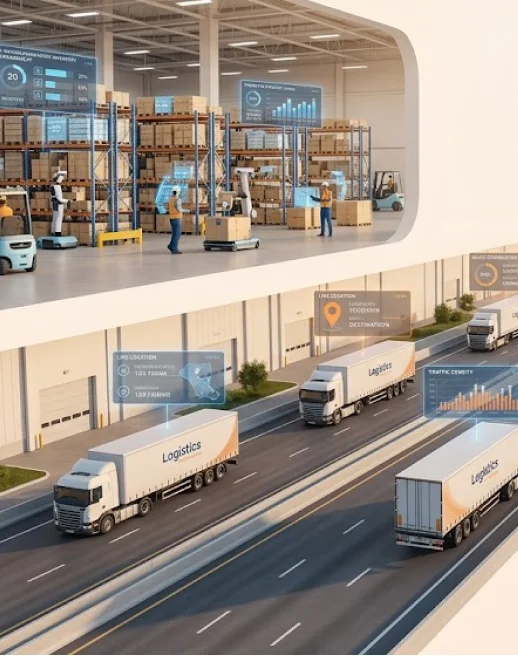
Automatic Replenishment Orders
Every event that triggers replenishment is recorded and prioritized for your planner’s review or automated order release, including the demand signal, inventory levels, supplier lead times, and costs.
ERP/WMS/Supplier Portal Integration
MultiQoS plugs into current planning systems, warehouse management systems, and supplier EDI solutions via standard APIs; no software replacement is necessary if you’re happy with what you have now.
Real-Time Supply Chain Dashboard
This live dashboard in our AI supply chain optimization solution provides visibility into forecast accuracy, inventory turns, fill rates, and working capital efficiency.
Industry Challenges
Why Traditional Supply Chain Management Fails?
Rule-based planning processes and manual inventory management systems are based on supply chain models characterized by low SKU complexity, predictable lead times, and higher stockouts.

Optimistic Forecast Leads
High expectations for slow-selling SKUs result in inflated inventory levels, while at the same time, low forecast levels translate into stockouts of the fast-moving items, hurting service levels and working capital performance.
Fixed Models For Safety Stocks
Safety stock formula based on average demand will not take into account the variability caused by seasonal fluctuations, channel shifts, or supply interruptions, leading to either excess inventory or shortages.
Inability to Predict Supplier Risks
The planner becomes aware of delayed orders from suppliers when the PO comes back. No system is in place that would send alerts about a risk relationship before a supplier site is missed, changed, or disrupted.
Lack of Flexibility in Managing SKUs
Cycle times required for the planning process are longer than product lifecycles, resulting in a large number of SKUs being planned using outdated demand profiles, assumptions, and replenishment settings.
Separate Systems For Inventory And Promotions
Product information stored in the WMS, historical data residing in ERP, and schedules on spreadsheets all operate as silos without a link between demand and inventory data, reducing planning accuracy and coordination.
Inefficiencies Due to Slow-Moving Stock
Overestimated demand causes the accumulation of stock on the shelves that needs to be identified and marked down in month-end reports, increasing holding costs and reducing warehouse space efficiency.

Pain Points
What Inaccurate Inventory Planning Is Actually Costing Your Operations
The true cost of inefficient supply chain execution isn't evident from a single sheet of numbers. It's found in lost sales, excessive carrying costs, expediting charges, and markdowns.

High-Level Expediting Charges
If expedites cost more than 8% of inbound freight cost, then your logistics team is consistently paying premium prices to mitigate from a demand plan that failed to meet the mark.
Working Capital Stressed
Slow-moving inventory accumulating throughout distribution centers locks up capital, occupies space, and eventually leads to costly markdowns on goods that shouldn't be ordered in such quantities.
No Metrics for Procurement
Your organization needs vendor-specific fill rate data, lead time variances by SKU, and on-time delivery trends for suppliers to manage your procurement relationships with facts.
Stockout Events on Core SKUs
The addition of extra analysts to an inherently flawed spreadsheet-driven demand forecast doesn't fix the underlying problems.
Service Level Failure
Escaping from forecast error means recalibration, tighter cross-functional planning, and the loss of shelf space despite solving the inventory problem too late to protect availability.

Limitations of Planning Cycle Time
Manual consensus planning is inherently a constraint that limits the speed of reaction to demand signals in fast-moving, high-velocity categories.
Eliminate Forecast-Driven Stockouts and Overstock With MultiQoS!
MultiQoS deploys a production-ready AI supply chain optimization solution in 8–10 weeks on a pilot product category, using your existing ERP and WMS infrastructure where possible.
Connect Now
Key Benefits
What Organizations Gain From Deploying an AI Inventory Optimization Solution
AI-based inventory optimization delivers higher forecast accuracy, reduced working capital exposure, and improved service levels, all without the requirement of hiring more planning analysts.
Improved Forecast Accuracy
While fixed planning models become less effective under promotional periods, product launches, and disruption situations, AI-based forecasting doesn't suffer degradation.
Reduced Inventory and Carrying Cost
Overstocks can be detected earlier within the planning cycle prior to the issuance of purchase orders, saving capital from high carrying costs.
Lower Stockout Rate
An AI model designed based on your own unique demand patterns and supply lead times produces service-level optimized safety stocks, correcting the weaknesses of static safety stock models.
Supply Chain Analytics in Real-Time Mode
Supply chain leaders receive real-time forecast accuracy, inventory turns, vendor fill rate, and service level metrics in near-instantaneous calculations.
Increased Operational Speed
Automated demand planning and replenishment processes allow execution at system speeds instead of at the pace determined by your planning bottleneck.
Flexibility During Promotional Periods
The AI forecasting model is dynamically recalibrated to account for promotion events, seasonality changes, and assortment variations.
How It Works
How Our AI Solution Delivers Precision Replenishment Decisions in Real-Time
Our AI-driven process transforms raw operational data into actionable replenishment intelligence through a five-stage optimization cycle.
Use Cases
Where AI Logistics Optimization Is Delivering Results Across Supply Chain
Warehouse Inventory Forecasting
AI-based forecasting models predict SKU velocity in each warehouse and deliver accurate replenishment signals to reduce excess inventory and stockouts, expediting costs.
Logistics & Transportation Planning
The AI-based supply chain analysis model considers carrier capacity utilization, identifies potential shipping opportunities, and selects the right mode of transportation that minimizes logistics cost-per-unit.
Supplier Risk Monitoring
The AI-based model continuously scores vendor performance based on fill rates, lead times, and on-time delivery rate in order to alert you about crossing the vendor risk level in advance before disruption hits.
Retail Demand Forecasting & Replenishment
AI inventory optimization considers promotional calendar, planogram change, and demand signals to predict store-level replenishment quantities in order to minimize OOS and backroom excess inventory.
Promotion Event Planning
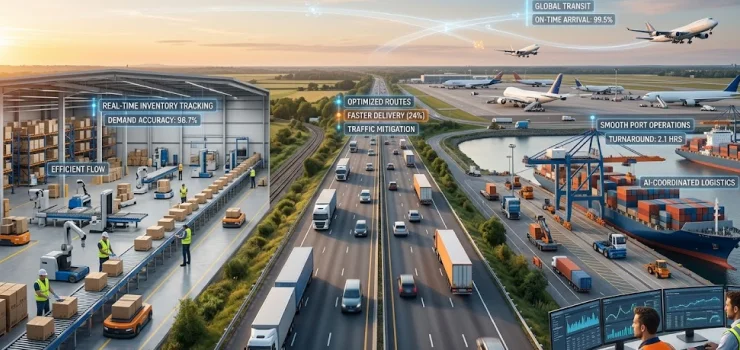
AI logistics optimization predicts demand during peak demand periods, analyzes promotional lift potential, considers warehouse constraints, and suggests optimal inventory pre-positioning to avoid expediting costs.
Distribution Network Optimization
Predictive supply chain analytics help suggest optimal stock positions for each SKU at each distribution center to optimize landed cost while ensuring service levels, faster replenishment, and lower transfer waste.
Eliminate inefficiencies with intelligent supply chain solutions.
Let's ConnectBusiness Impact
Measurable Results Organizations See With Our AI Supply Chain Optimization Solution
AI-powered supply chain optimization from MultiQoS reduces inventory carrying costs, eliminates forecast-driven stockouts, and improves working capital efficiency within 12 months of deployment.
Accuracy in Demand Forecasting
Accurate forecast for SKU-locations, removing all elements of uncertainty that cause both overstock and stockouts.
Savings in Inventory Holding Costs
Savings were made due to holding lower inventory costs from adjusting safety stocks and reordering according to demand volatility.
Savings in Stockouts
The savings being generated from lower stockout incidences translate to high order fulfillment rates.
Payback Period
The payback period is from the initial implementation until full returns on investments are made.

Integration
How MultiQoS Gets Deployed In Your Current Supply Chain Technology Stack
MultiQoS works with the systems you currently have in place, including your ERP, WMS, supplier portals, and logistics providers, by leveraging their standard connectors and APIs.
ERP and Financial Planning Integration
MultiQoS integrates with ERP solutions such as SAP, Oracle, Microsoft Dynamics, and others to get data on historical demand, open purchase orders, and product information into the AI-powered forecast algorithm.
Warehouse Management System Connectivity
Inventory position data collected by your WMS system is used by the replenishment module of MultiQoS to make sure that on-hand inventory, transit inventory, and backorders are accounted for in every replenishment signal.
Supplier EDI and Portal Connectivity
Order confirmation, purchase order acknowledgments, and advanced shipping notifications are communicated through EDI transactions and supplier portals.
TMS and Carrier Integration
Logistics optimization using artificial intelligence leverages TMS software capabilities in order to account for transportation availability, costs, and delivery schedules when planning logistics.

Why Choose Us
Why You Need MultiQoS For Your AI-Driven Supply Chain Optimization
The MultiQoS AI algorithms are customized for supply chain and inventory optimization scenarios, with domain knowledge on demand variation modeling, lead-time distribution evaluation, and multi-echelon network optimization.

Fast Deployment on Lean Datasets
MultiQoS achieves production-ready forecast accuracy on 18-24 months of historical sales records per SKU-location pair, resulting in quick go-live on newly onboarded categories and distribution nodes without waiting until decades of data collection are completed.
AI Solution Compatible
The MultiQoS AI supply chain analytics have been implemented in conjunction with ERP/WMS solutions offered by over ten different enterprise software vendors.
Continuous Training of Forecast Models
Continuous training and updates of our AI demand forecasting models happen automatically whenever your SKU set, distribution networks, and suppliers change, without the need for a new project setup cycle.
Forecast KPIs Designed in Partnership
The forecast accuracy, service level, and inventory turnover targets are co-defined with your supply chain, procurement, and finance leadership to keep the solution focused on the business-relevant metrics.
FAQs
Frequently Asked Questions
How much historical data do you need to be able to produce production-ready demand forecasts?
The MultiQoS AI-based demand forecasting solution is trained to reach production-ready levels with just 18–24 months of history per SKU x location, which is much less data compared to traditional statistical forecasting techniques that need at least 3–5 years of data to stabilize the seasonal model.
If there is no history available for new SKUs, locations, or distribution points, the solution will use category-level analog models as an initial basis to build first demand forecasts along with the confidence intervals.
Will your AI solution integrate with our existing ERP and WMS solutions?
Yes, our AI-powered supply chain optimization solution integrates seamlessly with leading ERP and WMS platforms through standard APIs and pre-built connectors, minimizing disruption to your existing workflows.
Does your AI forecasting differ from what is native to our existing ERP system?
The difference between AI and statistical demand forecasting is that the AI supply chain analytics platform learns from live demand data, taking into account any changes in promotional uplift, channel mix, supply chain disruptions, etc. that cannot be taken into account by any rule-based ERP-native planning engine.
What about those rare and hard-to-anticipate cases, such as new demand patterns, channels, or SKUs?
Signals that are outside the learned model patterns get flagged up in a review queue, where they are evaluated by the planning team for accuracy, based on both forecast confidence level and the underlying demand data. Reviewed forecast signals, then became training data for the specific SKU-demand context.
How long will it take to implement the solution in our company?
If you consider deploying the AI-based solution only for one specific product category, or one distribution center, expect to complete the whole process in 8–10 weeks, starting from project kick-off till delivery of live replenishment signals.