
Machine Learning in Sales: Benefits, Use Cases, and How to Get Started
Need quick insights? Summarize with AI & save time
 ChatGPT
 Perplexity
 Claude
 Google AI Mode
Table of Content
- What Is Machine Learning in Sales? (And How It Differs from Basic Automation)
- Key Benefits of Machine Learning in Sales
- Top Machine Learning in Sales Use Cases (With Real Examples)
- Use Case Comparison: Impact, Data Requirement, Time to Value
- How to Get Started with Machine Learning in Sales (Step-by-Step)
- Conclusion
- FAQs
Summary:
Traditional B2B sales methods that rely on manual forecasting and static CRM reports are failing revenue teams, with 69% of sales executives finding forecasting more difficult than it was three years ago. This comprehensive guide introduces Machine Learning (ML) in sales as the solution, moving organizations from gut instinct to algorithmic precision.
You will learn how ML analyzes historical data and buyer signals to predict conversion, driving a potential 10% to 20% improvement in sales ROI. The blog details six key benefits, including unparalleled forecasting accuracy and laser-focused lead prioritization.
It explores five high-impact use cases, from predictive lead scoring to dynamic pricing optimization, and provides a practical 5-step roadmap for implementation to ensure a successful transition from pilot to production.
Most B2B businesses use spreadsheets and static CRM reports, which means sales forecasts are unreliable. This renders sales forecasting difficult. Gartner reported 69% of sales operations executives believe that forecasting is more difficult than it was three years ago. Groups take time on leads that convert well but don’t convert.
Also, sales managers often find themselves in the position of not knowing which opportunities to focus on due to the absence of lead-scoring systems. Machine learning rectifies that.
It studies historical deal data, buyer signals, and sales representative activity to predict what will actually convert. McKinsey research shows companies investing in AI capture revenue uplift between three and 15%, with sales ROI improving ten to 20% across the function.
This guide explains what machine learning development does for sales, the highest-impact use cases, and a step-by-step roadmap to move from pilot to production without burning a year on data cleanup.
What Is Machine Learning in Sales? (And How It Differs from Basic Automation)
Machine learning (ML) in sales is the use of algorithms that learn from your past and sales outcomes data in your CRM and buyer behaviors to make future predictions. These systems enhance their performance over time and do not need to be explicitly programmed for each new scenario or market change, as is the case with traditional software.
It is not technical in nature, so consider the traditional software as regular spreadsheet formulas. Specific instructions must be given as to what and how to calculate. In contrast, machine learning can be considered a system that self-formulates formulas from the patterns it finds in your data.
While there are similarities and easy misconceptions about machine learning and sales automation, they are very distinct:
- Rule-Based Automation: This is an automation that is based on the “if/then” logic. For instance, if the lead score is set to 80, the lead will be automatically added to a sales rep’s list.
- Machine Learning: This is an agile and predictive way. Rather than having just one static rule, an ML model looks at 200+ variables at once (including email response time, website browsing, firmographics, and more), and applies a formula to determine an accurate probability of conversion.
In most situations, you’ll find that there are two types of algorithms you’ll come across when trying to implement machine learning in your revenue engine:
- Supervised Learning: This algorithm is taught using past data that has known outcomes (which deals have won or lost). This is the technology behind predictive lead scoring and deal forecasting with a high level of accuracy.
- Unsupervised Learning: The algorithm is used to uncover patterns or clusters within the data without any labels. This is mostly used in the field of sales to provide more advanced customer segmentation and anomaly detection, including flagging out-of-the-ordinary usage of your products at the customer level to predict churn.
However, these algorithms are only able to work if they have a solid base of information to work from, but they work strictly based on past behaviors. Generally, you need at least a year of historical CRM data to create a robust model and make accurate predictions.
Key Benefits of Machine Learning in Sales
Transitioning from intuition-based selling to algorithmic precision fundamentally transforms how sales organizations operate. The application of machine learning in sales fundamentally transforms how sales organizations operate.
By integrating AI development services into your tech stack, your organization can move beyond generic automation to deploy intelligent systems that actively drive revenue.
Let’s take a look at six tangible sales process improvements that are directly attributable to measurable business improvements:
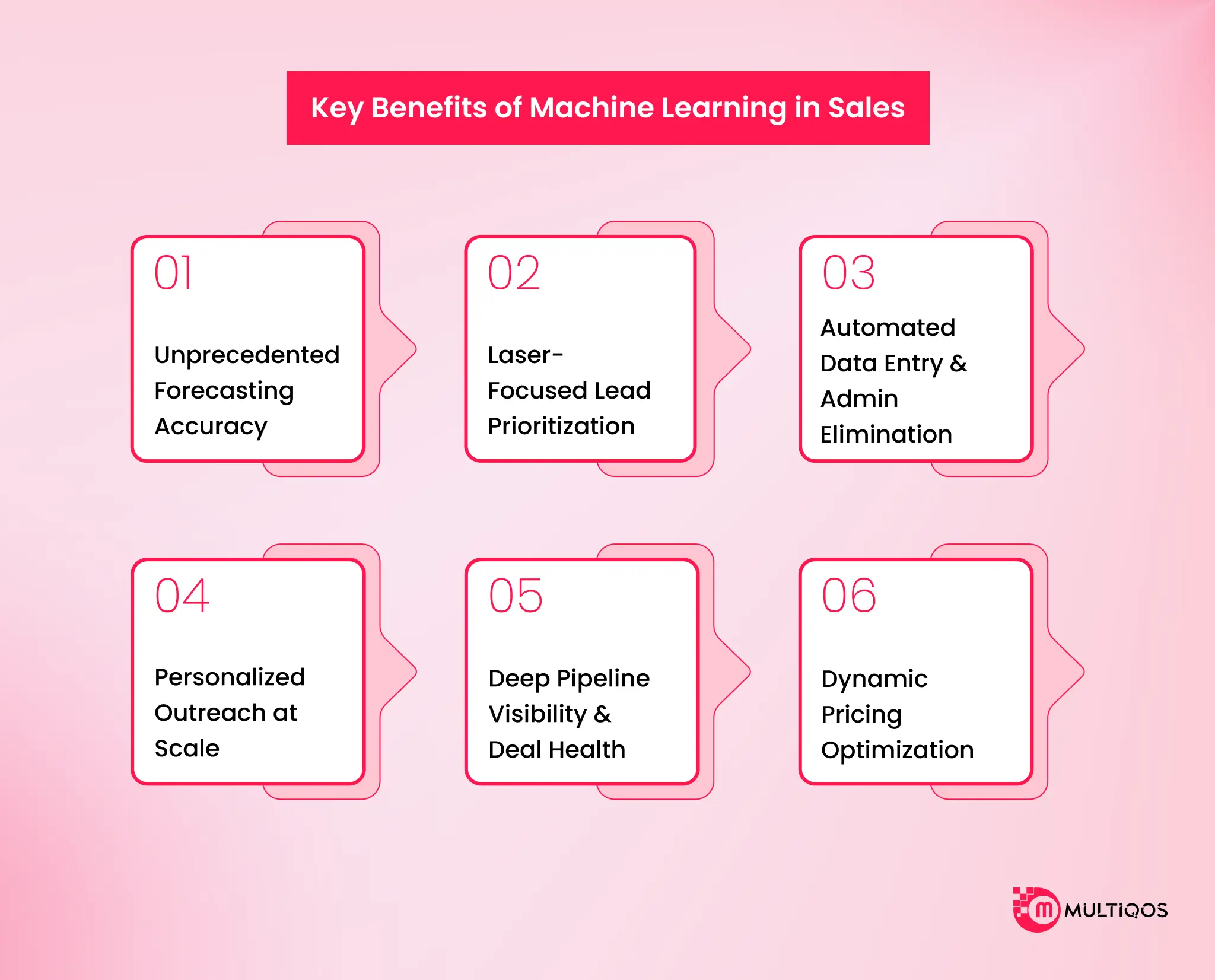
1. Unprecedented Forecasting Accuracy
For many years, sales forecasting has been based on gut feelings and subjective sales rep updates, which resulted in erratic revenue forecasts. In contrast, machine learning in sales models can create extremely accurate predictions.
What it means to the revenue leader: Forecasting errors can be cut in half or more, allowing revenue leaders to make confident budget decisions, manage workforce, and ensure revenue growth is scalable for stakeholders.
2. Laser-Focused Lead Prioritization
Not all leads are created equal. Effective machine learning in sales applies AI predictive analytics capabilities to create a robust lead scoring system. This includes firmographic data, along with nuanced behavioral buying signals, and ranks prospects based on their actual likelihood to convert.
Representatives spend only time with high-intent buyers instead of wasting time on unqualified leads. This can directly impact an overall increased win rate of 15-20% and considerably reduce Cost Per Acquisition (CAC).
3. Automated Data Entry & Admin Elimination
The sales representatives spend as much as 60% of their time on non-revenue-generating tasks. Machine learning in sales automatically adds relevant context to CRM records by listening and reading, without any manual data logging required.
These workflows are automated, saving 5+ hours/week/rep, which contributes to driving call volumes, more meetings, and increased quota attainment, all over the board.
4. Personalized Outreach at Scale
Today, customers want hyper-relevant communication, and with high volumes, that is impossible to do manually. When applying machine learning in sales, algorithms can craft the sequence of messages to an individual prospect through a series of customizations.
This includes the analysis of their user behavior, industry news, and previous interactions, and by determining the best time to send messages, and what content is most relevant to include.
Scalable Relevancy = Higher Open & Reply Rates = A Thicker Funnel at the Top Without an Additional SDR Team.
5. Deep Pipeline Visibility & Deal Health
Deadlock on the deal can slowly be fatal if it is not detected early. Effective machine learning in sales platforms cross-checks the entire pipeline to give managers scores on deals as they move. The AI identifies opportunities that are at risk of going cold using the analysis of the communication frequency, engagement of the stakeholders, and sentiment.
This visibility in real-time helps to implement proactive management interventions. As sales, marketing, and customer success data converge, this kind of deal intelligence becomes a core part of how RevOps and AI agents work together to keep the entire revenue engine aligned.
6. Dynamic Pricing Optimization
Machine learning models have the ability to determine competitor pricing, stock availability, customer lifetime value (CLV), and negotiation thresholds from the past to suggest the best price or discount, in real time, for a specific deal.
The more dynamic the pricing is, the better the margin protection. If you’re looking for more context on the impact of AI on revenue functions, check out how AI in retail transforms customer-facing operations & forecasting workflows at scale.
Top Machine Learning in Sales Use Cases (With Real Examples)
Machine learning has gone beyond the realm of mere concept for data scientists; machine learning in sales is driving the modern revenue engine. Let’s take a closer look at five successful machine learning use cases that are changing the way that sales teams operate today.
1. Sales Forecasting
Using historical win/loss data, seasonality, market trends, and active pipelines to model future revenues with predictive algorithms.
The traditional forecasting method heavily depends on a sales rep’s “gut feeling” or overly optimistic pipeline updates, resulting in fluctuating forecasts. With ML, the bias is eliminated, providing revenue leaders with mathematical certainty to make budget and headcount decisions safely.
Vodafone, a global telecoms services company, used machine learning to streamline its sales planning and forecasting globally. They eliminated the process of making a manual estimate and were able to generate highly accurate forecasts that aligned their global sales resources.
2. Predictive Lead Scoring
Analyzing thousands of data points – firmographics, job titles, subtle buying signals, and more to assign a mathematical likelihood of conversion to each prospect.
Not all leads are created equal. Predictive scoring takes the time out of the sales rep’s process to narrow down to the hottest prospects, and dramatically reduces Customer Acquisition Cost (CAC) and increases sales win rates by eliminating time spent qualifying lists manually or chasing after low-intent prospects.
Fintech giant Razorpay used a machine learning lead scoring algorithm that would constantly monitor social media engagement and website activity. This enabled their team to concentrate on higher potential leads, which led to their gross merchandise value increasing by 50% on a month-to-month basis and to their conversion cycle being reduced by one month.
3. Dynamic Pricing Optimization
Leveraging algorithms to automatically analyze competitor pricing, stock levels, buyer intent, and customer lifetime value (CLV) to know the best price to offer or the best discount on a given deal.
It’s important because sales representatives may opt to discount products just to close the sale, thereby reducing their profit. With the pricing guardrail offered by ML, you have the best chance of winning the deal without sacrificing the bottom line.
HP Inc. uses machine learning pricing software to fine-tune the B2B quoting process. The AI system can utilize historical deal information and market conditions to suggest the optimal price to the sales team, helping to minimize rogue discounting and preserve business profit margins.
4. Churn Prediction & Retention
Using data from after the sale, like the frequency of support tickets, the sentiment of communication, product usage drops, etc., to identify accounts that are extremely likely to cancel their contracts.
It’s always more affordable to keep an existing customer than to acquire a new one. When a Customer requests to cancel a contract, the Account Manager should already have the time they need to intervene, to resolve the real problem, and to save the revenue.
IBM uses its very own Watson machine learning capabilities to track enterprise client use and engagement. When the model identifies a significant decrease in active software use and a lag between that and the Account Manager’s response, it automatically alerts the team to a high-risk situation, and they will discuss the health check proactively.
5. Personalized Sales Outreach
Making use of the power of ML and Generative AI to analyze the digital presence, news coverage, and interactions of a prospect and automatically generate personalized email sequences and provide optimal send times.
Today, customers don’t read generic, template-rendered spam. But when a rep manually finds and composes hyper-personalized emails to hundreds of prospects, they are constrained in the volume of outbound. Teams can scale relevance without compromising volume when using ML.
This is a real-life example of an AI tool called Albert that a New York Harley-Davidson dealership used to automate and personalize its sales outreach and lead generation.
The machine learning algorithms identified prospects of great value, and tailored the messaging, which helped grow their qualified lead volume from 1 to 40 per day and dramatically improved motorcycle sales.
Use Case Comparison: Impact, Data Requirement, Time to Value
|
Use Case |
Primary Outcome | Data Required | Time to Value |
|
Sales Forecasting |
Accuracy lift, board confidence | 12 to 24 months of deal history | 8 to 12 weeks |
|
Predictive Lead Scoring |
Conversion rate improvement | Closed-won and closed-lost labels | 6 to 10 weeks |
| Dynamic Pricing | Margin protection, deal economics | Historical pricing and win-loss data |
10 to 14 weeks |
| Churn Prediction | Renewal retention, expansion lift | Product usage and support history |
8 to 12 weeks |
| Personalized Outreach | Reply rate, meeting bookings | Email engagement and CRM activity |
4 to 8 weeks |
How to Get Started with Machine Learning in Sales (Step-by-Step)
Most ML projects fail in the data stage, not the modeling stage. Deloitte found that 74% of organizations hope to grow revenue from AI initiatives, yet only 20% are already seeing it. The gap is execution, not ambition. The successful application of machine learning in sales relies on clean data.
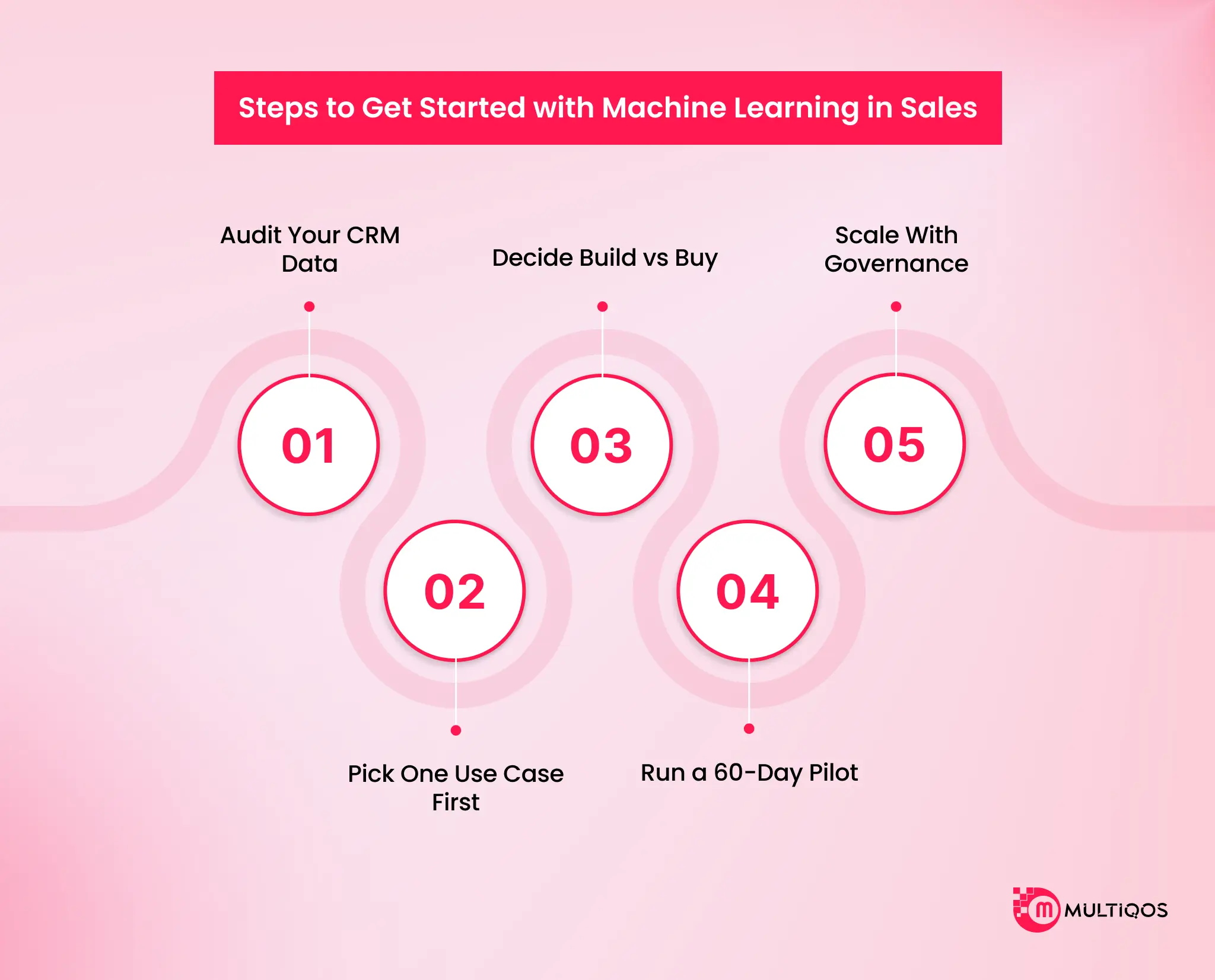
Step 1: Audit Your CRM Data
Additionally, Statista reports that machine learning remains the largest segment of the AI market and is expected to hold that position through 2030. Pull a sample of twelve months of closed deals. Check field completeness, stage consistency, and source attribution accuracy. If reps log activities inconsistently, fix the process before training a model. Garbage data trains garbage models every single time.
Step 2: Pick One Use Case First
The quickest return on investment is achieved from lead scoring or forecasting. For the first sprint, skip all the other sprints. If one is to be satisfied with the solution to five problems, then he will be satisfied with none of them.
Step 3: Decide Build vs Buy
The tools that are available off-the-shelf, such as Salesforce Einstein, HubSpot AI, and Gong, work quickly with regular CRM data. Proprietary data, deal complexity, and industry context often necessitate a custom model, which will be the correct solution. The first thing that most mid-market teams should purchase, and the second thing that they should build.
Step 4: Run a 60-Day Pilot
Choose one team or one region. Lock in baseline metrics first: win rate, cycle time, forecast accuracy, conversion rate. Run the model in parallel with the current process. Compare the outputs honestly before scaling further.
Step 5: Scale With Governance
Production deployment needs more than a trained model. You need monitoring for drift, retraining pipelines, role-based access for predictions, and sales representative adoption tracking.
Many organizations now treat agentic AI as the next layer once predictive models are stable, so AI agent development services become the natural follow-on for revenue teams.
Common blockers stop most teams in their tracks. Poor data quality kills model accuracy. Plus, lack of executive sponsorship kills funding the moment results slow. Plan for all three before you start the build.
Conclusion
Machine learning in sales is not a substitute for sales reps but an addition for every other task they do: sales forecasting, lead prioritization, pricing, and personalization without having to guess.
For organizations that are prepared to take their pilot systems to production-ready systems, MultiQoS can create ML solutions that seamlessly fit into the current sales stacks, such as Salesforce, HubSpot, and Dynamics 365, and can be implemented within a period of 6-12 weeks for the first use case.
Implementation, 60-day pilot, and governing and scaling 1 use case is the way forward. Now is the time for companies to implement this technology in order to establish revenue expectations for the coming decade.
FAQs
The general term for systems imitating human intelligence in things such as predictions and language is artificial intelligence. The subset that is learning from the sales data directly, without any special programming, is a subset of machine learning.
Typically, a dozen to a couple of dozen months of clean CRM data with uniform stages of the sales process are required for most production lead scoring and forecasting models. Lighter historical data sets can be used with smaller teams to begin using off-the-shelf tools.
In real application cases, AI investments get 10x to 20% improvement in sales ROI, according to McKinsey, and 3x to 15% revenue uplift. The time to pay back is normally 6 to 18 months, depending on the readiness of the data and its adoption speed.
Yes, but the use case should correspond to the amount of data that the group has to work with. This is because lead scoring and email personalization are the most valuable tools for teams with less historical information needed than full forecasting, which is under 50 reps.
Both Salesforce Einstein and HubSpot AI deliver built-in ML capabilities for scoring and forecasting, while Pipedrive also includes similar capabilities. Salesforce Einstein, HubSpot AI, Microsoft Dynamics 365 Sales Insights, and Pipedrive all have built-in ML features for scoring and forecasting. Custom needs can be met with dedicated models that can connect to any CRM via standard APIs.

Get In Touch

Get Stories in Your Inbox Thrice a Month.
Enterprise AI Implementation Challenges: Common Roadblocks and How to Overcome Them

Computer Vision in Retail Explained: From Smart Shelves to Smart Stores

The Complete Guide to Machine Learning in Healthcare: Uses, Benefits & Challenges