
How AI is Transforming Manufacturing: Key Use Cases
Need quick insights? Summarize with AI & save time
 ChatGPT
 Perplexity
 Claude
 Google AI Mode
Table of Contents:
- Introduction
- What is AI in Manufacturing?
- The Impact of Artificial Intelligence in Manufacturing
- Top Use Cases of AI in Manufacturing: Increasing Efficiency and Innovation
- How MultiQoS AI Solutions Drive Manufacturing Success
- FAQ on AI in Manufacturing
Introduction
Artificial intelligence, when applied in manufacturing, has many changes that help in its overall transformation. Most large manufacturing firms are applying AI as a competitive tool across the organization to work smarter and faster. The application of AI in manufacturing provides companies with better use of data analytics, machine learning, and digital automation tools to innovate.
These new technologies present a revolutionary step from conventional techniques, providing manufacturers with opportunities to bring their business into the new age, to become more immediate, and to remain relevant in a market that never stays still for long.
According to McKinsey & Company, around 88% of organizations already use AI in at least one business function, though many are still in the early stages of scaling it. In this article, we will discuss key manufacturing cases of AI that are shaping future breakthroughs in productivity, inventions, and competitiveness.
These examples show how AI is being employed successfully in a range of ways to improve efficiency, product development, and the re-establishment of its existence in the supply chain and smart factory practices.
What is AI in Manufacturing?
In today’s manufacturing environment, industrial IoT and intelligent services create massive amounts of data daily. This data is increasingly being utilized by manufacturers via AI technologies, consisting of machine learning (ML) and deep learning.
Perhaps one of the most giant uses of AI in manufacturing is in the prevention of system failure. This has the benefit of lowering maintenance costs and time on the production lines. AI also has other advantages; those include improved demand estimates and minimized waste.
The Impact of Artificial Intelligence in Manufacturing
AI is specifically useful in industries consisting of manufacturing because of its potential to manner and examine information accrued via IoT development and factories.
To effectively deal with this data, manufacturers are now employing and adopting AI technologies, including machine learning and deep learning neural networks, in order to make better decisions.
It is worth noting that AI is an indispensable tool in increasing output, capacity, and, in many ways, even the decision-making process. Quality control is another sector where the application of AI is highly effective. Through machine learning, systems are able to point out defects on products to make certain that only quality products get into the market.
Furthermore, AI tracks processes in smart manufacturing in real-time, offering solutions to optimize them and control resource wastage.
Summing up, the integration of artificial intelligence in manufacturing is becoming a key driver for change, increasing competitiveness and improving business processes.
As a way of increasing our knowledge of the results of using this era in manufacturing, underneath are some real examples of AI usage in production.
Top Use Cases of AI in Manufacturing: Increasing Efficiency and Innovation
Manufacturing in 2026 does not operate as a set of disconnected plants anymore. Systems across production, enterprise platforms, and machine networks interact continuously. Data moves across OT and IT layers without interruption, and AI now sits directly inside that flow, influencing decisions as they happen.
The change is gradual but visible. It shows up in how factories handle everyday situations rather than in isolated technology adoption. Here are some of the use cases where this shift becomes easier to see.
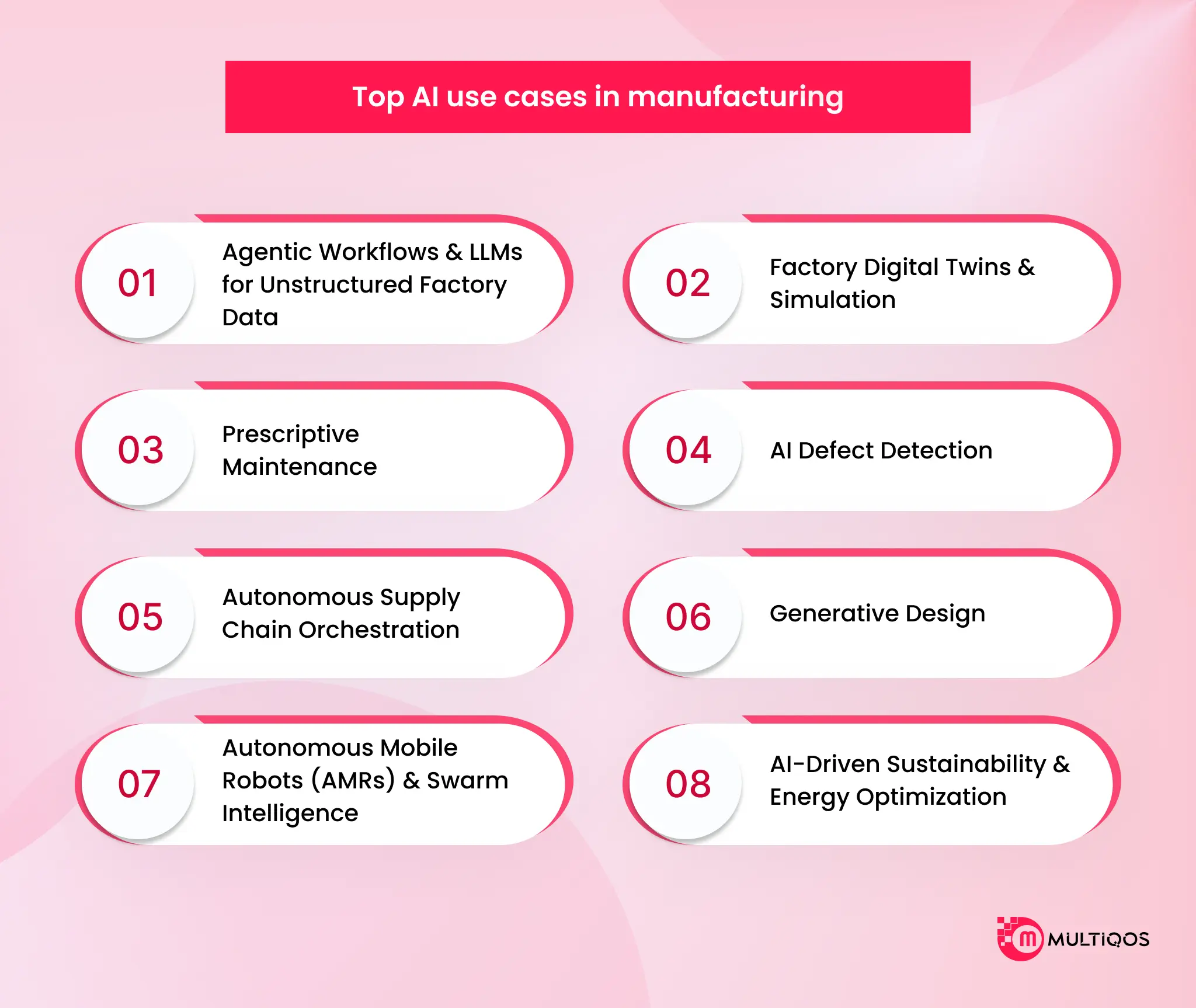
Agentic Workflows & LLMs for Unstructured Factory Data
Factories generate a steady stream of unstructured information. A large portion of this data comes from maintenance logs, technician notes, and shift updates, but most of it is not stored in structured systems in a usable way.
That is starting to change. AI models can now read these inputs and connect them to operational systems.
A note written by a technician no longer remains just a record. It can trigger actions. It may create a maintenance task or initiate a check for spare parts. In some cases, it can even connect to procurement systems without manual intervention.
This reduces the need for coordination between teams. In large automotive plants, it also shortens the time between identifying a problem and taking action.
Factory Digital Twins & Simulation
Digital twins no longer sit in the background as simulation tools used during planning phases. Many teams now run them alongside production. They receive live data, machine signals, sensor inputs, production flow, and reflect what is happening on the shop floor.
Engineers use them when decisions carry risk. Instead of changing production settings directly, they test those changes first in a virtual environment. The model shows how the system reacts.
They are able to see bottlenecks, delays, and capacity issues before they make any physical alterations. This method is already used by many semiconductor manufacturers, so any minor changes can influence yield greatly.
Prescriptive Maintenance
Maintenance has moved past prediction in several environments. Systems now point toward action. Machines generate continuous signals. Some changes are small, slight vibration shifts, and minor temperature variation. Over time, patterns emerge.
AI models interpret those patterns and flag early-stage issues. But they do not stop there. They suggest what needs to happen next. In some cases, they create tasks directly.
They also check whether parts are available and whether timing aligns with production schedules. In power plants, teams rely on this to plan turbine maintenance based on actual operating conditions instead of fixed timelines.
This is how AI predictive maintenance systems support more proactive and efficient maintenance strategies.
AI Defect Detection
Quality inspection no longer waits until the end of production in many setups. Cameras capture product images as items move through the line. AI models process those images in real time. Some defects are easy to miss at high speed.
Surface inconsistencies, alignment issues, and small structural variations appear more clearly when systems analyze them continuously. When the same issue appears repeatedly, the system does not wait for manual review. It feeds information back into production.
Adjustments happen closer to the source. Electronics manufacturing uses this to detect circuit board defects during assembly rather than after testing stages, enabled by AI-powered visual inspection systems.

Autonomous Supply Chain Orchestration
Supply chains rarely move in a straight line. Delays, disruptions, and sudden demand shifts are common. What has changed is how systems respond. Instead of waiting for periodic planning cycles, they react to signals as they appear.
Data from suppliers, logistics networks, and demand systems feeds into the same layer. When something changes, the system evaluates options. It may reroute shipments or shift inventory across locations. Some actions run automatically. Others still need human review, especially when decisions carry a higher impact. This approach is widely used in consumer goods networks during logistics disruptions. A similar capability comes from AI-driven supply chain optimization, where systems analyze demand signals and improve decision-making across the network.
Generative Design
Design processes no longer depend only on repeated manual refinement. Engineers now define constraints, material, cost, weight, and performance. Systems generate multiple design options within those boundaries. The process changes from creation to evaluation.
Instead of building each version step by step, teams review options that already meet requirements. This allows them to explore combinations that would take much longer to develop manually. In aerospace, this supports weight reduction without compromising structural performance.
Autonomous Mobile Robots (AMRs) & Swarm Intelligence
Movement flexibility in factories has also been enhanced. A specific route does not direct the autonomous mobile robots. They use mapping systems and sensors to navigate on the fly. They also change routes when the layouts vary or there is congestion.
Robot coordination is not necessarily based on a central controller. Systems exchange data with other units, and, therefore, respond to a similar environment. This minimizes the use of infrastructure. This is a strategy employed in automotive plants to maintain a constant material flow despite variations in production schedules.

AI-Driven Sustainability & Energy Optimization
Energy usage no longer follows static schedules in many manufacturing environments. Systems track consumption continuously at the machine level. They compare usage with production output and identify inefficiencies as they appear.
Adjustments happen in real time. Load distribution shifts. Equipment usage changes slightly to balance efficiency and output. In energy-intensive industries like steel, this approach helps control costs while improving overall efficiency.
How MultiQoS AI Solutions Drive Manufacturing Success
MultiQoS AI Solutions in Manufacturing are reshaping the manufacturing industry by implementing deep artificial intelligence approaches to achieve daily operations. MultiQoS then allows companies to optimize their operations by implementing artificial intelligence into their manufacturing processes to maximize quality while reducing costs.
Its AI solutions incorporate a range of features, such as the use of artificial intelligence as a machine learning tool, natural language processing, and computer vision to enhance quality control through automation, predict equipment failure, and optimize production lines for manufacturers.
In addition, what makes the systems based on AI outstanding is that they will work efficiently, day and night, then give real-time results, which will simplify work processes and help to achieve more for less money.
Ready to take your manufacturing operations to the next level with AI? Contact MultiQoS today to explore how our innovative solutions can drive your success and revolutionize your industry.
FAQ on AI in Manufacturing
AI improves industrial productivity through inventory management, prediction and maintenance, and improving the quality of the product. It helps in making many decisions based on the data and promotes change in the whole sector.
Yes, AI enhances the quality of the products and minimizes the risk of producing defective products by basing its analysis on data collected so there will be no inconsistency in quality.
Some of these are using machine learning for monitoring equipment health, computer vision for defect detection or identification, and AI algorithms for intelligent supply chain planning and demand forecasting.
The future of AI lies in more cutting-edge innovations, the main of which are generative AI for design, robotics AI for sophisticated operations, and AI application in supply chain in a way that is smarter and more adaptive.
AI positively impacts the supply chain by forecasting the demand, inventory management, disruption detection, and optimized logistics, and hence makes the supply chain more effective and economical.
Automated visual inspection for quality control, predictive analytics for maintenance, robotic automation for assembly lines, and AI-based systems for scheduling in assembly lines are some of the AI application areas.

Get In Touch

Get Stories in Your Inbox Thrice a Month.

A Comprehensive Guide on How Machine Learning is Transforming the Factory Floor

MultiQoS Technologies Named an OpenAI Select Partner