
AI Defect Detection Use Cases: How Manufacturers Are Eliminating Quality Failures at Line Speed
Need quick insights? Summarize with AI & save time
 ChatGPT
 Perplexity
 Claude
 Google AI Mode
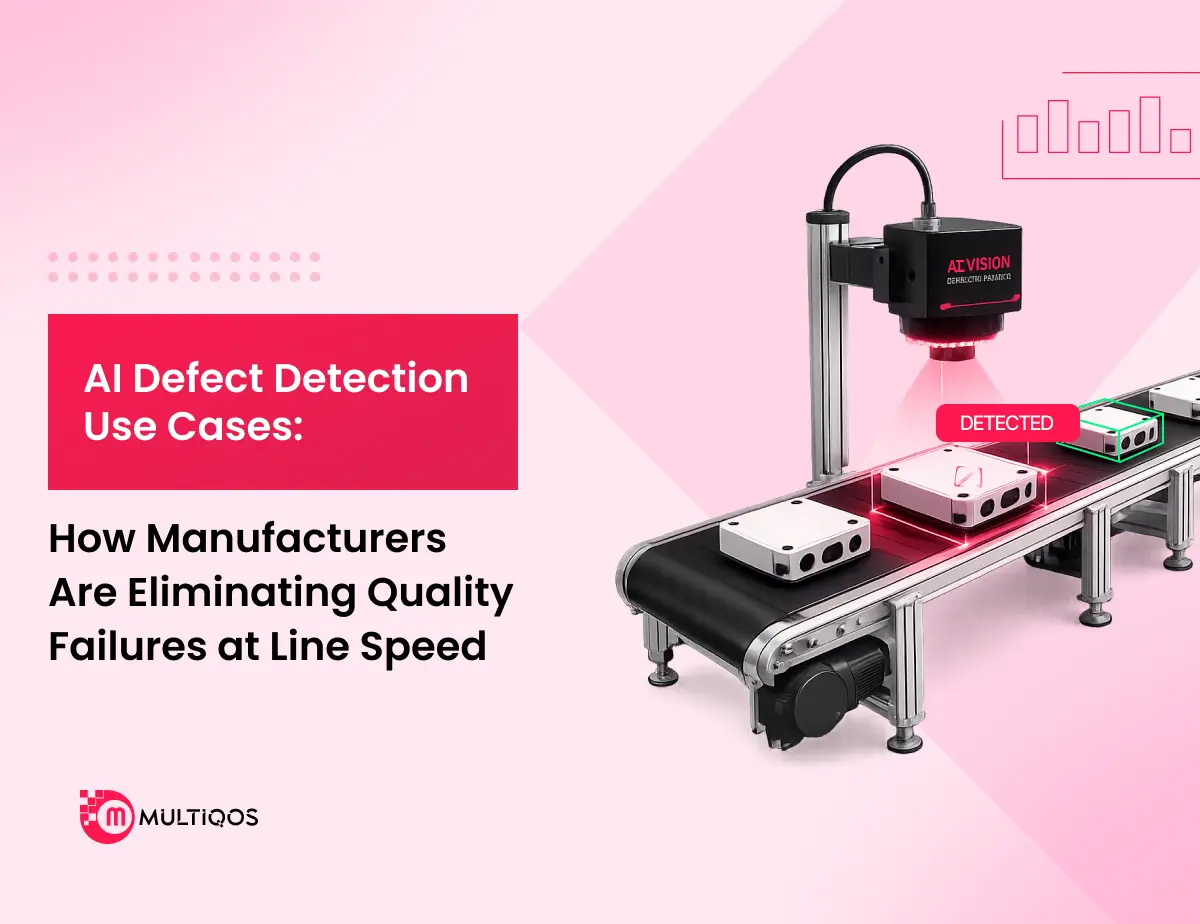
Table of Content
- What Is AI Defect Detection and How Does It Actually Work?
- 7 AI Defect Detection Use Cases Across Industries (Where Real Deployments Are Delivering Results)
- Why Traditional QC Methods Are Failing at Scale (and What AI Actually Changes)
- Conclusion
- FAQs
Summary:
This blog explores how manufacturers are replacing traditional, error-prone visual quality control with AI-driven computer vision systems. By leveraging Convolutional Neural Networks (CNNs) and Edge AI, these systems analyze products in under 50 milliseconds without slowing down production lines. It breaks down 7 specific, proven use cases across major industries—including Automotive, Electronics/PCB, Semiconductor, Textile, Pharmaceutical, Food & Beverage, and Aerospace. Finally, it outlines the critical difference between stalled pilot programs and successful, production-grade deployments, offering actionable advice for operations leaders to achieve zero-defect manufacturing and rapid ROI.
AI defect detection is the practice of using computer vision and deep learning for real-time defect detection in production lines. Poor quality costs manufacturers between 5 and 20% of annual revenue, according to the American Society for Quality (ASQ).
Human inspectors miss 20% more defects after just 30 minutes of continuous visual inspection. That is not an outlier. It is a physiological baseline that affects every quality inspection shift, across every facility, every day. At high production volumes, that degradation compounds into recalls, warranty claims, and customer attrition that show up in your ROI long after the root cause is forgotten.
This blog targets operations leaders and quality engineers who have already moved past the foundational question, offering an insight into key AI defect detection use cases. It helps you find answers to
- Which production environments are delivering the strongest results?
- What do proven deployments look like, sector by sector?
- Where is the gap between a vendor pilot and a production-grade system?
So, let’s start with the most fundamental question.
What Is AI Defect Detection and How Does It Actually Work?
AI defect detection is based on camera technology and neural networks and examines each unit of product at full production speed. Convolutional neural networks (CNNs) are used to compare images with the pattern of defects learned by the system, classify the anomalies, and activate the rejection mechanisms, all in less than 50 milliseconds, without stopping the line.
Unlike rule-based automated optical inspection (AOI), automated quality control using computer vision represents a fundamentally new approach. Just alter the product variant, tweak the lighting, or add a brand new fault type, and the system generates a massive amount of false positives. It is manually programmed, or your QC team scans for noise during the shift instead of true failures.
AI-driven systems learn. The labeled defect image enhances the confidence of the model in the classification. The system is able to differentiate over time between a cosmetic surface variation that meets your quality requirements and a defect that does not.
The process of detecting in the pipeline:
- Training phase: CNNs are trained with thousands of labeled product images, including good, borderline, and known defect types for your production environment.
- Edge inference: When deployed, the edge AI hardware will be able to dynamically analyze every camera frame locally without a round trip to the cloud, and maintain an average latency of less than 50 milliseconds.
- Classification and rejection: The system puts defect classifications and their confidence scores and notifies the rejection mechanism during the same production cycle.
- Integration with MES/SCADA: Defect classifications directly flow to production dashboards to help perform real-time quality trend analysis and traceability of batches for regulatory audits.
This means that inspections cannot be done with sampling methods, and the outcome is higher inspection coverage. Mathematically ensuring defect escapes is to inspect 10,000 units per hour, with a sample of one in a hundred.
The throughput at full line speed decreases by none at all from the first hour of a shift to the last, with 100% of the throughput covered by AI inspection.
7 AI Defect Detection Use Cases Across Industries (Where Real Deployments Are Delivering Results)
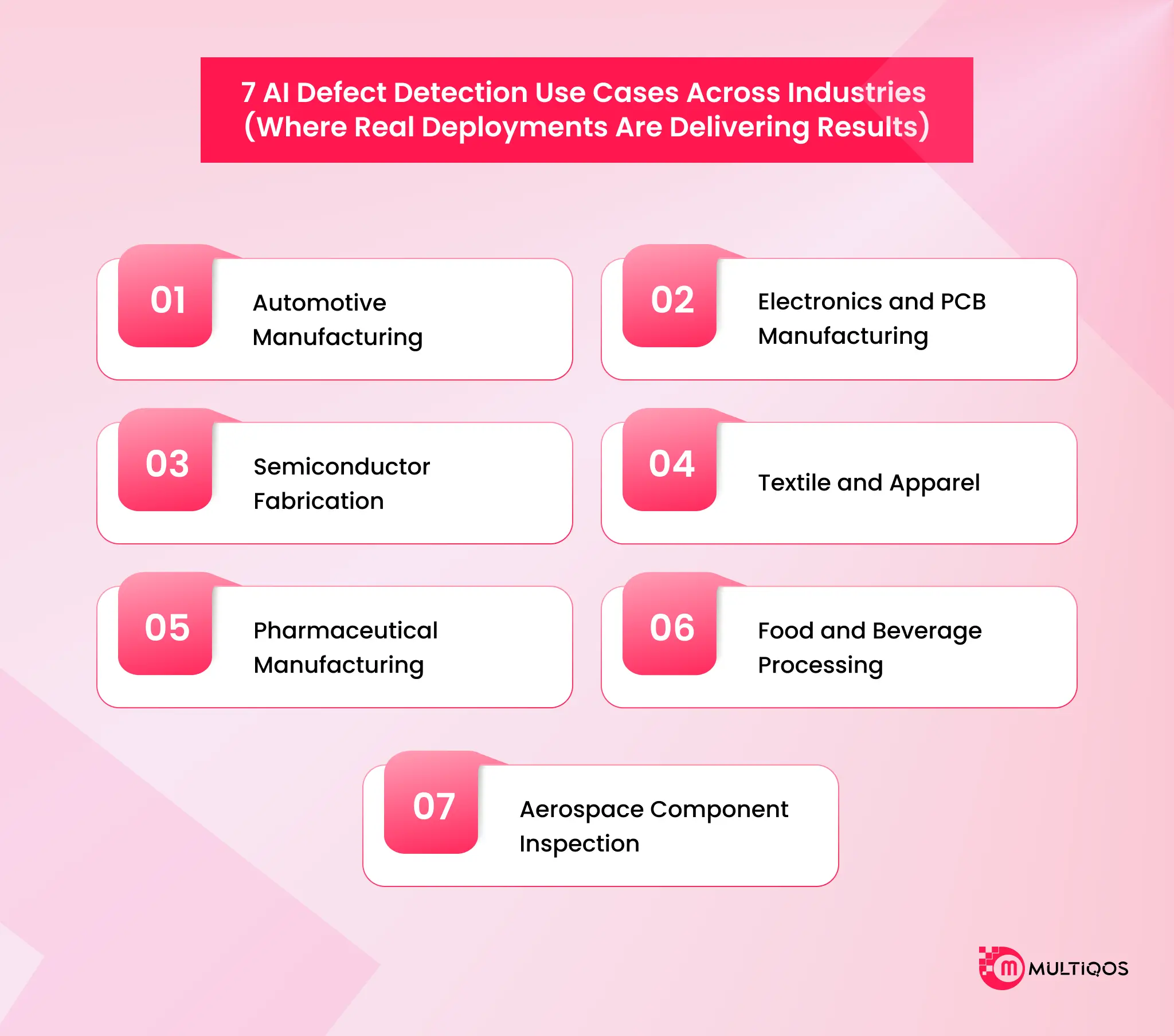
AI defect detection is not a monolithic product. Its architecture, camera configuration, and model training vary significantly by production environment.
Here is where proven deployments are delivering measurable operational outcomes today.
| Industry | Primary Defect Types | Sensor & Camera Type | Core Value Metric |
|---|---|---|---|
| Automotive | Surface cracks, weld seam gaps, NVH | High-res 2D/3D & Acoustic AI | 50% faster inspection gates |
| Electronics | Solder bridging, component misalignment | High-density AOI + YOLOv11 | Simultaneous defect classification |
| Semiconductors | Nanometer micro-cracks, contamination | High-magnification microscopy | Defect-trend yield optimization |
| Textile & Apparel | Weave patterns, continuous fabric tears | High-speed line-scan cameras | 100% continuous roll coverage |
| Pharmaceutical | Vial seals, tablet chips, label compliance | High-speed 2D vision | Audit-ready traceability logs |
| Food & Beverage | Foreign objects, fill levels, seal leaks | X-Ray & Multi-spectrum vision | Non-destructive inline sorting |
| Aerospace | Composite delamination, coating thickness | NDT (Non-destructive) + AI | Automated regulatory trials |
1. Automotive Manufacturing
In today’s automotive manufacturing, the most common inspection issues occur on the surface, in dimensions, when it comes to weld seam quality, and if any unwanted acoustic anomalies are present.
On the structural side, AI visual inspection solutions identify all surface deviations and assembly misalignments at the micron level that completely fly under the radar for human eyes. Nearly zero defect escapes on critical safety components, and inspection speeds are 50% faster for BMW and Tier 1 automotive suppliers versus manual inspection.
One of the most valuable seam inspection applications is for weld seams. A millimeter tolerance in a weld has an impact on the integrity of the structure, but is not detectable to a tired welder after a long shift. It is consistently detected by AI on every part and every cycle.
The final quality gate is the End-of-Line (EOL) testing with the help of AI-based rattle detection systems. Structural perfection is achieved by vision systems, while physical refinement is achieved by acoustic AI. These systems continuously monitor the cabin and chassis space and detect unwanted squeaks, rattles, and vibrations as they happen.
By catching these elusive NVH (Noise, Vibration, and Harshness) problems, which may be missed or subjectively ignored by human testers, absolute NVH quality control is assured, ensuring that acoustically defective vehicles are never delivered to the customer.
2. Electronics and PCB Manufacturing
Solder joint quality, missing components, short circuits, open circuits, and component misalignment are all detectable in a single inspection pass using modern AI architectures. YOLOv11 models can classify hundreds of distinct defect types simultaneously at the PCB level.
YOLO stands for “You Only Look Once.” It is an AI program that manufacturers can use as a set of fital eyes that can look at an image or video to find defects. Modern circuit boards have components smaller than grain of sand. And with YOLOv11 model factories can spot microscopic flaws.
Electronics manufacturing accounts for approximately 35% of the global market for AI defect detection in manufacturing, driven by the density and miniaturization of modern circuit boards that make manual inspection structurally impractical.
3. Semiconductor Fabrication
In semiconductor manufacturing, wafer inspection is carried out on a scale that is not large enough for human vision. Specialized high-magnification cameras with AI systems perform 100% inspection of wafers for contamination, die attach quality, and micro-crack patterns, eliminating the need for statistical sampling.
When one bad wafer can ruin hundreds of thousands of dollars’ worth of batch production, 100% inspection coverage isn’t an option but a requirement. The only acceptable standard is zero defect escapes. Importantly, this comprehensive defect data is then used to continuously optimize yields.
AI can automatically detect and characterize the trends in the nanometer range defects and immediately adjust the manufacturing process parameters, thus ensuring that the highest possible fraction of defect-free chips is delivered on every wafer and avoiding the risk of unwanted system drift, which can plague manufacturing processes.
The systems powered by AI are continuously operating to preserve and enhance this yield at these extreme accuracy levels and do not suffer from fatigue degradation associated with any human inspector.
4. Textile and Apparel
Weave pattern defects, color inconsistencies, holes, tears, and fabric staining all appear at high speed on continuous fabric rolls. Manual inspection of moving fabric is unreliable: the defect passes before an inspector processes what they saw.
AI vision systems maintain 100% inspection coverage at full production speed, flagging defect coordinates for automated marking or line rejection. Consistency across an entire production roll, not just spot checks at the start and end, is the operational outcome that textile manufacturers consistently report as the primary value driver from AI deployment.
5. Pharmaceutical Manufacturing
Drug packaging integrity, label correctness, tablet chip and crack detection, and batch contamination identification all fall within the scope of AI visual inspection for pharmaceutical lines. The stakes are unique: a packaging error or a contaminated batch carries regulatory penalties and patient safety implications that no other manufacturing sector faces at the same severity.
AI inspection provides audit-ready detection logs with full traceability, covering every unit with documented pass/fail records that satisfy regulatory requirements and eliminate the manual documentation burden from your QC team.
6. Food and Beverage Processing
Contamination detection, fill level verification, seal integrity, and foreign object identification are the core inspection tasks in food production. Some defects, such as a glass fragment in a sealed container, are invisible to human inspection without destructive testing. AI vision systems using X-ray integration identify foreign object contamination non-destructively, at full line speed.
Label accuracy and fill level verification run simultaneously, reducing the inspection overhead across multiple quality checkpoints to a single integrated pass. That consolidation directly reduces line footprint and labor cost per inspection task.
Take an example of the AI-powered vision inspection solution deployed by MultiQoS for a food and beverage business. Our solution helps the client detect defects in real time, remove faulty units during production, and reduce waste.
7. Aerospace Component Inspection
Composite material delamination, surface crack propagation, fastener installation accuracy, and coating integrity in aerospace components require inspection precision that manual methods cannot consistently guarantee. AI defect detection reduces inspection time per part while improving detection consistency across inspectors, shifts, and manufacturing facilities.
For manufacturers supplying safety-certified aerospace parts, AI inspection also generates the documentation trail required for regulatory certification automatically, eliminating a separate manual documentation step that currently adds hours to each inspection cycle.
Why Traditional QC Methods Are Failing at Scale (and What AI Actually Changes)
Human inspectors increase error rates during continuous visual inspection. That is not a performance problem with specific people. It is a physiological constraint affecting every sustained visual inspection task. At high production volumes, inspect-for-a-full-shift means your defect escape rate climbs through the day while your throughput stays constant.
Rule-based AOI was supposed to fix this. It did not. Pre-programmed pixel thresholds mean every new product variant, every lighting change, and every previously unseen defect type requires manual reprogramming.
The result is high false-positive rates that overwhelm QC teams, line slowdowns due to manual review, and a system that cannot adapt to product changeovers without engineering intervention.
What separates successful AI deployments from stalled pilots?
According to IDC, 88% of the AI pilots never reach the production stage. The cause is rarely the AI model itself.
The causes are:
- Data pipeline readiness: labeled image datasets that represent real defect distributions from your specific production environment, not generic pre-trained models from a different industry.
- Integration depth: connecting vision output to MES systems, physical rejection mechanisms, and quality dashboards so the system acts, not just alerts.
- Model governance: a defined process for retraining the model as defect patterns shift with new raw materials, process changes, or product variants.
Organizations that treat AI defect detection as a camera installation project hit all three walls. Organizations that treat it as a systems engineering project, combining ML model development with production integration and ongoing governance, ship it to production.

Conclusion
The cost of defect escapes is quantifiable. Traditional inspection methods are structurally unable to match modern production volumes. AI defect detection is deployed at scale across the automotive, electronics, pharmaceutical, semiconductor, food, and aerospace sectors today, with an 8.6% CAGR indicating broad adoption.
The question is no longer whether AI-based quality inspection works. The question is which use cases apply to your production environment and how to ensure your pilot converts to a production-grade deployment rather than stalling in the 88% that never reach production.
Build your use-case shortlist and start with one production line. Validate accuracy, integration, and model governance.
FAQs
AI vision systems detect defects that go below human visual resolution, such as micron-level surface cracks, sub-millimeter dimensional deviations, and even internal contamination via X-ray integration. They also ensure consistency in detection through a production shift.
Human inspectors become less accurate after 30 minutes of continual inspection. For the detection of defects that can’t be seen with the naked eye, like hairline cracks in semiconductor wafers or glass contamination in sealed food packages, AI vision systems are required that have specialized camera configurations trained in your defect distribution.
Production-deployed defect detection systems with AI have achieved 99% or more accuracy for trained defect types, while the accuracy of human inspectors is at 65-70% under continuous operating conditions. The quality of the training set is directly related to the accuracy.
A model learned from a labeled image set that is representative of the actual defect distribution of your production environment will greatly outperform a generic pre-trained model. Benchmark off of your product variations, not demo numbers from other industries by vendors.
The deployment of a production-ready solution usually requires 8-16 weeks, depending on the availability of the datasets, integration needs, and complexity of the production environment. The most time-consuming step is typically the data preparation step, collecting enough pictures to develop a good model with a high degree of accuracy for the type of defects in your product.
This is expedited greatly for organizations with pre-existing image archives from any previous manual or AOI inspections. Do a phased deployment: install a line, test it out for accuracy and integration, and add more lines.
Not necessarily. Most deployments involve the use of AI processing hardware in addition to already installed AOI systems, or the use of AI systems to complement existing camera systems. Rip and replace is not the first choice, and is usually not a solution.
The question that’s more important is whether or not your current cameras resolve enough information and frame rate to see the defect types you need to track. Early in the scoping process, a hardware review helps avoid costly surprises in the deployment.
The ROI depends on the cost of escaping the defects, volume of production, and the existing method of inspection. For applications where manual inspection is being replaced at high-volume lines, payback periods range between 12 and 18 months. These measurable factors that drive ROI are fewer warranty claims, decreased scrap rates, decreased reinspection labor, and increased customer retention.
This is because the cost of each escape is disproportionately high with respect to the investment in the inspection system, which often leads to the highest ROI for semiconductor and pharmaceutical manufacturers, where it has regulatory and patient safety implications.

Get In Touch

Get Stories in Your Inbox Thrice a Month.

A Comprehensive Guide on How Machine Learning is Transforming the Factory Floor

MultiQoS Technologies Named an OpenAI Select Partner