Computer Vision Development Services
Your cameras capture everything and decide nothing. We build computer vision systems that spot defects, flag hazards, and trigger action automatically, tailored to your environment.
Solution Overview
A Computer Vision Development Company Built for Production, Not Pilots
MultiQoS engineers design vision systems for variable lighting, throughput pressure, existing infrastructure, and a quality team that cannot afford false positives. Our approach starts with your environment. We assess camera placement, defect taxonomy, production speed, and integration requirements before writing a single line of model code.
 Years of Experience
With over a decade of industry experience, we bring deep expertise, proven strategies, and reliable solutions that help businesses grow and succeed in a competitive market.
Projects Delivered
We have successfully delivered hundreds of projects across various industries, ensuring quality, innovation, and timely execution tailored to our clients’ needs.
Happy Clients
Our client-first approach has helped us build long-term relationships, earning trust through exceptional service, transparent communication, and measurable results.
Services
Our Computer Vision Software Development Services
Our computer vision development services cover the full delivery lifecycle, from the first feasibility assessment through to a deployed, validated model that your operations team can depend on. Each service mentioned below addresses a specific failure point that commonly breaks vision projects at scale. Choose one capability or let us run the entire pipeline.
Most vision projects fail before model training begins. The use case is poorly scoped, the camera angle is wrong, or the labeled data does not exist. Our consultants assess your production environment, lighting conditions, throughput constraints, and defect classification requirements. We tell you honestly what is achievable and at what accuracy level. You leave with a scoped roadmap, a realistic detection target, and a deployment timeline you can take to budget approval.
Contact UsFrom Idea to Launch
Explore Our Growing Project Portfolio
We have crafted cutting-edge digital solutions for a myriad of businesses with our prowess in the computer vision field.


Turn Your Camera Network Into an Operational Intelligence Layer
You have the footage. You are missing the system that acts on it. Let us scope your first computer vision development project and show you exactly what it would detect.
Book Your Free Vision Assessment
Solutions We Offer
Computer Vision Solutions
Our computer vision solution is designed to address several operational challenges. These capabilities are linked to cost centers, increased scrap rates, reduced planned downtime, review hours, and fraud exposure.
Our vision systems check each unit as it moves through the line at real speed and uncover surface cracks, dimensional deviations, contamination events, and assembly misalignment in real time before they move into the next stage. The faulty units are automatically marked and removed. The accuracy is maintained during a transfer.
We use vision models that are continually observing critical equipment for early signs of wear, such as belt fraying, seal weeping, bearing heat signatures, and abnormal vibration patterns identified optically. If the system identifies early degradation, it sends out an alert to your maintenance team that gives them enough time to plan for action. The line cannot be laid down without planning.
Conduct Image and Video Analysis
Our models are able to automatically identify anomalies, behavioral patterns, and process deviations in live and recorded image and video streams. Security audits, quality checks, and compliance monitoring used to need an analyst's time to perform, but now run all the time, and escalate only the frames that require a human touch.
OCR and ICR
We create pipelines for OCR (optical character recognition) and ICR (intelligent character recognition) to accurately and at a low exception rate extract serial number, expiry date, batch code, and handwritten form fields. The data you extract goes directly into your operational systems, eliminating manual keying and the downstream propagation of errors caused by manual keying.
Face Recognition
We have face recognition systems that can identify persons as they arrive on-site and are used for secure entrance to the premises, automatic attendance, and identity-based fraud prevention. Each system we create has RBAC controls, audit trails required by regulation, and security and encryption at rest and in transit. Identity data remains controlled, accountable, and lawful on the way.
Data Labeling and Annotation
We offer high-volume data labeling and annotation services that adhere to strict data quality, a set of trained reviewers, and multi-stage quality audits. For Labeling Bounding Boxes to Pixel-Level Segmentation, we provide you with clean and scalable training datasets.
Industry-Specific Use Cases
Industry-Specific Computer Vision Use Cases
Computer vision value is domain-specific. The defect on an automotive production line is a fundamentally different detection problem from the anomaly in a medical scan. Below are the deployments where our computer vision development services produce measurable improvements in the operational metrics.
- Manufacturing
- Retail
- Food and Beverage
- Healthcare
- Automotive
- Supply Chain
- Finance & Insurance
- Agriculture
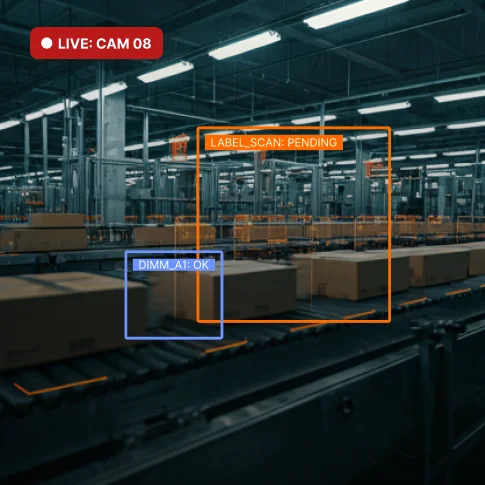
We deploy vision systems that inspect every unit at line speed, verify compliance with assembly sequence, and pull faulty components before they reach downstream processes. Our manufacturing deployments protect throughput and reduce per-unit quality cost simultaneously.
- Defect detection — spotting flaws on production lines faster and more consistently than human inspectors
- Predictive maintenance — visually detecting wear on machinery (cracks, corrosion, misalignment)
- Assembly verification — confirming correct part placement
- Worker safety — PPE compliance monitoring, detecting unsafe zones or behaviors
Why MultiQoS
Why MultiQoS Is a Reliable Computer Vision Partner
Selecting a vision engineering partner means deciding who is accountable for the distance between a controlled demo and a system that holds accuracy on your production floor. Here is where our custom computer vision development services demonstrate accountability across every engagement.
Full System Engineering, Not Isolated Model Delivery
Most vendors deliver a trained model and transfer responsibility to your team. We engineer the full system: data pipeline, inference layer, hardware target, and enterprise integration. The surrounding architecture, including pre-processing, post-processing, and failure handling, is what keeps the system accurate, fast, and maintainable when it encounters the messy reality of your production environment on a daily basis. Our AI development team takes ownership of the complete stack.
Edge and Real-Time Inference Performance
We optimize computer vision software development for the constraint that determines value: inference latency under continuous load. Our deployments achieve sub-50-millisecond inference across hardware configurations ranging from cloud GPU clusters to constrained edge devices. The system performs where the decision has to happen, at line speed, not in a test environment.
Domain-Tuned Model Accuracy
We build and validate models on your data, your defect taxonomy, and your hardest production edge cases. That domain tuning is the engineering decision that separates a model achieving 72 % accuracy in a demo from one achieving 99% or higher in production. Our machine learning development services prioritize this calibration from the first training run.
Governance and Compliance by Design
We architect governance controls into the system from day zero: role-based access control (RBAC), encryption in transit and at rest, and audit trails that satisfy the regulatory posture your industry requires. Compliance is not retrofitted after deployment. It is a design requirement from the first architecture session. Our approach aligns with the same rigor applied across our generative AI development services.
Integration Without Infrastructure Disruption
Your production environment already runs on MES, SCADA, ERP, and existing camera hardware. We deploy vision as an intelligence layer that extends your current infrastructure, not one that replaces it. Vision system outputs feed directly into the operational tools your team uses every day. Alert routing, audit logging, and data export conform to the interfaces your platforms already accept.
Proven Delivery Track Record
MultiQoS has shipped production vision systems, including a real-time AI-powered computer vision solution for a food and beverage client that detected packaging defects at full line speed, removed faulty units during active production, and reduced waste by a measurable margin. Experience in this domain is not a marketing claim. It is the operational history that allows us to scope your project accurately.
Technology Stack
The Technology Stack Behind Our Computer Vision Systems
The reliability of a computer vision system will only be as good as the engineering stack it runs. Spark architecture, inference engine, annotation toolchain, and hardware target all play a role in whether your deployment will be limited to 50ms latency on an edge device or suffer from cloud round-trip issues. This is the production stack that MultiQoS engineers use for all their computer vision projects.
- Python
- C++
- JavaScript
- TypeScript
- Java
- Go
- PyTorch
- TensorFlow
- Keras 3
- Hugging Face Transformers
- OpenCV
- ViTs
- CNNs
- YOLO26 / YOLOv12
- SAM 3.1
- CLIP
- DINOv2
- Stable Diffusion
- CVAT
- Labelbox
- Supervisely
- Roboflow
- V7
- NVIDIA Jetson Orin
- Intel OpenVINO
- Coral Edge TPU
- Qualcomm AI Engine
- TensorRT
- AWS Rekognition
- Azure AI Vision
- Google Vertex AI
- Kubernetes
- Docker
- MLflow
- Weights and Biases
Our Process
How We Engineer Reliable Computer Vision Solutions
We start from your business environment, then design, test, optimize, and incorporate the solution into your current processes. All phases are targeted at production reliability, real-time performance, and measurable business results.
Contact UsDiscovery & Vision Assessment
In order to assess technical feasibility, we analyze camera infrastructure, lighting conditions, movement of objects, defect taxonomy, operational constraints, and business goals.
Data Preparation & Model Engineering
Our engineers gather, preprocess, annotate, and modify image sets to create a dataset that suits your products, environments, and defect types, and build custom computer vision models.
Perform validation and performance optimizations
Optimize inference speed, minimize false positives, and tune model performance to ensure reliable accuracy on cloud, on-premises, and edge hardware.
System Integration & Deployment
Our computer vision outputs directly complement and are integrated with MES, SCADA, ERP, dashboards, and existing workflows, thereby eliminating the need to disrupt your existing infrastructure to trigger automated alerts, quality decisions, audit trails, or real-time actions.
Monitoring & Continuous Improvement
Model performance is continually monitored, data drift is detected, and the model to new production images and optimized for accuracy over time.
Trusted by the Clients
Praising Voices Reflecting Our Dedicated Efforts
Client’s words are a testimonial to our commitment of delivering optimized business outcomes.

“Our vision was understood and they asked really detailed questions to find out what was required. A well-defined process was followed during the development process and the team captured requirements diligently. The team is also flexible enough to adjust to the schedule.”
CEO - Gameday Guide

“I am highly satisfied with their work. Our collaboration is seamless, and we have regular discussions with their developers to define tasks and ensure progress. We were particularly impressed with their excellent communication skills.”
Founder - Screeners Berlin

“I had the pleasure of working with a team that not only demonstrated exceptional punctuality but also made the entire experience enjoyable. Their commitment to timeliness was commendable, ensuring deadlines were met.”
Founder - Michael John Norton

“It's rewarding to work with a diligent and dedicated team. Excellent guys to work with! Always listened to my thoughts and came up with creative design solutions. Whenever you need them, they are available and eager to share their knowledge.”
CEO - Polished


FAQs
Frequently Asked Questions
What are computer vision development services?
What is the accuracy of your Computer vision models?
How long does it take to deploy a computer vision solution?
Is there any special equipment required to implement computer vision?
Are you able to connect with our systems?
What are the differences between developing a custom computer vision system and using a commercial product?
How much will a computer vision project cost?
What do you do to manage data privacy and compliance?
Our Blog
Latest Insights
Keep up with the fast-paced world of technology through our expert research on current trends and innovations.