
AI Governance for Enterprise LLMs: Data Compliance, Model Monitoring, and Regulatory Readiness in 2026
Need quick insights? Summarize with AI & save time
 ChatGPT
 Perplexity
 Claude
 Google AI Mode
Table of Content
- Why Enterprise LLMs Break Without a Data Governance Roadmap
- What AI Governance Actually Means in a Data Engineering Context
- The 4-Pillar Data Governance Framework for Enterprise LLMs
- Cloud Data Governance Ecosystems: Snowflake Horizon vs. Databricks Unity Catalog
- Building Your Data Governance Roadmap: A Phased Implementation Approach
- Conclusion
- FAQs
Summary:
Data governance roadmap for enterprise LLMs is a 4-pillar engineering framework covering policy and risk tiering, data lineage, model monitoring, and regulatory readiness. This blog breaks down each governance pillar with engineering deliverables, compares Snowflake Horizon vs. Databricks Unity Catalog, and delivers a phased implementation roadmap (6–12 months) that data engineering teams can execute starting this quarter.
Most enterprises treat LLM governance as a policy problem. They write a few guidelines, publish an acceptable memo, and hand it to the legal team, and it’s done. But the fact is, it’s not over. It is an engineering problem, and the organizations often fail to recognize this distinction.
In fact, Gartner predicts that organizations will abandon 60% of AI projects unsupported by AI-ready data through 2026. Not 60% of bad projects or underfunded experiments, but 60% of all AI initiatives across the enterprise.
Plus, there is a new challenge around the corner that most enterprises are facing called the “AI bill.” Take an example of the recent exorbitant use of AI at Uber. A year of AI budget was used in 4 months’ time for Uber. This happened because AI usage policies and governance were nonexistent.
This blog delivers a 4-pillar data governance roadmap built specifically for LLM-powered data engineering ecosystems: policy and risk tiering, data lineage, model monitoring, and regulatory readiness. Each pillar maps directly to engineering execution, with phased timelines, and your team can start working against this quarter.
Why Enterprise LLMs Break Without a Data Governance Roadmap
The failure modes that affect enterprise LLM deployments are not the ones most teams prepare for. Hallucinations get the headlines. But the structural governance gaps that expose organizations to regulatory action, operational liability, and reputational damage are quieter, more systemic, and far more expensive.
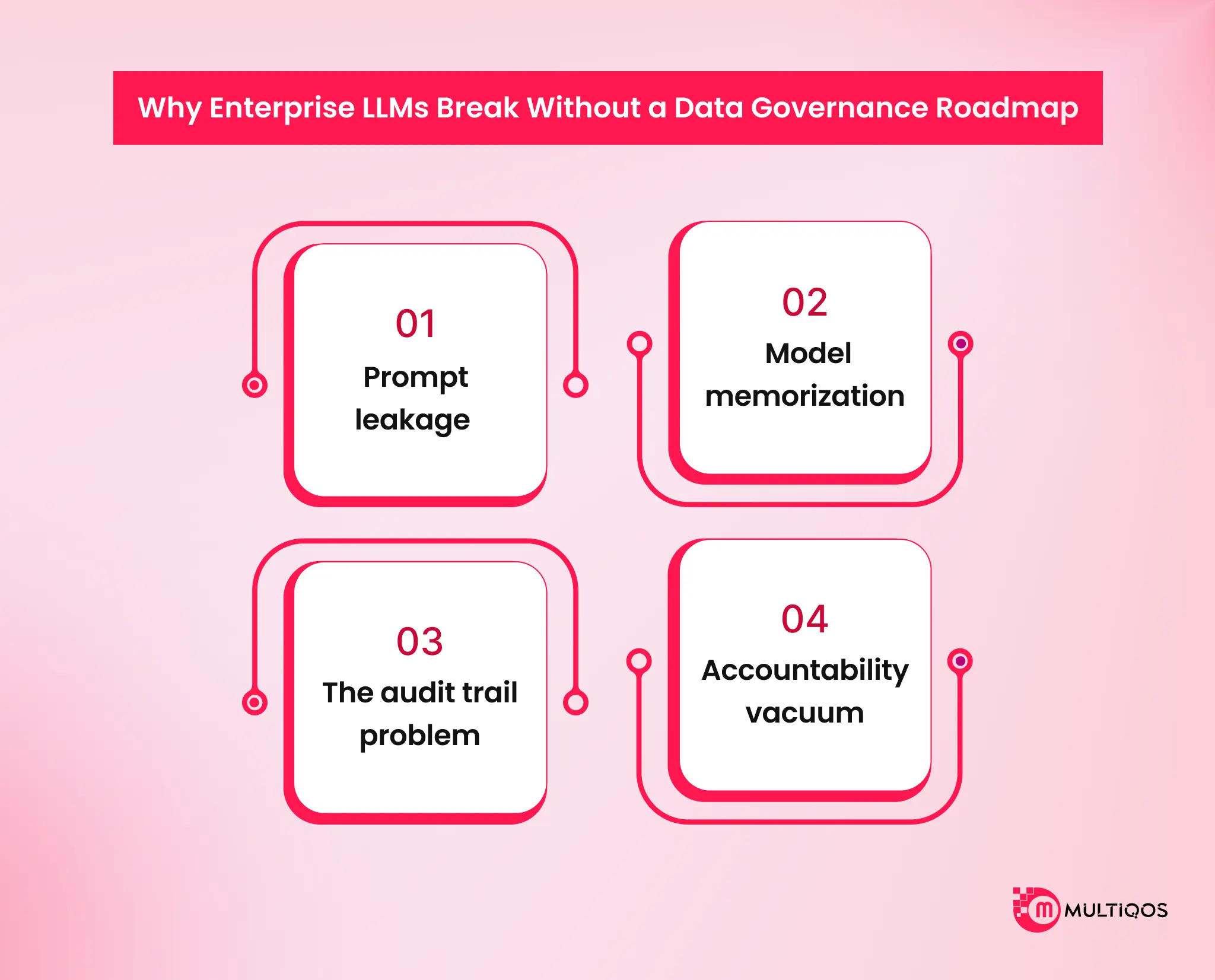
Prompt leakage
Employees routinely input sensitive business information into LLM prompts: customer records, financial projections, strategic plans, product roadmaps.
Without input guardrails and prompt auditing infrastructure, every query becomes a potential data exfiltration event. Samsung’s semiconductor division learned this when engineers pasted proprietary source code directly into ChatGPT, creating an exposure no policy document could retroactively contain.
Model memorization
LLMs can inadvertently retain and surface PII, credit card numbers, medical notes, and other regulated data encountered during training or fine-tuning. Your model does not forget on command. Without data lineage tracking from training data through to inference output, you cannot prove what your model absorbed or, more critically, what it might reveal.
The audit trail problem
Regulators under the EU AI Act and NIST AI RMF do not accept a policy PDF as evidence of governance. They demand demonstrable controls: logs of data access decisions, model version histories, prompt input/output records, and evidence of drift detection. If your LLM deployment cannot produce this evidence programmatically, your compliance posture is a fiction.
Accountability vacuum
Ungoverned LLM deployments across departments, each with different data access patterns, different prompting practices, and no centralized visibility, create liability exposure that scales with every new use case your teams spin up without IT oversight.

What AI Governance Actually Means in a Data Engineering Context
Traditional data governance was built for structured assets. Tables, schemas, ETL pipelines, and access control lists are mapped to databases and dashboards. It worked because the assets were static and their boundaries were clear. AI governance inherits none of that simplicity.
When you govern an LLM-powered system, you are governing an entirely different category of assets:
- Model weights that encode learned behavior
- Prompt histories that contain sensitive user context
- Inference outputs that may be consumed downstream by other systems
- Training data provenance that must be traceable to its source
- Agent tool calls that execute actions with real-world consequences
- Drift events that change model behavior without any code change.
None of these fit neatly into a traditional data catalog.
The LLM lifecycle itself demands governance at every stage. Use-case approval determines which business problems justify LLM development, deployment, and at what risk tier. Data access controls govern what training and retrieval data the model can access. Training pipelines require provenance tracking and bias audits.
From Training to Deployment: Why AI Governance Matters?
Deployment requires version control, rollback capability, and compliance checks. Monitoring catches drift, anomalies, and output quality degradation. Retirement ensures models are decommissioned without leaving orphaned data or zombie API endpoints.
The key differentiator between organizations that scale AI and those that stall is where governance lives in the stack. Bolting governance onto a deployed model is like adding brakes to a car that is already on the highway.
Modern data governance for LLMs must be embedded in DevOps pipelines as governance by design: automated policy checks in CI/CD, data classification at ingestion, access control enforcement at the API layer, and continuous monitoring as a pipeline stage, not a quarterly review.
If your organization separates “data governance” from “data engineering,” your governance program will always lag behind your deployment velocity. Data governance in data engineering is not a department overlap. It is the operating model.
The 4-Pillar Data Governance Framework for Enterprise LLMs
Governance for enterprise LLMs isn’t a checklist. It’s an operating system, built on four pillars: policy and risk tiering, data lineage, model monitoring, and regulatory readiness. Each one has real engineering deliverables behind it.
Pillar 1: Policy and Risk Tiering
Not all AI applications are created equal; some have more serious consequences than others. A chatbot that is able to extract answers from a pre-existing question-answer section isn’t the same as a tool that is underwriting policyholder information. It’s a waste of resources to treat them all equally, while leaving vulnerable those who need it most.
Risk tiering categorizes AI use cases based on their data sensitivity, regulatory risks, and downstream impact.
- Tier 1 tools are those being used for internal, non-sensitive data. Basic controls should be applied, such as access log, output monitoring, and quarterly review.
- Tier 2 logically falls somewhere between these two extremes in terms of deployments of intermediate risk. AI workflow orchestration and proactive model monitoring and drift detection capabilities help enterprises automate governance controls, coordinate AI systems, and maintain compliance across complex workflows.
- In Tier 3 systems (customer-facing, regulated data), the entire stack requires real-time monitoring, automated compliance checks, encrypted pipelines, and human approval gates.
This corresponds to the NIST AI RMF. It has four functions: Govern, Map, Measure, and Manage, which are repeated throughout the AI lifecycle. Risk tiering is the governance process that is actualized.
Pillar 2: Data Lineage and Knowledge Base Governance
Your LLM is only as trustworthy as what feeds it. Data lineage tracks every asset from source through transformation, into training or RAG retrieval, and out through inference. Without that chain, you can’t answer the most basic audit question: where did this output come from?
For enterprise RAG pipelines, governance extends into the knowledge base itself. Source certification vets every document before it’s retrievable. ACL-aware retrieval ensures users only get answers from data they’re permitted to see. Freshness controls prevent stale policy documents from generating confident, wrong answers.
For enterprises that are already using Collibra, Atlan, or Alation, there’s no need to start from scratch. Integrate an existing catalog into your LLM stack. And to integrate an existing catalog into your LLM stack, ensuring alignment with your business functions, is to partner with an AI development service.
Pillar 3: Model Monitoring and Drift Detection
Code is static. Models decay. An accurate system at 95% accuracy at start-up can quickly drop to 70% accuracy within a few weeks. Until a complaint or audit comes to light, nobody knows.
Monitoring includes compliance with schema and guardrails, length drift of responses, semantic similarity to baseline responses, and regression in structured outputs. Automated responses (not dashboards) begin to take place when drift is detected. Dashboards are spectators.
Pillar 4: Regulatory Readiness and Audit Trails
All three (EU AI Act, NIST RMF, HIPAA, GLBA, PCI-DSS): evidence NOT intent. This includes logs that are machine-readable of all governance decisions, approvals, data access, model versions, incidents, and resolutions.
Audit evidence is to be a consequence of everyday activities. If compliance teams are still having to manually put together packages prior to each examination, then the framework is not working.
Cloud Data Governance Ecosystems: Snowflake Horizon vs. Databricks Unity Catalog
Both Snowflake Horizon and Databricks Unity Catalog now govern far more than tables; we’re talking models, feature stores, inference pipelines, the whole AI stack. Which one fits depends less on features and more on where your workloads actually live.
| Factor | Snowflake Horizon | Databricks Unity Catalog |
|---|---|---|
| Core strength | Cross-engine interoperability via Apache Polaris (Iceberg REST) | Tight end-to-end governance inside Databricks Lakehouse |
| What it governs | Snowflake tables + external Iceberg/Delta + cross-platform assets | Tables, volumes, models, feature stores, AI assets, one namespace |
| Access control | Dynamic masking, row-level policies, zero-copy sharing | Catalog → schema → table → column → row, all fine-grained |
| Lineage | Available; strongest within the Snowflake ecosystem | Automated, source-to-dashboard-to-model output |
| Open source | Apache Polaris (Iceberg REST spec) | Unity Catalog donated to Linux Foundation, Oct 2025 |
| Best fit | Multi-engine shops need broad interoperability | Teams running AI/ML workloads primarily on Databricks |
Building Your Data Governance Roadmap: A Phased Implementation Approach
Enterprises require a sequential implementation plan with definite engineering outcomes and timelines. A data governance roadmap has been proven to work in enterprise data engineering programs.
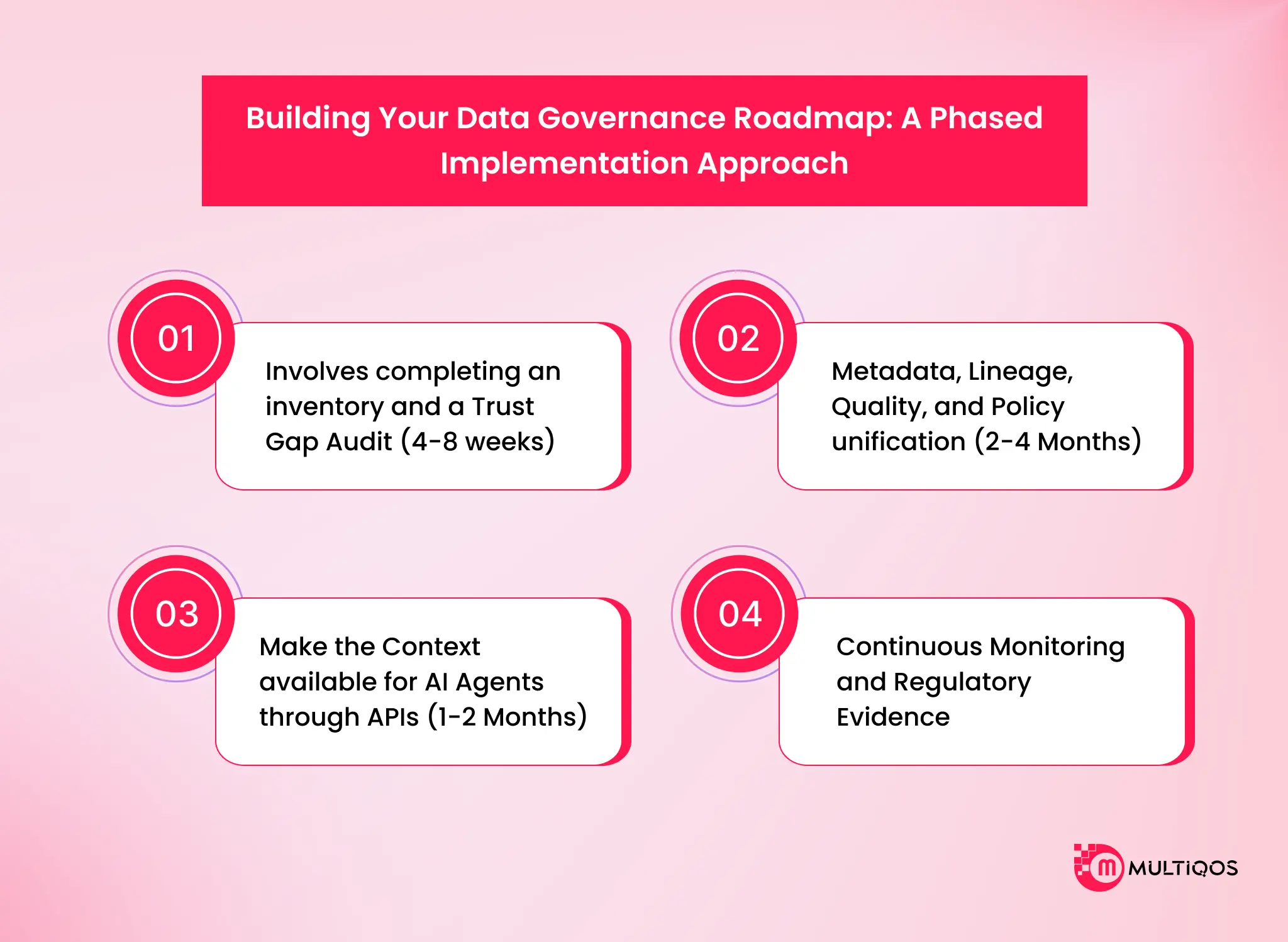
Phase 1 involves completing an inventory and a Trust Gap Audit (4-8 weeks).
List all existing and under-development AI systems and data assets. Create a diagram of all the LLM touchpoints to all data sources, all department use cases, and where there is unclassified PII, PHI, or PCI data in pipelines feeding AI systems. The key to this phase of establishing data governance for your AI implementation roadmap is to create an initial level of visibility.
Phase 2: Metadata, Lineage, Quality, and Policy unification (2-4 Months).
Tap into your existing data catalog and existing knowledge base of your LLM without having to re-construct governance infrastructure. For those using Collibra, Atlan, or BigID, take classification and lineage to your AI model registry and RAG pipeline assets.
Algorithmically classify PII/PHI/PCI with Machine Learning discovery tools. Enable lineage tracking at the column level throughout your cloud data platform (Snowflake, Databricks, BigQuery) and ensure every data input and output source for training is tracked back to its source.
Phase 3: Make the Context available for AI Agents through APIs (1-2 Months).
Design a context-aware API that provides governance context to AI agents and RAG pipelines when queries are made. We strongly believe that every answer should be based on data that the requesting user is allowed to access, and this is achieved by enforcing retrieval with ACL.
It’s a crucial step for companies that are implementing agentic AI on a large scale, as agents operating on data without authorization restrictions can pose a liability risk. All retrievals, tool calls, and actions should have a level of governance.
Phase 4: Continuous Monitoring and Regulatory Evidence
Implement drift detection triggers to automatically react to drift, including retraining models, rerouting to a fall-back model, a notification of an incident, and logging of drift governance events. Develop playbooks for incident response for governance incidents (data access, drift, output quality degradation). Hold periodic policy reviews, adjusting risk levels and governance mechanisms as needs evolve and regulations change, every quarter.
The automated audit trail generation gives regulatory evidence as a byproduct of operations, thus eliminating the manual compliance preparation cycle. Link governance outputs with data engineering and data science pipelines, and have compliance evidence flow with production data.
Conclusion
The transformation from policy documents to operational control systems is not optional. It is the difference between enterprises that scale AI into production and enterprises that accumulate regulatory exposure with every ungoverned deployment. A data governance roadmap for enterprise LLMs is not a compliance exercise. It is infrastructure.
BCG research confirms what engineering teams already know: responsible AI triples the chances of capturing full AI benefits. Governance does not slow deployment.
It speeds up progress by removing the compliance backwash, accountability shortcomings, and audit frenzy that are the death knell of AI initiatives months after launch. Put governance on the agenda. Make it from scratch from Day 0.
FAQs
The data governance roadmap for Enterprise LLM is a step-by-step plan that contains policy and risk tiering, data lineage tracking, monitoring of the models, and readiness for regulatory audit for each LLM-enabled application in your enterprise. Maps governance needs to engineer outcomes, which is typically a 6-12 month journey from the first audit until continuous monitoring deployment.
Model drift is the gradual degradation of the statistical properties of the production data over time from the ones used in the training data, without changing any code – this is an example of model drift. It’s important in the context of governance because, if it’s an un-monitored model that is not in compliance, it’s a regulatory exposure.
The more powerful Snowflake is when primary data workloads are deployed on Snowflake, and the need to extend governance to these external engines is met via Snowflake’s open Iceberg REST Catalog protocol. For organizations with more centralized governance of their AI/ML workloads that are centralized on Databricks Lakehouse, Databricks Unity Catalog provides more integrated governance.
Depending on the business, it can take as long as 6-12 months, and consists of 4 phases: Inventory & trust gap audit (4-8 weeks), Metadata & lineage unification (2-4 months), API-layer governance for AI agents (1-2 months), and Continuous monitoring deployment (ongoing).
Organizations that already have data catalogs and data lineage tools can significantly minimize the effort it takes to get started by connecting their tools to provide governance for AI models without having to build their own data catalog or lineage tool.

Get In Touch

Get Stories in Your Inbox Thrice a Month.
A Comprehensive Guide on How Machine Learning is Transforming the Factory Floor
MultiQoS Technologies Named an OpenAI Select Partner
Why Manual Data Pipelines Are a Silent Business Risk (And How Automation Fixes It)
Why Ethical Use of User Data in Software Matters More Than Ever
Top Benefits of Implementing Real-Time Data Systems for Enterprises