
Rethinking Software Delivery through AI Workflow Orchestration: The New Engineering Playbook
Need quick insights? Summarize with AI & save time
 ChatGPT
 Perplexity
 Claude
 Google AI Mode
Table of Content
- What is an AI Orchestrated Workflow in Software Delivery?
- How AI Transforms Each Stage of Software Delivery?
- Real-World AI Software Delivery Workflows: Enterprise Examples
- The AI Tools that are fueling Modern Software Delivery
- Building an AI-Orchestrated Software Delivery Pipeline: A Practical Roadmap
- The MultiQoS MOAT for AI Workflow Orchestrations
- Conclusion
- FAQs
Summary:
Engineers ship code faster than ever, but releases haven’t sped up the bottleneck, which has moved from coding to coordination. AI Workflow Orchestrations fix that by automating decisions and handoffs across planning, coding, testing, deployment, and monitoring.
This blog unpacks what AI orchestration is, how it differs from rule-based CI/CD, where AI intervenes at each SDLC stage, the tool categories powering it (coding assistants, intelligent CI/CD, AIOps, multi-agent frameworks), enterprise proof points (Netflix, Microsoft, AWS, JP Morgan), and a six-step roadmap to implement it with governance baked in. Built for VPs of Engineering, Heads of DevOps, and Digital Transformation leaders evaluating the next move in autonomous software delivery.
Nowadays, engineers write code at a pace that is unprecedented. Individual coding cycles have been reduced by GitHub Copilot, Cursor, and a dozen other AI coding assistants. However, company output speed remains virtually unchanged. Forecasts are still uncertain for release cycles. Even though deployment problems have been eliminated, production is still interrupted.
The friction between planning, coding, testing, and deployment that occurred five years ago still exists. The bottleneck has moved. Now it’s not about coding anymore. It is related to its coordination.
There is a handoff at every stage of the Software Delivery Lifecycle, and with each handoff comes the risk of delay, misunderstanding, and failure.
The 2025 DORA report reveals that 89% of organizations are already using AI in their development workflows, but most of those uses only go as far as the coding layer. The linkage of the various stages is still mostly manual, rule-based, or a combination of both.
AI-driven workflows make all that possible. They enable the automation of handoffs, decisions, and coordination in all phases of SDLC. This article dives deeper into what AI Workflow Orchestrations are, how they impact every delivery stage, the tools driving them, and how to create a viable roadmap for your organization.
What is an AI Orchestrated Workflow in Software Delivery?
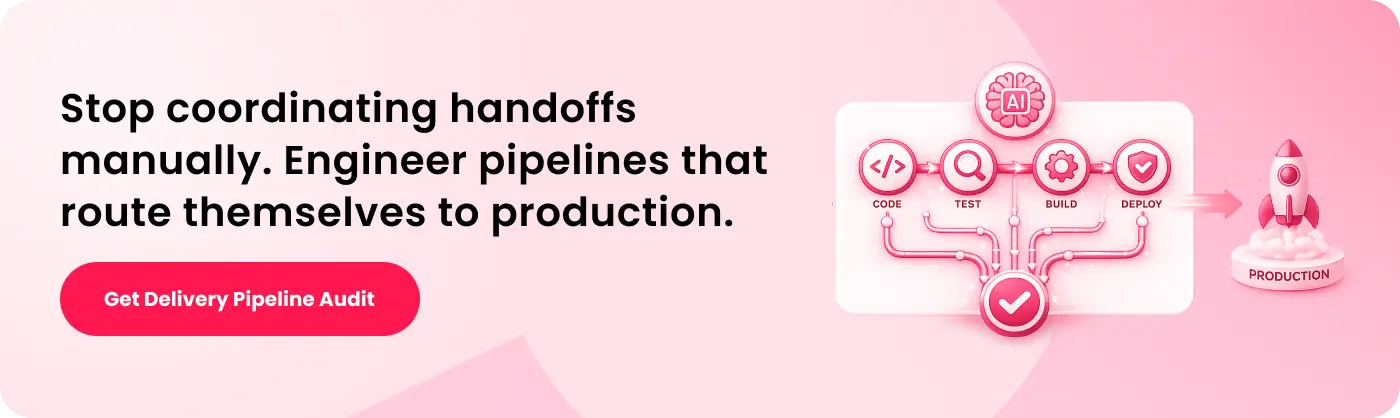
AI Workflow Orchestrations in software delivery are a system of AI agents that coordinate, sequence, and adapt tasks, decisions, and handoffs throughout the SDLC.
It does not have to be interfaced with by people at each crossing. The orchestration layer infers, adapts, and routes work as a function of context, previous results, and live data signals.
How AI Orchestration Differs from Traditional Automation?
The traditional CI/CD automation is rule-based. A pipeline is a sequence of steps that are fixed to be executed by a pipeline. The pipeline is halted if a test fails.
Interference between planning, coding, testing, and deployment is ongoing. Each phase of the software delivery process is a handoff, and each handoff is a chance to cause delay, miscommunication, and failure.
AI orchestration introduces reasoning into the sequence. When a test fails, an orchestrated system can
- Analyze the failure pattern
- Correlate it with recent code changes
- Classify the failure, auto-remediate
- Re-route the pipeline
- Alert a human only when needed.
The practical difference is significant. Rule-based pipelines scale predictably but break unpredictably. AI-orchestrated pipelines adapt.
According to a 2025 paper in the World Journal of Advanced Research and Reviews, AI-powered DevOps pipelines can achieve up to 60 % lower mean time to recovery (MTTR) when compared to traditional automated pipelines. The reason is that AI-based systems can recognize and take action on failure patterns instantly, rather than having to wait for a human diagnosis.
The Essential Elements of an AI-driven SDLC process.
An AI-driven SDLC is made up of five interconnected layers:
- AI planning agents understand product briefs and link requirements to engineering tasks.
- AI coding review systems generate code, review code, and refactor code with context-aware support.
- Intelligent test orchestration automatically selects test suites based on the impact of code changes.
- Autonomous deployment engines can perform canary releases, listen to real-time signals, and auto-rollback.
- AIOps monitoring layers integrate information across infrastructure, application, and business layers.
How AI Transforms Each Stage of Software Delivery?
The most costly defect in software delivery is that it does not have clear requirements. It is much more expensive to correct a misinterpreted requirement as it happens than it is at the planning stage. However, most engineering teams still approach requirements as a document-level activity.
By analyzing the product briefs, user stories, and inputs from stakeholders, AI can distill them into a structured engineering tasks list, uncover contradictions, and highlight missing specifications before any code is written.
-
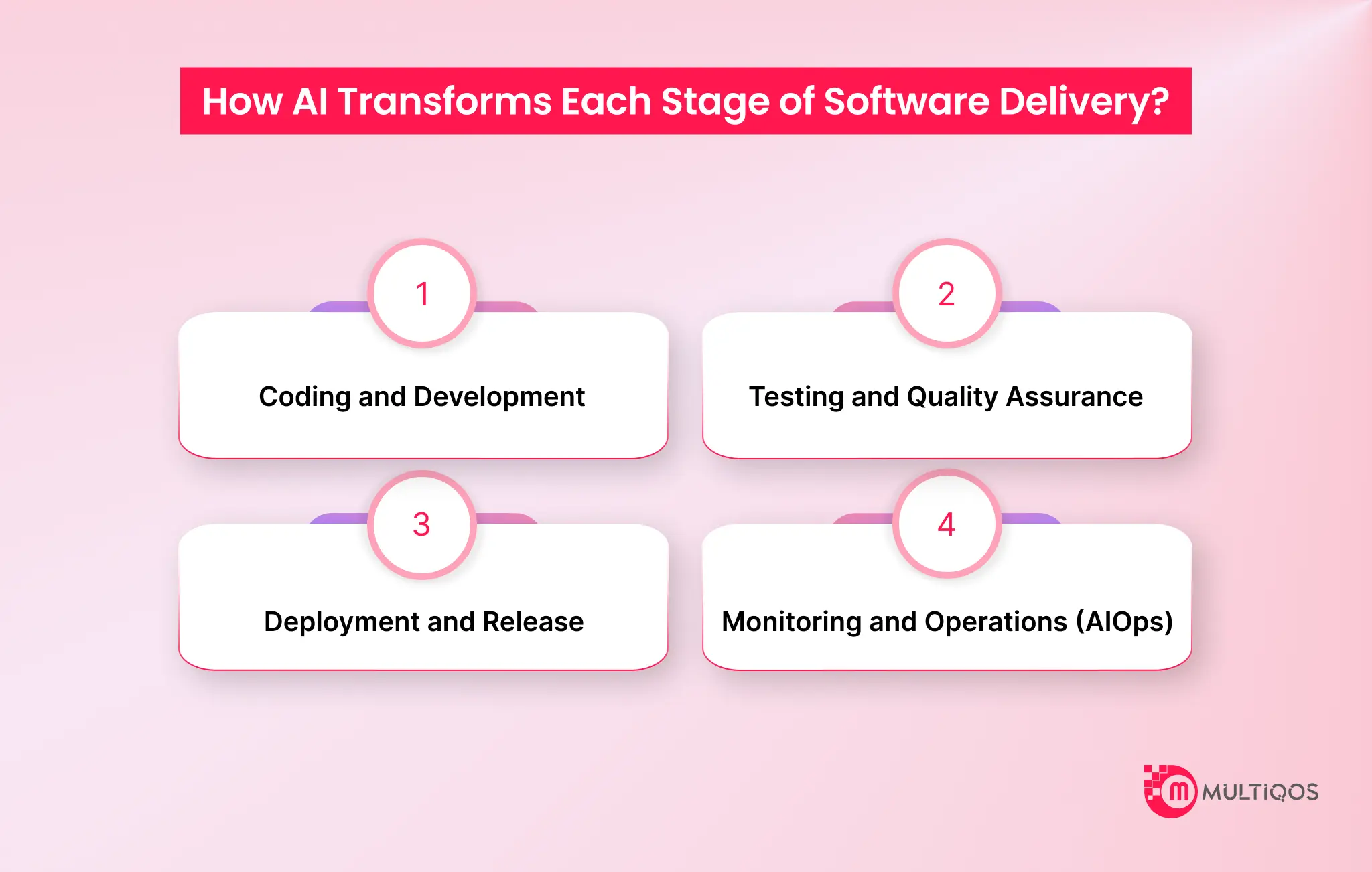
Coding and Development
The most easily perceptible part of the AI DevOps transformation is AI coding assistance. It’s also the most impactful when it isn’t the only thing you do. Incorporating AI coding tools into the orchestration stack adds to this compound value.
If the coding assistant can see the test suite, deployment environment, and the production monitoring signals in real time, the code that it suggests takes into account these constraints. Not only is it autocomplete, but it’s now something else. It’s smart tech. It’s intelligent technology.
-
Testing and Quality Assurance
The majority of the value of AI orchestration lies in testing. The typical company still performs full regression tests on each commit. That doesn’t work well on large data sets. It brings about the deployment anxiety that DevOps teams are familiar with: a one-hour-long pipeline, one flaky test that blocks a release, one gap in coverage that allows a defect to get in.
However, AI test orchestration overcomes this by performing impact analysis as it happens. Instead of running all tests, the system is able to tell which parts of the system have changed and map these parts to the tests they are covered by, and then run only the tests that might have caused the regression.
-
Deployment and Release
The term deployment anxiety refers to a symptom. The problem is that there is a lack of real-time confidence as to what is about to go live. In most deployments, the significant sign that lets you know whether a deployment was successful or failed is the pass/fail message from the pre-production tests.
Changes in the confidence model due to AI orchestration of deployment. The intelligent CI/CD platforms with ML-assisted insights continuously track the signals while doing deployment and take autonomous decisions.
Understanding the difference between AI chatbots and AI agents matters here. Chatbot-style AI responds to queries. Agentic AI, which is what intelligent deployment systems use, acts on real-world signals without being prompted.
-
Monitoring and Operations (AIOps)
The traditional monitoring lets you know something’s broken. The AIOps will alert you to an upcoming failure. That’s the most expensive part of the entire delivery stack.
AIOps platforms tie all infrastructure metrics, application performance data, log streams, deployment events, and business KPIs together.
If a degradation pattern that has been observed before a known application–level incident occurs in the infrastructure metrics, it is presented as a predictive alert, rather than a post-mortem data point.
Real-World AI Software Delivery Workflows: Enterprise Examples
The transformation described above is not theoretical. The following organizations have embedded AI Workflow Orchestrations into their engineering operations, and the outcomes are measurable.
Netflix: Chaos Engineering at Scale
Netflix’s approach to delivery reliability is built on deliberate failure injection, an approach known as chaos engineering. It’s Chaos Monkey, and the broader Simian Army toolkit, automates the injection of failure scenarios across production infrastructure. The system introduces them at controlled intervals to surface weaknesses before they manifest as user-impacting incidents.
Engineers deploy hundreds of changes per day using automated canary release mechanisms and AI-assisted rollback triggers. The orchestration layer evaluates deployment health signals continuously and acts without requiring manual review for the majority of release decisions.
The result is a delivery cadence that most organizations with a fraction of Netflix’s scale cannot match, not because Netflix has more engineers, but because their delivery pipeline is orchestrated to make autonomous decisions at every handoff point.
Microsoft: MLOps and Predictive Developer Experience
Microsoft has embedded AI across its developer tooling stack, both for internal engineering productivity and as a product offering through GitHub Copilot and Azure DevOps AI capabilities.
Their internal deployment of GitHub Copilot to engineering teams showed productivity gains measured in pull request velocity and task completion rates.
Perhaps more important, though, is the work that Microsoft has done on MLOps infrastructure, which involves developing continuous model evaluation and retraining pipelines that “think of AI models as living systems” instead of static deployments.
Monitoring is performed in production, triggering of degradation is based on automated workflows, and updated models are subject to the same CI/CD validation process as application code.
Amazon AWS: Dynamic Auto-Scaling in CI/CD
Amazon’s engineering organization operates on a two-pizza team model with autonomous deployment authority. The organizational structure is the governance framework that makes autonomous software delivery possible. Services have their own pipelines, independent coordination of deployments, and their own production performance monitoring.
The AWS Fault Injection Service is AWS’s way of bringing chaos engineering to the infrastructure level. The system emits simulated failures to the AWS services in an orchestrated way to test the services’ resilience in advance of major events, such as high traffic volumes and product releases. This is Hyperscale autonomous software delivery orchestration!
The AI Tools that are fueling Modern Software Delivery
In 2026, there are four types of AI DevOps tools. Before making tooling decisions, it’s crucial for engineering leaders to know where each category fits into the software development stack.
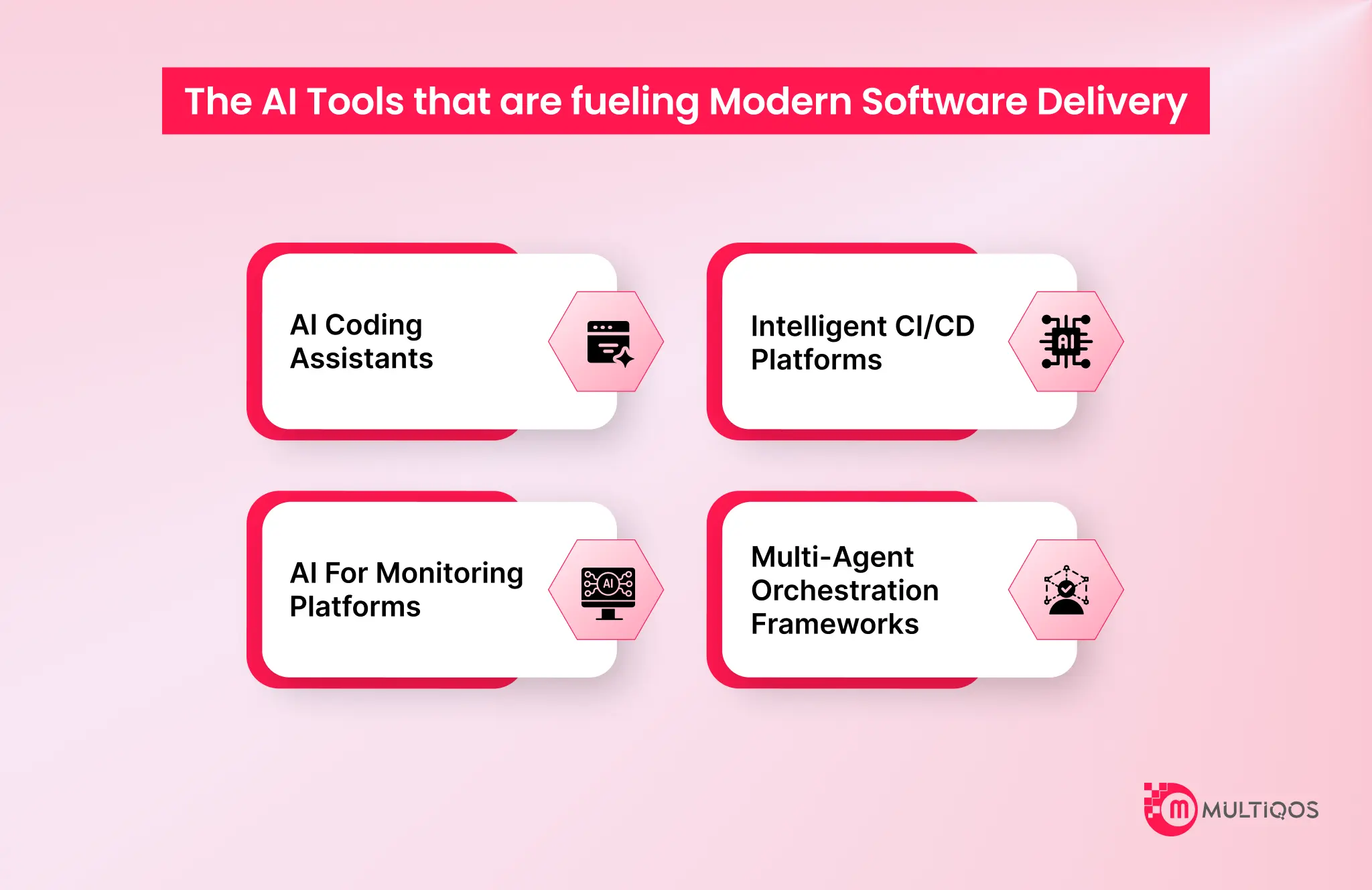
AI Coding Assistants
An AI coding assistant works on the developer level. They offer varying levels of codebase awareness and in-IDE code suggestion, generation, and review. Enterprises can leverage AI development services to leverage the potential of such coding assistants without spending heavily on hiring in-house talent.
- GitHub Copilot (Copilot Workspace and Copilot Models) is the most widely used and integrated into the GitHub workflow. It now supports multi-file aware and pull request summarization, in addition to line-level suggestions.
- Cursor lets developers ask and change questions in a natural language through the codebase, with context retrieval deep in the file structure.
- With Amazon Q Developer, developers can tap into AWS services, get code help, and automate code transformation for legacy migration scenarios.
Intelligent CI/CD Platforms
These are the areas where the individual developer’s productivity links to organizational delivery velocity. These tools work at the layer of the pipeline and enable the addition of AI-based decision-making to the build, test, and deploy process.
- The AI-powered deployment verification, anomaly detection, and automatic rollback capabilities are provided by Harness AI. They have a pipeline intelligence layer that learns from the historical deployment data and separates production anomalies from deployment data.
- By utilizing the timing data from past runs, CircleCI with AI-assisted test splitting and dynamic resource allocation can execute pipelines faster by splitting the test runs to run in parallel.
- The GitLab Duo is a new AI feature that appears throughout the entire DevSecOps lifecycle on the GitLab platform, from code review to explanation of vulnerabilities to optimizing pipelines.
AI for Monitoring Platforms.
AIOps platforms bring the production-to-pipeline circle back to each other. They transform monitoring information into actionable delivery intelligence.
- Dynatrace offers comprehensive observation and root cause automated analysis for the entire stack. Its Davis AI engine automatically correlates anomalies across the infrastructure, application, and business metrics, compressing mean time to detection (MTD) from hours to minutes.
- The new features of Datadog AI, such as predictive alerting and anomaly forecasting, extend its observability capabilities to help teams take proactive action before incidents happen.
- PagerDuty Operations Cloud’s AIOps capabilities are designed to intelligently route, suppress, and escalate alerts based on context, which will mitigate the risk of alert fatigue and accelerate the response to incidents.
Multi-Agent Orchestration Frameworks
Multi-agent frameworks offer the necessary coordination mechanisms to enable specialized AI agents to work together and coordinate on multi-step engineering tasks.
- The most popular pipeline frameworks for building agentic pipelines are LangChain and LangGraph. To enable agents to carry forward information between steps of multi-step workflows between the planning, execution, and validation phases, LangGraph introduces stateful coordination.
- AutoGen (Microsoft) is a multi-agent conversation frameworks that involve specialized agents working independently to complete software tasks, such as coders, reviewers, and testers.
- CrewAI is dedicated to role-based agent orchestration and doesn’t require a team to have extensive ML knowledge to create their first agentic delivery pipelines.
Organizations exploring AI chatbot solutions as part of their broader AI strategy should note that the same agent orchestration principles that power AI-driven customer interactions also underlie autonomous software delivery pipelines. The architectural patterns are transferable.
Building an AI-Orchestrated Software Delivery Pipeline: A Practical Roadmap
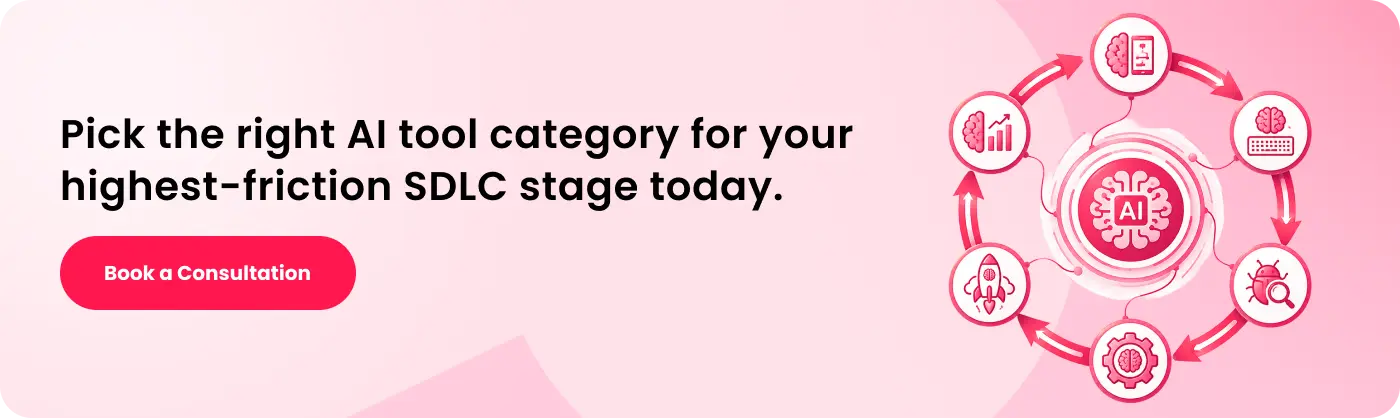
The following framework provides engineering leaders with a foundation for adding incrementally to the platform, rather than replacing the entire platform or undertaking a transformation initiative over a span of several years.
Step 1: Audit Your Pipeline
Outline each phase of the current SDLC (planning through production monitoring). Find all manual handoffs, all places where context is lost as someone uses a tool, and all of the common ways of failing (fails).
Step 2: Identify the highest friction handoffs
The second step is to identify the highest friction handoffs. Not every handoff is created equal! Some cause 2-hour delays, and others cause 2-day delays. Make the most frictional handoffs a priority, such as between code merge and test completion.
Step 3: Select the AI Tool Category Per SDLC Stage
Match the category of the AI Tool to the SDLC Stage, using the comparison table in step 2. Try to avoid jumping straight into multi-agent orchestration frameworks. Begin with the tools recommended to go to the highest friction handoff identified in Step 2.
Step 4: Define the Governance Framework
Before granting any autonomy of decision-making in the pipeline, create a governance layer. This encompasses logging of all AI decisions, override options at each automated decision point, authorized parties for increasing the AI scope of automation, and monitoring of AI agent behavior drift over time.
Step 5: Measure AI-Augmented Metrics
The four DORA metrics, deployment frequency, lead time for changes, change failure rate, and mean time to recovery, are the foundation of the measurement framework.
Add AI-specific metrics to them:
- Pipeline on-board intelligence coverage (percentage of decisions made on-board vs. in the office)
- The accuracy of AI decisions (the percentage of decisions that were successfully made automatically that resulted in the desired outcome)
- Indicate the developer’s cognitive load.
Step 6: Incrementally expand the pipeline
If the first orchestration target is working, move to neighboring stages. Anchors monitoring layer to deployment layer to form a feedback loop.
Link the testing layer to the coding layer so that you can use impact-based test selection. The value of the components attached to each connection is multiplied by the value of the connection.
The MultiQoS MOAT for AI Workflow Orchestrations
Most vendors sell a toolchain. We sell the connective tissue that keeps AI orchestration alive in your real pipeline.
Here is what that means.
- We start with your SDLC map, not our product deck. Where do releases stall? Which handoff burns two days? That is where we plug in the right AI tool category, Harness, LangGraph, Copilot, whatever fits, not what pads the invoice.
- Then we build governance before autonomy. Every agent decision is logged. Every auto-rollback has an override hook. Drift gets flagged weekly. For fintech, insurance, and healthcare, that is the only way autonomous delivery survives an audit.
- For SMBs, we ship a 90-day starter on one pipeline stage. For enterprises, a federated orchestration plane across teams. Our teams leverage DORA plus three AI-specific metrics: agent decision accuracy, intelligence coverage, and developer cognitive load.
Conclusion
The transition from automated to AI-orchestrated software delivery is not a future state. It is happening now, and the organizations pulling ahead are not the ones with the most AI tools. They are the ones that have embedded AI into every delivery handoff while maintaining the governance discipline that makes autonomous operation trustworthy at scale.
The engineering organizations that will define the software delivery benchmark in 2026 and beyond are building pipelines that coordinate themselves. AI handles the coordination. Engineers handle the judgment. That division of responsibility is the new engineering playbook.
FAQs
AI-orchestrated software delivery workflow: a system of software development where software development tasks, decisions, and handoffs are coordinated, sequenced, and adapted by the AI agents throughout SDLC without the need to have humans intervene at each SDLC transition point.
Traditional CI/CD automation runs a set of scripts. If the test fails, and the rule is “STOP”, the pipeline stops and waits for a human. There is also now an AI orchestration that adds reasoning: The system analyzes the reason for the test failure, correlates it with the changes made recently, classifies the type of failure, and auto-remediates or sends the right human decision.
The improvements in productivity per individual user attributed to AI coding support have been found to be between 20% and 26% in controlled experiments based on task completion rates, with certain experiments showing greater productivity benefits in specific coding tasks. The organizations that experience tangible benefits at the pipeline level and have time to utilize AI across various SDLC stages are the ones that adopt not just as a point tool in the coding layer but as a comprehensive solution throughout the entire pipeline.
The main challenges include governance gaps, ambiguity of accountability, and AI agent behavior drift. In the absence of humans making decisions, roll back releases, or route code changes, the decision must be recorded, trackable, and reversible. Without this governance framework, organizations implementing AI orchestration can end up having a problem with decisions made without human oversight, leading to compounding errors.

Get In Touch

Get Stories in Your Inbox Thrice a Month.
A Comprehensive Guide on How Machine Learning is Transforming the Factory Floor
MultiQoS Technologies Named an OpenAI Select Partner
Managing Distributed Development Teams: Strategies to Improve Collaboration
Tips for Smooth Software Development in Regulated Industries
Microservices Architecture for Large Systems: Building for the Future