
AI-Powered Automation in 2026: How Agentic AI and RPA Together Transform Enterprise Workflows
Need quick insights? Summarize with AI & save time
 ChatGPT
 Perplexity
 Claude
 Google AI Mode
Table of Content
- Why AI-Powered Automation Has Become a Strategic Imperative?
- What Is Agentic AI? (And Why It’s Not Just RPA with a Fancy Name)
- RPA vs. Agentic AI: A Side-by-Side Comparison
- How Agentic AI Works: The 6-Step Process Inside Enterprise Workflows
- Enterprise Use Cases: Where AI-Powered Automation Delivers Real ROI in 2026
- How It Works With Microsoft Power Platform: Power Automate + AI Builder + Copilot Studio?
- Conclusion
- FAQs
Summary
AI-powered automation is entering a different phase in 2026. Enterprises are no longer satisfied with task bots that only follow fixed instructions. They want systems that can understand context, make bounded decisions, and keep work moving across departments without creating more operational overhead.
This blog explains why agentic AI and RPA are now being deployed together, not treated as competing bets. It breaks down the architectural difference, where each approach fits, how hybrid automation works in enterprise environments, and what leaders should evaluate before scaling.
88% of organizations now use AI in at least one business function. And yet, fewer than one-third have scaled it beyond a single use case. The gap between “we use AI” and “AI runs our operations” has never been wider. And it’s not just about alignment with the right use case.
The reason is architecture. Legacy RPA bots were built for predictable, rules-driven work. They execute scripts, but don’t have context-based awareness. And in 2026, the workflows that actually move business need to be adaptable and context-aware.
Everything from supplier onboarding to demand forecasting to IT incident resolution is unpredictable. Operations are dynamic, multi-step, cross-domain, and full of unstructured data.
This is where agentic AI automation comes into play. And it does not replace RPA, but extends it. This blog breaks down what agentic AI actually is, how it differs from RPA, how the two work together in a hybrid enterprise stack, and where the real ROI is showing up in 2026.
Why AI-Powered Automation Has Become a Strategic Imperative?
Gartner reports that 40% of enterprises will deploy AI-powered workflows, with task-specific AI agents by 2026. The enterprises that haven’t are not waiting; they’re falling behind. But deployment and scale are two different things, and most organizations are stuck in the former.
Traditional RPA was a productivity gain, not a transformation. Bots that automate repetitive keystrokes free up human capacity. That matters. But they cannot handle an invoice with missing fields, a claim with conflicting documentation, or a supplier that responds via unstructured email rather than EDI. The moment the process deviates from the script, the bot fails. This is why the rise of agentic AI matters for organizations already exploring Agentic AI in enterprises.
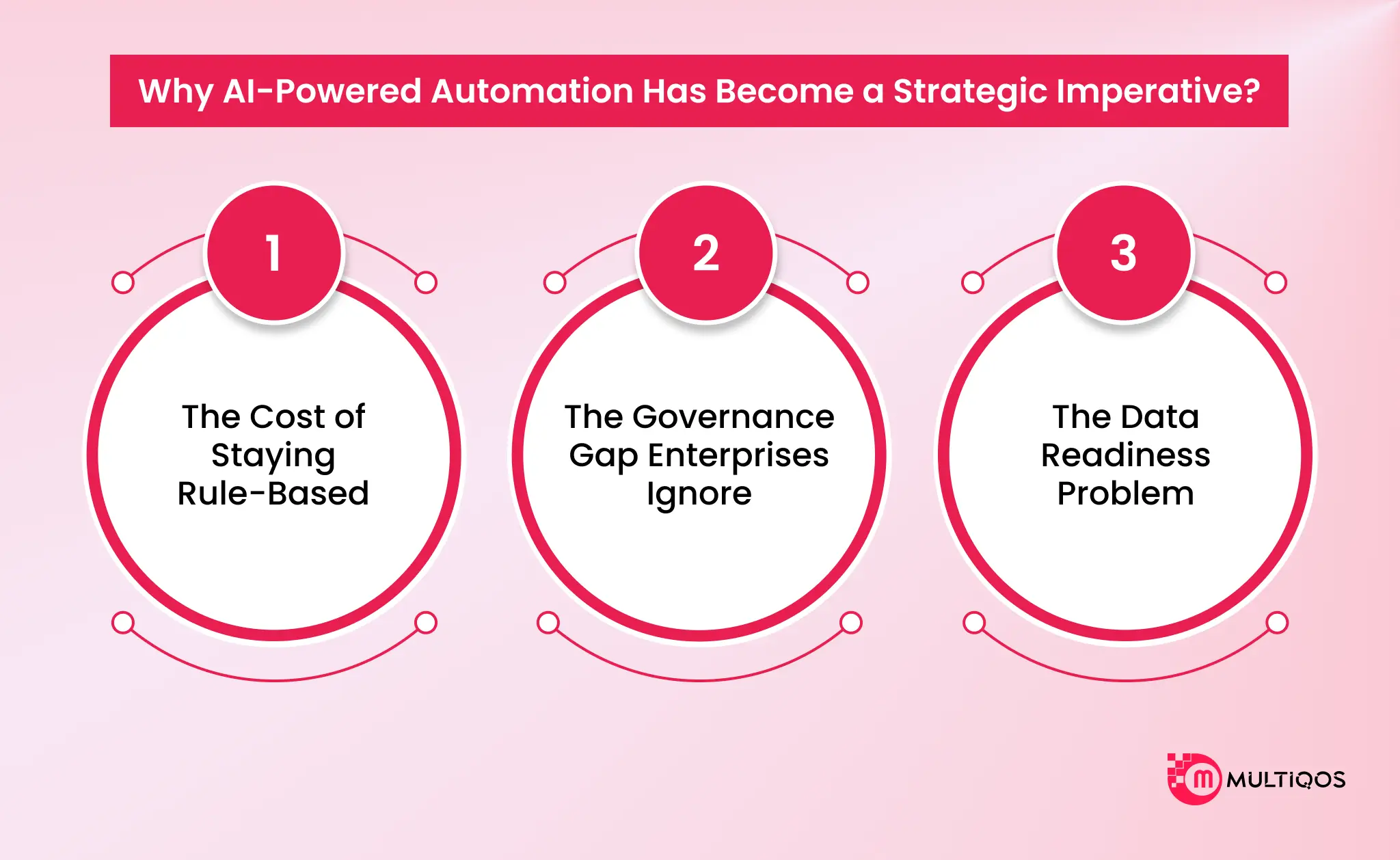
The Cost of Staying Rule-Based
Every process change, a new ERP field, a regulatory update, or a supplier format shift requires manual RPA reconfiguration. IT backlogs fill with maintenance tickets. The bots that were supposed to free your team are now consuming it.
The Governance Gap Enterprises Ignore
Without governance, scaling up automation means organizations have shadow automation bots running undocumented processes, making decisions no one can audit. As the automation progresses from structured tasks to cognitive decision-making, organizations need robust AI governance for enterprise LLMs to establish explainability frameworks, RBAC controls, decision logging, and human-in-the-loop oversight.
The Data Readiness Problem
Agentic AI can only function as well as the information it can process and understand. With ungoverned data pipelines, organizations are not prepared to deploy enterprise llm, autonomous agents, no matter what their vendors promise.
What Is Agentic AI? (And Why It’s Not Just RPA with a Fancy Name)
Agentic AI is goal-driven. That is the core distinction. As opposed to conventional RPA, which performs a set number of operations, the agentic AI system receives an objective, recognizes the current situation, makes decisions about the course of action, implements the action, and draws lessons from it.
It operates in a continuous loop of Perception-Reasoning-Action-Memory. This is why you need a custom Agentic AI service that helps you build an autonomous agent for your processes.
The evolution path is as follows:
- RPA executes fixed rules on structured data. No judgment. No adaptation.
- Intelligent Automation RPA + basic ML for classification or extraction. Still mostly rules-driven.
- AI Agents models that can handle specific tasks with some autonomy.
- Agentic AI is a multi-step, goal-oriented systems that coordinate multiple agents, handles unstructured data, makes contextual decisions, and improves with every cycle.
The difference between an AI agent and agentic AI is orchestration. A single agent answers a question. An agentic system routes a claim, flags an anomaly, contacts a supplier, escalates an exception, and updates three downstream systems without a human touching any of it.
RPA vs. Agentic AI: A Side-by-Side Comparison
The right enterprise Ai-powered automation stack is not RPA or agentic AI. It is both, each doing what it does best.
|
Dimension |
RPA |
Agentic AI |
|
Autonomy |
Low, follows predefined rules | Higher, goal-driven within policy guardrails |
|
Data handling |
Mainly structured data |
Structured and unstructured data |
|
Decision-making |
If/then logic |
Contextual and adaptive reasoning |
|
Task complexity |
Low to medium |
Medium to very high |
|
Adaptability |
Rigid when conditions change |
Can adjust to changing conditions |
|
Learning |
No native learning loop |
Can improve from memory and feedback |
|
Audit model |
Easier, step-by-step logs |
Requires decision logging and explainability |
|
Best fit |
Stable, repetitive, high-volume tasks |
Dynamic, cross-functional, exception-heavy workflows |
However, there’s a place for RPA yet. High-frequency, consistent, and structured processes, like payroll calculation, invoice matching, and regular reporting, are what the RPA technology can be applied to. The problem lies in applying the RPA to highly variable and judgment-based processes.
Agentic AI becomes useful when the workflow depends on judgment, context, and unstructured signals. Think of finance exceptions, IT ticket triage, supply chain disruptions, and onboarding cases that span multiple systems. In those environments, a static bot quickly shows its limits.
That said, governance is more demanding on the agentic side. RPA offers relatively simple audit trails. Agentic AI needs decision logs, role-based access controls, human-in-the-loop checkpoints, and explainability standards. Without that, autonomy becomes operational risk.
Teams that are already modernizing robotic process automation in enterprises usually do best when they treat agentic AI as an extension layer, not a wholesale replacement.
How Agentic AI Works: The 6-Step Process Inside Enterprise Workflows
Understanding the mechanics of AI-powered automation matters before investing in it. Here is what actually happens when an agentic AI system runs inside an enterprise workflow.
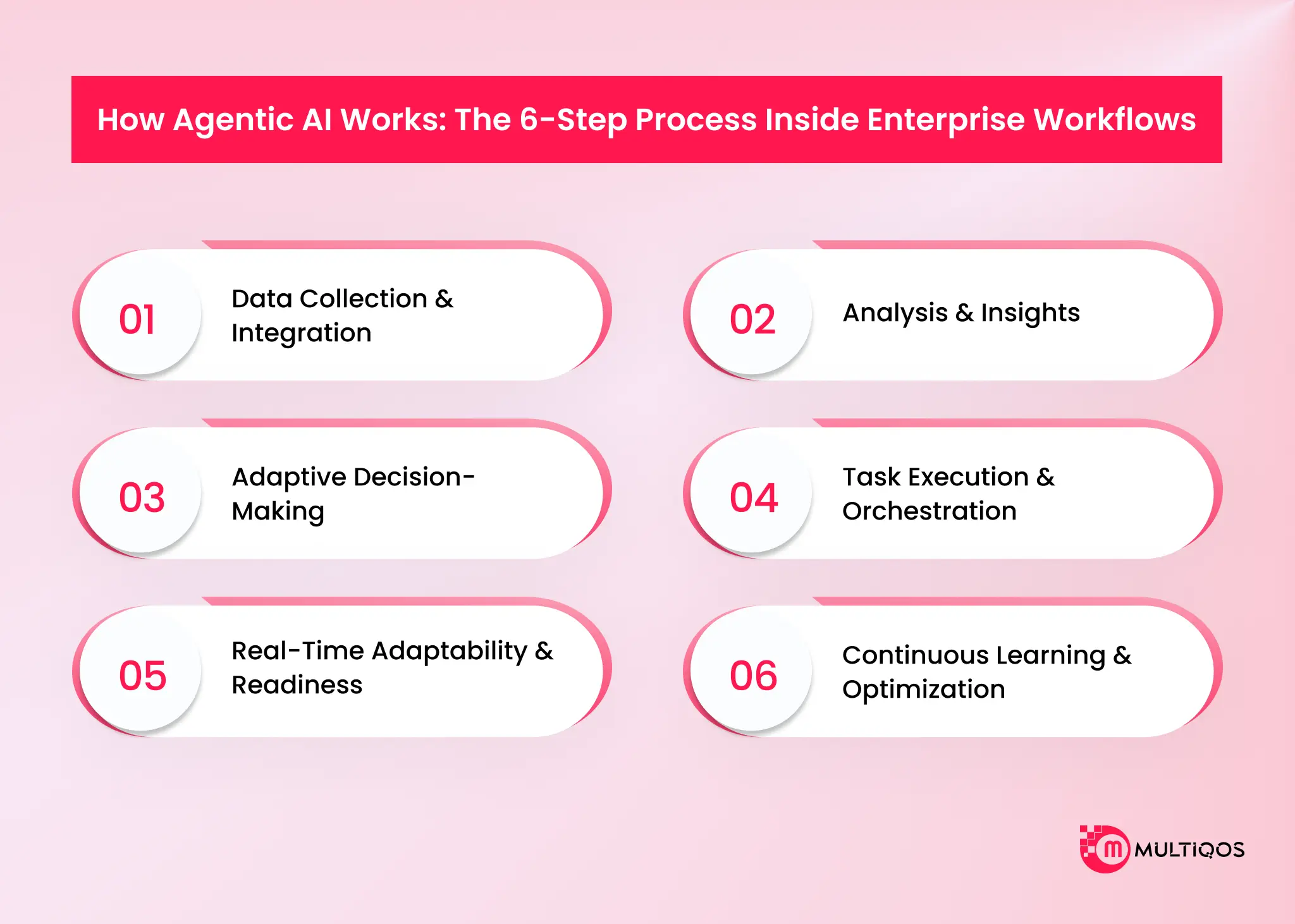
1. Data Collection & Integration
Through the use of the technologies of natural language processing (NLP) and large language models (LLMs), the AI agent integrates the information from different sources, including structured databases, customer relationship management systems (CRM) entries, emails, scanned documents, and event logs.
2. Analysis & Insights
Using ML models, patterns, anomalies, and trends are detected across the collected data. Generative AI layers include predictive outputs that warn of potential exceptions, risk indicators that highlight potential issues, and summarization of document content for downstream routing, among other uses.
Green = high human impact, Red = high AI impact. Click sentences to swap alternatives.
3. Adaptive Decision-Making
The agent blends predefined business rules with adaptive algorithms. It assesses context, priority, and available action paths, then selects the best sequence. Not the scripted sequence. The contextually appropriate one. This is the step that separates agentic AI from every automation approach that came before it. And to make sure you make the most of agentic abilities for real-time adaptive decision-making, engaging with an AI development service matters the most.
4. Task Execution & Orchestration
The agent connects to external applications and APIs, manages task dependencies, handles sequencing and wait states, and coordinates sub-agents when multi-domain execution is required. An insurance claim doesn’t live in one system. A supply chain exception touches six. Agentic orchestration handles the handoffs.
5. Real-Time Adaptability & Readiness
When something unexpected happens, a missing document, an API timeout, a supplier response that doesn’t match the expected format, the agent doesn’t fail. It course-corrects. It re-routes, escalates to a human when appropriate, or attempts an alternative path. This is what “autonomous” actually means in practice.
It is also the most realistic answer for companies asking, “Is your business ready for agentic AI?” It is also important to understand that AI readiness is not about replacing everything. It is about knowing where autonomy improves outcomes and where deterministic control should remain.
6. Continuous Learning & Optimization
Outcomes, exceptions, approvals, and user feedback become learning signals for future cycles. This does not mean unchecked self-modification. In enterprise settings, it usually means supervised improvement, better recommendations, and stronger exception handling over time.
This hybrid pattern is especially relevant for teams using Microsoft tooling. Power Automate, AI Builder, and Copilot Studio now give enterprises a practical path to combine classic workflow orchestration with GPT-based reasoning and agent-led actions. An agentic system, however, does. That makes AI agent development services more relevant to operations strategy than they were even a year ago.
Enterprise Use Cases: Where AI-Powered Automation Delivers Real ROI in 2026
AI-powered automation becomes persuasive when the use case connects directly to cost, cycle time, accuracy, or compliance.
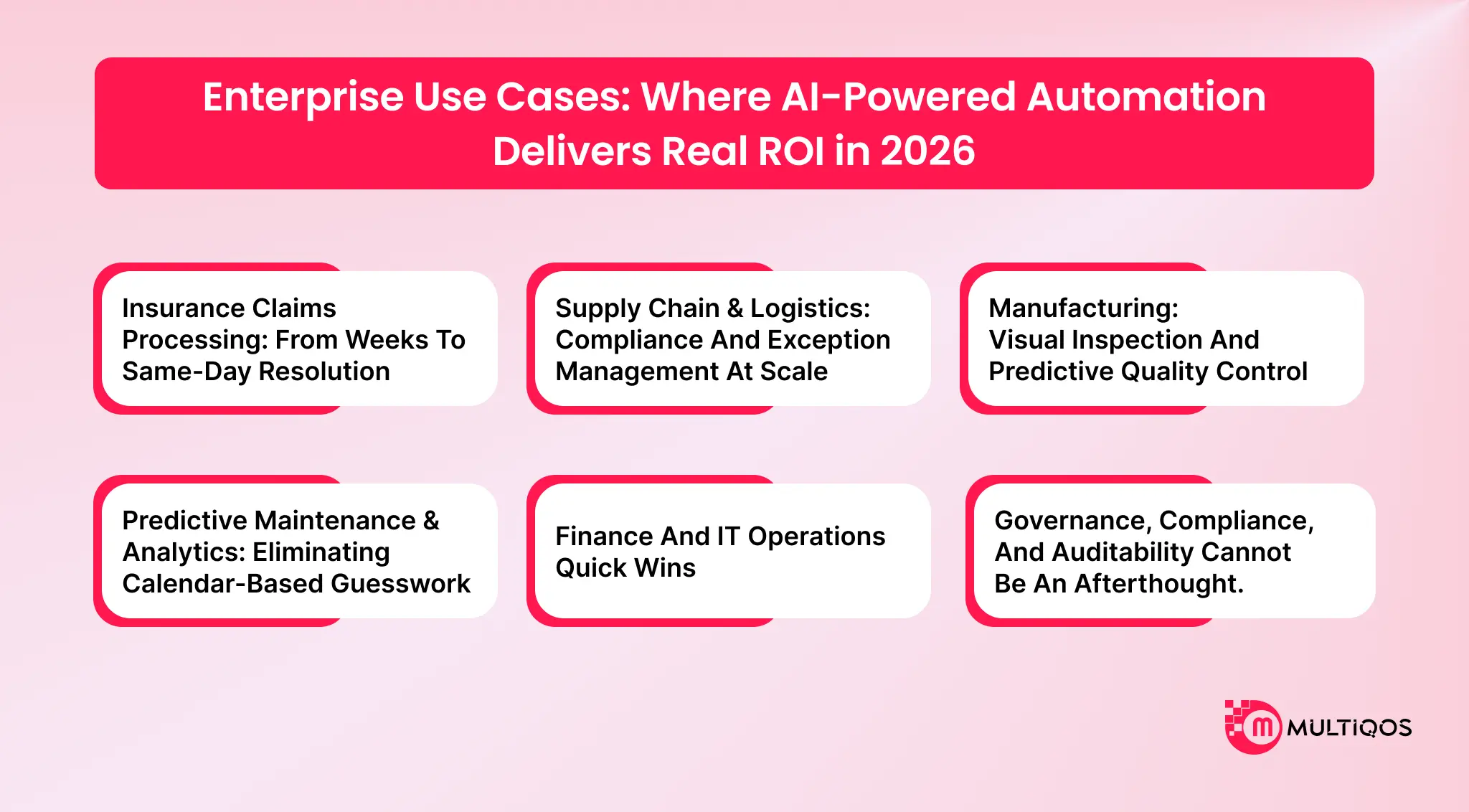
Insurance Claims Processing: From Weeks to Same-Day Resolution
The manual claims processing process is the costliest risk factor that an insurer faces during its operations. The adjusters waste time gathering evidence, checking coverages, cross-referencing the policy clauses, and identifying anomalies, which could be recognized within seconds by a trained system.
An agentic artificial intelligence system is fed with the notice of loss document, extracts relevant data from the ACORD document and other supporting documents, checks the policy clauses, detects any anomaly, and allocates the claim to the correct adjuster.
Supply Chain & Logistics: Compliance and Exception Management at Scale
Cross-border logistics is based on documentation, such as a certificate of origin, a customs declaration, a bill of lading, and a compliance certificate. A shipment is held due to a single missing or wrong field. Manual review of thousands of documents a week is a time-consuming and human error-prone process.
Agentic AI processes, validates, and cross-references shipment documents in real time in compliance with regulatory requirements. It flags non-compliant documents before they reach customs, identifies patterns in supplier errors, and automatically generates exception reports with recommended resolution paths.
Manufacturing: Visual Inspection and Predictive Quality Control
Computer vision, machine learning, and workflow automation can work together to detect anomalies, classify defects, and trigger downstream action. Once an issue is identified, deterministic automations can create tickets, alert supervisors, and record the event. This is one reason machine learning development is now tied much more closely to automation strategy.
Predictive Maintenance & Analytics: Eliminating Calendar-Based Guesswork
You wouldn’t know by looking at the calendar when these indications of wear are detected by your equipment, as they come in the form of vibration patterns, temperature drift, and performance degradation.
Agentic AI systems can be seamlessly connected to the Internet of Things (IoT) sensor network and the computerized maintenance management system (CMMS) to detect RUL in real-time, schedule maintenance tasks optimally, and automatically update work orders.
Finance and IT Operations Quick Wins
The most immediate adoption areas remain invoice exception handling and IT ticket triage. These workflows mix high volume with recurring judgment calls. A hybrid model (RPA+Agentic AI) works well here because one layer interprets and prioritizes while another executes the repeatable steps.
For teams that want adjacent examples, agentic AI in education shows how the same architecture can support domain-specific coordination, decision support, and personalization outside traditional enterprise operations.
Governance, Compliance, and Auditability Cannot Be an Afterthought.
The commercial upside of AI-powered automation is real, but so is the governance burden. Autonomous systems need stronger controls than standard task bots.
Enterprises should define approval thresholds, escalation triggers, tool permissions, decision logs, and review loops before scaling deployments. Role-based access control matters. So does observability. So does the ability to explain why the system chose one action over another.
Add prompt injection safeguards: sanitize user inputs feeding agents. Monitor for hallucinations in high-stakes outputs (finance, HR, legal). Enforce AI usage policies: which models agents can call, which data they access, audit trails for every decision.
This is especially important in regulated functions such as finance, HR, healthcare administration, insurance, and procurement. Human-in-the-loop oversight should not be treated as a sign of weak automation. It is often the mechanism that makes scaled automation acceptable to risk and compliance teams.
Leaders also need better business framing. The question is not just whether a workflow can be automated. It is whether the automation model is governable, cost-justified, aligned with service expectations, and resilient to model drift or adversarial input. That is where discussions around the AI implementation roadmap become more useful than broad AI enthusiasm.
How It Works With Microsoft Power Platform: Power Automate + AI Builder + Copilot Studio?
For enterprises already in the Microsoft 365 ecosystem, the path to agentic AI doesn’t require ripping out existing infrastructure. It requires layering intelligently on top of it.
Power Automate handles the deterministic workflow layer, the scheduled triggers, the structured data movements, and the approval chains. It is enterprise-grade RPA with native M365 integration. This is your existing automation foundation.
AI Builder extends Power Automate with GPT-based orchestration. Document processing, sentiment analysis, prediction models, and object detection plug directly into Power Automate flows without requiring a data science team to deploy them. For enterprises with domain-specific needs, Azure AI Foundry fine-tunes and evaluates models before deploying them into AI Builder flows.
Copilot Studio Agents are where agentic behavior enters the stack. An enterprise can use Copilot Studio to create agentic applications that orchestrate actions among Power Automate flows, Dataverse, and third-party APIs. An application created using Copilot Studio can be fed with an unstructured input, such as an email, ticket, or a reason in a field report, to determine what actions to take, call the correct Power Automate flows, update Dataverse records, and communicate with the person who made the request.
The combination is not a science project. It is a production-grade automation architecture that enterprises in finance, insurance, HR, and operations are already running today.

Conclusion
Agentic AI-powered automation does not make RPA obsolete. It makes RPA useful again by handling everything RPA was never built for. In 2026, the enterprises winning on operational efficiency are running hybrid stacks: RPA for predictable volume, agentic AI for dynamic cognition, and Microsoft Power Platform as the connective tissue that holds both together.
The problem is not deciding whether to adopt agentic AI. That decision has already been made by your competitors. The problem is knowing where to start, what to build first, and how to govern it as it scales.
Your team knows the operation. Ours knows the technology. Let’s build the stack that closes the gap between where your automation is today and where your operations need it to be.
FAQs
Yes, in most Enterprise environments and many. RPA facilitates structured steps in workflow with rules, and agentic AI facilitates unstructured inputs, exceptions, and decisions that break the structured workflows. It is possible to achieve this stacking using Microsoft Power Platform: Power Automate (RPA-style workflows) + AI Builder (intelligent processing) + Copilot Studio Agents (autonomous orchestration), all in one stack.
AI Builder is the low-code AI capabilities of the Power Platform from Microsoft. It provides Power Automate flows with access to the GPT-based models used to process documents, make predictions, analyze sentiment, detect objects, and others, without the need for a dedicated ML team. An AI Builder model can be used in a Power Automate flow that previously required manually reviewing all the invoice exceptions to determine the type of the exception (and classification), score the exception, and then recommend a resolution for the exception.
The most promising use cases for 2026 are: Insurance claims processing (multi-day to same-day claims resolution), Supply chain compliance documentation (validation of compliance documents is manual, which is eliminated at scale), Manufacturing Quality inspection and predictive maintenance (condition-based instead of calendar-based), and IT operations (IT operations provide autonomous incident triage and resolution). The point in common: They all have a multi-step process.

Get In Touch

Get Stories in Your Inbox Thrice a Month.
Move Beyond Pilot: How to Drive Optimum Value from AI Agents in Retail
A Comprehensive Guide on How Machine Learning is Transforming the Factory Floor