
 ChatGPT
 Perplexity
 Claude
 Google AI Mode
$550b
AI could unlock value up to $550 billion across the real estate chain.
McKinseyNeed quick insights? Summarize with AI & save time
Summary:
917 minutes. That’s how long a real estate agent takes to answer an inquiry. Yes, that’s correct. A real estate agent takes about 15 hours to reply to a prospect.
In a competitive industry, such as real estate, where people are browsing listings on their phones and sending inquiries at night, that’s a lengthy wait time. The agents are losing the inquiries as they are juggling between paperwork, showings, and existing clients.
This comprehensive guide covers everything about AI voice agents and how they help cover this gap.
AI could unlock value up to $550 billion across the real estate chain.
McKinseyAI in real estate is estimated to add over $180 billion to the US real estate market.
VirtasantThe global agentic AI market is predicted to rise from USD 10.86 billion in 2026 to approximately 199.05 billion by 2034.
Precedence ResearchReal estate leaders spend thousands of dollars to make that phone ring. Portals, ads, referrals, open houses everything exists so that retailers can generate leads. Yet of every 100 calls made, only 97 are connected, 53 reach the agent, and only 33 are able to speak to them. The marketing works. But the handoffs don’t. For a real estate agency, the biggest leak in the pipeline is not in lead generation but in the first few minutes after a lead calls.
AI voice agents for real estate bridge the gap.
Voice AI has natural language processing (NLP), machine learning (ML), and automated speech recognition (ASR) at its core. With such an advanced foundation, they are easily able to respond to human voice input. In the real estate sector, smart agents, voice assistants, and AI phones are powered by this technology.
The sellers and buyers can speak directly to the voice AI agents to get an appropriate and quick first response. This translates into reduced workload and improved engagement.
The real estate sector depends on speed, availability, and personal attention, and traditional phones fail to deliver all of these. Therefore, it is necessary for real estate leaders to switch to AI voice agents.
Buyers and sellers favor those real estate agents who respond on time. In a market where competition is razor-thin, delayed responses lead to lost business opportunities.
AI voice agents support multiple languages and reply to clients in their own language. This improves client experience and allows the real estate organization to serve diverse clientele without hiring multilingual resources.
The agent replies to any call within seconds, not hours; as a result, no customer has to wait for the agent to be free.
As the AI agents handle customer queries, human agents have time to initiate and complete revenue generation activities.
A voice agent performs primary screening, schedules showings, and filters out customers who are just looking for properties.
A single missed call from a potential buyer or a relocating agent often sends revenue straight to the competitor.
Voice AI agents answer calls, qualify leads, and schedule showings. This reduces the manual workload of the real estate team.
Here is a step-by-step guide on how these agents manage conversations for real estate agents.
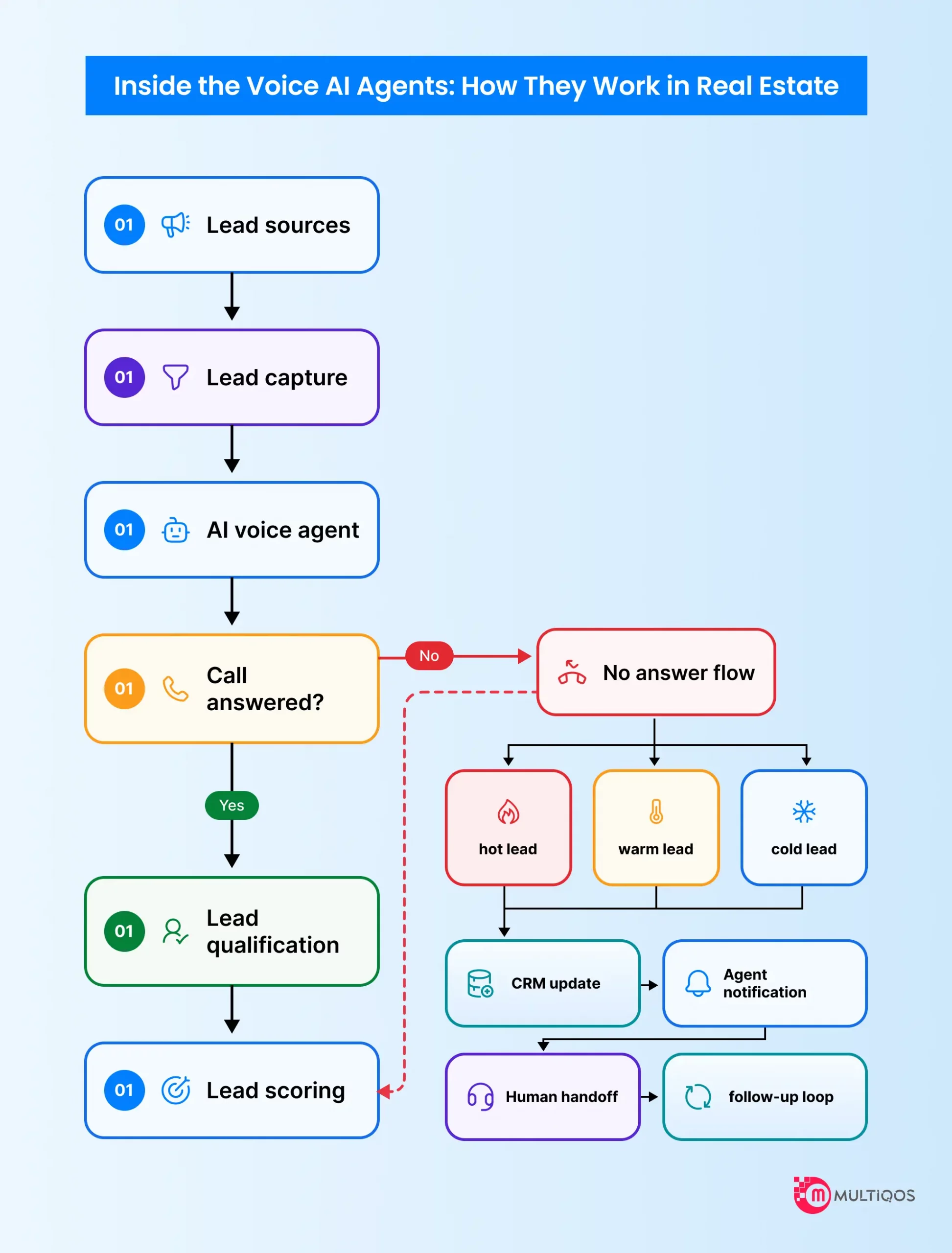
Buyers and sellers contact any real estate agency via different channels such as website, phone call, referral, Google ads, WhatsApp, and property portals. Every query is quickly captured, and the next course of action is initiated.
All the essential information, such as name, number, and email, is captured and updated in the centralized CRM for proper management and follow-ups.
The agents are programmed to call the leads within 30 seconds of the first interaction. The rapid response results in a good brand impression and improves the chances of conversion.
The conversational AI judges the next steps on the basis of the lead interaction. If the lead has answered the call, then it is considered qualified, and if not, then a re-engagement sequence is initiated.
No Answer Flow: The agent will leave a voicemail if the lead has not answered the call. They will call back at regular intervals to improve the chances of reaching the lead.
The AI agents ask predefined questions such as property type, budget, location, and more to determine the intent of the buyer and seller.
Based on the interaction, the AI agents categorize the leads into different sections.
AI agent updates details of every lead interaction in the CRM, making it easy for the sales team to initiate informed conversations.
When a lead qualifies all the set parameters, the concerned agent receives all the information, such as interest, appointment scheduling, and more.
If the discussion gets serious, negotiation support or assistance for complex questions is required, the AI agent will hand over the lead details to a human agent.
The AI agent continues nurturing the leads by sending the customized promotional material.
From first inquiry to final follow-up call, phone conversations shape almost every stage of real estate transactions. Here are some use cases where AI agents are making conversations effective and fast.
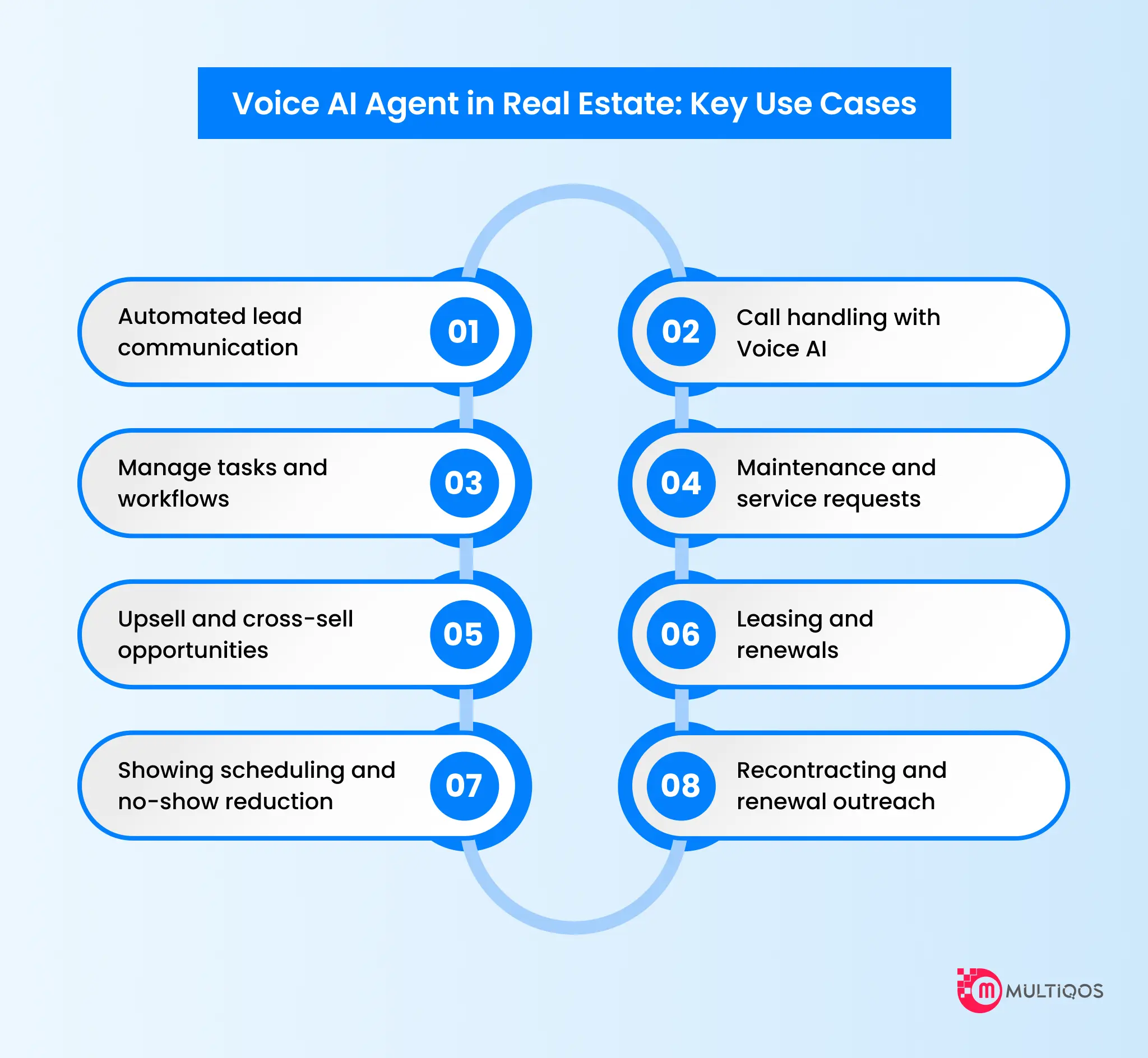
A voice AI agent immediately replies to every inquiry irrespective of the time (weekend or night) and source (website, WhatsApp, email, phone call, SMS, or listing portal). It answers primary questions such as price, neighborhood, and availability. It also qualifies buyer or seller according on the basis of their intent. It also schedules appointments for property viewings and reflects them directly in the concerned agents’ calendars.
Every unanswered call is a lead that might never return. Whether it is a renter looking to schedule a property visit or a seller wanting to list a property, a slow response sends them to the next real estate agency.
A voice AI agent is a receptionist that never goes off-hook. It answers every call, solves any query, qualifies callers, and hands over urgent matters to the human agent.
In a real estate agency, many things are happening at once – showings run back to back, paperwork piling up, guest visits, and vendor waits for a callback. It is certain that something always slips.
AI agents can be programmed to create a task for every request that comes through, assign it to the right people, and send reminders regularly, if required.
Most of the maintenance and service requests don’t end with the first report. When a problem is reported, there is a series of tasks that follow. Someone has to categorize the issue, judge its urgency, assign it to the relevant technician, arrange property access, send regular updates to the residents, and confirm once the request is completed.
A voice AI agent handles all these tasks from the first call to the final confirmation without anyone chasing the ticket.
Every client interaction is a chance to build relationships. A real estate AI agent captures details from every conversation, such as preferences and timelines, so that the human agents can follow up with relevant, informed outreach. This helps in spotting a new opportunity and turning conversation into revenue.
Leasing is considered a marketing process. However, when we look at the nuances, it is a sequence of operations that starts from inquiry and progresses to qualification, availability check, tour scheduling, application support, document collection, approval, move-in, and ends at renewal. A minor delay at any step results in friction between the prospect, the leasing team, and the property owner.
Voice AI agent completes the manual tasks such as collecting details and answering property-related questions. It monitors pending maintenance issues, missed appointments, negative feedback, and slow responses.
Once a lead is qualified, a human agent schedules a property visit after confirming the prospect’s availability. However, this might not be the case every time. While managing several inquiries, booking calendar slots and sending reminders becomes a tedious task.
Voice AI agent fills this gap by automating the entire process. The agent checks the calendar, books a free slot, and sends a confirmation email. 24 hours prior to the appointment, the agent sends an appointment reminder. This exercise prevents no-shows, as the leads whose situation might have changed can reschedule or cancel in advance.
The agents lose against competitors simply because they missed reaching out to the tenant before their lease expires. A workflow can be set where CRM triggers a call 90 days before the lease expires. An AI voice agent starts the conversation with the tenant to identify if the renewal date has changed. Once the preliminary round of details collection is completed, the agent books the call with a human agent. For properties whose prices have been reduced, the entire process is in reverse. The voice AI agent calls every lead who inquired about that particular listing, notifies them about the price change, and checks if they are still interested.
Businesses are able to harness the exact value of their AI investments if they begin with the right use case, and partnering with an experienced agentic AI development company is the key to achieving real value.
Voice AI agents automate several routine tasks such as calendar management, cold calling, lead qualification, and documentation, enabling the agents to focus on client relationship-building activities.
Investors can get a brief overview of the neighborhood and other market conditions with the help of voice AI agents. Other important information, such as zoning changes and pricing trends, is also available.
Real estate companies have access to a wealth of data that they rarely put to work. AI agents and machine learning can analyze property, customer, and operational data to identify patterns and generate insights. These insights power informed demand forecasting decisions and offer assistance with pricing and investment analysis.
Voice AI analyzes available customer data and offers suggestions based on customers’ preferences, boosting loyalty and satisfaction.
A voice AI agent works as a receptionist for real estate agencies, one that is always on duty. It answers every call, whether at night, during a weekend, or on a holiday. No inquiry has to wait for a human agent. It transcends geographic boundaries and offers multilingual support regardless of time zones.
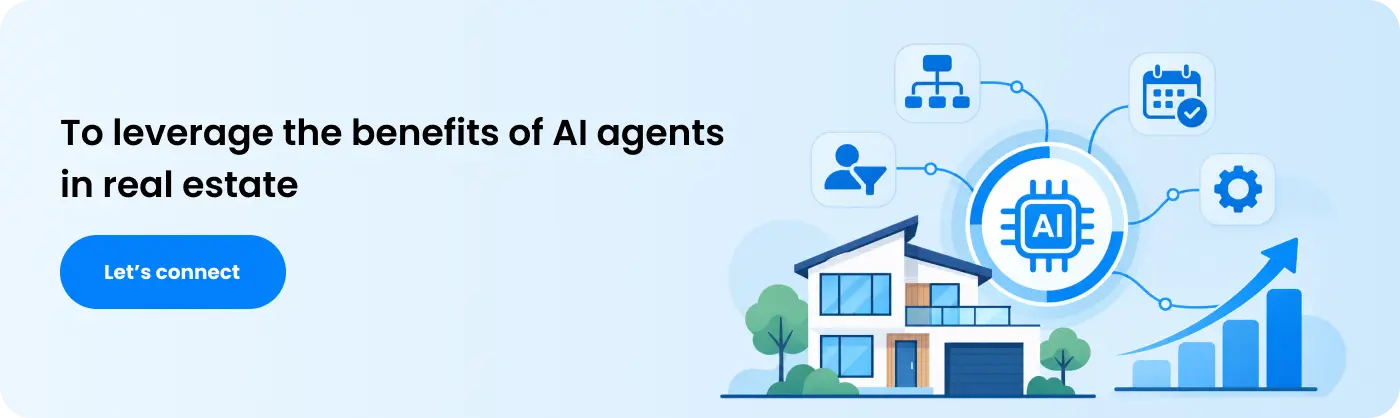
A real estate agency should evaluate the parameters below before deploying voice AI agents.
For an AI agent to deliver accurate and speedy results, it is necessary that data is checked at regular intervals. Partnering with an AI development company can make this task easy.
When conversations require human intervention, they should be handed off to the live agents without friction.
The data collected by the AI agents should be easily synced with the CRM to ensure proper conversations with audiences.
Make sure that every call meets legal and privacy requirements, including customer consent, call recording rules, access control, and data protection standards.
Evaluate different parameters – speed to first contact, lead qualification rate, lead-to-opportunity conversion, and agent hours saved to gauge the impact of AI agents.
Engaging with a trusted AI agent development company enables businesses to ensure that they are starting on the right footing.
Voice AI agents are no longer an experiment for the real estate industry. From re-engaging old listings to handling customer queries, voice agents take over tedious manual tasks, allowing the teams to focus on strategic initiatives.
To harness the full value from the AI investment, real estate agents need to pick one use case, integrate with the existing CRM and workflows, and then measure results.
The technology is ready, and the outcomes are proven. You just need to figure out the starting point. To learn more, connect with MultiQoS today.
A voice AI agent attends calls on behalf of human agents. They use natural language processing (NLP) to understand caller intent, book showings, answer queries, and log structured data into the CRM.
No, voice AI cannot replace human agents. They can certainly augment the capabilities of human agents by automating manual tasks for them.
Track metrics such as contract rate, task completion rate, appointments booked and cost per completed interaction of approximately 2,500 calls. Compare the results with human-led processes and calculate the cost difference between the hourly rates.
It is advisable to start with speed-to-lead callback as it offers the highest ROI and its impact is easy to measure. Once the team is habituated with the speed-to-lead callback feature, implement after-hours inbound qualification and showing scheduling – as it is less tedious to measure the impact of these use cases.
The implementation timeline for a voice AI agent depends on the complexity of the project and also how clean the systems and data are. It also depends on the main requirement of the real estate agency. For example, a basic plug-and-play tool can be rolled out in 8-10 minutes, whereas a complex customized project might take 8-12 weeks for deployment and 6 to 12 months for company-wide adoption.
Yes. Voice AI agents study voice, tone, and other engagement cues to qualify a lead.
Well-known AI development service providers build compliance and regulatory features in voice AI agents. Call recording disclosure, do-not-call list scrubbing, and data privacy protection are a few examples. Always make sure your provider complies with TCPA, FTC, and state-specific real estate communication regulations before deployment.

Get In Touch

Get Stories in Your Inbox Thrice a Month.
AI Agent Development Cost: A Strategic Investment for Business

AI Agents for Fraud Detection: Core Capabilities, Benefits, and Implementation Roadmap

From Pilot to Production: How Forward Deployed Engineers Make Enterprise AI Work