
The Promise of AI Agents in Legal: Stronger Compliance, Better Costs, and Enhanced Accuracy
Need quick insights? Summarize with AI & save time
 ChatGPT
 Perplexity
 Claude
 Google AI Mode
Table of Contents
- What are AI agents in legal?
- The Framework of AI Agents in Legal
- How AI Agents Complete Legal Tasks?
- Where are AI Agents Used in Legal Work Today?
- What are the Benefits of AI Agents in Legal?
- What are the Types of AI Agents in Legal?
- How AI Agents are Reshaping the Role of Junior Associates?
- Conclusion
- FAQs
Summary:
For a long time, the legal industry has relied on human efforts to manage the lengthy paper trail. Every contract file and compliance record has traditionally passed through many hands. This activity makes legal processes slow and prone to errors. This picture is going to change now. This shift goes beyond digital filing and paperless offices. It comes from the arrival of AI agents in law, which do more than answer questions. They can take on tasks, work through multi-step processes, and support lawyers from start to finish.
What are AI agents in legal?
AI agents are basically software tools that complete routine tasks without manual input. In the legal industry, they analyze documents, search databases, draft text, and manage information flows.
The key difference from legacy legal software is autonomy. Tools like document management systems, clause libraries, and template generators are passive: they store data, but humans must take the next step.
AI agents can read a contract end to end, flag risky or non-standard clauses, compare terms against the company’s playbook, suggest redlines, and draft a response, all without anyone clicking through menus or filling out forms.
This shifts lawyers’ work from doing the first pass to reviewing it. Manual tasks such as NDA reviews, contract intake, and compliance checks move faster while attorneys spend their time on judgment calls, negotiation strategy, and client advice. Human oversight is still needed, but towards the end of the workflow and not from the start.
The Framework of AI Agents in Legal
The AI agent framework comprises several components, such as memory, tools, action, and planning. These components work together to enhance the efficiency, productivity, and accuracy of legal practices. Here is a detailed description of how these fit into the workflows at a legal organization.
Memory
The memory component stores and retrieves information that is necessary for making decisions and training processes. This component ensures that the immediate and long-term tasks can be efficiently completed on time.
- Short-term memory: As the name suggests, it holds temporary information such as details of the ongoing tasks. It ensures that the current work is completed using the most recent information.
- Long-term memory: This component stores information that is required for a long period. Client history, legal precedents and regulatory changes are some of the examples. This data allows AI agents to build a deep knowledge base that promotes informed decision-making.
Tools
Legal firms can improve the capabilities of AI agents by integrating them with specialized tools. Some of these tools are
- Document Reviewer: Reviews and organizes documents to extract the relevant information.
- Legal Researcher: Sifts through the information in legal databases and produces results quickly.
- Client Manager: Completes manual tasks such as client communications, appointment scheduling, and sending reminders.
- Data Organizer: Stores and segments the data properly to boost search efficiency and retrieval capabilities.
- Compliance Checker: Checks that all actions are compliant with the industry rules and regulations.
- Contract Analyzer: Identifies key terms and potential risks by analyzing contracts.
- Deposition Summarizer: Highlights important points and discrepancies by summarizing depositions and other legal documents.
- Case Tracker: Sends updates on court dates and deadlines and monitors the progress of cases.
Planning
This component breaks a complex task into numerous simple tasks to ensure that no details are missed and all tasks are completed with efficiency and precision.
- Self-reflection: Evaluates historical data to decide the next steps. Analyzes old data regularly to train with the updated information and continue delivering accurate results.
- Guardrails: Set boundaries and guidelines to ensure the agent doesn’t miss any legal standards or compliance regulations.
- Chain of thought: Creates logical sequences to complete a complex task successfully without any errors. For example, if there is a case with multiple moving parts, the AI agents decompose these into different parts, analyze previous rulings and findings, and suggest the further course of action accordingly.
Action
This component executes the activities the agents analyze. This involves performing tasks and interacting with the environment to achieve the intended results.
- Automating: Reviews and analyzes documents to spot discrepancies and ensure that the documents meet the compliance guidelines.
- Managing client communications: Schedules appointments, sends updates, and answers routine queries.
- Organizing data: Sorts and stores information properly to ensure that the required data is fetched without any delays.
- Ensuring compliance: Verifies that all the legal activities are in accordance with the laws and regulations, cutting down the risk of legal issues.

How AI Agents Complete Legal Tasks?
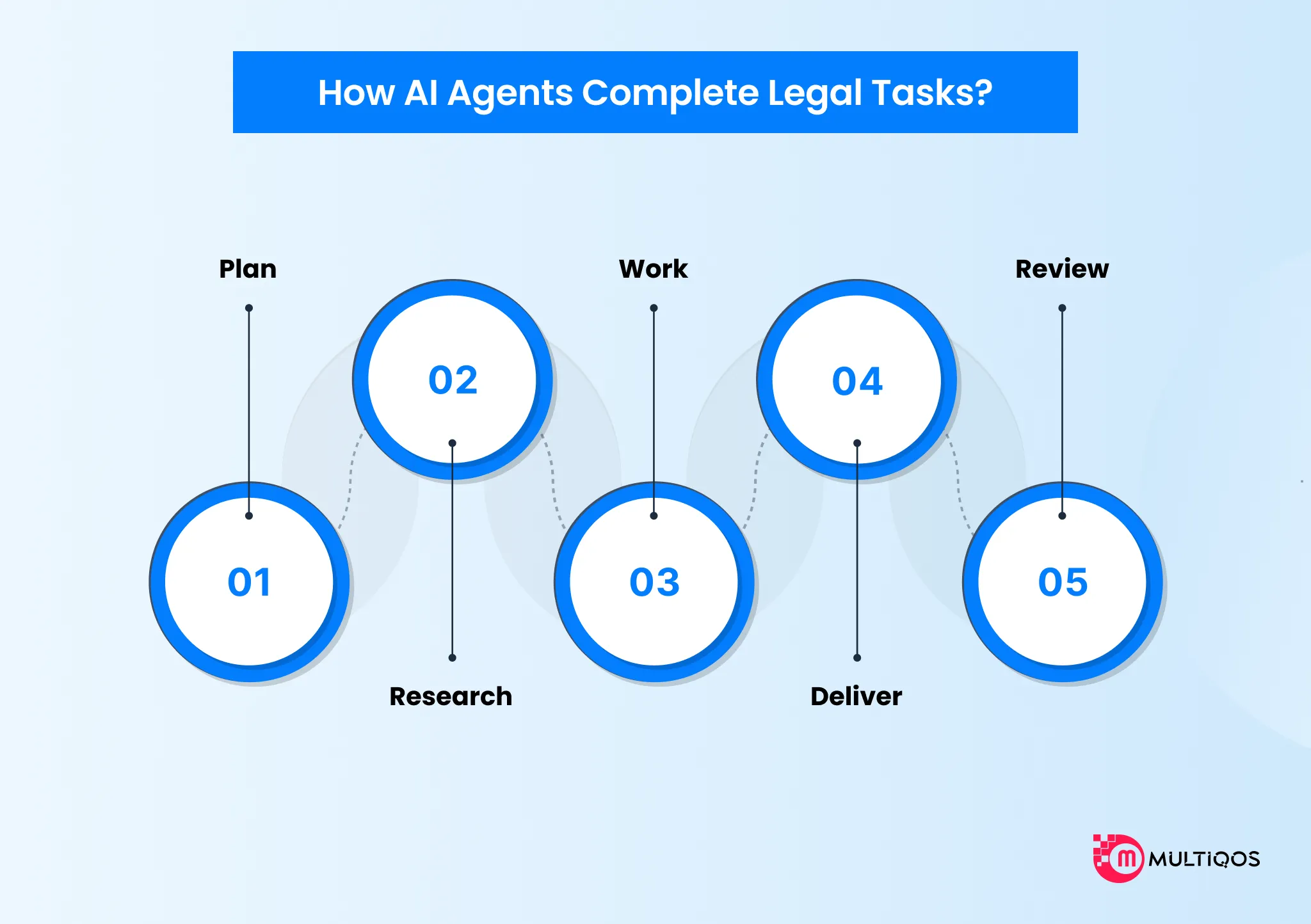
The lawyers need to confirm if the AI agents in legal are able to produce the intended results. They need to assess AI agents based on these five parameters: Plan, Research, Work, Deliver, and Review. The lawyer supervises AI agents at every stage and signs off on the result.
-
Plan
The agents convert the goal into a step-by-step plan. If the objective of any task is unclear, it asks certain questions. For example, an attorney asks the agent to review the incoming NDA from the vendor. The agent might confirm whether non-standard terms against the company’s playbook should be checked or simply highlight the clauses that need attention. The agent then shares the plan with the lawyer so that any adjustments can be initiated before review.
-
Research
The AI agents pull data from different sources such as documents, vetted databases, and the live web, if applicable. The AI agents cite every claim with an appropriate source for the lawyer to audit and change if required.
-
Work
This is the stage where an AI agent proves its capabilities. Instead of just finding the information, it completes the task – structures the markup, builds the issues list, compares a disclosure against the industry regulations, and extracts obligations from the record of decision.
-
Deliver
The agent delivers its work in the required format. For example, the contract markup comes back with redlines and comments in the right places. A memo has a clear structure and proper citations. A diligence summary arrives as a structured document, not a chat transcript. This matters because deliverable quality is of significant importance for the legal industry. If an attorney has to reformat the document, then the AI agents need to be trained again.
-
Review
At this stage, the lawyer verifies the results and accepts or rejects them. Every decision teaches the agent, so the agents get sharper over time and become suited to suffice the distinct needs of the law firm. In this manner, the accountability remains with the lawyer only.
Where are AI Agents Used in Legal Work Today?
AI agents are automating several routine processes, enabling lawyers to focus on strategic initiatives.
-
Document Review and Management
AI agents eliminate the risk of human error by reviewing and classifying documents with accuracy and speed. The AI agents also extract key information such as dates, parties, and clauses and flag issues before the lawyer verifies them. In litigation, they search millions of records to search for evidence. AI agents read legal documents and route the information to its source.
-
Legal Research and Analysis
AI agents make legal search sharper and faster. They search case law, statutes, and regulations by context, analyze past cases to identify patterns and likely outcomes, and compare laws across jurisdictions. They can also suggest arguments, help draft briefs, and answer lawyers’ questions with cited sources and precedents.
-
Contract Generation and Review
AI agents boost the efficiency of the contract generation and review process. They generate first drafts of routine agreements like NDA and tailor documents to specific requirements such as different types of visas or contract terms. When reviewing, they compare clauses against the standard company terms during negotiations so no subtle changes slip through. The result is less time spent on routine work and fewer missed details.
-
Client Interaction and Management
AI agents improve the client experience by answering simple questions quickly. They personalize communication using the historical data and handle scheduling and updates. The agents also match the clients with the right lawyer. The agents upload documents in the workflows and streamline onboarding. They also analyze client feedback to determine the scope of improvement in the existing services.
-
Legal Writing and Case Summarization
AI agents also support legal writing. They produce first drafts of citations and memos by adding the required and relevant information. They can summarize lengthy cases and also highlight critical points such as key facts, principles, and verdicts. The AI agents format the documents to ensure that they adhere to the specific formatting requirements given by the court and other judicial bodies.
What are the Benefits of AI Agents in Legal?
AI agents are giving law firms and agencies a competitive edge. From faster and more accurate document review to more consistent compliance, the benefits go beyond saving time. The agents can improve accuracy, reduce risks, and allow lawyers to focus on the tasks that matter the most.
-
Enhanced Quality of Legal Services
AI agents take the reliability of legal services a notch higher. The agents prepare a comprehensive research document for the lawyers to build their argument points. They review documents for compliance issues and flag them early to avoid legal trouble. As they reduce human intervention, due diligence is ensured, and quality is uniform across every document.
-
Enhanced Decision Making
AI agents can analyze massive datasets in a matter of a few minutes and deliver insights that are quite helpful for the attorneys. Also, the agents flag issues in the early stages, allowing the lawyers to protect clients’ interests from the very start. As the analysis has roots in data, the AI agents are the foundation of objective, well-informed judgment across legal workflows.
-
Enhanced Legal Writing and Communication
AI agents can draft a complex legal document in simple language that a client can easily understand. They are capable of creating documents that are clear, consistent, and adhere to various compliance requirements. Together, these qualities improve both the quality of legal services and client experiences.
-
Improved Contract Management
AI agents can support contract negotiations by identifying areas of conflict. They analyze the contracts to suggest counteroffers. Also, they keep monitoring the contract and alert lawyers regarding violations and breaches.
-
Enhanced Legal Search and Analysis
AI agents compare the laws across different jurisdictions, giving the lawyer a complete picture of the legal issues. They also verify if the precedents and profiles have evolved, adding a layer of nuance to the existing questions. They identify patterns in the data that a human might miss and offer insights that might be vital in forming legal strategies.
What are the Types of AI Agents in Legal?
As there are a multitude of tasks in the legal industry, there are different kinds of AI agents. Understanding their functions helps the legal agency choose the correct agent for their activities.
-
Contract Review Agent
The agent analyzes the document to spot errors and legal discrepancies. They compare the legal documents with your company playbook and flags deviations.
-
Document Drafting Agent
The agent specializes in creating a primary draft of common legal documents – correspondences, motions, and other legal documents. It can prepare documents on the basis of the given prompts.
-
Due Diligence Assistant
The agent reviews documents related to mergers, acquisitions, and investments. This agent highlights inconsistencies and missing information.
-
Client Intake Assistant
The agents handle the initial process of client intake. They specialize in collecting information, scheduling appointments, and determining case viability.
-
E-process Discovery Agent
The agents process and index the electronic evidence – videos, call transcripts, and chat logs. They organize, search, and tag different materials for review.
-
Deposition Preparation Agent
This agent analyzes the case files to identify inconsistencies and key facts. The agents highlight impeachment opportunities for the trial attorneys to complete depositions in 2-3 hours, which took 6-8 hours initially.
Since AI agents are available in many types, legal organizations need to rely on an experienced AI agent development company to select the right fit. Picking the most apt AI agents ensures that law firms are able to derive significant impact from the investment.
How AI Agents are Reshaping the Role of Junior Associates?
When AI agents are doing the preliminary round of documentation, the role of junior associates doesn’t shrink. Initially, junior associates were dedicating 40 hours to prepare primary documents; now the number has been reduced to 5-10 hours.
The risk is that instincts come from drafting the documents. Associates might be able to proofread the documents and spot errors but might not be able to write from a blank canvas. They might not be able to identify if the AI agent has missed any crucial information. Smart firms are treating this as a training problem by teaching juniors what good looks like and making them write a document and then compare it with the AI agents.
Conclusion
The first phase of AI in the legal industry included single-task execution such as underwriting assignment or checking a disclosure against regulatory requirements. The next phase sounds exciting. The AI agents will be able to take up different complex projects such as diligence and drafting, and analysis of a single matter in parallel. The agents will continuously upgrade themselves.
For the leaders, the question has pivoted to which tasks should be given to agents and how to train junior lawyers when writing a first draft is not a billable skill as of now.
Firms that answer these questions early will be the ones leveraging the early benefits of AI agents with confidence.
FAQs
AI agents in legal are deployed to review contracts and maintain compliance records. However, they can not replace in-house lawyers.
AI agents maintain security and governance through encryption, role-based data access controls, master data isolation, audit trails of every action, and human review checkpoints, so sensitive data can stay protected, and every output can be traced and verified.
AI agents are highly efficient when it comes to verifying documents and extracting data, but they are not 100% accurate. They require multi-layered checks or human intervention.
Successful adoption of AI agents in legal depends on different factors. Data security controls protect confidential data, while human oversight keeps lawyers in the loop for fair judgment. Accuracy verification ensures outputs are cited and verified to avoid hallucinations, and smooth workflow integration connects agents with existing practice management and document tools. Teams should also measure cost and ROI by comparing time saved against subscription and deployment expenses and set clear governance policies.

Get In Touch

Get Stories in Your Inbox Thrice a Month.
AI Voice Agents in Real Estate: From Use Cases to Implementation, Everything You Need to Know
AI Agent Development Cost: A Strategic Investment for Business
AI Agents for Fraud Detection: Core Capabilities, Benefits, and Implementation Roadmap