Top Use Cases of Machine Learning in Manufacturing
Real-world Examples and Case Studies
Benefits of Machine Learning in Manufacturing
Machine Learning in Manufacturing: Implementation Challenges and Risks
Implementation Roadmap for Machine Learning in Manufacturing
Conclusion
FAQs
Summary:
Machine learning in manufacturing is one of the stepping stones for Industry 4.0. The technology is powering real-time data accessibility and allowing manufacturing leaders to shift from fixed maintenance schedules to predictive maintenance frameworks. With information gathered from sensors and machines, ML models can predict equipment failures and defects, enabling staff to reduce downtime.
This guide covers every nuance of machine learning in manufacturing, including top use cases, real-life examples, an implementation roadmap, and key benefits.
Machine Learning in Manufacturing: Key Statistics at a Glance
$725b
The machine learning market is exhibiting strong and rapid growth. The market is projected to increase to cross USD 725.66 billion by the end of 2036.
Every hour a machine sits idle unexpectedly, costs climb, production stalls, and deadlines slip. For years, manufacturers have tried to solve this issue with fixed calendar maintenance schedules. Machine learning is pivoting manufacturing leaders away from this situation. According to research, ML-driven predictive maintenance can reduce unplanned downtime by 30-50% and cut maintenance costs by 20-30% when compared to traditional maintenance methods.
The numbers demonstrate how machine learning is boosting productivity and operational efficiency of your manufacturing facility. Let’s look at all the possibilities ML can unlock for you, along with challenges and risks, real-life examples, and more.
What is Machine Learning in Manufacturing?
Machine learning is a branch of AI that uses models that learn from the available data. By studying historical and real-time data, these models are able to spot patterns, predict outcomes, and improve accuracy. Machine learning is implemented through algorithms and data collected through IoT sensors. A large amount of data is collected, which is used by machines to pinpoint defects, optimize production schedules, and ensure consistent quality control.
Applications of Machine Learning in Manufacturing
Modern manufacturers have faced financial losses, resource wastage, and delayed production due to equipment failure. Machine learning in manufacturing is an easy way to resolve these concerns.
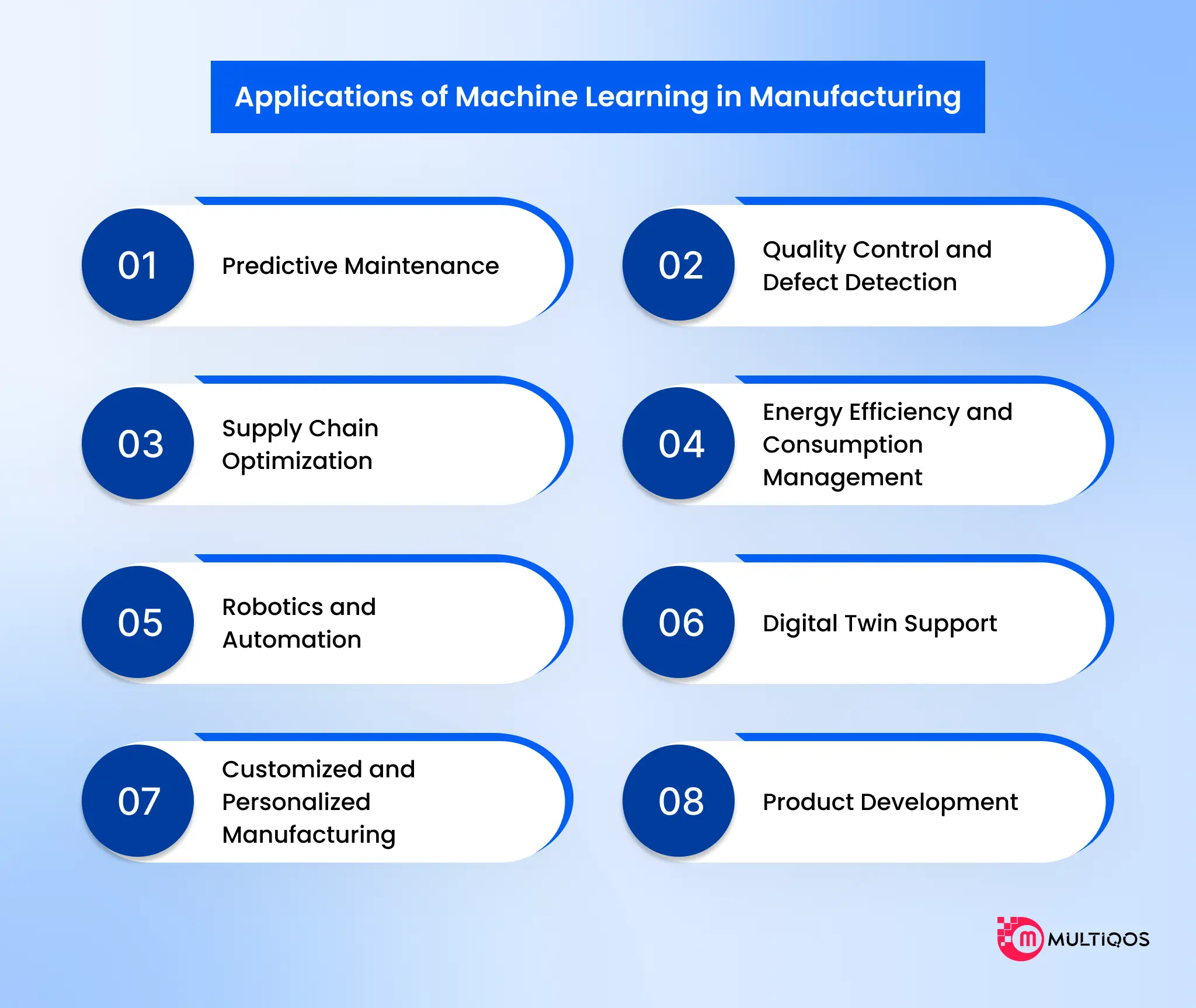
Here’s how machine learning is shaping the future of the manufacturing industry
1. Predictive Maintenance
With the data gathered from IIoT sensors, ML analytics automatically detects minor deviations in system performance, which often are the first signs of potential system failure. Using the insights from Predictive Maintenance systems, teams can check the machinery before it stops working.
Repairs can be scheduled during quiet production hours, leading to reduced unplanned downtime
Maintenance costs are curtailed as repairs are only undertaken when data actually shows potential breakdown
Machine learning enables manufacturers to ensure high quality standards on two fronts – product and process.
Product: On the assembly line, machine learning identifies irregularities in the product at a granular level and flags them in real time. As the defect is captured early, faulty parts can be removed, saving time and effort. The result is high customer satisfaction, reduced product wastage, and superior product quality.
Process: Visual inspection systems can quickly determine faults in the process and recommend adjustments to rectify them. A healthier process means fewer defective parts leave the production line.
3. Supply Chain Optimization
Machine learning offers highly accurate demand forecasts by analyzing vast datasets such as historical sales, weather patterns, and economic shifts. Inside the warehouse, the algorithms periodically monitor inventory levels, enabling manufacturers to avoid overstock and stock-out conditions. Machine learning evaluates supplier risks by tracking lead times and disruption signals. Simultaneously, machine learning also analyzes the best route by analyzing live data and carrier costs. In a nutshell, machine learning reduces material waste and operational overhead while preventing factory bottlenecks.
4. Energy Efficiency and Consumption Management
Machine learning in manufacturing analyzes energy and resource data from sensors, meters, and other systems and highlights usage patterns that are often missed by humans. For example, machine learning can determine the sources where the energy is being wasted. Also, it can forecast energy demand so operations can be avoided during peak hours and load spikes.
5. Robotics and Automation
Industrial robots augmented with computer vision and machine learning can adjust their movement to prevent collisions and hence ensure high workplace safety. The robots notify maintenance teams about machine wear to prevent production delays.
6. Digital Twin Support
A manufacturing digital twin is a replica of the original manufacturing facility, enabling continuous monitoring, simulation, and analysis of production processes with the use of data collected from sensors installed across the factory floor. When machine learning comes into the picture, the capabilities of digital twins improve manifold. For example, a digital twin alerts concerned teams when there is a subtle deviation in the equipment performance.
7. Customized and Personalized Manufacturing
Modern customers prefer personalized products, but traditional assembly lines are not designed for mass production. With a leading machine learning development services provider, manufacturers can add customizations to their production line without major disruptions.
8. Product Development
ML-based product development, also popularly known as generative design, automates engineering tasks, reducing product development time. Also, as issues are detected early, the highest product quality is guaranteed.
Top Use Cases of Machine Learning in Manufacturing
Food and Beverage Industry: Predictive Maintenance on Production Lines
In the highly competitive food and beverage industry, downtime often translates to missed production deadlines and wasted targets. Machine learning models analyze vibration, acoustics, and temperature of motors, blowers, conveyors, and other rotating parts to detect early signs of wear. Maintenance teams can schedule repair work during the quiet hours and avoid unplanned downtime.
Consumer Packaged Goods (CPG): Anomaly Detection on Rotating Equipment
Most CPG leaders rely on traditional calendar-based maintenance, making it difficult to prevent equipment failure. ML-powered anomaly detection continuously checks the systems for any deviations from normal behavior. An alert is sent to the concerned teams if any error is found. The maintenance teams can prevent scrapping an entire product batch and put efforts where it matters the most.
Pharmaceuticals: Continuous Monitoring of Batch-processing Equipment
In the pharmaceutical industry, maintaining product quality is of the highest importance. A single equipment failure mid-batch can ruin an entire run, creating waste, regulatory risks, and delays in medication for the patient. Continuous ML-based monitoring offers real-time insights into asset health, so teams can step in and initiate repair plans and prevent downtime.
Building materials: 24/7 Anomaly Detection on Production Lines
Building materials manufacturers often operate around the clock; therefore, a short outage can result in hefty losses. Anomaly detection on production lines can enable the manufacturers to shift from time-based maintenance to condition-based maintenance. As alerts for any defects are shared early, teams can plan for parts availability on time, respond to alerts faster, keep lines running, and reduce costly emergency repairs.
Real-world Examples and Case Studies
A Food and Beverage Manufacturer: Reduce Packaging Defects with an AI-based Vision Inspection System
Challenge: A food and beverage manufacturer had 240 bottles running on the production line per minute, making it difficult for the teams to ensure quality manually. Defects slipped up to 5.8%, and as quality varied from batch to batch, several concern reports were raised by the retail partners.
The Solution: MultiQoS built a vision inspection system directly on the production line. The strobe-lit cameras capture every bottle from multiple angles. A custom-trained model checks each unit in 40 milliseconds, and the gate ejects the faulty bottles from the production line. A centralized and intuitive dashboard was designed to track quality by batch, shift, and product. The Result: Defect escapes fell by 71%, retailer non-conformance notices became zero, and every bottle became traceable. Every batch now has full traceability, turning quality control from a bottleneck to competitive advantage.
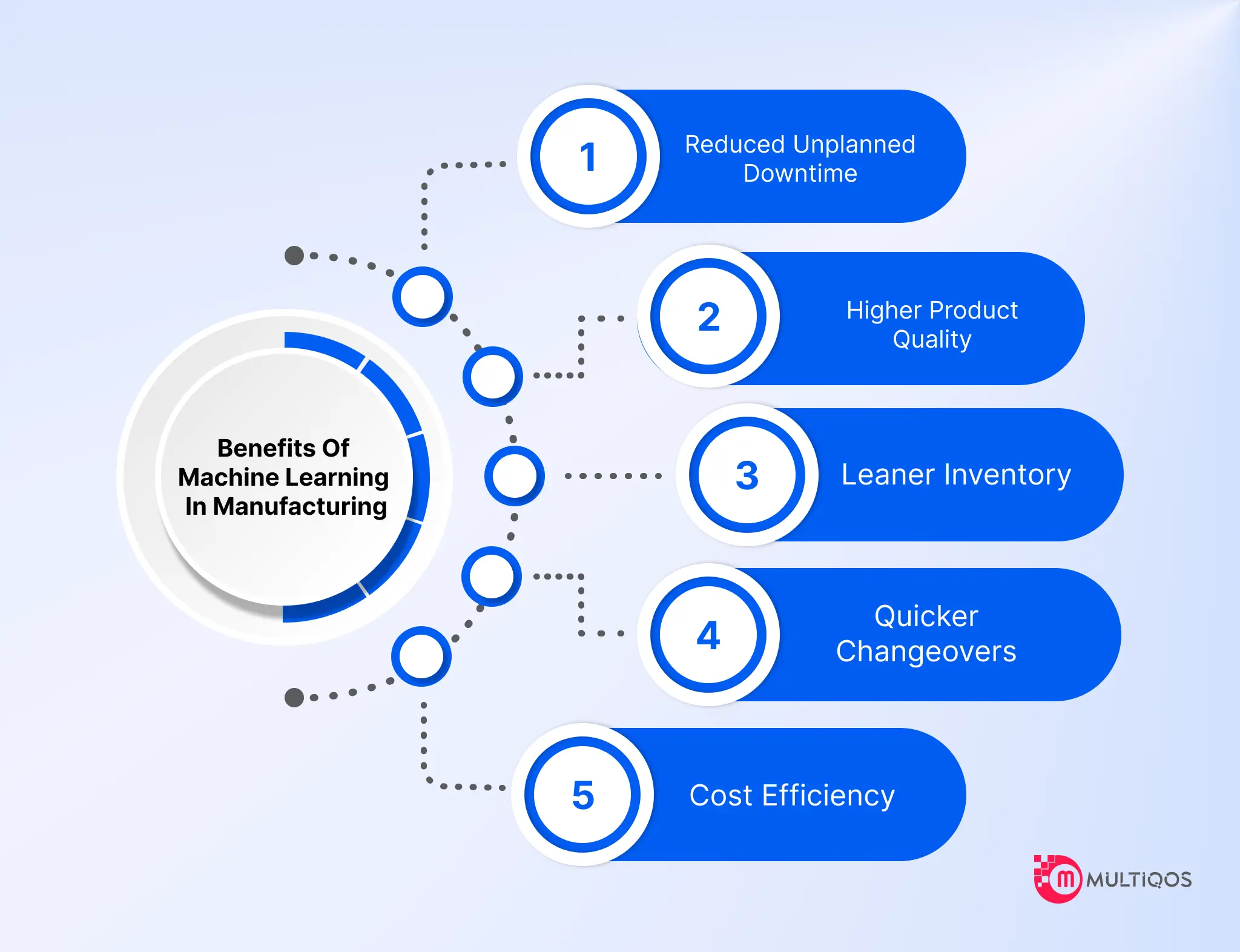
ML pays off in significant and measurable ways. Here are a few benefits manufacturers can expect with machine learning implementation.
Reduced Unplanned Downtime
ML models can detect faults in equipment by analyzing several signals such as temperature, vibration, and current. The maintenance team can schedule repairs and prevent breakdowns. This ensures business continuity and avoids rush repairs and emergency parts orders.
Higher Product Quality
ML-powered vision systems thoroughly check the products on the production line for the minutest defects, which are easy to miss if inspected manually. The result is fewer returns, fewer warranty claims, and stronger customer trust. As the system points out the origin of the defect, it becomes easy for the team to eliminate the cause.
Leaner Inventory
More accurate demand forecasts let manufacturers purchase raw materials and plan production closer to the actual need. Doing so reduces capital tied to surplus materials, unfinished goods, and lowers storage and obsolescence costs, while reducing the fear of stockouts.
Quicker Changeovers
Digital twins let engineers test the production line without accessing the actual physical equipment. The issue is visible directly on the screen and not on the factory floor, making it easy for manufacturers to rectify the defects. This is valuable for manufacturers running numerous product variants or having short production runs.
Cost Efficiency
Predictive maintenance and process optimization slash operational costs substantially. Manufacturers can save due to fewer breakdowns, lower energy use, and improved use of labor and equipment. These savings add up across the plant and show in cost per unit.
Machine Learning in Manufacturing: Implementation Challenges and Risks
The risks and challenges rise due to the factory floor, not the algorithms.
Legacy Machines
Traditional systems were not designed to send digital reports; therefore, retrofit projects became mandatory.
Workforce Adoption
Training sessions should be arranged for the plant staff. Also, the team needs to learn to trust these model outputs. Some roles shift from manual inspection toward monitoring and exception handling.
Data Quality and Labeling
Desired benefits can only be leveraged if the datasets used for training ML models are prepared after extensive research and labeling. Preparing datasets is often the slowest stage of any machine learning project.
Change Management
There is a high chance that any false alert raised by the ML model is ignored. Setting the model to match how many false alarms your plant can realistically handle is also as important as maintaining accuracy.
Implementation Roadmap for Machine Learning in Manufacturing
A quick look at the step-by-step machine learning model implementation guide in a manufacturing setup.
High-value ML Use Case Definition
Identifying business pain points should be the first step before starting any machine learning project. Establish a clear objective, whether you want to reduce scrap rates or avoid equipment failure situations. Defining a goal from the start ensures that measurable results are achieved.
Data Gathering
Once the purpose is defined, it is necessary to determine the data type and its source. For example, predictive maintenance uses data generated by the sensors, while visual inspection systems require thousands of faulty images.
Data Cleaning and Formatting
Clean, contextualize, and organize the initially gathered raw data in a format that can be easily understood and analyzed by the ML models.
Data Visualization and Planning
Data visualization is an ideal way to ensure that manufacturing leaders can understand AI-driven insights. Design intuitive dashboards to make it easy for the plant engineers to read reports and make informed decisions.
Model Training
Once the datasets are created, you can start training the machine learning models. Conduct retraining sessions if the models fail to produce accurate results.
Model Validation and Deployment
Make it a point to test the machine learning model using real-time data. If the model works perfectly after multiple tests, then only deploy it into the production environment.
Continuous Model Retraining
The models should evolve to suit your changing business needs. To avoid model drift, retrain them at regular intervals to maintain peak accuracy.
Conclusion
The application of machine learning in manufacturing is growing by leaps and bounds. The usage is not limited to predictive maintenance to reduce downtime. Vision systems that catch defects before products reach the customer are one of the most common uses. With smart inventory and flexible production, ML broadens Industry 4.0 initiatives. The benefits are significant but can be leveraged only if the ML models are implemented properly.
The gap between manufacturers who adopt machine learning and those who wait will widen as the data sets and competitive pressure grow. The best time to identify your first use case is now.
FAQs
Machine learning finds applications in different areas of the manufacturing setup. Predictive maintenance, automated quality checks, and optimized supply chains are a few of them.
Deep learning is used to optimize complex production processes, automate operations, and predict equipment failures.
Machine learning drives AI-assisted manufacturing by turning real-time data into automated predictions, process optimizations, and quality improvements.
Machine learning boosts supply chain efficiency by analyzing large datasets to predict future needs and optimize logistics.
Manufacturers should define a clear goal they want to achieve with their machine learning initiative. They need to ensure that the datasets are clean and properly contextualized.
The cost of machine learning projects typically ranges from $20,000 to over $1,00,000. The cost of applications for mid-sized manufacturing units is between $50,000 and $ 250,000. As these applications are targeted to solve a specific business problem, customizations come into play, and costs may vary.
Prashant Pujara is the CEO of MultiQoS, a leading software development company, helping global businesses grow with unique and engaging services for their business. With over 15+ years of experience, he is revered for his instrumental vision and sole stewardship in nurturing high-performing business strategies and pioneering future-focused technology trajectories.


 ChatGPT
 Perplexity
 Claude
 Google AI Mode