
Escaping Pilot Purgatory: Why AI in Supply Chain Fails and How FDE Turns It Around
Need quick insights? Summarize with AI & save time
 ChatGPT
 Perplexity
 Claude
 Google AI Mode
Table of Contents
- Why Good AI Pilots Don’t Become Good AI Deployments?
- Super Six Reasons Why AI in Supply Chains Fails at Deployment
- How Do Forward Deployed Engineers Solve Every AI Deployment Challenge in Supply Chain?
- How to Pick a Forward Deployed Engineer Partner?
- Conclusion
- FAQs
Summary:
Many supply chain AI implementations fail to reach the deployment phase. In most cases, the fault is not with the model itself. It is the gap between the purpose of AI implementation and the reality of unstructured and isolated data, legacy systems, and daily operations. This blog explores every reason why supply chain AI implementation is stalled at deployment and how forward-deployed engineers embed with the client teams to close that gap and turn pilots into working systems.
Consider a pharmaceutical distributor that implemented AI in its supply chain to reroute shipments, flag products nearing expiry, and predict shortages. The system went live, and leadership wanted fewer stockouts, less wastage, and faster fulfillment for hospitals and stores.
The results painted a different picture. Each warehouse recorded batch numbers, expiry, and stock information in their own way. Also, the data was updated at night, not in real time. AI treated this information as fact and, as a result, false alerts were generated, and products nearing expiry were recommended for rerouting.
The team soon learned that relying on the AI system meant checking everything manually. Trust in the AI solution dwindled substantially.
In this scenario, AI deployment wasn’t the real problem. It was working with fragmented data and without the practical knowledge and experience that the teams rely on. This is the kind of gap Forward Deployed Engineers (FDE) aim to close. They standardize data, connect AI to the existing systems, and build on-the-ground knowledge into the systems for AI to use and make decisions.
Why Good AI Pilots Don’t Become Good AI Deployments?
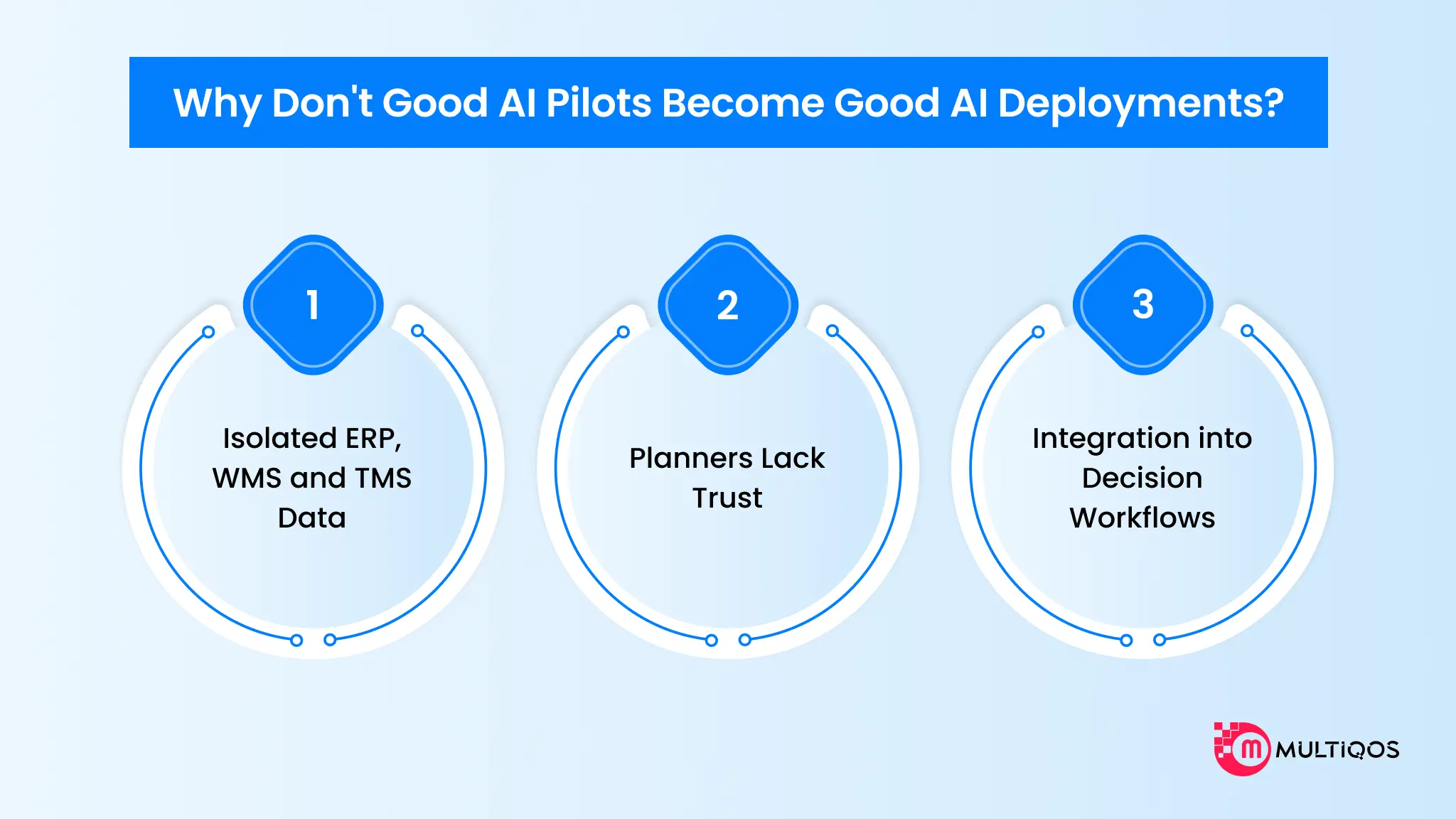
Getting supply chain AI implementation from pilot to production depends on three factors: data that is connected across different systems, planners’ belief in the results delivered, and tools that complement the existing workflows. These need to be built into the design and operating model from the start and not later.
-
Isolated ERP, WMS and TMS Data
Pilots work on a chunk of structured data, and as a result, the chances of any discrepancy in results dwindle. Production systems work on the live data streams, which might represent the same entity in different ways. A SKU might be identified by various names in ERP, WMS, or TMS. Calendars differ too, with fiscal weeks in finance and ISO weeks in logistics.
-
Planners Lack Trust
Planners are responsible for inventory management and order fulfillment. Therefore, when a model suggests an order without any reasoning, they don’t trust it and fall back on the manual way of working.
-
Integration into Decision Workflows
A forecast that has no impact on the decision is often considered useless. Many pilots stall because predictions aren’t connected with the systems where orders and transfers occur. A decision layer fixes this by turning forecasts into reorder quantities, allocations, and alerts that respect minimum order sizes, shelf life, and supplier schedules.
Super Six Reasons Why AI in Supply Chains Fails at Deployment
By 2031, AI will solve 61% of supply chain issues without human intervention. – Gartner.
Yet most companies struggle to introduce AI in their supply chain operations. However, the problem is rarely the technology; it is what happens between a working pilot and a trusted production system.
-
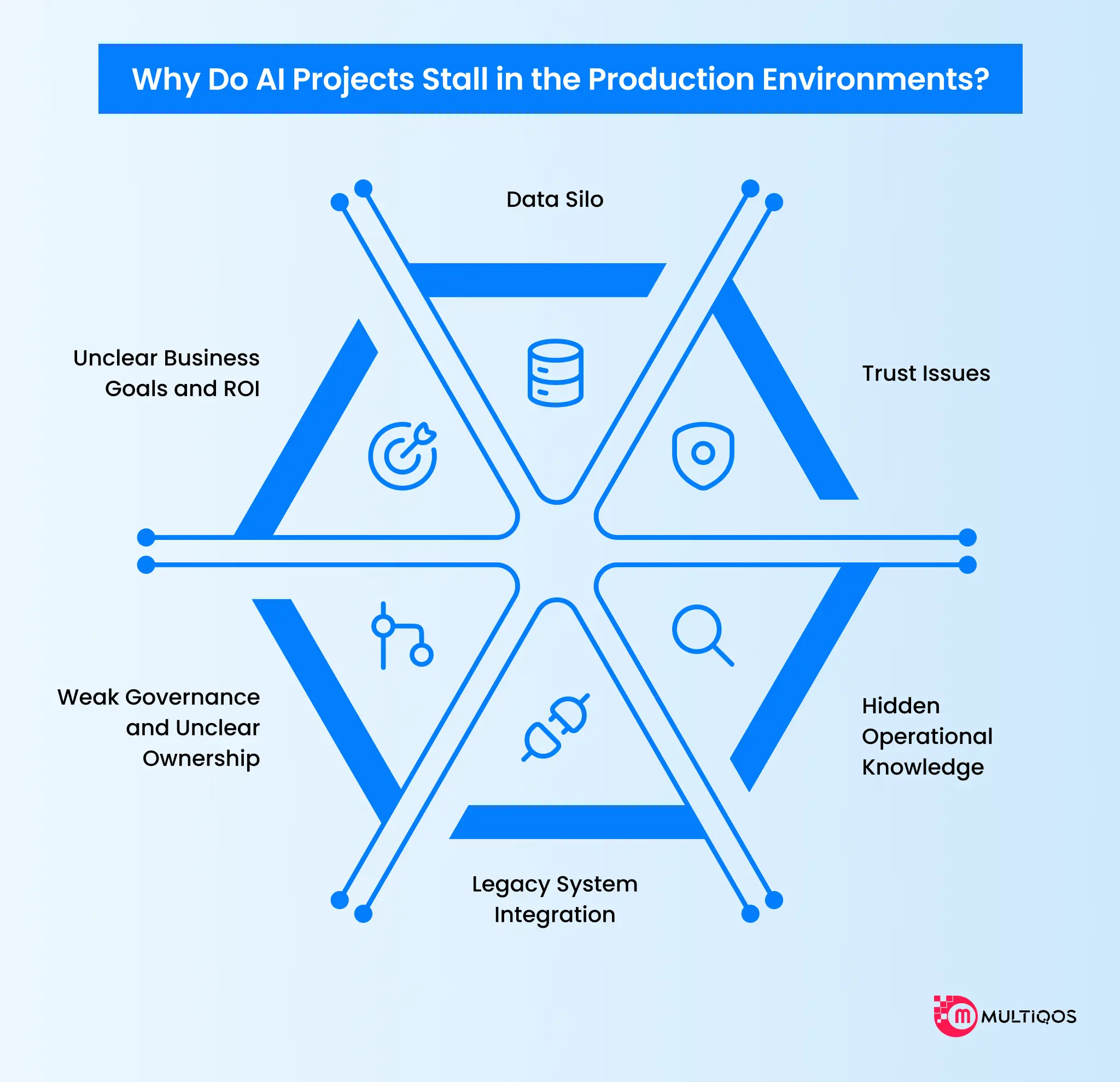
Data Silo
AI follows instructions without checking the quality and accuracy of the data. Feed it inconsistent data, and it will deliver flawed results – forecasts drift off-target, risk models flag suppliers, while missing real disruptions and inventory optimization creates shortfalls that cascade through operations.
That is why AI-powered freight audit systems need data validation and quality controls built in as core features and not added later. Deploying AI on top of inaccurate data doesn’t fix the problem; it only accelerates bad decisions.
-
Trust Issues
Real data AI readiness starts with data trust, not algorithmic sophistication. Quality is a part of it, but trust is broader: do planners and leaders trust the numbers in front of them enough to start taking actions? That belief comes from knowing the source of the data, who owns it and how it moves across different systems. When people can trace a figure back to its source and rely on it to stay consistent, they use the system’s recommendations. When they can’t, they fall back to the spreadsheets, and even the best systems goes unused.
-
Hidden Operational Knowledge
Every supply chain runs on the knowledge that resides in planners’ notebooks, spreadsheets, or their experiences. For example, a planner knows that a particular supplier ships materials five days late before a holiday, or a customer always revises order quantity once the order is confirmed, or a certain port gets congested at the end of every month. None of this information appears in the ERP data, so AI has no access to it. During supply chain AI implementation, the recommendations look logical on paper, but they might not match how the real operations work. Planners spot these gaps quickly; they override outputs and lose trust in the system. Adoption drops, and the project gets labeled a failure even though the algorithm itself is safe.
The problem is made worse by the fact that this knowledge is Fhard to capture through documentation.
-
Legacy System Integration
Legacy infrastructure is another barrier. AI depends on cloud computing, integrated ERP systems, and APIs, yet many companies still run on rigid, decades-old software that was never designed to connect with modern tools. Integrating cloud-native AI into these systems is difficult, expensive, and risky, and friction between old and new technology is often the main reason for AI projects failing in the deployment phase.
-
Weak Governance and Unclear Ownership
Many AI projects are initiated with enthusiasm, but there is no clear answer to the question: who owns it? The IT teams build a model, the supply chain team is expected to use it, and the data team manages the input. When there is any discrepancy in the result, each team assumes that the other is responsible.
Without accountable ownership, the decisions certainly fall through the cracks. Nobody is responsible for monitoring the model performance; therefore, it is apparent that the forecast drifts away. No one decides when any exception can be overridden, or who approves exceptions. Data quality issues bounce between the teams without any proper resolution.
Weak governance is another staggering issue. If an AI system recommends an incorrect supplier, there is no set process to trace the decision, explain, or correct it.
-
Unclear Business Goals and ROI
When AI in supply chain implementation is launched without aligning any business objective to it, tracking the impact of this AI initiative becomes a tricky endeavor. Without a specific target, such as reducing stockouts by a set percentage or cutting freight spend on a particular lane, there is no benchmark for success, and projects drift until management questions the investment.
Picking the right use case is as important. Not every supply chain challenge needs AI, and applying it to problems with too little data or simple rules-based fixes adds cost without improving outcomes.

How Do Forward Deployed Engineers Solve Every AI Deployment Challenge in Supply Chain?
A forward-deployed engineer (FDE) works embedded within the client’s operations, not from a distance, to build, operate, and modify the existing workflows. In supply chains, FDEs work in tandem with the client’s team. They work with planners, IT teams, and decision-makers to close the gap between the AI in pilot and production. They solve data integration problems, ownership, and trust issues on the ground.
-
Connecting AI with Legacy Systems
AI is more useful when it is tied tightly to existing systems – ERP, CRM, HRM, supply chain platforms, and document management systems. Forward-deployed engineers connect AI applications to these systems using APIs, integration tools, cloud platforms, and data pipelines so that the information flows freely and accurately between them.
For example, an AI demand forecasting tool can pull sales and inventory data from the ERP, generate stock refill recommendations, and write approved orders back into the planning system, while an AI assistant can connect to supplier contracts and shipment databases so that the planners find the answers quickly. Engineers also set up authentication, access rights, and security guardrails to ensure that AI works smoothly with the existing systems.
-
Improve Data Readiness
Forward Deployed engineers work with the teams who use and create the data daily. They start by assessing where the information lives across ERP, transportation, warehouse, and supplier systems, then identify gaps, inconsistencies, and outdated records that could further weaken the AI results. From there, they build data pipelines that standardize and connect these data sources. They also add various parameters so that the data is verified regularly to ensure that the AI systems are fed with accurate data. They also work with planners to understand which data is manually entered or where workarounds are used, so these are accounted for early. By making data consistent and accurate for AI to use, FDEs help companies avoid flawed outputs and build a foundation that supports reliable, scalable AI.
-
Help Employees Adopt AI in their Daily Workflows
Forward Deployed Engineers empower supply chain organizations to improve AI adoption across different teams. They work alongside planners, IT teams, and decision makers to turn AI in a pilot into a trusted part of the employee’s technology suite. They connect AI with ERP, CRM, and existing systems, secure AI systems, and add human approval into every workflow. Because they work with the planners, IT decision makers, and other teams, they are well aware of the businesses’ evolving requirements.
-
Test, Deploy, and Continuously Improve AI Solutions
Enterprise AI transformation is a continuous process. As businesses grow, new applications are introduced and, therefore, the capabilities of AI models should be revised regularly. Forward-deployed engineers monitor the performance of AI applications and introduce changes to suit the evolving business needs. Different factors such as model accuracy, processing speed, response quality, system usage, and user feedback are studied thoroughly by the FDE. On the basis of these results, FDE improves AI models, enhances data pipelines, and modifies the applications.
For example, if an AI initiative is successful for the supply chain, then FDE can replicate the same capabilities for other functions such as logistics, procurement, and more.
-
Building Customized AI Solutions with Real-time Feedback
Every business has different workflows. Therefore, AI implementation in supply chains can’t be done while following the cookie-cutter approach. The customization of AI solutions is handled by the FDEs, as they work within the business environment, so they are well aware of the niche requirements. For example, an AI assistant may initially help supply chain teams search supplier documents and contracts. After receiving feedback from the planner, engines can add features such as document summarization, data extraction from invoices and bills of lading, and workflow automation for exception handling and order updates.
-
Strengthening AI Governance, Security, and Reliability
Enterprise AI applications need strong security and data management, as businesses handle a large volume of sensitive information such as supplier contracts, pricing, financial details, and customer and employee records. Forward Deployed Engineers build security controls right into the base of AI applications. They also add human review and approval steps to the workflows that need extra checks, such as high-value purchase orders or supplier changes.
-
Measuring Business Impact through Practical AI Outcomes
A successful AI in supply chain implementation should deliver real results. Forward-deployed engineers help companies measure those benefits by measuring technical metrics like model accuracy and speed, and translating them into real operational impact: higher planner productivity, shorter processing times, better cost control, and improved customer service. For example, an AI document processing tool can be measured by how quickly it scans an invoice and how accurately it extracts data from invoices or bills of lading. An AI forecasting tool can be judged by fewer stockouts, lower excess inventory, and reduced freight costs.
-
Capturing Hidden Operational Knowledge
Forward Deployed Engineers sit with planners, learn the patterns that never reach the ERP, such as pre-supplier’s holiday delays, end-month port congestion, and turn them into rules, formulas or exceptions which can be used by the system. Planners then review the recommendations and flag what is off, so each correction becomes a permanent improvement. When planners see their own knowledge in outputs, trust grows and adoption follows. 
How to Pick a Forward Deployed Engineer Partner?
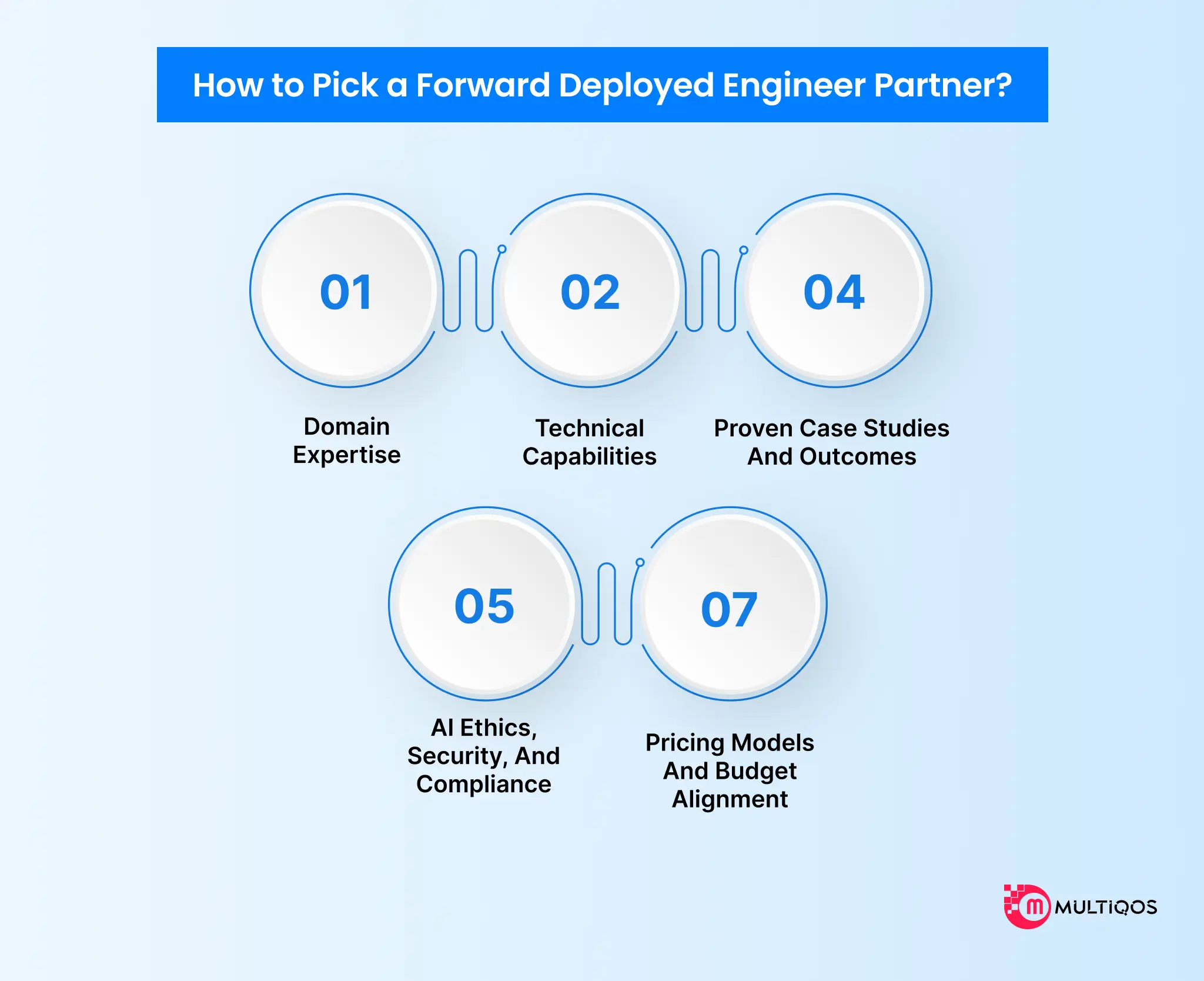
The right FDE partner understands a company’s systems, data, and people, which makes it important to evaluate them on more than one parameter.
-
Domain Expertise
FDE must be well aware of the industry standards and business-critical functions, because AI systems deliver the intended results only when they are fed the correct data. A partner with proper supply chain industry knowledge is the key to building successful AI models that work on relevant data while following industry standards.
-
Technical Capabilities
A FDE partner should demonstrate strong expertise across the full AI stack, including machine learning, deep learning, NLP, data engineering, MLOps and more.
-
Proven Case Studies and Outcomes
A properly drafted case study for an FDE demonstrates how the engineer approaches a problem and uses the latest AI solutions to deliver ROI. Supply chain organizations can look for measurable outcomes such as fewer stockouts and lower freight costs.
-
AI Ethics, Security, and Compliance
A reliable FDE partner prioritizes ethical AI practices, strong data governance, and privacy rules for suppliers and customer information.
-
Pricing Models and Budget Alignment
A good FDE partner offers transparent payment models such as fixed-price, time-and-materials, or subscription-based models that align well with the company’s budget.
Financial clarity builds trust and promotes long-term collaboration.

Conclusion
Now, the question is not whether AI will transform supply chain operations. It will.
The dilemma is whether organizations will be able to redesign themselves to get the most from AI in the supply chain. The organizations that thrive in the AI era are not the ones with the most advanced tools, but the ones that have revamped their workflows to accommodate AI capabilities.
This is where Forward Deployed Engineers (FDE) make the difference. As part of the team, they understand the exact business scenario. They can easily connect existing systems with AI and also train and help the team build trust in the AI solutions, and hence bridge the gap between pilot and production.
MultiQoS partners with supply chain organizations to help them choose the right use case and derive real value from AI investments.
Talk to MultiQoS today to work with the team of forward-deployed engineers who help businesses pick the first right use case and derive real value from the AI investments.
FAQs
A forward-deployed engineer takes 6-8 weeks on average to deliver a measured first version and 3–6 months to reach the broader production rollout.
A forward-deployed engagement as a service for supply chain typically costs between $8k-$13k per engineer per month. The cost might vary according to the seniority, talent location, and pod size.
FDEs help AI supply chain projects succeed by working side by side with the planning and operations team, closing the gap between a working pilot and daily production use.
Choosing a FDE partner for AI in supply chain implementation means selecting a team with proven expertise, strong technical depth across data engineering, MLOps, integration, and a track record of measurable outcomes.
A traditional partner or consultant designs a technology solution according to business requirements and hands it over. A FDE works together with the client’s team, building, integrating, and adjusting AI systems hands-on until it reaches production.

Get In Touch

Get Stories in Your Inbox Thrice a Month.
The Promise of AI Agents in Legal: Stronger Compliance, Better Costs, and Enhanced Accuracy
AI Voice Agents in Real Estate: From Use Cases to Implementation, Everything You Need to Know
AI Agent Development Cost: A Strategic Investment for Business