
Super Apps: Should Your Enterprise Build an All-in-One Platform
Need quick insights? Summarize with AI & save time
 ChatGPT
 Perplexity
 Claude
 Google AI Mode
Table of Content
- Introduction
- Why Enterprises Are Exploring Super Apps
- How to Build a Super App: A Step-by-Step Approach
- Should Your Enterprise Build a Super App?
- Conclusion
- FAQs
Summary :
Most companies have a lot of tools. They struggle to keep track of all these tools. People in these companies keep adding ones, but old tools are still in use. This makes it tough to keep all information in one spot and get things done easily.
An app idea is gaining popularity due to this issue. The problem is that companies have tools, and it’s hard to keep everything organized. People are looking for a solution to simplify their work. The app aims to solve this problem by providing a platform. It’s becoming popular as companies seek to streamline their tools and processes.
This blog is going to talk about what a super app’s how it can help companies like yours. We will look at when it is an idea to use a super app and when it is better to use a lot of different tools that work together. So you can make a good decision about what to do with your company’s super app.
Introduction
The rise of super apps is already transforming the digital world. As enterprises expand, their systems become more complex—but not necessarily more connected. Over time, teams adopt different systems to solve specific needs. But when you look at how work actually happens, the gaps become clear. Teams jump between apps, workflows span systems, and data remains scattered. Managing tools starts to take more time than the actual work.
Many organizations try to fix this with more tools or better enterprise app integration. That helps for a while, but it doesn’t simplify the system. It just shifts the complexity. This is where the idea of an enterprise super app platform comes in. A super app helps businesses move to a digital platform where services, data, and workflows are connected.
This platform brings all services. Workflows all in one place, so users do not have to switch between systems. That sounds like a start. Let’s take a step back. The trend is clear. But the real question is whether an enterprise super app platform will actually simplify your operations or just concentrate the same complexity in one place.
Let’s break that down.

Why Enterprises Are Exploring Super Apps
Most enterprises don’t plan to build a super app from day one. When systems do not connect well, users have to switch between apps to do simple tasks. By then, what users expected had changed.
At the same time, expectations have changed. People prefer one place to manage everything. That’s why enterprises are rethinking how they structure their platforms.
Here’s why enterprises move in this direction:
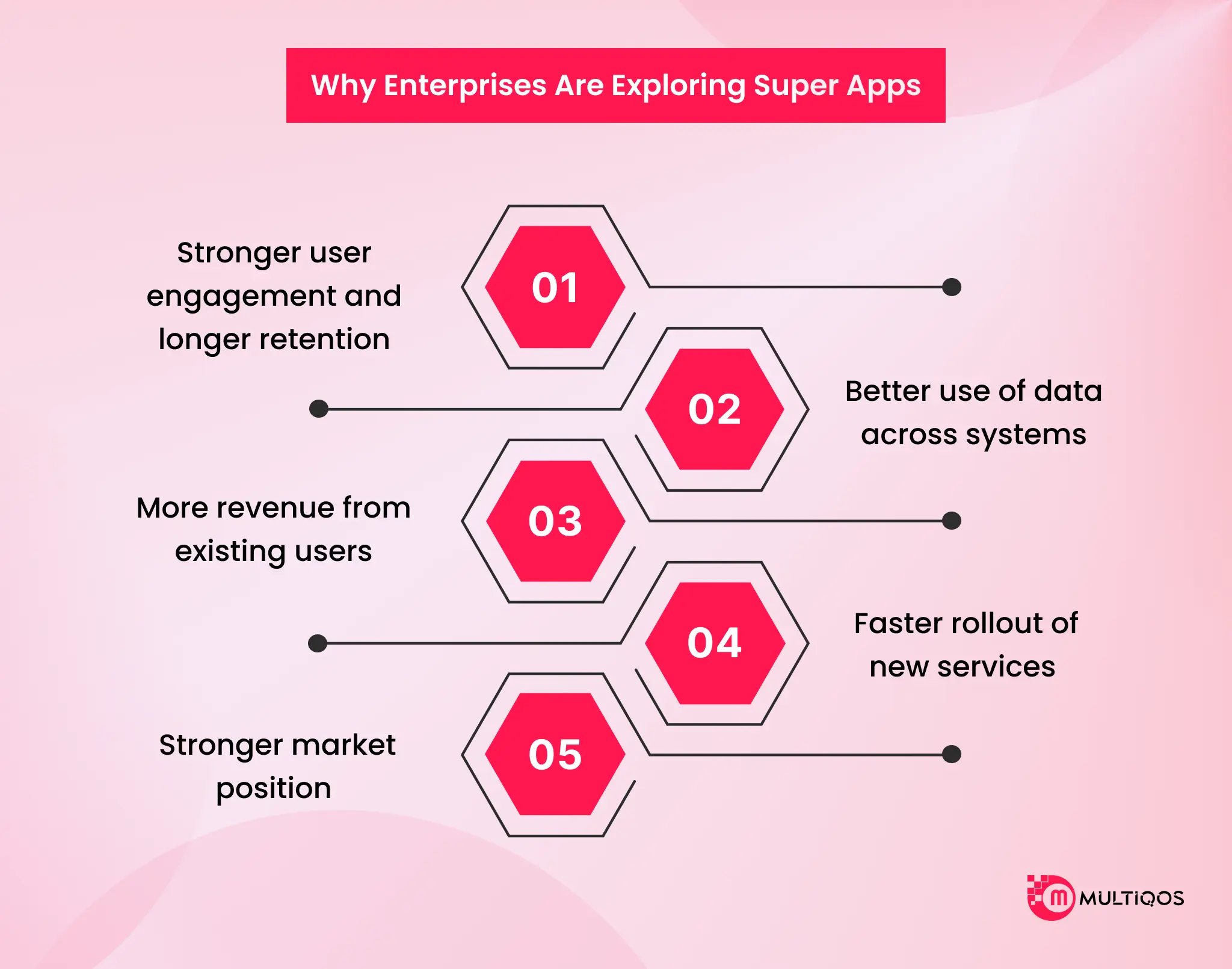
Stronger user engagement and longer retention
When users find value in one platform, they tend to stay longer. They don’t leave the app to complete related tasks. That keeps engagement high and reduces drop-offs over time. Platforms like WeChat show how this approach works in practice. It has already crossed 1.4 billion monthly active users, which clearly reflects the scale this model can reach.
Better use of data across systems
Most companies already collect data, but it stays scattered. A super app brings that data together. Teams understand user behavior more clearly and improve their design of services.
More revenue from existing users
Businesses now expand services within one platform by building and marketing separate apps. They sell more to existing users of the app, which is less expensive than finding new users of the super app. Over time, this boosts the revenue of the app without spending on finding new customers for the super app.
Faster rollout of new services
Teams add new services without starting from scratch each time. They test ideas, launch features faster, and adjust based on real usage.
Stronger market position
When a super app platform becomes part of a user’s routine, it becomes harder to replace the super app. Companies like Grab built positions by expanding around the core user needs of the super app instead of staying limited to one use case of the super app.
This shift is not about adding features to the super app. It’s about making the services of the super app work together. That’s what makes the super app model worth exploring for businesses that want to build an app.

How to Build a Super App: A Step-by-Step Approach
Building an app needs planning. If you try to do everything at once, it gets messy quickly. A clear plan helps keep the build on track.
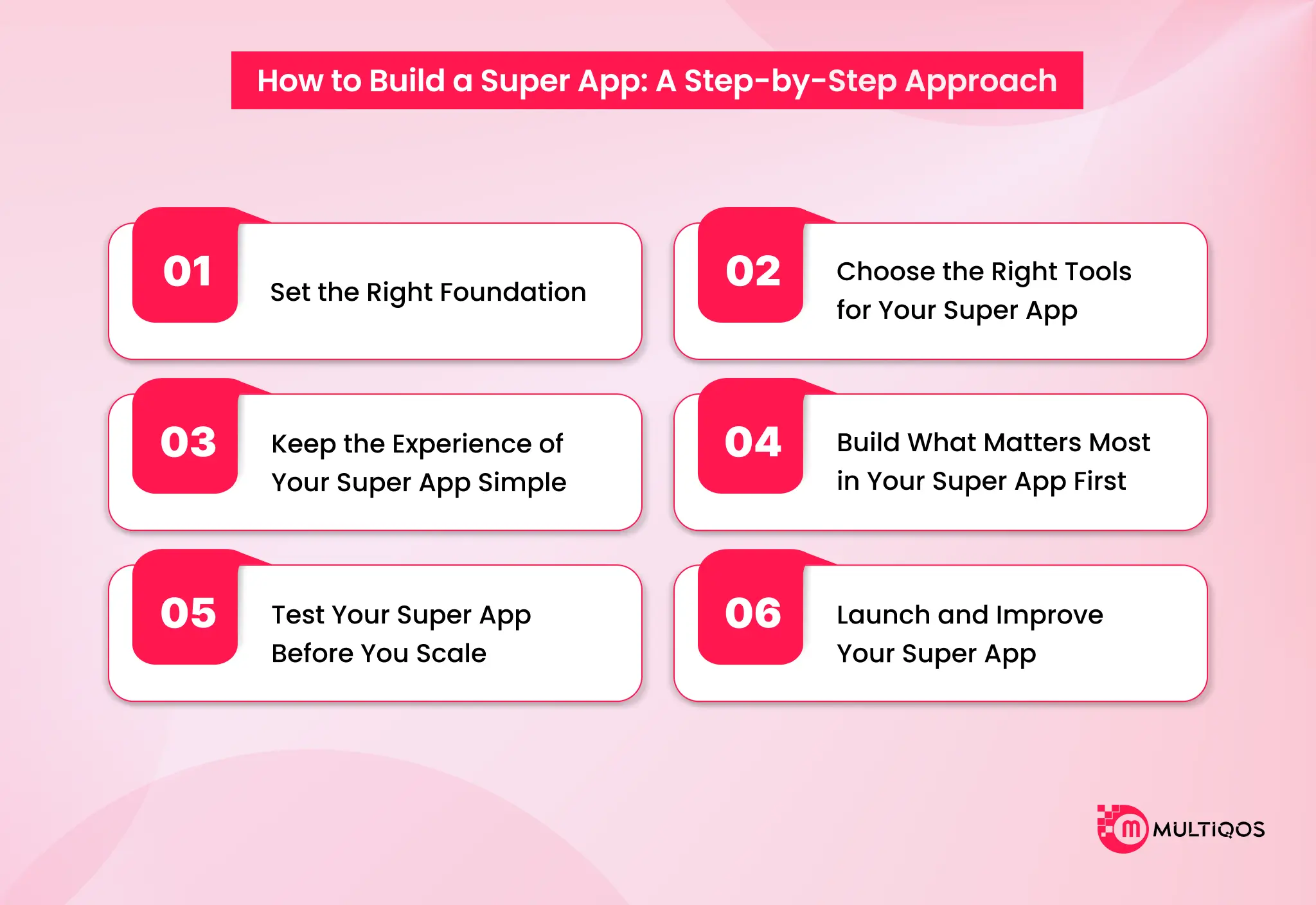
Step 1: Set the Right Foundation
To start, be clear about what you want to achieve with your app. Decide which problem to solve first. Choose which service to offer. A solid mobile app development approach can make this step much easier.
Step 2: Choose the Right Tools for Your Super App
When it comes to tools for your app, do not overthink it, but do not pick random tools either. Choose tools that you can manage easily when your super app grows.
Make sure that:
- Your systems can connect easily
- You can. Change things in your super app without breaking everything
- You use cloud services, so scaling your super app does not become a problem
- You only use intelligence in your super app, where it actually makes a difference
Step 3: Keep the Experience of Your Super App Simple
Do not try to make your super app too fancy. Just make it easy to use. If users of your app have to think much while using it, then something is wrong with your super app. Keep everything in your app clear and easy to navigate.
Step 4: Build What Matters Most in Your Super App First
Focus on the features of your super app. Get the login feature working. Get the main feature of your app working. If your super app needs a payment system, set that up first. Do not waste time building features in your super app that are not necessary.
Step 5: Test Your Super App Before You Scale
Before you launch your app to everyone, test it properly. See how your super app behaves when more users start using it. Check if anything slows down or breaks. Fix those problems early.
Step 6: Launch and Improve Your Super App
Do not wait for everything to be perfect before you launch your app. Launch a version of your super app. Watch how people use your app. You will quickly see what works and what does not work in your app. Fix those gaps. Then grow from there.
Should Your Enterprise Build a Super App?
A super app is not just another feature you add. It changes how your entire platform works. So don’t build a super app just because it’s trending. Look at how your systems run today, how your teams work, and what your users actually need. If your setup doesn’t demand it, a super app will only make things harder.
When It Makes Sense to Build
Build a super app when your business already deals with multiple services that should work together, but don’t.
- Your workflows run across different systems and slow things down.
- Your teams keep jumping between tools to finish one task.
- Your services share the same users but don’t connect properly.
- You plan to expand your offering beyond a single use case.
In this situation, a super app helps you bring everything into one place and make it work smoothly.
When You Should Avoid It
Avoid building a super app if your business doesn’t really need that level of setup.
- Your systems already work fine and are easy to manage.
- You can fix your problems by improving integrations.
- Your services don’t overlap much.
- You don’t have the time or team to maintain something complex.
Here, a super app will slow you down instead of helping you grow.
A Smarter Way: Start Small, Grow
Begin by linking what you already have. Don’t try to build everything at the start. Start with connecting systems, then build a platform based on how people use it. Fix problems, make systems work better together, and make it easier for users. Once you see people using services together, you can add more steps by step. That way, you build based on real need, not assumptions.
Why Choose MultiQoS for Enterprise Super App Development
Most companies do not have trouble building features, but they do have trouble when those features need to work at scale. A super app brings systems and services into one place, so if the foundation is not right, small gaps can turn into bigger issues. When this happens, integrations become fragile, and performance starts to drop. The user experience feels inconsistent.
A super app brings systems and services into one place. If the foundation is not right, small gaps turn into bigger issues. When that happens, integrations become fragile, and performance starts to drop. The user experience feels inconsistent.
At MultiQoS, we start with your existing ecosystem. We look at how your systems connect, how your data moves, and how your users interact with services. Then we design the app to fit into that setup so everything works smoothly. You don’t need a team that only builds features. You need a partner who brings systems together and makes them work as one with the app.
Conclusion
A super app can simplify how enterprises manage systems, but only when it fits the way the business actually operates. It works best when multiple services need to connect, and users expect everything in one place. Otherwise, it can add more complexity instead of reducing it. The right approach is to start small, connect what already exists for the app, and expand based on real usage of the super app rather than assumptions about the super app.
FAQs
A regular enterprise application does one thing, like handling HR. A super app platform puts applications and services together so users can access everything from one screen of the app.
It depends on how complicated it is and what features are needed for the super app. Some apps are simple. Some are complex. You can get a version up. Running in a few months, but a scalable super app can take 6 to 12 months or longer to build.
The cost of building an app for the app depends on things like feature complexity, integrations, and security standards for the super app. All these things take time and money to implement for the app.
Yes, they can, because the super app should fit their business needs and resources, so they can start small with the app.

Get In Touch

Get Stories in Your Inbox Thrice a Month.
iPhone Duo App Development: The Hidden Cost of Not Adapting Your Enterprise App
Why Upgrading Your iOS Architecture for Foldables Protects Your Brand Impression
Is Your Enterprise iOS App Ready for iPhone Duo’s Screen Layouts?