
 ChatGPT
 Perplexity
 Claude
 Google AI Mode
+95%
Core engineering skills appeared in more than 95% of FDE job listings in 2026.
Perspective AINeed quick insights? Summarize with AI & save time
Summary :
AI pilots rarely fail because of the model. They stall on legacy systems, scattered data, and security reviews. This guide explains what a forward-deployed engineer (FDE) is and what the role involves week to week, from discovery to production go-live. It covers the skills the role needs and how FDEs compare with software, solutions, and AI/ML engineers. It closes with when your enterprise should build an FDE team or partner for one.
Core engineering skills appeared in more than 95% of FDE job listings in 2026.
Perspective AIForward-deployed engineer job postings increased by more than 700% year over year, according to Indeed data reported in 2026.
Business InsiderFDE Pulse tracked 1,321 active Forward Deployed Engineer job postings across 750 companies in April 2026, indicating growing demand for engineers who can take AI and software solutions from development to real-world deployment.
FDE PulseAI pilots are easier to build but complex to integrate into existing systems. The gap is not the model itself but legacy systems, fragmented data, APIs, and security controls. This is where Forward Deployed Engineering becomes crucial.
Forward deployed engineering puts engineers directly inside enterprise environments to solve implementation bottlenecks end-to-end. The work spans technical discovery, scoping, system design, hands-on development, and production deployment.
What this means for enterprises is end-to-end AI adoption without the hassle of dealing with the technical debt and bottlenecks of legacy systems. A forward-deployed engineer deploys an AI model combining software engineering, AI implementation, system integration, and business problem-solving capabilities.
This piece provides everything you need to know about what an FDE is, their daily responsibilities, and how they differ from software and solutions engineers. So, if you are looking to optimize AI implementations in your enterprise, this is the piece you need.
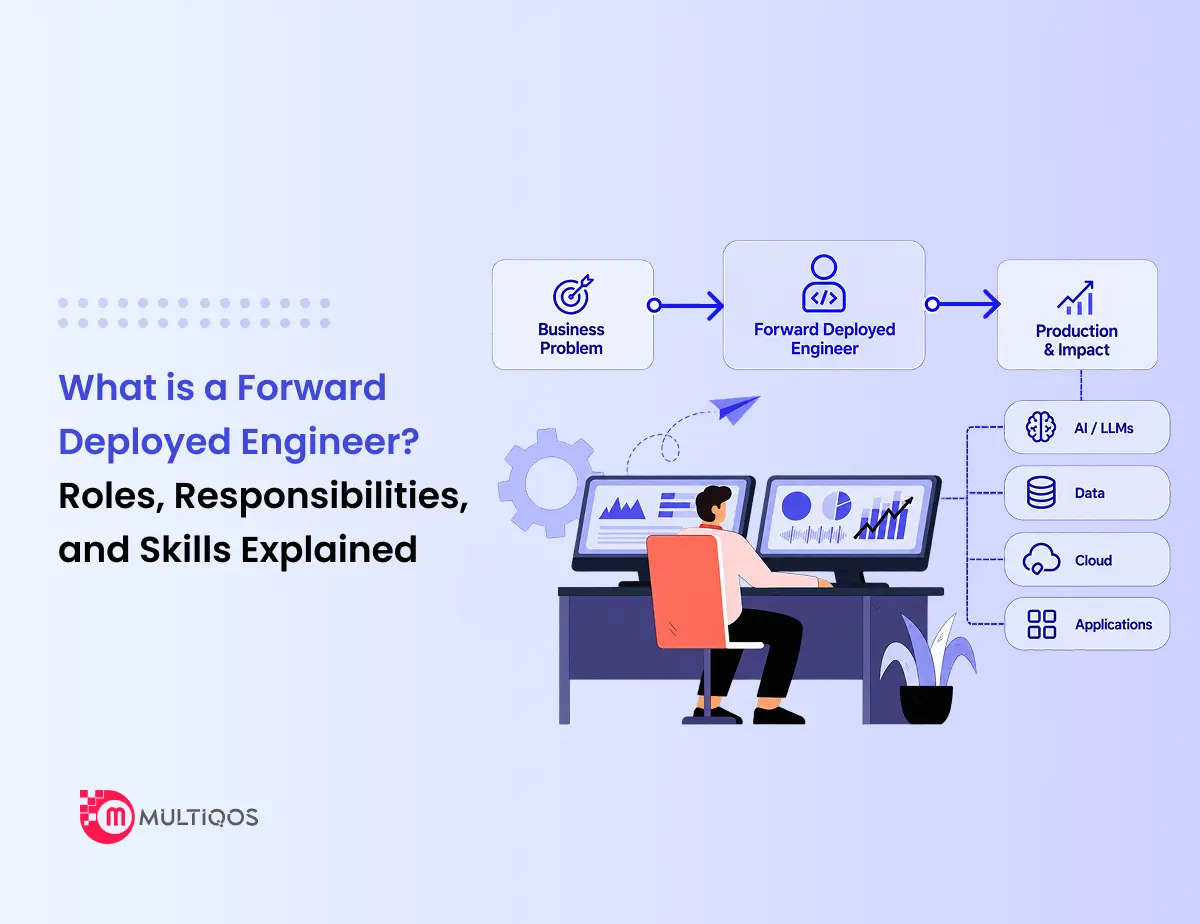
A forward deployed engineer (FDE) is a software engineer who embeds with a customer’s team to build, integrate, and ship production software inside that customer’s own systems. Unlike a consultant or pre-sales engineer, an FDE writes the code, and is judged on whether it works in production.
The model traces back to Palantir in the early 2010s, and for years it stayed a niche practice in defense and government data work. Generative AI changed that. Once models got good enough, the hard problems shifted from the model to the customer’s stack, and enterprises needed engineers who could work there.
Ownership is what separates the role. Plenty of people can get a model working on sample data. The FDE is the one still there when it meets real traffic, real permissions, and a 2 a.m. timeout from a mainframe batch job.
One distinction matters if you’re buying rather than hiring. An FDE employed by an AI vendor works on that vendor’s platform and carries field lessons back to its product team.
An FDE from an implementation partner works across whatever your stack already runs, whether that’s OpenAI, Anthropic, Azure OpenAI, or an open-weight model, and answers to your business outcome rather than one vendor’s roadmap. So, before you ask who to hire, ask whose platform you want the work tied to.
The case for FDEs has little to do with who is hiring them. It comes from a structural gap in how enterprise AI gets delivered. MIT research found that 95% of enterprise generative AI pilots fail to deliver measurable ROI, and it traced the problem to how tools fit into real workflows, not to model quality.
The failure pattern is familiar. A vendor ships a capable model. An internal team is asked to make it work inside systems that were never designed for it. And the space between the two, where integration, data preparation, and security sign-off live, belongs to nobody. Five problems keep showing up in that space.
In a typical AI rollout, the vendor owns the model, IT owns the systems, and the business unit owns the outcome. The work that connects them, such as mapping data sources, building connectors, and clearing security review, sits between org charts. So it waits.
An FDE closes that gap by taking single ownership of the path from discovery to go-live, with the authority to make technical calls and the accountability for whether the system actually gets used.
Calling an API takes a weekend. Wiring that model into a bank’s twenty-year-old core system, a hospital’s records pipeline, or a retailer’s inventory stack is a different problem entirely. The difficulty isn’t the model. It’s everything the model has to sit next to: messy data, brittle legacy software, permission rules spread across directories, and workflows nobody fully documented. Solving that takes someone who can read a legacy codebase and an LLM trace in the same afternoon.
The classic delivery model of spec, build, test, and hand over assumes a system gives the same output for the same input. AI doesn’t. Its answers vary, its quality drifts as data and prompts change, and a model upgrade can quietly break a workflow that worked last month. That calls for evaluation suites, guardrails, and monitoring designed around the business’s own definition of a correct answer, built by someone who stays long enough to see how the system behaves with real users.
Enterprise AI budgets now face the same scrutiny as any other capital spend. A demo on clean sample data doesn’t answer the questions that release funding. Will it pass security review? What does each transaction cost? Where does the return show up in the P&L? An FDE turns a pilot into something that clears procurement, compliance, and a CFO’s review, and measures success in production numbers rather than demo results.
Most enterprises have capable application developers, data engineers, and security teams. What they rarely have is one person who combines all three with LLM deployment experience and the ability to run a discovery session with business stakeholders.
Building that mix in-house takes months of hiring, and core engineers are usually committed to the product roadmap anyway. An FDE brings the full combination from the first week of the engagement.
A customer rarely hands a forward-deployed engineer a clean spec. They describe half the problem, sometimes the wrong half, and the engineer still has to get working software into production.
Then comes the part most job descriptions skip: turning what broke, and what finally worked, into patterns the next deployment can reuse.
So no two weeks look alike. Here is how that work splits across six core forward-deployed engineer responsibilities.
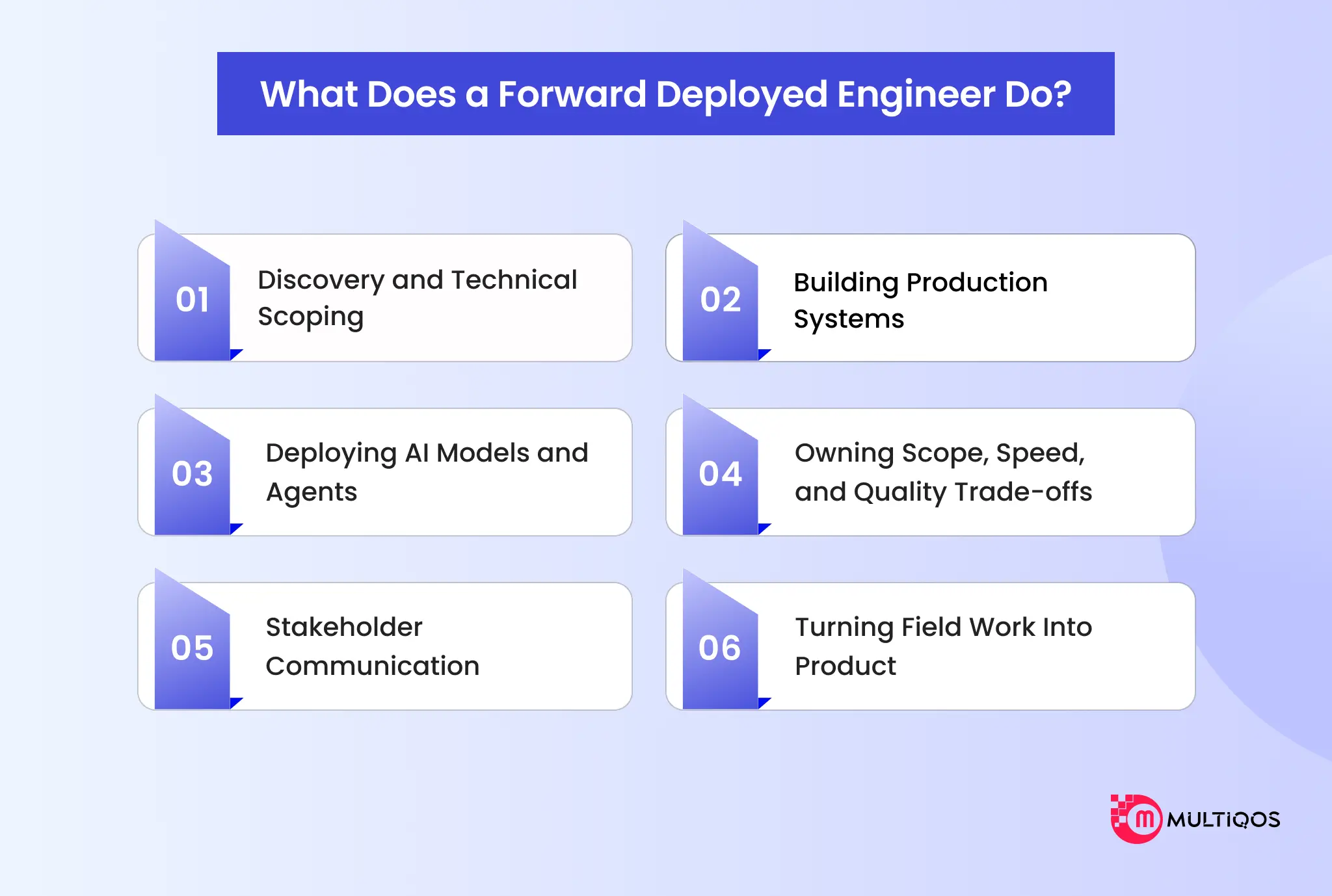
FDEs spend most of their hours in client-facing settings, and most of it goes to discovery. A user asks for a dashboard. The FDE asks what decision it should change, then shadows the operators who make it. Vague complaints turn into real requirements, with success metrics, data availability, and security boundaries mapped before a line of code exists.
Here is where forward-deployed engineering splits from pre-sales. A solutions engineer or solutions architect hands over a demo or a slide deck. A forward-deployed software engineer commits production code into the client’s repositories. That’s the whole forward-deployed engineer vs. solutions architect question.
The work is mostly plumbing: data pipelines and middleware API wrappers, undocumented APIs on a 15-year-old on-premises ERP or SAP database, OAuth 1.0 to OAuth 2.0 token exchanges, plus exponential backoff, dead-letter queues, and idempotent event IDs so the integration survives when third-party systems fail.
The AI forward-deployed engineer is where most hiring sits today. A foundation model gives a slightly different answer every time, and someone has to make that hold up inside a regulated business.
So LLM deployment work means RAG architectures built on hybrid search (vector + keyword), with rerankers and semantic chunking on top of vector databases like Pinecone, Weaviate, or pgvector. It also means fine-grained access control lists (ACLs) that mirror Active Directory/LDAP, so users can never retrieve a document they couldn’t open themselves.
Then there are multi-step AI agents on LangGraph or CrewAI with human-in-the-loop checkpoints, internal systems exposed through MCP servers, and ETL pipelines in Python, SQL, and Spark feeding it all.
However, nothing reaches production AI without evals. FDEs build eval suites on golden datasets that track accuracy, cost, and latency. They score outputs with LLM-as-a-judge and rerun the suites as regression tests every time a prompt or model changes.
Next come guardrails, which pair deterministic policy rails with safety classifiers (NeMo Guardrails, Llama Guard) to handle PII redaction, prompt-injection defense, and policy enforcement. Observability and tracing run through LangSmith, Braintrust, or HoneyHive. Evals are the most underrated skill in enterprise AI deployment. Teams spend three weeks on agent logic and an afternoon proving it works.
Ship a proof-of-concept in days, or build it clean enough to avoid next quarter’s technical debt? FDEs make that call weekly, like founders. They also push back on scope creep- a happy client will ask for five more features, and three won’t touch the goal the contract was signed for.
A CFO doesn’t want to hear “non-deterministic.” They want to know if the invoice agent is wrong once in fifty runs or once in five thousand. Customer-facing engineering means that translation, plus calming a live demo failure, getting API credentials out of a reluctant IT team, and handing the system over so it outlives the embedded engineers who built it.
Build every integration as a one-off, and each new AI use case starts from zero. So, FDEs build on shared platform primitives, pull repeated fixes into reusable adapters, SDKs, and playbooks, and document failure modes so the next team doesn’t rediscover them. Field “gravel roads” become “paved highways.”
For an enterprise, that’s where the long-term payoff sits. The second AI use case ships far faster than the first, because the connectors, eval sets, and security patterns already exist.
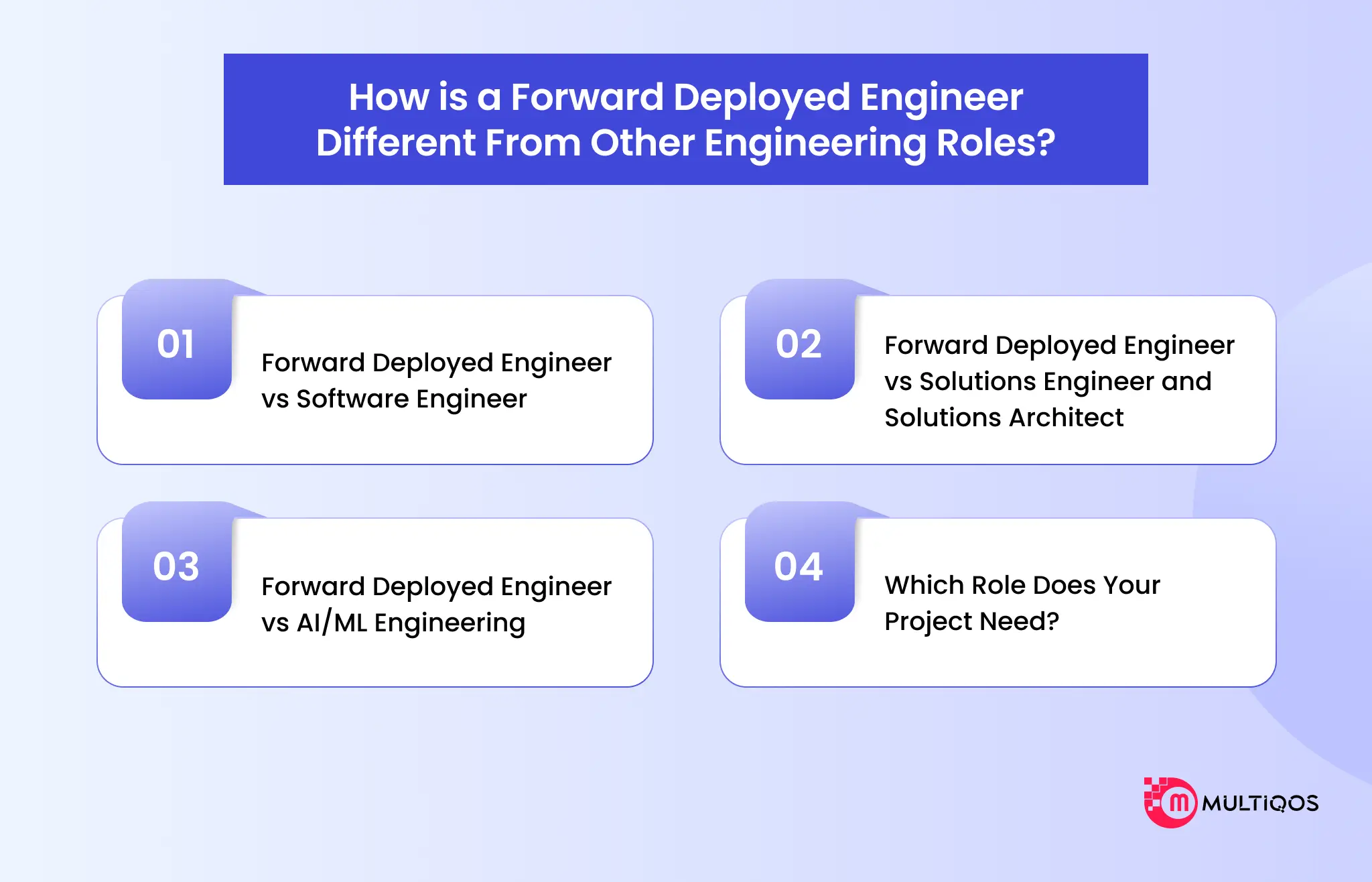
A forward deployed engineer writes production code inside a customer’s environment. A software engineer builds the core product. A solutions engineer sells it before the contract is signed, and an AI/ML engineer improves the model itself. Only the FDE is measured on what actually runs at the customer.
| Role | Where the work happens | Writes production code? | Stage of the deal | Measured on |
|---|---|---|---|---|
| Forward deployed engineer | Inside the customer’s systems | Yes, in the customer’s repos | Post-sale implementation | Customer outcome in production |
| Software engineer | Internal product codebase | Yes, for the core product | Not tied to a deal | Features shipped, code quality |
| Solutions engineer | Demos and proof-of-concept environments | Low to medium | Pre-sale | Revenue influenced |
| Solutions architect | Architecture reviews and advisory | Rarely; MVPs on sample data | Pre-sale and early post-sale | Sound design, technical win |
| AI/ML engineer | Model training, evaluation, and serving | Yes, for models and ML infrastructure | Not tied to a deal | Model quality, latency, cost |
Forward deployed engineer vs software engineer comes down to who writes the spec. A product engineer receives one. An FDE engineer writes it after a week on the client’s floor, then ships it. The forward deployed engineer skills behind that (production code, data engineering, LLM work, patience for security reviews) are rare together, which pushes forward deployed engineer salary bands at AI labs to or above senior engineering pay.
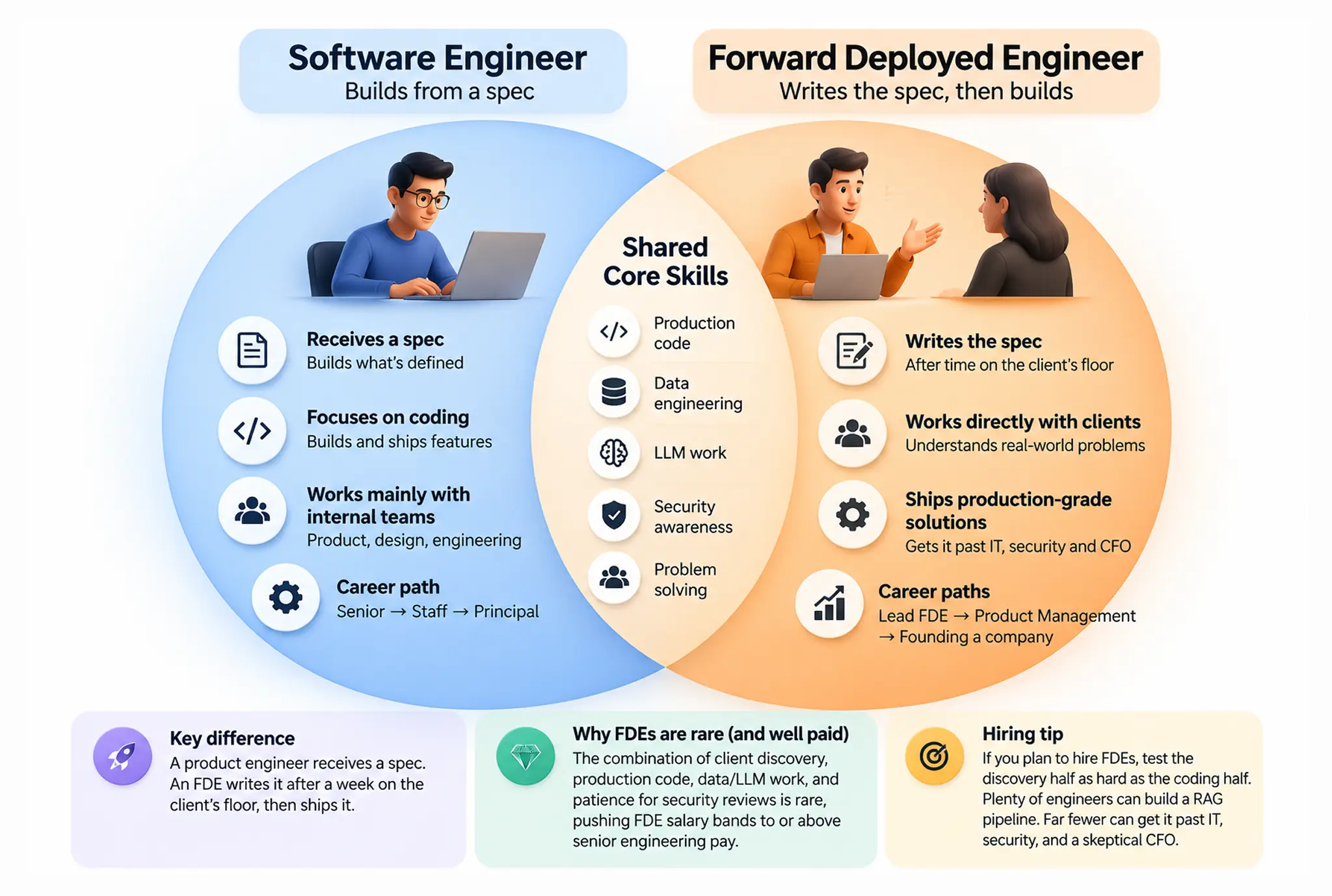
Career paths split, too. The software engineering ladder runs Senior, Staff, Principal. FDEs more often move into lead FDE roles, product management, or founding a company, because field insight is the asset they accumulate.
So, if you plan to hire forward-deployed engineers, test the discovery half as hard as the coding half. Plenty of engineers can build a RAG pipeline. Far fewer can get it past IT, security, and a skeptical CFO.
“The SE sells the vision. The FDE builds it.” A solutions engineer lives in the pre-sales cycle, running demos and proof-of-concept environments, and gets judged on revenue influenced rather than code shipped.
Solutions architects sit closer to the build but stop short of owning it. Some AI vendors draw the line in a way worth borrowing: solutions architects build MVPs on anonymized data, while FDEs work on live customer infrastructure. One proves it could work. The other is on the hook when it doesn’t.
An AI/ML engineer makes the model better. An FDE makes the model useful to one specific business, with its permission rules, its data quirks, and a compliance team that reads every prompt log. The first works on training runs, fine-tuning, and serving infrastructure, mostly inside the vendor. The second works on retrieval, orchestration, evals, and integration, mostly inside the customer.
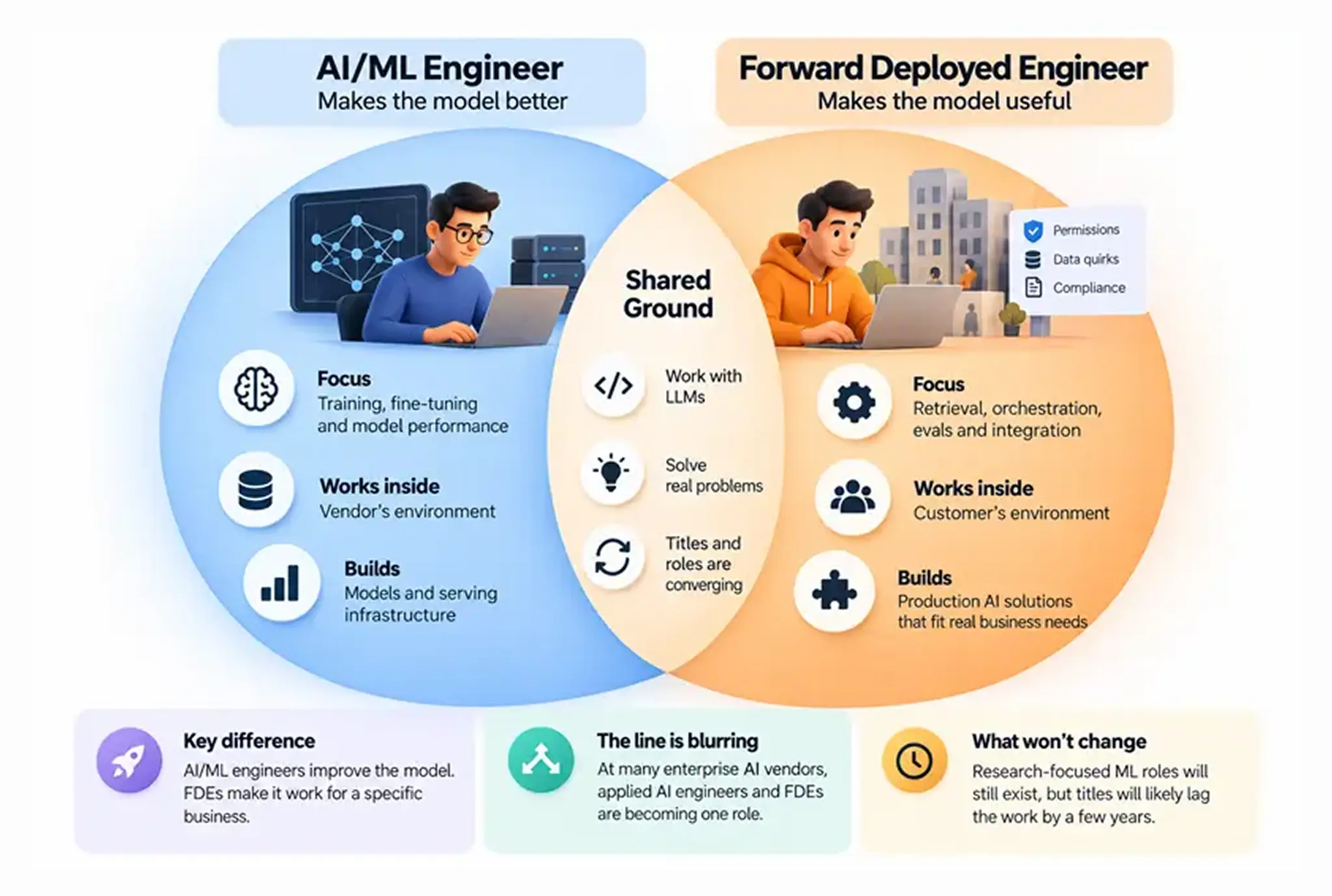
That line is blurring fast. Research-side ML roles aren’t going anywhere, but at most enterprise AI vendors, the applied AI engineer and the FDE are quietly becoming one job. Titles will lag the work by a couple of years.
Match the hire to where the project is stuck. If the buyer hasn’t signed, you need a solutions engineer; if the architecture is the open question, a solutions architect; if the model underperforms on your task, an AI/ML engineer. But if the pilot works in a sandbox and dies on contact with your ERP, your identity provider, or your data team’s backlog, that’s an FDE problem- and no number of extra demos will fix it.
A forward deployed engineer needs three skill sets in one person: production software engineering, applied AI, and customer judgment. Perspective AI’s review of 2026 postings found core engineering skills in 95%+ of FDE listings, AI-specific skills in 80%+, and discovery and stakeholder skills in 70%+.
The overlap is the hard part. Each skill on its own is easy to hire for.
Most FDE postings ask for strong Python, often with TypeScript or Java alongside, and expect engineers who can write and review production-grade code across frontend and backend. Above that floor, four clusters show up again and again:
The closest comparison is a startup CTO: someone who decides what to build, builds it, and explains it to leadership, often in the same week. Job listings describe it as high agency and the ability to navigate ambiguity inside complex organizations.
The non-technical differentiators are customer empathy, problem decomposition under ambiguity, executive communication, and system-level thinking across unfamiliar codebases.
Of those, problem decomposition is the one most interview loops skip. It’s also the one that most often sinks an engagement, because an FDE who solves the wrong problem well still ships nothing that matters.
| Skill | How to test it | Red flag |
| Production code | Pair on a real integration bug in an unfamiliar repo | Only greenfield projects on the resume |
| LLM deployment and evals | Ask how they would prove an agent works before launch | Talks about prompts, never about eval sets |
| Data engineering | Model an unstructured dataset with missing keys and duplicate records | Assumes the data arrives clean |
| Discovery | Role-play a vague stakeholder request | Starts designing before asking what decision should change |
| Executive communication | Explain a 2% agent error rate to a CFO in two minutes | Hides behind jargon |
| Scope judgment | Hand over a feature list twice the timeline allows | Says yes to everything |
| Security fluency | Walk through getting an agent past an InfoSec review | Treats security as someone else’s job |
Budget for the search, too. Paraform puts a typical FDE search at eight to twelve weeks, with 83% of roles concentrated in San Francisco or New York.
Forward-deployed engineers support enterprise projects by owning the stretch between a working prototype and a system people use every day. On AI projects, that means production hardening. On data projects, it means making scattered data usable by a model. On enterprise software projects, it means wiring new capabilities into the ERP, CRM, and identity systems the business already runs on.
A pilot proves a model can do the task once. Production asks whether it can do it ten thousand times a day, for the right users, inside a cost ceiling, without anyone rewriting prompts. That’s a different engineering problem, and it’s the one FDEs are hired to own.
Pilots usually run on a curated sample of clean data, one friendly user, and no authentication. Production brings real permissions, edge-case inputs, latency targets, and an audit trail that compliance will actually read.
An FDE works on all of them at once. Costs get a token and latency budget per workflow, with simple requests routed to smaller, cheaper models. Business value gets an evaluation suite tied to the metric the sponsor actually tracks, whether that’s resolution rate or hours saved, instead of a generic accuracy score.
Most AI implementation challenges trace back to data nobody has mapped. Gartner found 63% of organizations either lack or aren’t sure they have the right data management practices for AI. It also predicts that through 2026, organizations will abandon 60% of AI projects unsupported by AI-ready data.
However, clean data alone doesn’t make it AI-ready. A model needs data it can find, is allowed to see, and can trust to be current. That’s where an FDE spends the first weeks of most engagements:
It’s slow, unglamorous work. It’s also the difference between a RAG system that cites the right policy and one that confidently cites last year’s. If there’s one phase teams consistently underbudget, it’s this one, and it’s where FDEs and data engineering teams overlap most.
An AI capability that lives in a separate tab gets ignored. Adoption happens when it shows up inside the tools people already use: the ERP screen, the CRM record, and the service desk queue. Getting it there is integration work, and on most enterprise projects it’s the largest single block of FDE hours.
Where replacement does make sense, FDEs typically work alongside custom software development teams to rebuild one module at a time.
Hire forward deployed engineers when your AI pilots work in a demo but stall before production, and nobody on your team owns the last mile. Five signals make the case:
Build in-house if AI deployment is your product, and you will run dozens of engagements a year. And you have to pay for it. The total compensation is $300,000 to $450,000, and the talent search takes two to three months per hire.
Partner if you need one or two systems in production this quarter, or your stack is niche enough that generalists will spend months learning it.
A forward-deployed engineer is three roles under one title: a production engineer, a field consultant, and the fastest feedback loop a product team has. For most of the last decade, that combination was a Palantir quirk. Today it’s one of the fastest-growing hiring categories in software.
The reason is simple- models got good enough that the bottleneck moved. It now sits in your data, your legacy systems, and your approval chain.
So, the enterprises that pull ahead over the next two years probably won’t be the ones with access to better models. Everyone has access. They’ll be the ones who got those models through security review and into Monday-morning workflows first.
If your AI pilots are stuck between demo and production, MultiQoS forward deployed engineers are embedded with your team to scope, build, and ship them inside your own systems, from discovery through go-live.
FDE stands for forward deployed engineer, a software engineer embedded with customers to build and deploy production systems inside their environments. Palantir created the role in the early 2010s under the internal name “Delta,” and until around 2016 it employed more FDEs than traditional software engineers.
Yes. Writing production code is what separates an FDE from a solutions engineer or consultant. FDEs commit code into customer repositories, build integrations and data pipelines, deploy LLM applications, and own that code after go-live. Job-posting analyses estimate about 30% of their time goes to deployment code, with most of the rest spent with the customer.
A solutions engineer works pre-sale, running demos and proofs of concept to close the deal, and is measured on revenue influence. A forward-deployed engineer works post-sale, embedding with the customer to build and ship production systems, and is measured on outcomes in production. The SE sells the vision; the FDE builds it.
An AI forward-deployed engineer needs strong Python, full-stack production engineering, SQL and data pipeline skills, cloud deployment experience, and hands-on LLM work: RAG, agent orchestration, MCP servers, and evaluation frameworks. Equally important are customer discovery, executive communication, and the judgment to turn ambiguous business problems into shippable scope.
The hardest part of enterprise AI is no longer the model. It’s getting the model into production around legacy systems, messy data, and security controls. FDEs close that gap and feed field lessons back into the product. OpenAI’s $4 billion Deployment Company, launched in May 2026, shows how central the role has become.

Get In Touch

Get Stories in Your Inbox Thrice a Month.
Enterprise AI Implementation Challenges: Common Roadblocks and How to Overcome Them

Computer Vision in Retail Explained: From Smart Shelves to Smart Stores
The Complete Guide to Machine Learning in Healthcare: Uses, Benefits & Challenges