
Enterprise AI Implementation Challenges: Common Roadblocks and How to Overcome Them
Need quick insights? Summarize with AI & save time
 ChatGPT
 Perplexity
 Claude
 Google AI Mode
Table of Content
- Why Enterprise AI Implementations Still Stall in 2026
- 8 Enterprise AI Implementation Challenges You Need to Overcome
- A 90-Day Roadmap to De-Risk Enterprise AI Implementation
- Conclusion
- FAQs
Summary:
Most enterprise AI programs do not fail because of the model. They fail on data readiness, legacy integration, agent permissions, compliance classification, and unclear ownership. This guide breaks down the challenges that stall production rollouts, the fix for each, and a roadmap to de-risk your next deployment.
Walmart has more than 4,000 stores in the United States. To operate these stores efficiently, Walmart built its own AI platform instead of buying one. The platform, called Element, now serves 1.5 million associates and handles 3 million queries a day.
They were, however, confronted with constraints such as,
- Model pricing and capability changing faster than procurement cycles
- Vendor lock-in across a store estate that cannot be re-platformed twice
- Cost-performance tradeoffs varying by task, not by contract
Such difficulties could be met by standardizing on a single frontier model vendor, which is what most enterprise LLM implementations default to, and that choice buys speed at the price of every future renegotiation.
So, they built an LLM-agnostic abstraction layer that gave them,
- Automatic routing of each query to the cheapest model that can handle it
- Model swaps without re-architecting the applications above
- Reusable components across five shipped apps instead of five separate builds
Their shift-planning app cut manager planning time from 90 minutes to 30. The lesson is not about Walmart’s budget. It is about where they made the real effort, ensuring the layer beneath the model is well structured. Like Walmart, many enterprises face multiple challenges.
In this article, you will get to know many of the enterprise AI implementation challenges that stall production rollouts, along with best practices to overcome them.
Why Enterprise AI Implementations Still Stall in 2026
Most enterprises that invest in AI in 2026 are going through cycles of multiple failures and abandoned pilots, and an MIT report suggests that 95% of these pilots fail. This is due to multiple issues:
- The late realization of the adoption-to-value gap.
- The proof of concept, which actually works in isolation but does not work across the enterprise.
- Non-realization of true blockers
The adoption-to-value gap: high investment, low measurable ROI
The single most important issue with the modern enterprise AI implementation is the lack of understanding of what it will solve. Stakeholders often miscommunicate the true problem AI would solve.
Especially, the problem shared by business leaders is often interpreted differently by the technical teams, and the solutions that these teams propose often do not match the organizational needs and business-critical objectives.
This leads to higher investment and lower measurable ROI. This has a lot to do with the lack of AI change management, and it leads to an increase in the total cost of ownership.
PoC-to-production drop-off
Enterprises often reinvest in AI adoption because they think that they had chosen the wrong model the first time. After the third failed initiative, executive engagement drops, and organizations think that AI adoption does not deliver any value.
This happens because the proof of concept does work, but it works for a specific task and not for the entire organization. Closing that gap is a delivery sequence, and our AI implementation roadmap breaks it into three 30-day phases.
Why the blockers are organizational, not model-related
Realizing the wrong reasons for failures causes the stall in enterprise AI implementation, because most enterprises think this is due to the wrong model, but it’s not due to the wrong model. Rather, it is due to inefficient processes and a lack of knowledge among employees.
Plus, there are issues of weak data and fragmented information. Most of the enterprise data is often trapped in different departments, and these departments are siloed, poorly structured, and lack AI governance frameworks.
Legacy infrastructure gaps also stall enterprise AI implementations because they are not compatible with modern agentic systems, which is why integrating AI into legacy enterprise systems is a separate workstream and not a line item inside the model build.
Now that we have understood the specific reasons that most of these enterprise AI implementations stall and AI pilots fail, it’s time to understand the real operational challenges that organizations are facing.
8 Enterprise AI Implementation Challenges You Need to Overcome
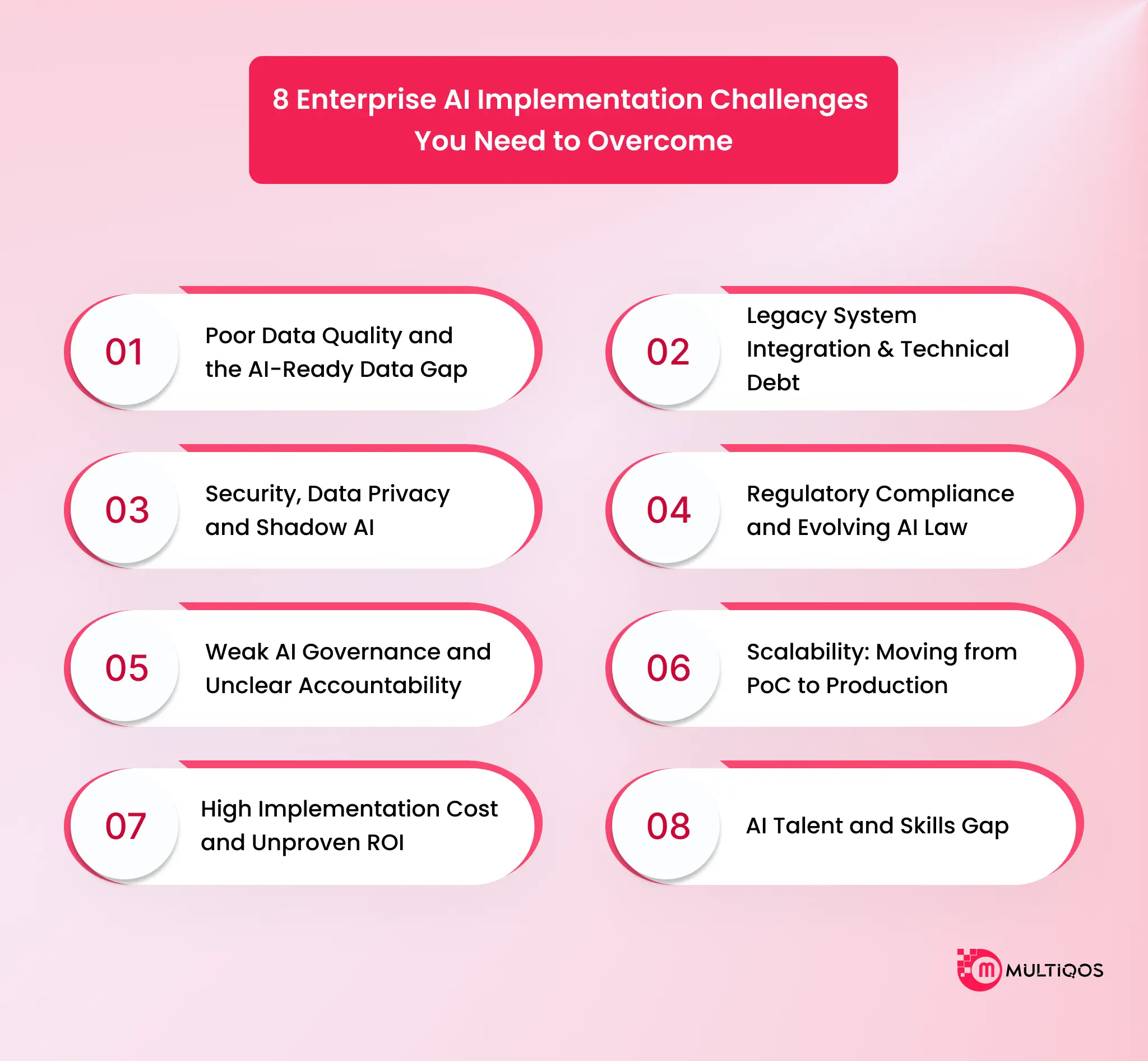
Overcoming AI adoption challenges does not just require technical expertise. It also requires strategic advantage because enterprises are not just facing one challenge, such as data quality or a lack of skilled employees.
There are multiple challenges, and they are not just because they lack technology. Enterprise AI implementations face such challenges because these organizations are structured around legacy systems, and with the introduction of AI, these structures need to adapt and change. This is where the challenge begins.
1. Poor Data Quality and the AI-Ready Data Gap
Data is the basis on which AI adoption happens. If your data is weak and fragmented, the model it is trained on will also provide an outcome that is not aligned with your business requirements. It is important to ensure your data quality according to what outcomes you need.
Why fragmented, unlabelled, and unstructured data breaks AI projects
Unstructured and unlabeled data is one of the biggest barriers to AI adoption for enterprises. The reason is not just about quality, because quality does affect the model output. The alignment of data to the operational capabilities of an organization and how it will impact the ultimate outcome needs to be defined before you integrate any AI model.
This is where most organizations falter because they have data systems that have been designed for legacy systems and not according to the latest AI. This is why legacy modernization becomes crucial, and choosing among proven legacy system modernization strategies is the step that decides whether the data layer can carry AI workloads at all.”
The data-trust paradox inside enterprises
A crucial challenge for every enterprise is to overcome the false confidence in AI readiness. Most enterprises are rushing to adopt AI, but their governance frameworks are not capable enough to handle the pace at which these AI models are working.
According to a report, 70% of organizations are rapidly integrating generative AI, but data leaders admit that their AI governance frameworks are not enough to keep pace with actual workforce utilization. This is where it is important to understand that adoption without proper governance can lead to catastrophic events.
How to overcome it: data contracts, lineage, and an AI-ready data layer
Overcoming the data trust paradox requires organizations to deploy proactive data contracts, which is foundational work that sits inside data engineering services rather than inside the model project. This will enforce schema rules at the source, implement automated AI-ready data lineage, and establish a centralized semantic layer.
The data lineage implementation ensures that systems can track asset provenance in real time, and establishing a centralized semantic layer feeds AI agents unified definitions and information.
Best practice: treat data readiness as a continuous practice, not a one-time cleanup
Best approach here is to treat data readiness as a continuous practice. This eliminates the costly cycle of emergency project cleanups. Plus, it helps enterprises shift from a reactive firefighting mode to a permanent state of model-ready production.
2. Legacy System Integration and Technical Debt
Every enterprise AI implementation is a roadblock, and that is not the model. The real constraint is the technical debt accumulated in enterprises over the years due to legacy systems built around fixed cycles. These legacy systems often include core ERP, banking, and mainframe platforms, blocking agentic workflows. Agentic AI struggles to read the state, take an action, and see the result immediately around these peak cycles.
Why ERP, core banking, and mainframe estates block agentic workflows
Agentic AI workflows require an on-demand interface, which helps them read the current state of the system. Plus, it allows them to write specific changes to the code if required. Most legacy systems offer none of these because these systems were designed around scheduled jobs and not on-demand requirements.
Most enterprises have their business logic sit in COBOL or heavily customized ABAP. These are undocumented because people who wrote it decades ago are often retired.
The next issue is customization, as enterprises have modified their ERP heavily over the years without standard connectors that match their instances, and each new AI use case adds more complexity to this problem.
Batch data and the real-time context problem
Legacy systems move data in batches, which means the data an agent will read is not accurate because it’s not in real time. Take an example of an inventory agent working from a batch feed. It will show inventory stock to the end customer that has already been sold, and this causes a lack of trust for the customer.
How to overcome it: API/event abstraction layer, strangler-fig modernization, model-agnostic platform
Overcoming such issues requires building an API and event abstraction layer between the agents and the legacy systems. This is where technical prowess becomes crucial, and you need a technical partner who can provide you with the right resources and team to build such an abstraction layer. With these APIs, agents will be able to call a stable contract.
Such contracts expose business capabilities, such as checking availability or posting a payment, and then the abstraction layer would translate it. Now, if you pair it with an event stream, the state Changes will be published as they happen, and the batch problem will disappear.
Best practice: treat the abstraction layer as the product, not as plumbing.
It is what turns the fifth and twentieth deployment into a configuration exercise rather than another custom build.
3. Security, Data Privacy and Shadow AI
Security for enterprise AI adoption is a layer that decides whether an AI initiative will reach production or not. Most enterprises that plan for AI security treat it the same way they treat application security; however, both of them are different. AI systems consume data, retain context, and act on behalf of users in ways that traditional security systems were never designed for.
Breaches of AI models and the missing access-control layer
According to IBM’s Cost of a Data Breach report, 13% of organizations have already experienced an attack that impacted their AI models or applications, and 97% of those breached organizations lacked proper AI access controls.
Lack of access protocols is one of the significant security gaps that most enterprises face while implementing their AI projects. The reason is a lack of definition of the access protocols. These organizations would connect AI systems to knowledge bases, CRMs, and document repositories without having proper access-based protocols established, which exposes the system.
The cost premium of ungoverned shadow AI
Shadow AI is the use of unsanctioned AI tools by employees, and it is now a measurable cost line. The same IBM report found that shadow AI added an extra USD 670,000 to the global average breach cost, and 63% of the organizations studied had no AI governance policies in place.
Shadow AI is a term that can be best defined as the use of unsanctioned AI tools by employees. This happens because the sanctioned path is slower than the unsanctioned one.
When employees do not get proper approval for AI access, they may paste sensitive customer data, context, and source code into public AI tools to complete their work. This is what every enterprise should avoid because it can create security issues for their systems.
Prompt injection, data leakage, and agent permissions
Agentic deployments often face the security issue called prompt injection. What this means is that instructions are hidden inside content the agent reads, such as a document, a ticket, or a web page. By following these instructions in such materials or content, the agent would be unable to separate trusted instructions from untrusted data.
The level of security threat depends entirely on the type of permissions an agent has. For example, if an agent has read access, it may leak sensitive information. If the agent has write access, then it can send data outward, modify records, or trigger downstream systems.
This is why identity scoping belongs in the build itself. If AI agent development provisions agents with a single shared service identity, every agent inherits the maximum blast radius by default.
How to overcome it: sanctioned AI gateway, DLP, least-privilege agent identity, red teaming
One enforcement point carries logging, rate limits, model allowlists, and prompt inspection; shadow AI dies when the approved path becomes the fastest path, not when policy forbids the alternatives. A way to overcome this issue is to route every AI call through a sanctioned gateway.
Extend DLP to both sides of the model. Regulated fields get masked on the way in, and anything carrying them gets blocked before it leaves the session. A support agent that pastes a full claims record into a summarization prompt should hit the mask, not the model.
Best practice: govern access at the agent level, not the application level.
Application controls assume one human behind each request. Agents fire thousands, chain them, and reach across systems, so the permission boundary belongs on the agent identity itself.
4. Regulatory Compliance and Evolving AI Law
Regulation is now a design input for every AI system, not a check at the end. Most enterprises build first and map the legal position later, and that sequence is what turns a working system into a blocked one. Among enterprise AI implementation challenges, compliance is the one that decides whether a deployed system can stay in production.
EU AI Act 2026: what applies to your enterprise?
The EU AI Act is a binding framework that applies to developers, providers, and deployers, and it applies outside the EU as well if your system touches EU users. High-risk system obligations are the layer most enterprises are unprepared for, because they require conformity assessment, quality and risk management systems, post-market monitoring, and formal marking before the system can operate.
Sector rules, data residency and sovereign AI constraints
The AI Act does not replace the rules you already carry. It sits on top of them. Enterprises in regulated industries still hold their data protection duties, their operational resilience obligations for financial systems, and their cybersecurity standards, and now they hold AI-specific duties alongside all of it.
The practical outcome is overlapping obligations across the same system. Meeting them requires cloud computing solutions that enforce domain-owned data products with data sovereignty and local residency controls built in, and privacy handled at design time.
This is another reason legacy modernization keeps appearing across the challenges enterprises face in implementing AI, because older estates cannot enforce residency or ownership at the data-product level.
Liability for AI outputs
Enterprises do not get to separate themselves from what their AI systems say. The liability for incorrect information provided to a customer is not the model’s or the vendor’s but the deployed system’s. Any deployment that involves customers or is of great importance to the decision is important because it eliminates the “assumption of responsibility” that can be taken in any disclaimer.
Treat every automated output as a statement made by your organization. That single framing changes how much review a system needs before it goes live.
How to overcome it: AI system inventory, risk classification, conformity evidence
Start with a centralized inventory of every AI system in the organization. The inventory tracks each system’s scope, training data lineage, model documentation, and a named owner.
Then classify each system by risk. Internal tools that are low risk should be monitored, signed off by humans, and entered into the central log. Medium-risk customer-facing systems involving personal data require impact assessment, process owner naming, and a rollback plan.
Best practice: generate compliance evidence continuously, not at audit time.
Classification without recorded evidence is an opinion. Evidence produced as the system runs is what satisfies a regulator.

5. Weak AI Governance and Unclear Accountability
Governance is the gap between what an enterprise permits and what its people actually do. Most AI adoption challenges at this layer are not technical. They are ownership problems that surface only after something goes wrong.
Governance is lagging behind employee AI use.
Enterprise adoption has moved faster than the governance built around it. Tool access has expanded across the workforce, but the rules covering how outputs are checked have not expanded with it.
The result is a behavior gap. Employees use AI regularly, accept the output without evaluating accuracy, and carry that output into work deliverables. The exposure here is not the model. It is the absence of a defined verification step between the output and the deliverable.
The risk-awareness vs. risk-mitigation gap
Most enterprises know the risks and have not built controls against them. Responsible AI maturity across organizations stays low, and leadership readiness is usually reported as stronger than operational readiness in infrastructure, data, risk, and talent.
This is where the AI governance framework stops being documentation and becomes an operating requirement. Awareness does not reduce risk. Enforcement does.
How to overcome it: NIST AI RMF and ISO/IEC 42001 as the operating backbone
Pair a risk framework with a certifiable management standard. The NIST AI Risk Management Framework gives you a continuous loop. Govern sets culture, policy baselines, risk appetite, and executive accountability.
Map catalogs system boundaries, context, intended uses, and supply chain dependencies. Measure evaluates drift, accuracy, safety, and bias. Manage applies risk treatments, incident response, and runtime intervention.
ISO/IEC 42001 sits alongside it as a certifiable AI management system standard that requires formal impact assessments and structured controls. Running the NIST loop as your internal operating model produces the documentary evidence those audits and provider obligations require, so one effort serves both.
Best practice: named ownership, model registry, human-in-the-loop thresholds.
Every production system gets a business unit owner with accountability for outcomes, not a handoff to a central technical pool. Maintain a single live registry capturing system context, feature definitions, data lineage, risk tier, and connected APIs from intake, run on the same discipline that separates MLOps from DevOps.
6. Scalability: Moving from PoC to Production
The pilot is not the hard part. Most enterprises can demonstrate a working model. The constraint appears when that model has to run against production systems, production volume, and production accountability.
Why agentic pilots get canceled before they scale
Pilots stall for organizational reasons, not model reasons. The first pattern is building proofs of concept in isolated environments that were never engineered to integrate with backend systems or handle production traffic.
The second is accumulating tools and licenses without redesigning the workflow around them, which produces local efficiency that never reaches the bottom line. The third is routing AI initiatives entirely through technology departments without operational sponsorship from the business.
The fourth is saving employee time without redirecting that time to higher-value work, so the gain disappears into slack.
AI pilot to production is a delivery problem. Fixing the model does not fix any of these four patterns.
Missing MLOps/LLMOps foundations: evaluation, observability, rollback
Most enterprise architectures were not built to observe a model in production. They lack real-time observability, automated evaluation, prompt versioning, and a rollback path. Without MLOps/LLMOps foundations, a degrading system keeps serving output, and nobody knows until a user reports it.
Continuous post-deployment monitoring is what closes this. It tracks drift, latency, and anomalous response patterns as they happen.
Agent washing and vendor capability mismatch
There is a gap between what vendors describe as an agent and what an agent actually requires. Static scripts and basic chatbots are frequently sold as autonomous systems. These deployments fail because the orchestration and integration layers that make agentic behavior possible were never there. Evaluate vendors on the integration layer they provide, not on the label attached to the product. A side-by-side of AI agent frameworks shows how wide that gap actually runs.
How to overcome it: platform-first delivery, reusable patterns, production gates
Select first production use cases that are frequent enough to generate real signal, auditable so humans can verify output, simple in process logic, and transferable so the result becomes a template for other departments.
Then rewire at the domain level rather than scattering isolated use cases across the organization. Domain-level work is what converts local gains into outcomes the business can measure. Support it with cloud-native orchestration that exposes enterprise data and backend APIs as secure, reusable services, so the next deployment is configuration rather than a new build.
Best practice: build the platform once and treat every later use case as a deployment on it.
This is the difference between an AI implementation roadmap and a sequence of disconnected projects.
7. High Implementation Cost and Unproven ROI
Cost is rarely a single line. It accumulates across inference, data work, integration, and rework, and most enterprises do not see it until the invoice arrives.
Where AI budgets balloon
Budgets expand because inference runs unoptimized, agentic loops run without limits, fragmented legacy databases require extensive cleaning, and failed pilots get rebuilt instead of retired. AI total cost of ownership includes all of this, and none of it appears in the initial estimate.
The AI cost-visibility gap
Many executives running AI initiatives cannot say how those projects are performing financially. The reason is the metrics being tracked. Organizations count prompts processed and users logged in, which are activity measures, and skip cost per transaction, resolution time, and error rate reduction, which are business measures. AI ROI measurement only works when the metric is tied to an outcome the business already reports.
How to overcome it: FinOps for AI, use-case value gating, build-vs-buy discipline
Enforce infrastructure controls. Set per-user request rate limits, token budgets per call, hard step caps and timeouts on autonomous loops, and real-time cost anomaly alerts.
Score prospective use cases before funding them. Value density, data readiness, error tolerance, and ownership clarity together tell you whether a project belongs in the first wave or the backlog. Projects with weak ownership or unready data do not improve once the build starts.
Best practice: tie every use case to a baseline metric before the build starts.
Document current cycle time, error rate, and cost per unit processed, then set an explicit numerical target. Without a baseline recorded beforehand, the result cannot be proven afterward.

8. AI Talent and Skills Gap
Talent is the constraint that slows every other item on this list. The AI skills gap enterprise-wide is now cited by technology leaders as the single biggest barrier to returns on agentic deployments.
Shortage of ML, data, and AI platform engineers
Competition for specialized talent is intense across MLOps engineers, data architects, and AI security specialists, and it carries a salary premium. Hiring alone will not close this gap at the pace enterprises are deploying.
Data and AI literacy gaps outside the technical team
The larger constraint sits outside engineering. HR, finance, operations, and legal teams are expected to work with AI systems without the training to evaluate them, and most workers do not feel adequately prepared for the tools they have been given. This is where unverified output enters business processes.
How to overcome it: hybrid build model, partner augmentation, internal enablement tracks
Hire AI developers to augment internal teams for initial platform architecture and complex model design, and run structured internal enablement in parallel so capability transfers rather than leaves with the engagement.
Best practice: build hybrid professionals rather than hiring only specialists.
Domain experts in operations, finance, or legal who learn prompting, evaluation, and workflow design are more useful than engineers who do not know the process.
A 90-Day Roadmap to De-Risk Enterprise AI Implementation
90 days is enough to change which of these challenges you carry into the next budget cycle.
- Days 1-30: triage and baseline. Inventory every AI system in use, sanctioned or not. Score each candidate use case on value, data readiness, and regulatory exposure, then cut the bottom half. Map NIST AI RMF functions to named owners and open the model registry with one entry.
- Days 31-60: thin slice and integration spike. Build one use case end to end, narrow and real, with its baseline metric captured before the first commit. Ship the evaluation harness in the same sprint as the feature. Spike the integration against your hardest legacy dependency, because the abstraction layer should be designed around your worst system.
- Days 61-90: gates, adoption, instrumentation. Hold the use case to the production gates in Challenge 6. Launch the champion network in the affected function before rollout, not after. Instrument cost per unit of work and output quality on one dashboard, and take both to the steering committee in the same review.
Conclusion
What companies will benefit from AI in 2026 are not the ones that had models that were lagging and just not quite making it. They made another choice as to where the hard work goes, and they put it in the layer below the model: the data contracts, the abstraction layer, the evaluation harness, the named owner, the champion network.
So, the choice of the next steering committee is not about which model to choose. Today it is which of these barriers are owned and which are still awaiting discovery in production.
FAQs
The cost depends on the use case, but KPMG data, cited by Flexera, indicates that planned average spending on AI by an organization is $188m. Inference at production volume, data engineering, data integration, and rework are among the sources of overruns, and just 31% of organizations have accurate visibility of the spending on AI software.
Instead of connecting models to ERP or core banking systems, or mainframe systems, enterprises connect to AI systems via an API and event abstraction layer to the systems of record. The layer broadcasts changes in state as events and exposes the actions as governed, idempotent calls to modernize and retire the legacy paths, then function by function.
A narrow use case that can be built with existing data can go to production within about 90 days: Triage and Governance baseline takes 30 days, thin-slice build with an evaluation harness takes 30 days, production gates and adoption enablement takes 30 days. These use cases require new data pipelines and/or evidence of conformity with the EU AI Act, and the stumbling block is typically the data readiness, rather than model work.
Know ROI by taking a baseline measurement before the build begins and assigning costs to each unit of work after the build: cost per resolved ticket, cost per document generated, cost per workflow completed. As for those that have executive-level AI cost accountability, Flexera identified that they have three times the ROI, and only one in four does.

Get In Touch

Get Stories in Your Inbox Thrice a Month.
Move Beyond Pilot: How to Drive Optimum Value from AI Agents in Retail
A Comprehensive Guide on How Machine Learning is Transforming the Factory Floor