
 ChatGPT
 Perplexity
 Claude
 Google AI Mode
88%
88% of AI pilots fail to reach production environments.
CIONeed quick insights? Summarize with AI & save time
Summary:
Every AI stall comes with a price tag – the licenses, the engineering hours, the executive attention, and months of lost momentum. Multiply this across your entire AI ecosystem, and the cost of almost deployed becomes hard to ignore.
The truth is that the gap is not because of a weak model. It comes due to the distance between the capabilities displayed by an AI model in a vendor’s environment and a customer’s environment.
Forward Deployed Engineers (FDEs) exist to close that connection. FDEs work as an extension of the customer’s team. As they are present in the client’s environment, they have better insights into AI integration and customization challenges.
88% of AI pilots fail to reach production environments.
CIO65% of organizations have abandoned their AI initiatives due to skill gaps.
Plural Insights63% of organizations confirm that they either lack the right data management practices to support AI or aren’t sure if they have them.
GartnerImagine this: An AI pilot has impressed the leadership team in the demo. The models deliver accurate results, dashboards look clean, and everyone agrees that this should be made live. Now the real work begins. The AI pilot needs to be connected with the legacy CRM and ERP and traditional datasets. It also needs to fit into the already existing workflows. As a result, the project is stalled, and the demo is now a distant memory.
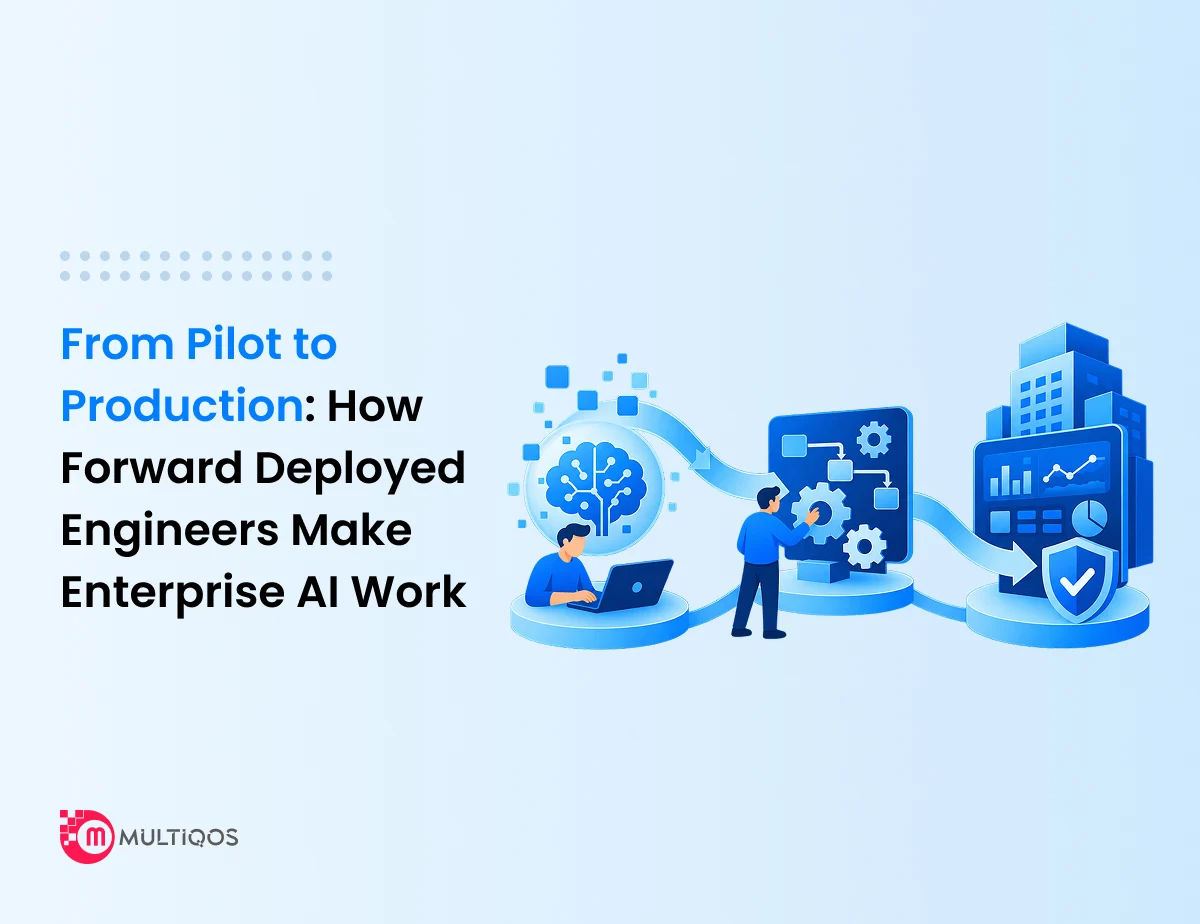
This is a common story of almost every enterprise. Rarely, the bottleneck is the AI model. In most of the cases, it is the deployment strategy. To avoid this situation, AI companies are changing how they work with the engineers. Now, the deployment engineers are directly placed in the production environment.
These engineers are called Forward Deployed Engineers (FDE). Read on to learn why modern AI enterprises are moving towards them.
As technology evolves, building a powerful solution is not enough. Today’s AI and enterprise systems are complex and rarely work well out of the box. Every business has its own systems, data, workflows, and constraints, so they need someone who works in their environment and has a complete overview of their operations.
That is the role of the forward-deployed engineer (FDE). An FDE doesn’t walk away once the deployment is done. They implement the solution in the customer’s environment, customize it to a specific use case, and operationalize it to achieve the intended results.
In simplified terms, an FDE:
A prototype exists to prove that an idea can work. This idea should be working day and night and in every setting. Many promising ideas stall in the gap between the two.
Prototypes are designed to run on a small set of data in ideal conditions. In production, the same solution has to accommodate requests coming from different users and process a larger dataset. They should be able to support business-critical workflows where any error has real consequences.
There is no plugin to add AI capabilities into CRM, ERP, or any traditional application. Every solution brings its own set of data formats and asset rules. This integration is often one of the biggest problems between a successful demo and a live deployment. Reliable data engineering services can help businesses prepare and integrate the data needed for enterprise AI applications.
A prototype with errors might be able to bypass security and governance checks. However, the same thing is not possible for a system in the production environment. There are certain moving parts such as access rules, audit trails, and compliance regulations that should be fixed in the prototype stage. Implementing these controls in the production stage is cumbersome and also introduces delays.
A feature-rich AI solution is considered to be a wasted effort if the employees don’t know how to use it. The solution must fit into the existing workflows, tools, and habits, and benefits should be clear too. Without user adoption, it is impossible to drive intended value from the AI solution.
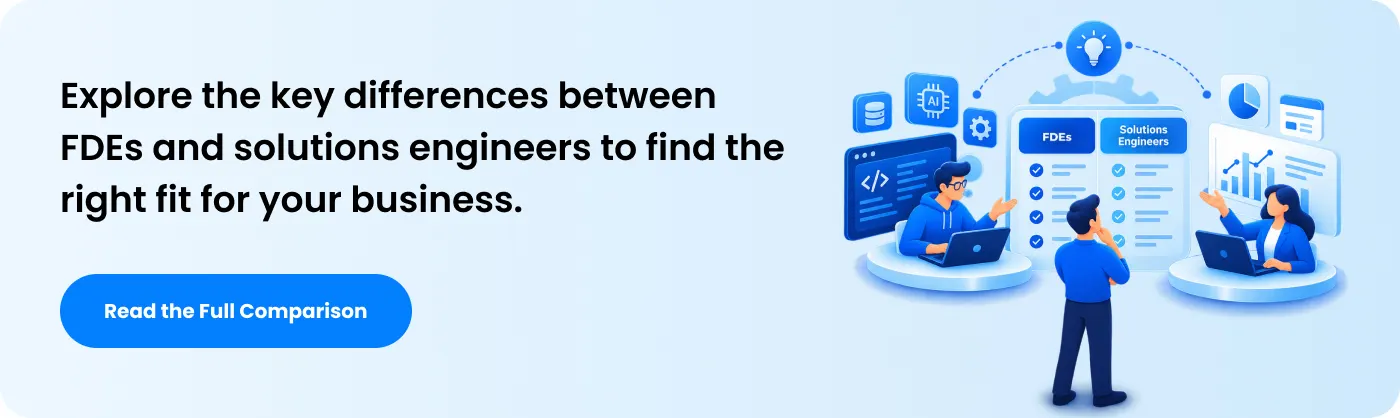
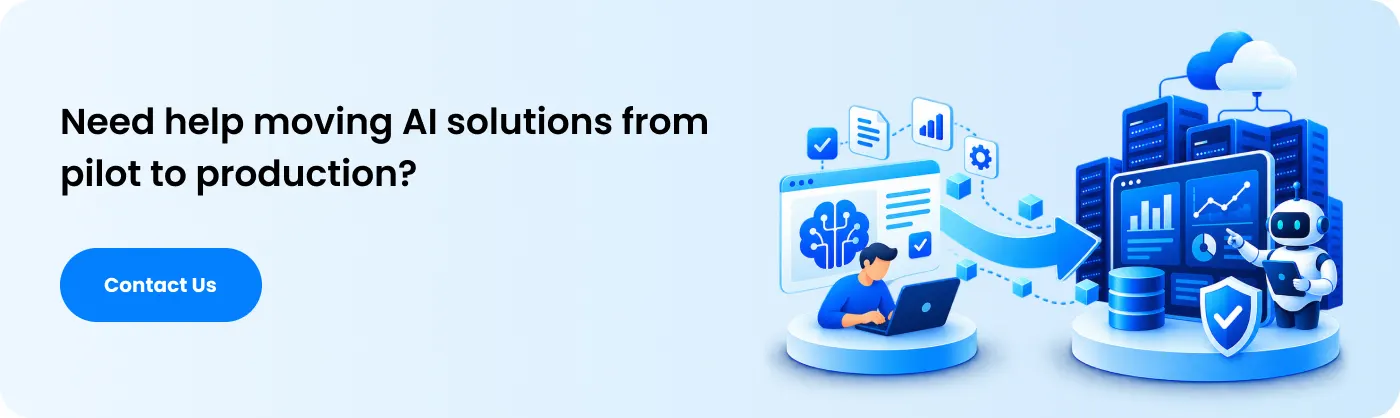
AI enterprises are acknowledging the fact that a great model is only half the battle won; the real challenge lies in making the solution work in the client’s infrastructure. If your AI project needs dedicated implementation expertise, you can hire forward-deployed engineers to help move solutions into production.
Organizations have moved from generic chat assistants to autonomous agents. These agents should be able to manage supply chains, automate compliance checks, or process legal documents within their own technology stack. Achieving these involves integration with data schemas, legacy infrastructure and other controls which were not designed while considering AI. No off-the-shelf deployment can handle this. An FDE can.
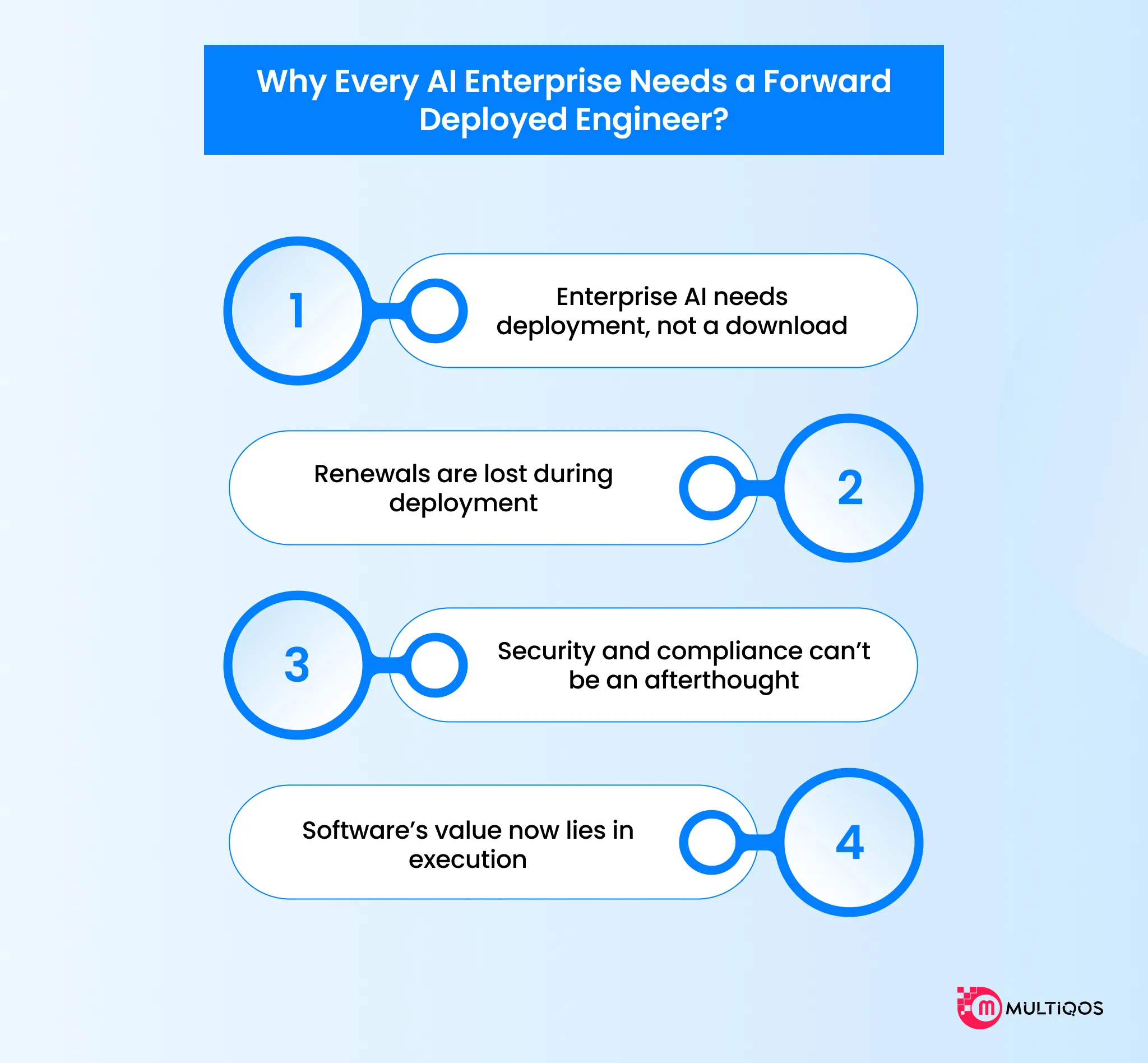
Closing the deal is only the first hurdle for any AI vendor. The customer is indeed lost or won only when the product is deployed. If a customer’s implementation drags or fails, the customer is unlikely to stay, and they will spread the negative review as well. This is where a Forward Deployed Engineer steps in and turns a risky rollout into a successful implementation. They don’t just ship the software; they own the customer’s success beyond go-live.
Highly regulated industries such as healthcare, financial services, defense, and legal can’t just plug in AI and start using the system. Data residency, audit logging, role-based access control, and output model governance should be engineered in the customer’s environment, and none of this can be handled by subscribing to an AI service. An FDE is required to handle this opportunity.
AI coding tools are making it easy for anyone to build software; therefore, designing solutions is not a lucrative job. The engineers who can integrate applications with the customer’s existing infrastructure, navigate through complex data infrastructure, and deliver AI models that offer measurable business impact are paid more. The competitive edge has moved away from building models and toward deploying them successfully in an enterprise environment.
Palantir was an early pioneer of the Forward Deployed Engineer, and it has paid off. Now, big leaders such as Salesforce, OpenAI, Anthropic, and Google are making their own FDE teams. When every company is in the race to build its own FDE resource pool, the question now is: Can we move forward without dedicated FDEs?
FDEs power customization of AI solutions for different companies, as they are an extension of the client’s team and have first-hand information about their specific problems. Businesses with unique integration requirements can use custom software development to connect existing systems with new solutions.
Traditional engineers follow a cookie-cutter approach for every client. They design one product for thousands of users. Forward-deployed engineers write custom code that connects APIs directly to unorganized data, legacy systems, CRMs, and approval workflows.
Out-of-the-box API applications are created to cater to the unique needs of any organization. Every client typically needs its own set of prompts, set of connected tools, APIs, and use cases. An FDE fine-tunes these layers, enabling AI solutions to scale with the business.
FDEs have a varied skill set. They blend engineering, product management, and a consulting approach to understand the client’s problems. Then, they prepare a technical scope that solves the customer’s challenge and runs smoothly in the production environment.
As FDE works closely with the client, they have direct access to their environment, as a result of which they can identify if there are any cracks in any solution. They pass these findings to the core product team so that they can make appropriate changes to the product.
Reliable FDE teams don’t build a one-time solution. They turn what they built for one client into a repeatable architecture, shared internal libraries, and standard workflows that can be used by many businesses. As a result, the platform grows into a solution that can handle different uses.
An FDE enables enterprises to harness the exact value of the AI solution.
| Enterprise AI Challenge | What Forward Engineers Do |
|---|---|
| AI pilots to reach production | Design and deploy AI solutions in the client’s environment. |
| Enterprise systems are difficult to integrate. | Integrate AI capabilities with existing APIs, databases, and knowledge bases. |
| AI implementations are not reliable. | Set up evaluation frameworks, monitoring, access controls, and fallback mechanisms |
| Misalignment between business and technical teams | Prepare technical architecture as per the business requirements |
| Cost of AI implementation | Spot deployment bottlenecks, simplify integration, and build solutions that fit your enterprise infrastructure. |
| Scalability of AI use cases | Design production-ready infrastructures that can easily be replicated into different business operations. |
| Proving the value of AI | Create evaluation metrics to measure the impact of AI solutions |
Most enterprise AI doesn’t deliver the intended value, but the AI model is rarely the cause. The real problem lies in how it is implemented inside the client’s environment. Whenever a requirement for a software implementation arises, it flows from the sales team to the solution team and the support team. There is no single team handling the entire process; as a result, the details might get lost along the way. Another issue is that the internal teams build solutions, and they don’t have first-hand experience and access to the customer’s environment. As a result, the chances of software breaking down in a live instance are high.
A Forward Deployed Engineer (FDE) works in conjunction with the client’s team; therefore, they are able to discover the problems early, in the planning or testing stage, so these don’t reach the live environment.
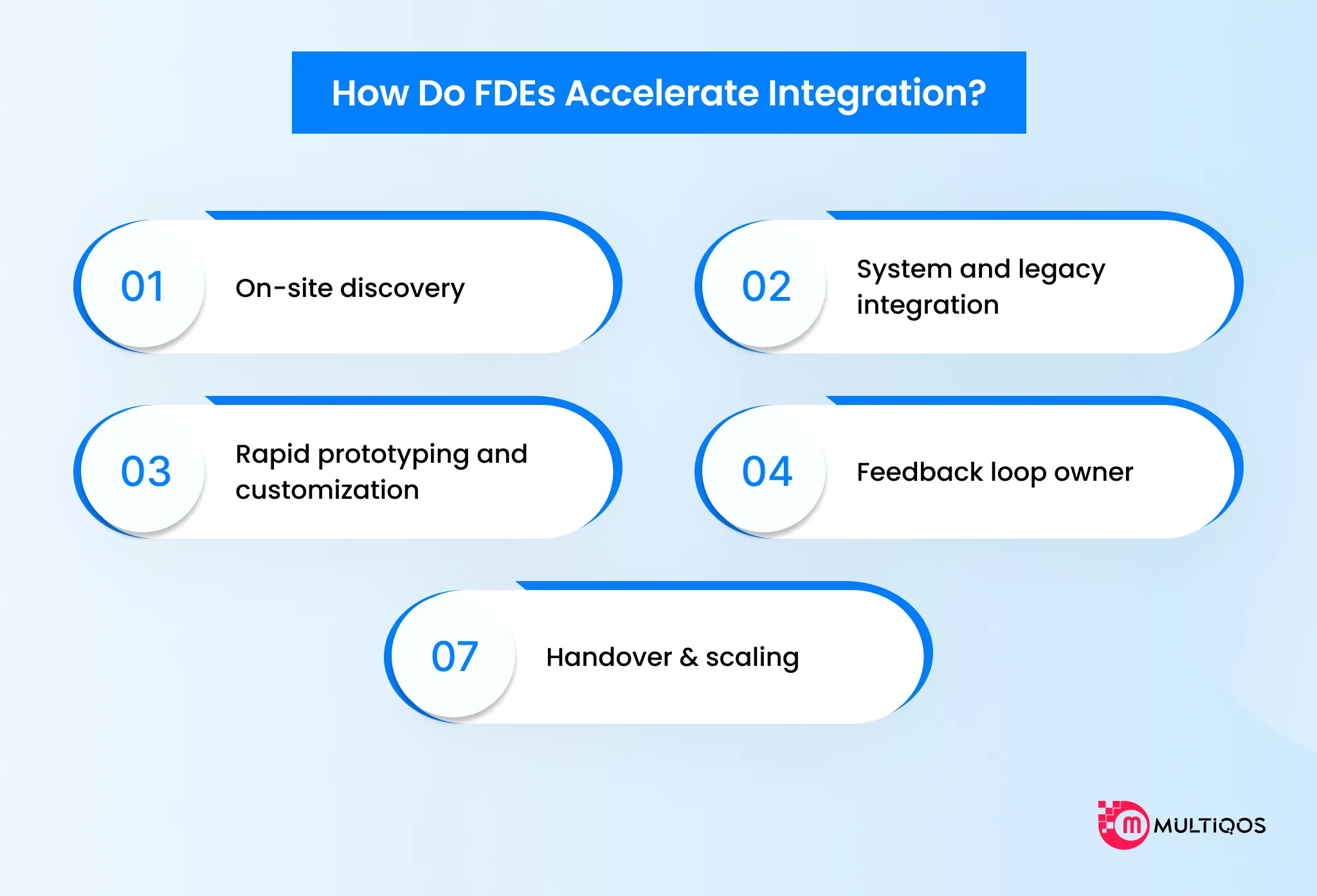
An FDE bridges the gap between AI solutions and the existing infrastructure.
Work in tandem with client stakeholders, from business leaders to IT and operations teams, to understand how their day-to-day operations run and which goals AI should support. Then recommend solutions that complement the existing processes finely.
Integrate AI agents, APIs, and databases with the current infrastructure, security controls and legacy enterprise software so that the AI solution can access the system and data it needs. This means that the FDEs are working to accommodate the present systems in the AI solution fabric.
Build, test, and rework the AI solution in the client’s existing environment only, rather than creating it in a separate lab. Working in the live environment enables the FDEs to try the idea quickly, get the feedback, and work on it again if the need arises.
Translate field-level usage signals into clear, actionable feedback for the core product and engineering teams. FDEs know which feature is utilized on the ground, where users find difficulty, and what keeps breaking. By sharing the suggestions, they help the core team fix the recurring issues and determine the product roadmap.
Train the client’s internal team to ensure that the systems keep running smoothly once the deployment team stops supporting. This includes making the client’s team aware of every product feature and hardening the pipeline so that the business’s growing needs are catered to.
AI doesn’t deliver value when it is built. Significant business impact is derived only when the AI models work well in the production instance. Most of the AI efforts are stalled in this phase only. Forward Deployed Engineers act as a bridge in this situation. They work inside the client’s environment, design the AI solution to complement the business processes, and ensure that the compliance and security controls are met.
Ready to accelerate the AI solution from pilot to production? Connect with MultiQoS today and close the gap.
An FDE aligns AI solutions with high-value business cases and measurable metrics. They eliminate deployment hurdles and optimize AI solutions to work with the real business workflow.
More and more organizations are moving beyond the AI pilot stage. Therefore, they need professionals with the capabilities to solve deployment, customization, and integration challenges.
Yes, the role will certainly remain relevant. As the AI platforms mature and become easy to deploy, the focus of FDE will shift to improving the integration and customization of these solutions.
Traditional consulting is more about strategy and communication. FDEs are skilled at building, integrating, customizing, and improving AI solutions.

Get In Touch

Get Stories in Your Inbox Thrice a Month.
Move Beyond Pilot: How to Drive Optimum Value from AI Agents in Retail
A Comprehensive Guide on How Machine Learning is Transforming the Factory Floor