
Digital Transformation Roadmap 2026: A Practical 6‑Step Guide for Mid‑Market Enterprises
Need quick insights? Summarize with AI & save time
 ChatGPT
 Perplexity
 Claude
 Google AI Mode
Table of Contents
- What is the Digital Transformation Roadmap?
- Why Invest in Building a Digital Transformation Roadmap in 2026?
- Key Forces Shaping Digital Transformation in 2026
- Assessing Digital Maturity Before the Roadmap
- Step-by-Step Digital Transformation Roadmap for 2026
- Mistakes to Avoid While Building a Digital Transformation Roadmap
- Build Your Digital Transformation Roadmap with MultiQos
- FAQs
Summary:
Digital transformation is becoming a practical need for businesses in 2026. Companies are changing how they work to keep up with digital trends and stay competitive. Many businesses still struggle with older systems that slow processes down and create extra manual work. Mid-sized companies often face this more than others.
That is why having a roadmap matters. It gives businesses a clearer way to improve systems, take changes step by step, and support future growth. This blog looks at how mid-market enterprises can move forward with that approach.
What is the Digital Transformation Roadmap?
A digital transformation roadmap is a strategic, structured, and step-by-step blueprint. It outlines the timelines and resources required for the adoption of the modern plan. It states how an organization moves from its current technology stack to a more data-driven, efficient, and scalable operating model.
A well-planned application modernization strategy can help overcome the hindrances of legacy system modernization. Without it, these efforts often create silos and duplicate investments. Over time, this indeed creates operational complexity and costs rather than reducing them.
Hence, a successful digital transformation strategy includes key elements like:
- Strategy-first alignment of technology with business goals
- Assessment of current digital maturity and setting measurable KPIs
- Prioritize high-impact initiatives to achieve quick wins
- Implementation of the necessary tech and related changes
- The best digital transformation strategy prioritizes change management to overcome resistance.
Strategy vs Execution in the Digital Transformation Roadmap
One of the most common reasons that stalls the digital transformation efforts of most organizations is the disconnect between strategy and execution. Many have great vision, but are unable to convert. Reports state that over 90% of organizations have already taken steps towards transformation, yet execution remains a challenge for many.
This is where understanding the difference between digital strategy vs digital transformation becomes essential.
A digital strategy is a well-organized series of steps that defines the long-term direction for how technology will support business goals. Digital transformation focuses on the execution of that strategy by modernizing outdated systems or redesigning organizational workflows.
Two factors play a crucial role in helping you execute the strategy with precision. You must include them while building a digital transformation roadmap.
Alignment
Your technology initiatives must directly support transformation goals. When you align your digital investment with measurable outcomes (revenue growth, operational efficiency, or customer experience), you can prioritize projects more effectively.
Iterative Process
You must consider that the digital transformation is not a one-time program. It is a continuous process. The best digital transformation efforts invest in an iterative model where organizations implement improvement in phases. The iterativeness towards modernization allows businesses to deliver value early while adapting to changing business needs.
However, it is wise to opt for digital transformation services to create and execute an effective strategy for your business. This will help you bridge the strategy and execution gap.
Why Invest in Building a Digital Transformation Roadmap in 2026?
Every business today knows the value of being digital and is experimenting with diverse ways to improve its presence. Still, some are unable to completely adapt to the transformation.
So, what’s the issue?
It is not investing in creating a full-fledged digital transformation strategy that assists an organization, especially a mid-market enterprise, to leverage the complete potential of the market. A roadmap provides clarity on what to modernize first, what steps to take, how to integrate systems effectively, and more.
The benefits of digital transformation have evolved from a single digitization to autonomous intelligence and continuous resilience.
-
Cost Efficiency
Documenting a digital transformation strategy is crucial. Surprisingly, over 70% of companies have not documented their plan. When there are no proper steps for transformation, the operational costs can be higher. This can be due to unnecessary integration or overlapping platforms.
This is where the importance of a precise digital transformation roadmap shines. It helps in optimizing technology and related investments. This will minimize duplicate spending and allocate resources optimally.
-
Risk Reduction
Operational, data migration, and system compatibility risks are some of the major hindrances for a mid-market enterprise aiming for transformation.
A structured digital transformation strategy is helpful in minimizing those risks. This is because it includes sequencing updates by prioritizing the most high-impact, low-complexity projects first to ensure a quick win. This will reduce these risks and allow a team to test and validate changes.
-
Better Transparency
The best digital transformation roadmap creates visibility across the entire organization. This is done by connecting tech initiatives with the business goals. This is really helpful in letting stakeholders understand ongoing initiatives.
-
Improved Customer Experience
When you are implementing a digital transformation roadmap, it often involves the use of modern technologies. Tech like AI, ML, and big data allows an organization to be proactive by analyzing user behavior and providing personalized content for engagement.
Key Forces Shaping Digital Transformation in 2026
The transformation has changed over the years. Today, it is more towards intelligent systems, automated workflows, scalable, and secure architectures. The best digital transformation efforts include how technology supports business operations and improves customer engagement.
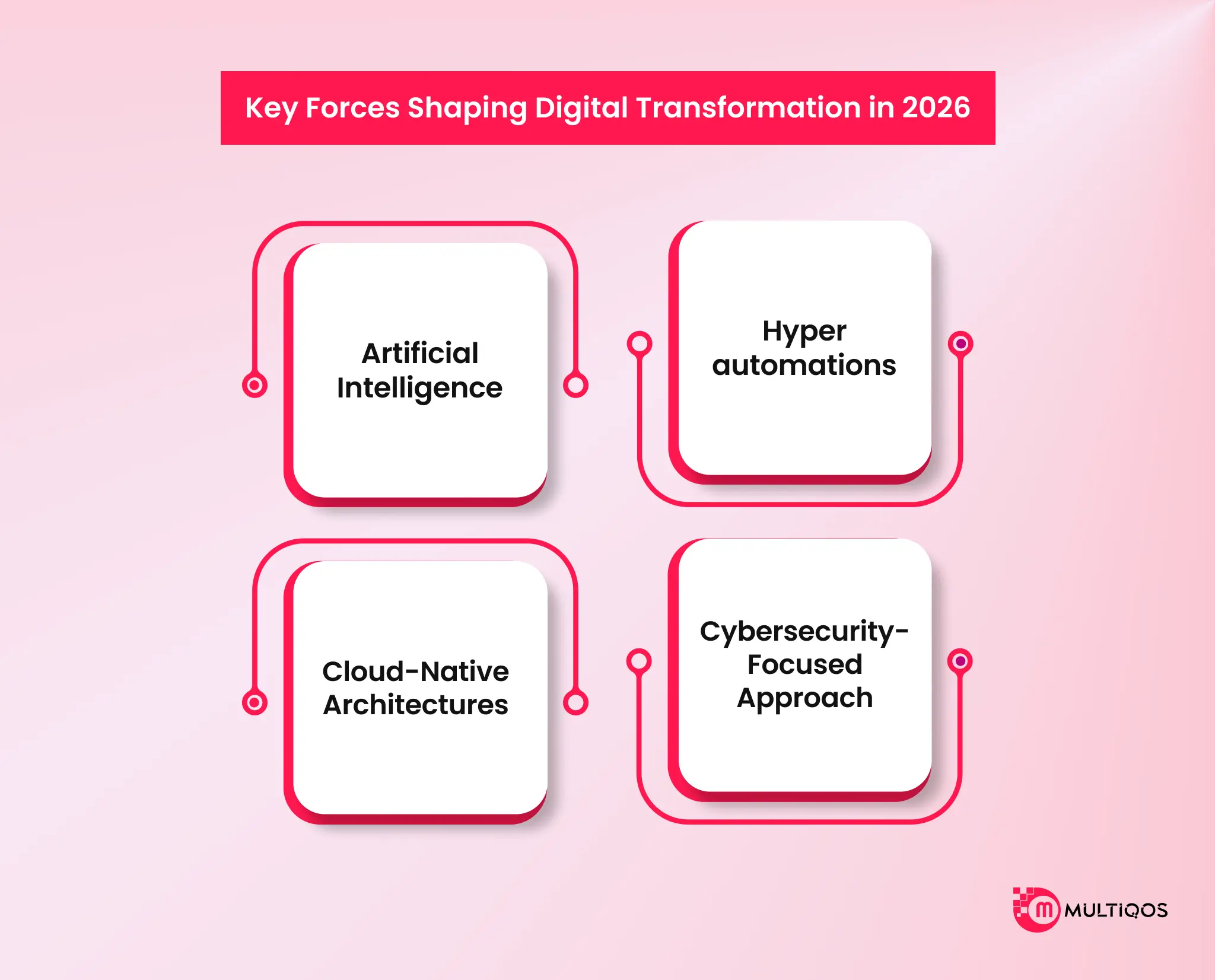
Artificial Intelligence
Organizations are embedding AI directly into their workflow to support decision-making. The accelerator of this shift is generative artificial intelligence. This enhances customer service and supports employee training.
Gartner states that by 2030, over 80% of organizations will use AI-native development platforms to build solutions with smaller, AI-augmented teams.
Hyperautomations
Earlier rule-based automation was heavily used. Traditional robotics process automation solutions were focused on completing tasks like data entry or report generation. The shift has transformed today from automation to hyperautomation. It is a strategic mixture of modern agentic capabilities and analytics with the RPA technology. This enables a system to interpret complex data and make decisions on its own.
Cloud-Native Architectures
Cloud adoption is one of the core elements of a successful digital transformation roadmap. However, the strategy has changed over time. The traditional “lift-and-shift” method is no longer the preferred long-term approach among mid-market enterprises. The focus today is on designing, building, and running applications that are specifically for the cloud.
This is because it combines microservices, containers, and orchestrations. These help improve the scalability, speed, and resilience of a solution.
Cybersecurity-Focused Approach
Security is essential and a core component of transformation. As a mid-market enterprise, you must implement cybersecurity best practices to stay secure against sophisticated AI threats.
You can also adopt a zero-trust architecture. This way, you can continuously verify every device, user, or network request. As a result, it will lower the risk of breaching.
Assessing Digital Maturity Before the Roadmap
You must assess and determine the current capabilities, weaknesses, and starting point while building a digital transformation roadmap. This is highly essential. Without it, the efforts revolve around new tech implementation rather than solving the operational gaps.
A digital maturity test helps you as an organization to understand what exactly you have to modernize first by overcoming the limitations. Key areas to check before implementing a transformation roadmap include:
Evaluating Tech Infrastructure
Most mid-market enterprises operate with a mix of legacy technologies, SaaS apps, and internally developed tools. Assessing this requires experience and expertise. An IT consulting service provider can be of great help.
The experts assess the current tech by performing an in-depth check to find the areas of improvement and help you prepare a better blueprint for your business. This way, you will have enough understanding of whether you should invest in adopting new technology or re-engineer the underlying issues.
Define Outcomes, KPIs, and Success Metrics
The best digital transformation initiatives must be tied to outcomes. These can be measured over time. You must consider questions like this:
- How will this improve operational efficiency?
- What specific business problems are we trying to solve?
- What baseline metrics exist today, and how will this be monitored later?
- How will AI integration contribute to measurable outcomes?
- What improvement targets are we really looking for?
These questions will help you outline a better digital transformation implementation roadmap.
Assessing Data Analytics
You must evaluate how actively you collect, manage, and analyze data. This assessment assists in improving the data flow by identifying opportunities for creating unified data platforms. Effective assessment will help you highlight the prevailing issues in the data pipeline and build related solutions, which further improve evidence-based insights.
Reviewing Digital Skills
Investing in technology adoption won’t drive complete transformation. It is partial unless you invest in reviewing and upskilling your employees to adapt to modern technologies. You can do this by building effective training programs that can fill the critical gaps.
Step-by-Step Digital Transformation Roadmap for 2026
Imprecise implementation can hinder the plans of a business towards successful digital transformation. The root cause may be unstructured efforts behind the process. This can lead to fragmented processes, digitizing inefficiency, and data silos.
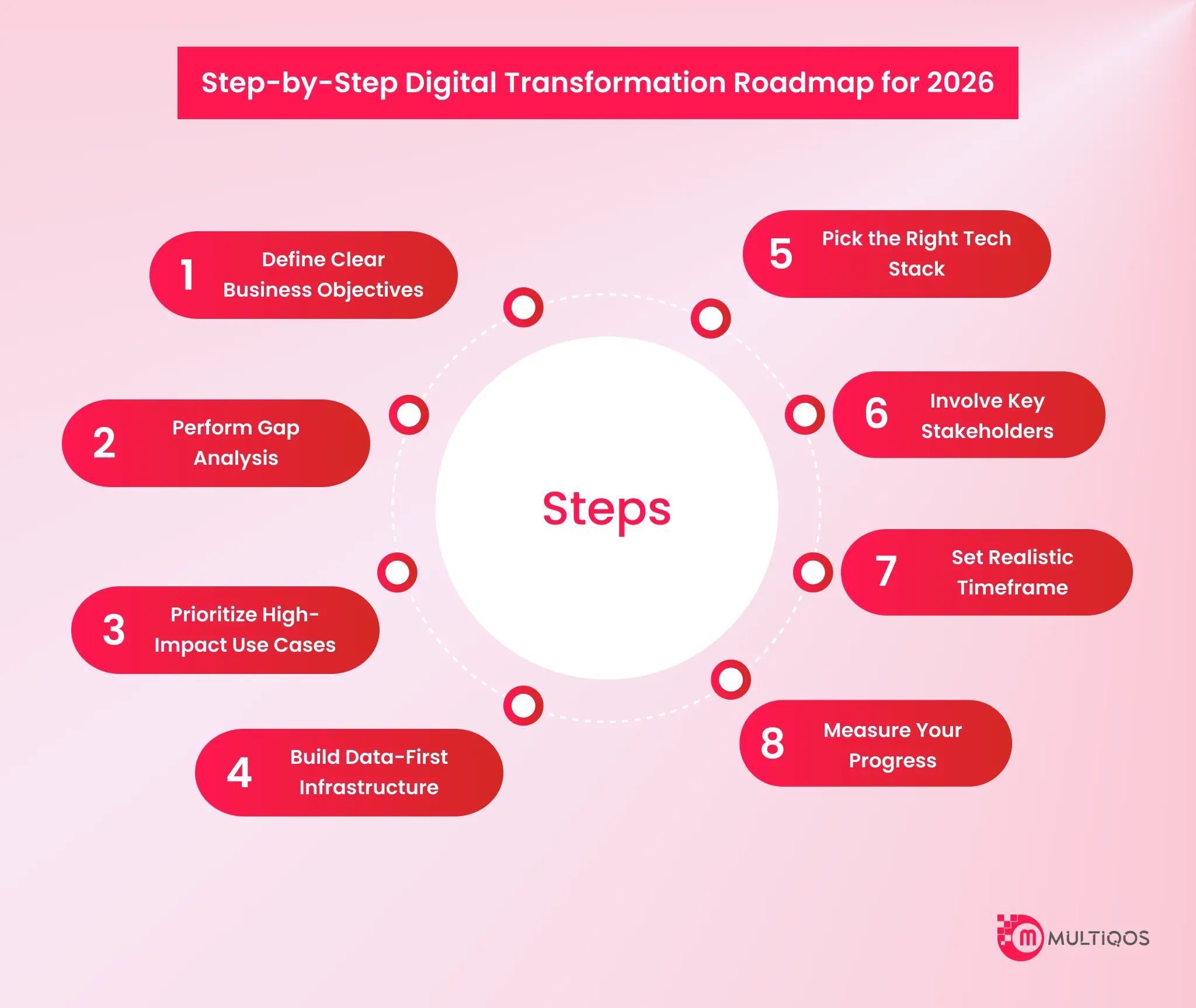
Thus, a successful organization always invests in quality digital transformation services to avoid these issues. Here is a blueprint that can help you in your efforts:
-
Define Clear Business Objectives
It is crucial to clearly identify and define your mid-market enterprise’s objectives before initiating transformation. This is because the precise determination of what you want to achieve through modernization is crucial.
Clearly defining your business objectives by highlighting questions and aspects like:
- How will transformation improve operational efficiency?
- How does it improve customer experience?
- Should you invest in data-driven insights?
- Launching/adding new digital services
Defining these goals early will help you prepare a better digital transformation journey roadmap.
-
Perform Gap Analysis
Now that you have defined your business objectives, the next step is to find the gap. You can do this by evaluating the capabilities of your current systems and processes. Write down the inefficiencies you find during the analysis. This will help you locate the what and why of the further steps.
-
Prioritize High-Impact Use Cases
Do not try to perform the transformation all at once. The gap analysis will let you identify the areas that need to be diagnosed first. This will deliver greater value in a shorter time. You can do this better by partnering with a skilled legacy modernization company. They will assist you more precisely in approaching this step.
-
Build Data-First Infrastructure
Data plays an important role for every organization. It works like a backbone. Modern-day transformation focuses on building data-first infrastructure. You can do this by integrating diverse data sources or modernizing data platforms to gain actionable insights. This will support informed and timely decision-making.
-
Pick the Right Tech Stack
Selecting the right technology is equally important as building a data-first infrastructure. You must ensure to choose the tech stack that helps you build adaptable and efficient solutions. The more business goals aligned your stack will be, the better the outcome.
If you opt to invest in modern technologies like machine learning, artificial intelligence, and cloud-native development, it is wise to consult with an AI development company. Their proper guidance will help you build systems that stay sustainable and growth-focused.
-
Involve Key Stakeholders
Onboard stakeholders that stay in line with your vision. This is an effort and time-consuming task that lets you find who those are and how you will communicate with them. You can do this by finding “change enthusiasts” across departments and tailoring your message accordingly.
-
Set Realistic Timeframe
A digital transformation strategy must have a realistic timeline. This can’t be delusional. Your initiatives should be implemented via phased modernization rather than a complete system overhaul at once. This approach helps you incorporate feedback, change the non-requires, and evaluate progress.
-
Measure Your Progress
Your digital transformation implementation plan must include the metrics and KPIs to measure the progress. You should track performance linked to the objectives of the transformation. Continuous monitoring allows you to bridge the gap between failed efforts and success.
Mistakes to Avoid While Building a Digital Transformation Roadmap
Transforming your age-old processes and redesigning your workflows can deliver significant benefits. But many projects lose momentum due to avoidable planning and mistakes in executing the digital transformation strategy.
To ensure your enterprise leverages the advantages, you must avoid certain mistakes that can hinder your objectives.
-
Technology-First Thinking
Prioritizing only technology as a goal to achieve in digital transformation is one of the biggest mistakes that major organizations commit. Since tech is a crucial enabler of this, aligning your business goals and outcomes with transformation is essential. Hence, your enterprise should begin with clear objectives and then identify technology that supports those goals.
-
No Proof-of-Concept
Avoid skipping proof-of-concept. It can be hazardous. No PoC means removal of the essential steps that confirm whether an idea is technically feasible.
For instance, you have implemented a technology on a large scale but have not tested it first. This opens the gate for various operational risks like workflow disruption or unexpected integration challenges.
This is where building a PoC is essential. It will help you convert costly, high-stakes guesswork into data-driven decisions.
-
Poor Change Management
Often, the initiative of being digital and staying aligned with the modern tools and tech fails. Data supports this, as over 70% of transformation efforts fail due to poor change management. Digital transformation is a complete approach towards modernization. Successful efforts are those that work on the tech + human synergy, which covers clear communication, employee training, and leadership support.
-
Unrealistic Timelines
Clarity is essential while setting the timelines. Setting something unrealistic can derail the entire project. This happens mainly when the transformation is not phased. This is where digital maturity assessment is crucial in setting up a realistic timeframe for transformation.

Build Your Digital Transformation Roadmap with MultiQos
A digital transformation roadmap is essential for a mid-market enterprise. This will help them move from a fragmented to a cohesive and agentic operating model. Success relies on moving toward a data-first and phased implementation that prioritizes autonomy.
However, building and executing the roadmap requires the right technical expertise, industry insights, and support. MultiQos brings years of experience and vetted professionals’ expertise to transform legacy systems into modern-day-focused solutions. We have successfully delivered over 700 projects with over 350 global clients.
Our team follows a structured process that covers:
- An in-depth assessment to identify modernization opportunities
- Then, we create a digital transformation journey roadmap that aligns tech investment with your business goals.
- We ensure a seamless implementation of the roadmap that prioritizes high-to-low impact use cases.
- As a top digital transformation service provider, our team ensures continuous optimization to match the market pace.
We work with a team of skilled developers who are highly experienced with modern technologies, architectures, and strategic implementation. Our team performs the transformation more precisely by aligning it with the objectives of your business. Experience top-grade expertise in transforming obsolete business systems with us.
FAQs
You must take it one step at a time. Focus on following change management, using data to make better decisions, and planning for growth. Remember, a successful strategy always allows you to use tech that supports your business goals.
You will update your current digital presence. The service providers will conduct an assessment of your current tech infrastructure and find operational gaps. This will help them build a strategy that prioritizes high-impact areas.
Well, every industry is gradually shifting its presence towards digital. But industries like Finance, Retail & eCommerce, Healthcare, Manufacturing (4.0), EdTech, and Energy are heavily impacted.
Yes. Netflix, Adobe, Domino’s, DBS Bank, IKEA, and more are businesses that have successfully adopted digital transformation.

Get In Touch
Get Stories in Your Inbox Thrice a Month.
Proven Legacy System Modernization Strategies for Digital Transformation
Digital Transformation Trends: 8 Ways Enterprises Are Being Reshaped
Top Must-Have Digital Transformation Tools for Business Growth in 2025