
Machine Learning in Finance: Use cases and Risk Assessment
Need quick insights? Summarize with AI & save time
 ChatGPT
 Perplexity
 Claude
 Google AI Mode
Table Of Content
- Introduction
- What Is Machine Learning in Finance?
- Key Use Cases of Machine Learning in Finance
- Understanding Risk Assessment in Finance
- 7 Ways Machine Learning in Finance is Transforming Risk Assessment
- Wrapping Up
- FAQs
Summary:
Machine learning is revolutionizing the field of finance by learning from transactions, prices, and customer actions to make predictions and automate decision-making in real-time. In this blog post, we will look at the meaning of machine learning in finance and some of the major use cases of machine learning in finance, which include fraud detection, algorithmic trading, credit scoring, risk management, portfolio optimization, and robo-advisors.
Machine learning (ML) changes risk assessment in finance by moving away from traditional, static models to future systems. To provide a more comprehensive approach to ML algorithmic risk, you can analyze large amounts of both structured and unstructured data.
Introduction
You are ahead of a quiet revolution in the financial world, and its driving force is machine learning. For decades, risk assessment depended on static models and historical data, which were slow to adapt to new threats. Today, with machine learning in finance, you move towards a dynamic future that stems from a reactive perspective.
By taking advantage of large amounts of data and advanced algorithms, you can identify patterns and deviations that would be beyond human analysis and traditional systems. This is not just an improvement; this is a whole new way to control risk.
According to a recent report, 85% of financial institutions globally have implemented AI to increase operations, with large applications in risk management, fraud detection, and regulatory compliance. This emphasizes the important role you can play in driving efficiency and innovation.
What Is Machine Learning in Finance?
Machine learning in finance refers to algorithms that can learn patterns in financial information to predict future events, make automated decisions, and gain insight without having to program each action. Machine learning is one form of artificial intelligence based on statistics and computational modeling. Machine learning algorithms learn from past information such as transactions, price levels, and customer behavior.
Unlike other forms of automation, machine learning improves itself continually as new information is received by the system. Financial firms implement machine learning in their business to help them prevent fraud, evaluate credit risks, develop effective trading tactics, and customize their services for clients.
Key Use Cases of Machine Learning in Finance
Machine learning has shifted from an experimental technology to one of the key operational tools in the financial industry. Financial organizations now use ML algorithms to process vast amounts of information in real-time—something that is impossible for old rule-based systems.
With machine learning, financial institutions are able to detect fraud within milliseconds, predict defaulting customers before the loan expiration date, and much more. Here are six of the most influential use cases of machine learning in finance.
1. Fraud Detection & Anti-Money Laundering
Machine learning algorithms detect abnormal behaviors in transactions in real time, which might suggest that some fraud or money laundering is being committed. Unlike conventional rule-based approaches, machine learning algorithms detect what kind of activities are usual for particular customers and update their models if the methods used by fraudsters change, and detect sophisticated schemes that would not be detected by other methods. This helps decrease the number of false alerts and increase the speed of investigation, as well as comply with AML regulations.
2. Algorithmic & High-Frequency Trading
In algorithmic trading, machine learning algorithms analyze past prices, sentiment from news articles, and various market indicators to identify trends and make trades in seconds. In particular, reinforcement learning algorithms are widely used in such cases because they allow a system to adjust its strategy based on the results of previous trades. Trading companies use these algorithms for high-frequency trading to profit from short-term price inefficiencies. Thus, decisions are made much faster and with less emotional involvement.
3. Credit Scoring & Loan Default Prediction
Traditional credit scoring relies on a narrow set of factors like credit history and income. Machine learning expands this by analyzing hundreds of variables—spending habits, transaction patterns, and alternative data sources—to more accurately predict a borrower’s likelihood of default. This allows lenders to make faster, fairer approval decisions and extend credit to applicants who might be overlooked by conventional scoring models. It also helps financial institutions proactively manage loan portfolios and reduce default-related losses.
4. Risk Management
Machine learning improves risk management through pattern recognition within large data sets that are not easily recognizable by people. Machine learning is capable of predicting the volatility of the market, simulating market scenarios on a portfolio, and detecting potential risks before they grow into larger problems. This approach proves useful in the case of credit risk, operational risk, and regulatory compliance. As machine learning constantly learns from new data, it helps organizations to react more quickly to changes in the market environment.
5. Portfolio Optimization
The machine learning approach assists investors and portfolio managers in crafting the perfect combination of risk and rewards in their portfolio allocations. Using past performance data, correlation of assets, and changing market dynamics, the ML algorithms can provide portfolio suggestions based on the investor’s objective and risk appetite.
These ML algorithms keep updating with the changing market dynamics in terms of new data, thereby making the portfolio allocation process dynamic in nature as compared to conventional static techniques.
6. Customer Behavior, Personalization & Robo-Advisors
Machine learning technology allows financial organizations to process customer data such as spending patterns, life events, and financial goals and provide them with customized product recommendations and financial advice accordingly. Through the application of machine learning algorithms, robo-advisers can construct investment portfolios for people according to their risk assessment and objectives without needing a financial adviser.
It helps make personalized financial advice cost-effective and available. Machine learning is also applied in banks to retain customers and design products according to their evolving requirements.
Understanding Risk Assessment in Finance
Finance includes the ability to evaluate financial losses in risk assessment and develop strategies to reduce risk. This is an important process for financial institutions, as it helps them make informed loans, investments, and manage their portfolio. From the customer’s credit history to macroeconomic indicators, economic analysts can create a comprehensive risk profile by analyzing a wide range of data points.
This process is quickly becoming sophisticated with the integration of machine learning into finance, which allows rapid analysis of giant datasets to identify significant patterns and predict the decline in the market with more accuracy than traditional methods.
An important component of modern risk assessment is the use of advanced analysis tools and models. Many financial companies are turning to machine learning development services to create customized algorithms that can automate parts of the risk analysis process. These services provide the competence to create models that not only consider current risks but are also compatible with changing market conditions.

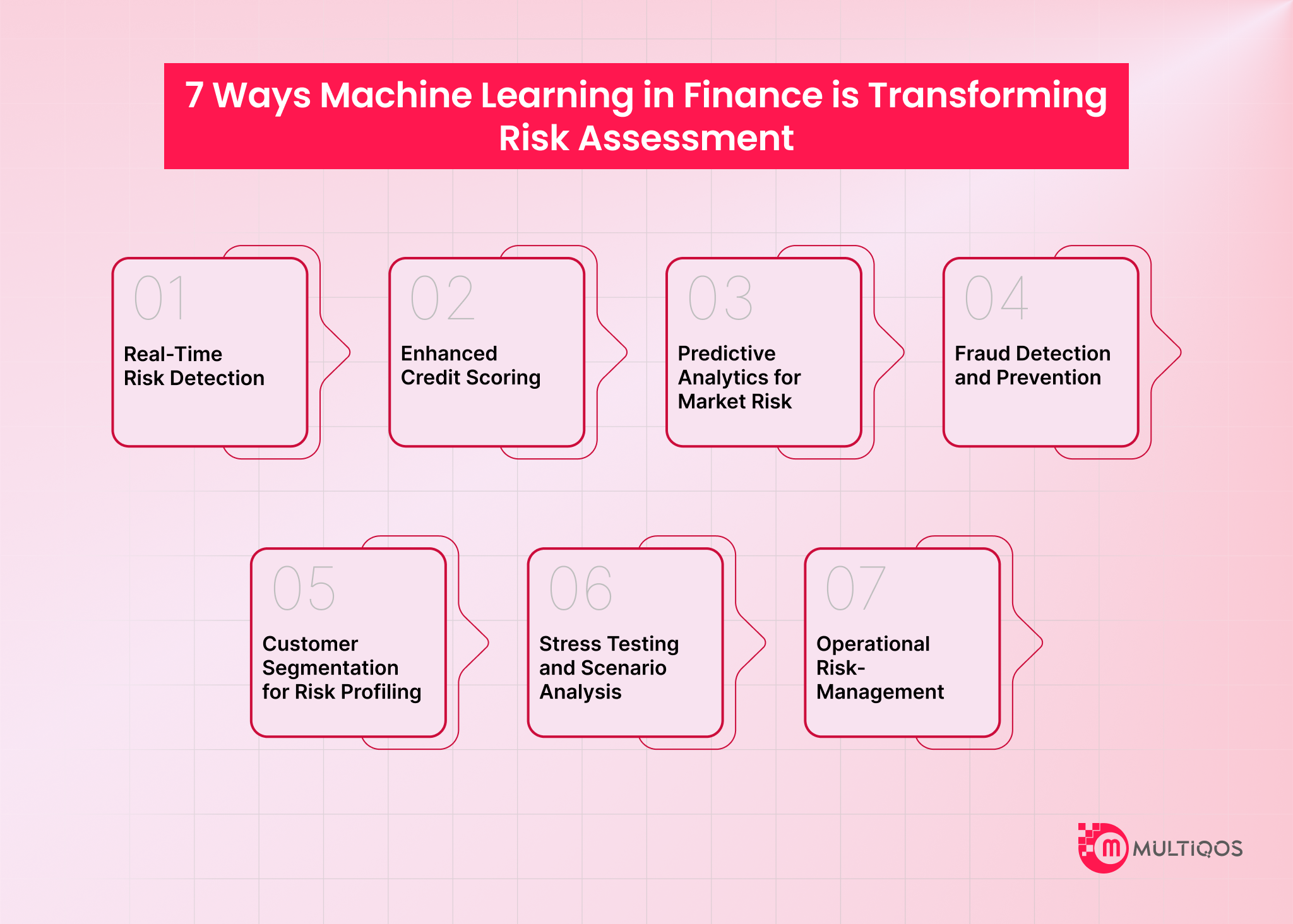
7 Ways Machine Learning in Finance is Transforming Risk Assessment
1. Real-Time Risk Detection
Traditional risk assessment often depends on historical, batch-developed data, which can delay the identification of new dangers. With machine learning in finance, financial institutions can analyze transactions and behavioral data as they occur. The algorithm can immediately flag anomalies, such as an unusual transaction location or a change in a user’s habits, allowing instant measures to prevent sudden changes, fraud, or other financial losses.
2. Enhanced Credit Scoring
Traditional credit scoring models are often based on a limited set of data, such as payment history and debt-to-income ratios. Machine learning in finance enables the use of “alternative data” sources, such as equipment payments, rental history, or even online purchasing behavior. By treating this wide dataset, the ML models can provide more nuanced and accurate credit assessments and help lenders serve a comprehensive population, including those with limited credit history.
3. Predictive Analytics for Market Risk
Market risk, which is the risk of loss in the investment portfolio due to market price movement, is a complex challenge. When it comes to machine learning in finance, it helps future analysis to analyze market data, news articles, and large amounts of financial reports. These Predictive Analytics models can identify subtle correlations and patterns that humans can remember, provide more accurate forecasts of potential market volatility, and help adapt portfolio strategies to reduce risk.
4. Fraud Detection and Prevention
Fraud detection is one of the most well-known applications of machine learning in finance. ML algorithms are trained on datasets with both fraudulent and legitimate transactions. They learn to identify scam patterns, from a single suspected transaction to complex, mutual scam networks. This capacity allows institutions not only to detect existing fraudulent schemes but also to adapt and prevent new ones.
5. Customer Segmentation for Risk Profiling
Machine learning in finance provides the opportunity for a more sophisticated customer division than before. Instead of grouping customers only by age or income, ML models can group them on the basis of their unique behavioral patterns, transaction history, and risk tolerance. It creates dynamic risk profiles that allow financial institutions to offer individual products and services by assessing and managing the risk associated with each customer correctly. Similar predictive techniques are also widely used in machine learning in sales to improve lead scoring, customer targeting, and revenue forecasting.
6. Stress Testing and Scenario Analysis
A stress test evaluates the flexibility for extreme but adverse events in a financial institution, such as an economic recession or a sudden market crash. Machine learning in finance improves this process by enabling the simulation of more complex and realistic scenarios. ML models can generate synthetic data, detect a large number of potential consequences, and provide a stronger and more comprehensive approach to the firm’s vulnerabilities and capital adequacy.
7. Operational Risk Management
Operational risk stems from internal process failures, people, and systems. It can analyze huge, unnecessary data sets such as e-mail for employees, internal logs, and financial reports to identify possible matching problems, system failures, or human errors before it lead to significant damage. This active approach helps to make financial companies more flexible and efficient in their operations.
Wrapping Up
The shift in machine learning is not just a technological upgrade; this is a fundamental change in how you see risk. Now you not only react to previous events, but also predict future events. This change requires not only new equipment, but also new talent. To fully use AIS power, you need a team that understands the complex algorithms and can translate data into action-rich strategies.
To remain competitive, consider a strategic initiative to hire machine learning developers and data researchers who can produce and distribute these advanced models. By investing in this expertise, you not only use a new technology; you create a more flexible, intelligent, and profitable future for your organization.
FAQs
Static rules are used to detect traditional fraud. In contrast, ML-based systems are used to detect anomalies to learn the user’s general behavior and to identify any significant deviation, use new and developed fraud to quickly develop a strategy.
Yes. ML analyzes large structured and unstructured data in real time, such as news articles and sentiment in social media. This helps identify important indicators of market change and predict potential shocks with greater speed and accuracy.
No. ML acts as a powerful tool to automate data analysis and generate future insights, but human expertise is still necessary. Analysts require analyses to explain the results, validate the model, and make nice decisions that require moral decisions.
The most important challenges are data quality and model clarity. The ML model requires that high-quality data is effective, and “Black Box” for some advanced models can be a problem for natural regulation, which often requires clarification.

Get In Touch

Get Stories in Your Inbox Thrice a Month.


A Comprehensive Guide on How Machine Learning is Transforming the Factory Floor

MultiQoS Technologies Named an OpenAI Select Partner