
What Is Green Software Development? A Beginner’s Guide
Need quick insights? Summarize with AI & save time
 ChatGPT
 Perplexity
 Claude
 Google AI Mode

- Introduction
- What is Green Software Development?
- How Software Development Contributes to Carbon Emissions
- Principles of Green Software Development
- What are the Benefits of Green Software Development?
- Best Practices for Green Software Development
- Conclusion
- FAQs
Summary:
Green software development is an emerging approach that emphasizes building software applications with sustainability in mind. This beginner’s guide breaks down the concept, explaining how developers and organizations can reduce the environmental impact of their digital products.
It explores the growing need for energy-efficient, carbon-conscious code due to the massive power consumption of data centers, cloud services, and digital infrastructure. Readers will learn the core principles of green software engineering, including energy efficiency, hardware optimization, and sustainable architecture design.
Whether you’re a student, a developer, or part of a forward-thinking tech company, this guide offers actionable insights to help you start your journey toward greener, more responsible software development.
Introduction
When our world becomes increasingly digital, the environmental impact of technology advances at a rapid pace. From large data centers to everyday mobile apps, software uses energy, and a carbon footprint comes with it, which we can no longer ignore. While permanent hardware and renewable energy sources have attracted attention, climate-wise innovation has a new selection: Green software development.
Green software development is a modern approach to creating digital solutions that are not only functional and effective but also environmentally friendly. Whether you are a first discovery or an experienced developer, it is important to understand this concept in today’s technical world.
What is Green Software Development?
Most people do not realize that the software we use every day has an impact on the environment. Green software development is about writing programs that work without wasting energy. It’s not just about cutting back on power—it’s about being smarter with how things run behind the scenes. Developers might clean up bulky code, avoid unnecessary processes, or pick hosting options that use less energy.
When a software development company focuses on this, they’re not just building apps—they’re thinking long term. It’s about helping businesses do things in a cleaner, more efficient way. You’re not sacrificing quality, just avoiding waste. In the end, it’s better for the planet, and probably better for your budget too.

How Software Development Contributes to Carbon Emissions
Although software seems weightless, it is not. Somewhere on a real server, every line of code that runs, every API call, and every file stored in the cloud uses electricity, and that electricity nearly always has a carbon cost.
Data Centers and Cloud Infrastructure
Applications run on servers located in data centers, which require continuous electricity for both computation and, crucially, cooling. The ICT sector contributes between 1.5% and 4% of global greenhouse gas emissions, which is equal to the aviation industry, according to research from the World Bank and the International Telecommunication Union.
Data center electricity demand has been increasing annually as more companies move workloads to the cloud and rely on AI-driven features, making infrastructure decisions one of a software development company’s most important levers has over its environmental footprint.
Inefficient Code and Resource Waste
Not every piece of code is made equally. Servers are forced to work harder than necessary due to inefficient algorithms, needless loops, memory leaks, and duplicated background activities. Small inefficiencies add up to a substantial quantity of energy lost at scale, over millions of users. Additionally, bloated apps frequently require more power from user devices, which reduces battery life and raises the frequency of hardware upgrades.
Data Transfer and Network Load
Every request sent over the internet consumes energy, from the user’s device through the network to the server and back. Uncompressed images, unnecessary API calls, oversized payloads, and auto-loading media all add up to heavier network traffic, and heavier traffic means more energy drawn across the entire chain of routers, base stations, and switches that make up the internet’s backbone.
Hardware Manufacturing and Device Lifecycle
The production of a gadget accounts for a significant portion of its overall emissions rather than its use. Mining raw minerals, fabricating semiconductors, and international transportation are all energy-intensive processes in the production of smartphones, laptops, and servers. Software that is developed without consideration for outdated or subpar hardware subtly encourages users and organizations to update more frequently, contributing to electronic waste and embodied emissions that are never visible in a company’s direct energy bill.
Development and Testing Pipelines
Production settings are not the only source of emissions. Staging environments, automated testing suites, local development setups, and pipelines for continuous integration and deployment all use electricity, frequently and continuously. Because it occurs behind the scenes, long before an application reaches a single end user, teams that keep environments running idle or execute complete test suites for small changes contribute an operational cost that is simple to ignore.
When taken as a whole, these five components show that software carbon emissions build up across infrastructure, code, data, hardware, and process rather than being the product of a single bad decision. Because of this, green software development treats sustainability as a design philosophy from the outset rather than considering it as an afterthought grafted on after launch.
Principles of Green Software Development
Green software development focuses on reducing the environmental impact of software. It’s not just about pure code – it’s all about making smart decisions at all stages. Here are some of the most important principles that govern this approach:
- Carbon efficiency: This means building software that produces minimal carbon emissions. Developers consider where and how the code runs, and when it is possible to choose platforms and cloud areas operated by cleaner energy sources.
- Energy Efficiency: The software should use the minimum amount of energy required to do its work. That means optimizing algorithms, reducing background tasks, and avoiding features that burn through unnecessary power.
- Carbon Awareness: Being carbon-aware is about understanding the effect of our digital decisions. Developers and teams need to think about how design options affect emissions and trade off against the stability of the mind.
- Hardware Efficiency: Good software goes well on existing hardware without pushing it to its limits. If an app is forcing users to upgrade only devices, it is not hardware-educated. The goal is to create devices that work evenly in a series of systems.
- Demand Shaping: This means adjusting how and when software is used. For example, encouraging users to run updates during off-peak hours or to move the treatment at a time when the energy cleaner helps with low emissions.
- Networking Efficiency: More data is transferred to the Internet, and more energy is used. Green development is looking for ways to reduce data transfer, such as compressing files, proper payment, or limiting unnecessary network calls.
- Data Efficiency: Storage and processing of data takes energy. The purpose of the developers is to only use the data that is really necessary, clean the old or unused files, and avoid collecting excessive information. Smart data use means the use of low energy.

What are the Benefits of Green Software Development?
Green software development is a great approach that is focused on creating energy-efficient, environment-friendly, and sustainable software development solutions. Below are the biggest benefits of developing green software:
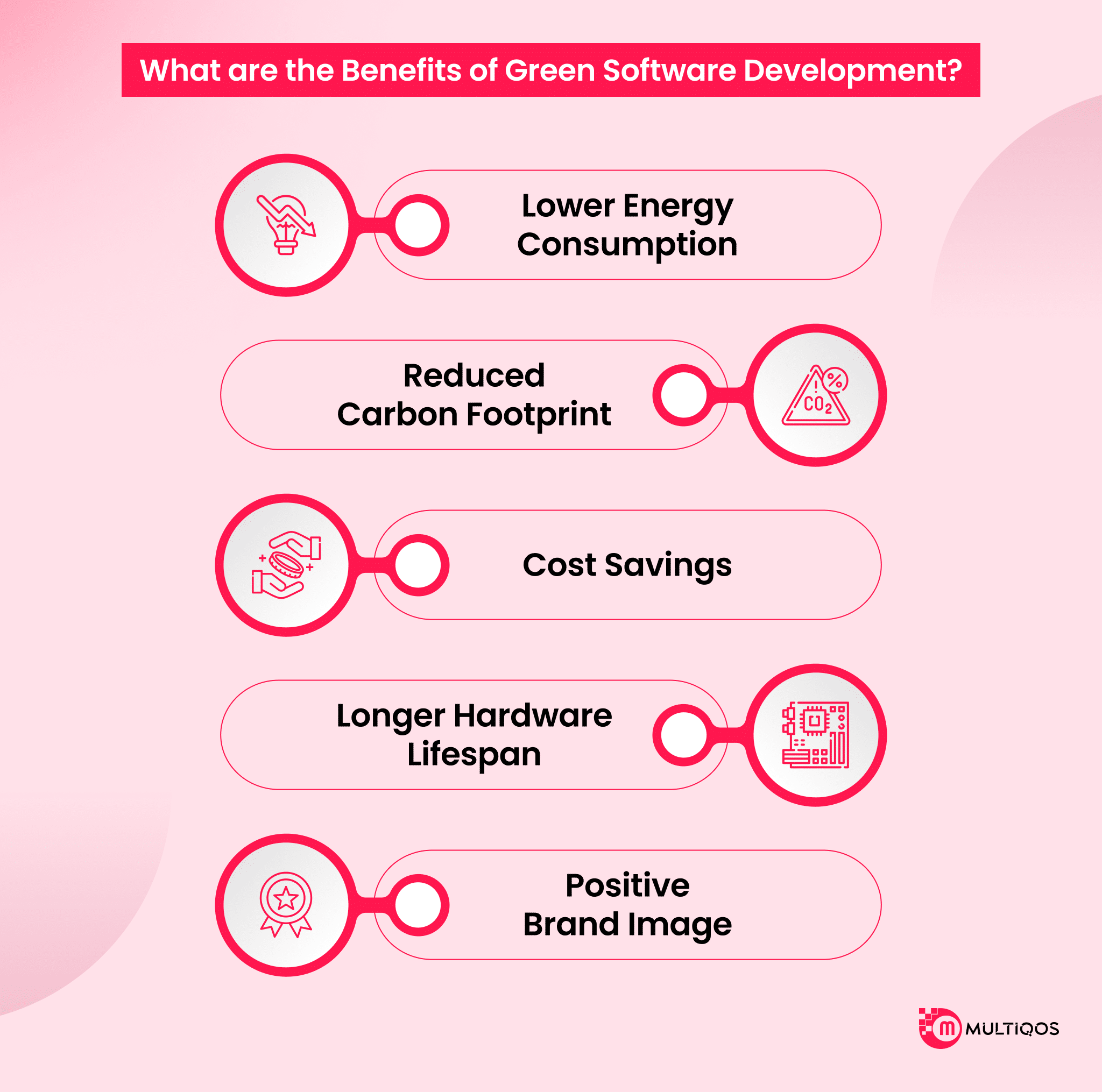
1. Lower Energy Consumption
Green software development emphasizes ongoing software that requires low processing power and memory. Lightweight apps, optimized infrastructure, and effective algorithms eliminate the demand for energy consumption for tools and data centers, which can lead to more sustainable operation.
2. Reduced Carbon Footprint
When the utilization of energy consumption is reduced and you’re adopting environment-friendly practices, green software development can surely help mitigate carbon emissions that are highly related to software development. This deficiency is particularly notable in the system and the Cloud Computing environment, where resource utilization is crucial.
3. Cost Savings
Energy-capable software directly reduces the needs of low-use and low-infrastructure bills. Green software development can also reduce the need for hardware upgrades over time, which saves organizations significantly and reduces operating expenses.
4. Longer Hardware Lifespan
Effective software has less stress on hardware components, reducing wear and tear. Consequently, devices can work effectively for a long time, reduce electronic waste, and cut replacement costs.
5. Positive Brand Image
Adopting green software development indirectly reflects the company’s commitment to environmental responsibility. It strengthens the reputation of the brand, supports compliance with stability regulations and standards, and attracts conscious customers about the environment.
Best Practices for Green Software Development
Green software development is about designing software solutions that are both very effective and environmentally sustainable. This encourages developers to use energy-conscious habits that reduce resource consumption without compromising functionality. Below are the best practices that help create Green software development:
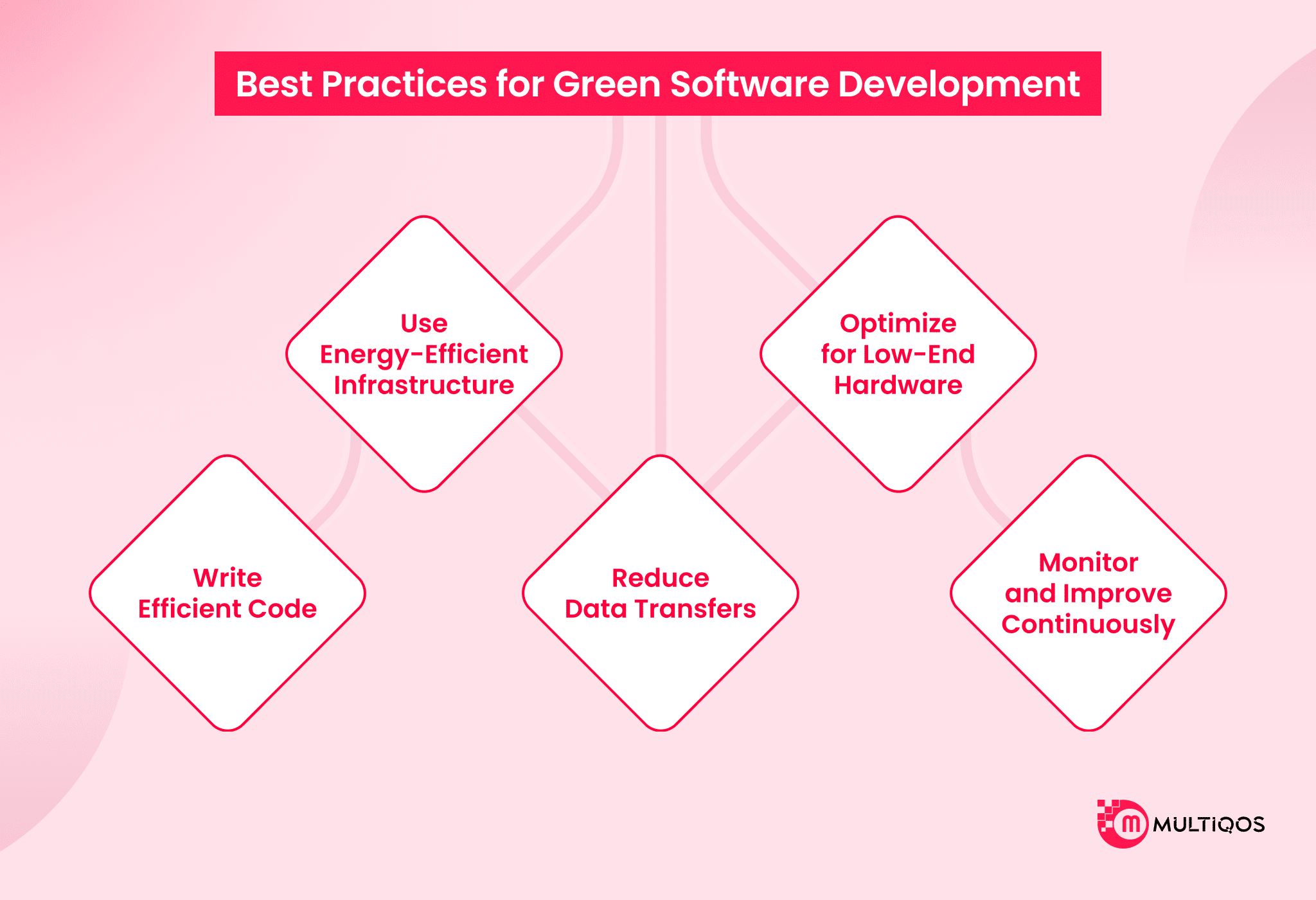
1. Write Efficient Code
One of the main principles for Green software development is to write clean, customized code. If the algorithms are effective and reliable, they use less CPU and memory, which can eliminate energy consumption. Developers should not consider unnecessary loops, memory-intensive operations, and redundant computations. Also, make sure that the code that moves quickly and requires low resources can lead to reduced environmental effects.
2. Use Energy-Efficient Infrastructure
Make sure to choose a reliable and effective infrastructure when it comes to sustainable software development. Cloud suppliers might be dependent on renewable energy sources and provide carbon-neutral services that are a perfect fit when aligned with goals for green software development. Distributing applications on an efficient server or server-free architecture can cut a lot on power consumption.
3. Reduce Data Transfers
Transferring a massive amount of data requires significant energy. Green software encourages the development of files to reduce the data movement by compressing files, using payment strategies, and locally processing data whenever possible. Reducing API calls, reducing HTTP requests, and limiting background data also contribute to energy savings.
4. Optimize for Low-End Hardware
The design software that runs well on a low-speed unit helps reduce electronic waste and increase the safety of chronic hardware. As we all know, green software growth promotes high convenience and light apps that perform well on a wide range of equipment and allow users to delay unnecessary upgrades and reduce their general environmental impact.
5. Monitor and Improve Continuously
As organizations scale software delivery, AI workflow orchestration can help automate monitoring, optimize resource utilization, and reduce inefficiencies across development pipelines, supporting long-term sustainability goals.
Conclusion
Green software development is more than just a trend-it is a responsible, forward-looking approach that is for construction technology that corresponds to global stability goals. Developers can play an important role in reducing their digital carbon footprint by focusing on energy efficiency, reducing resource consumption, and using environmentally friendly practices.
Companies that prefer stability not only contribute to a better future, but also get a competitive management in a quick marketplace.If you want to integrate stability into your technical initiatives, it is necessary to hire software developers who understand the green development practice and give them. The right team can help you create scalable, talented, and environmentally responsible digital solutions.
FAQs
Honestly, it’s easy to forget that the internet runs on real machines. All the cloud stuff? It’s physical somewhere. Servers, data centers—they eat up a ton of electricity. And that power? Not always clean. So yeah, making software that uses fewer resources? It actually helps. It’s not just about saving money—it’s about not frying the planet.
It’s just about not being wasteful. Think of it like this: If you can write something that gets the job done without being a resource hog, why wouldn’t you? Use what’s needed. Cut the fluff. That’s it.
Best advice? Keep things simple. Avoid bloated libraries. Don’t run background stuff if no one’s using it. Clean up your code. Choose tools that don’t drain performance. And yeah, maybe host your app with a company that uses renewable energy. All of it adds up.
Sure. Some tools let you see how much energy your code uses. Others flag inefficient bits. But honestly, half the time you can tell just by looking. If your app feels heavy or slow, it probably is.
Upfront? Maybe a little—if you count your time. Long term? Probably not. Better code runs faster, uses less energy, and crashes less. That saves money. Plus, people actually like using things that don’t lag and stay ahead of the competition.

Get In Touch

Get Stories in Your Inbox Thrice a Month.

Rethinking Software Delivery through AI Workflow Orchestration: The New Engineering Playbook
Managing Distributed Development Teams: Strategies to Improve Collaboration

Tips for Smooth Software Development in Regulated Industries