
AI Chatbot Development Cost in 2026: Build vs. Buy, Phases, and Industry-Wise Pricing
Need quick insights? Summarize with AI & save time
 ChatGPT
 Perplexity
 Claude
 Google AI Mode
Table of Content
- What Drives AI Chatbot Development Cost? The Six Factors That Decide Your Budget
- Build vs. Buy AI Chatbot: The Real Decision Frame
- AI Chatbot Development Cost Breakdown by Phase
- GPT-Based vs. Proprietary vs. Hybrid Chatbots: Architecture Cost Comparison
- Industry-Wise AI Chatbot Types and Pricing: What Your Vertical Actually Costs
- The Hidden Costs of AI Chatbot Development: No Proposal Shows You
- The Decision-Grade Cost Framework for Enterprise AI Chatbot Programs
- FAQs
Summary:
Budgets for enterprise AI chatbots almost always fail to live up to expectations because of the technology; they actually fail because of a lack of understanding of the Total Cost of Ownership (TCO). This detailed guide breaks down the actual AI Chatbot Development cost in 2026, going beyond the initial vendor estimate.
We dive into the critical Build vs. Buy decision fact pattern, uncover the 6 hidden cost drivers of using LLM’s from usage to HIPAA compliance, and deliver accurate industry-specific pricing models for FinTech, Healthcare, Retail, and SaaS. Learn how to prevent year-two billing shocks, avoid expensive integration times, and create a scalable, ROI-generating conversational AI solution.
Budgets for enterprise chatbots don’t fail because the technology is misunderstood; they fail because teams don’t crunch the numbers. The issue is simple but challenging: no one crunches the numbers.
This $2,000/month SaaS fee is not going to remain at that price forever. Add on top token overages, platform migration costs, and premium compliance tiers, and your $24K annual subscription quickly becomes a TCO of more than half a million dollars.
When the discovery process moves too quickly, the number of integrations is reduced, and compliance is only seen at the end of the project.
The global revenue of the chatbots market is expected to grow at a CAGR of 19.6% and will reach $41.2 billion at the end of 2033. Those numbers are not a fabrication, but what this number does not show you is how volatile the underlying price range could be, depending on the industry, solution architecture, and compliance efforts taken by the team in scoping.
This post provides a cost analysis of an enterprise chatbot. This guide explores four aspects: what factors drive the price range, whether you should build from scratch or procure, what the real costs are in each stage of the development process, and how the industry affects pricing.
What Drives AI Chatbot Development Cost? The Six Factors That Decide Your Budget
Budgets usually go south due to a common misunderstanding that teams think of chatbot creation as a software project. However, it is more than just software development. Six key cost drivers operate in parallel during the process. Underestimate any of them and your second year results in budget surprises, invalidating the whole project ROI.
| Cost Driver | What It Controls | Cost Implication |
|---|---|---|
| LLM Choice | GPT-5.5 vs. Claude Sonnet vs. Llama 4 | Order-of-magnitude difference in token costs |
| Integration Scope | CRM, ticketing, ERP, identity, telephony | Each system adds 4 to 8 weeks of engineering |
| Compliance Posture | HIPAA, PCI-DSS, EU AI Act | Dedicated hosting adds $2K to $4K/month minimum |
| Conversation Complexity | Intent count, fallback depth, multi-turn | Drives design and QA spend significantly |
| Volume Profile | Conversations per month | Token and infra cost variability at scale |
| Maintenance Posture | Annual retraining, observability, HITL | 15 to 20% of the build cost per year, ongoing |
Driver 1: LLM Choice Determines Your Entire Cost Structure
The cost of using GPT-5.5 is $5 per million input tokens and $30 per million output tokens. Gemini 3.5 Flash comes in at $0.15 per million input tokens and $0.60 per million output tokens. If the production workload is the same- a million conversations are processed a month with 1,500 tokens in each conversation- it would cost $375,000 per year with GPT-5.5 and about $11,250 per year with Gemini 3.5 Flash.
Driver 2: Integration Scope Is Where “Quick Build” Estimates Collapse
A chatbot disconnected from your CRM and ticketing system is an expensive FAQ page. Connecting to Salesforce, Zendesk, and Okta typically runs 12 to 16 weeks of backend engineering. Add a legacy ERP on a proprietary API, and that extends by six weeks minimum, at least.
Driver 3: Compliance Adds Fixed Cost Before a Single Conversation Runs
HIPAA requires a BAA with your hosting provider, encrypted data at rest and in transit, audit logging, and dedicated compute. That’s $2,000 to $4,000 per month before deployment. Teams skipping compliance scoping in discovery consistently run 40 to 60% over original estimates.
Drivers 4 to 6: The Costs Nobody Puts in the Sales Deck
A 50-intent chatbot takes four weeks to design. A 200-intent enterprise assistant with escalation paths and multi-channel consistency takes twelve. Whereas auto-scaling infrastructure becomes necessary in case of volume spikes or the system would degrade, most proposals don’t even have to consider this FinOps challenge.
Maintenance costs are 15-20% of the original build costs annually, including annual retraining, hallucination monitoring, and human-in-the-loop operations. That line item rarely appears in vendor proposals. It always appears in year-two invoices.
Build vs. Buy AI Chatbot: The Real Decision Frame
Build vs. Buy isn’t a cost question. It’s a control, compliance, and differentiation question. Wrong call costs 18 months of correction.
| Criterion | SaaS Wins | Custom Wins | Hybrid Wins |
|---|---|---|---|
| Time to deployment | 4 to 8 weeks | 16 to 24 weeks | 8 to 14 weeks (SaaS core + custom layer) |
| Compliance posture | Low-medium (shared infra) | High (dedicated, auditable) | Configurable by workload |
| Domain depth | Generic Q&A | Deep workflow embedding | Tier-1 SaaS + custom RAG |
| IP ownership | None | Full | Partial |
| Cost structure | Predictable subscription | Higher upfront, lower scale cost | Blended |
| Integration flexibility | Connector-limited | Unlimited | SaaS connectors + custom APIs |
| Vendor risk | High lock-in | None | Reduced |
| Scalability | Platform-capped | Architecture-dependent | Modular scale |
SaaS Wins When Speed Beats Differentiation
No compliance mandate. No appetite for 18-month engineering projects. Predictable Q&A volumes. That’s SaaS territory. A $50,000/year platform like Intercom or Freshchat, deployed in six weeks, generating 40% ticket deflection across 10,000 monthly tickets, pays back in under six months. The ceiling is real, though: you own nothing, differentiate on nothing, and sit entirely at the mercy of platform roadmap decisions.
Custom Wins in Regulated Industries
No SaaS platform gives banking, healthcare, or insurance teams the compliance posture their regulators require. A KYC chatbot accessing core banking APIs with custom fraud rules and full interaction logging cannot run on shared infrastructure. Healthcare triage bots accessing Epic or Cerner under a BAA face the same wall. For these teams, custom isn’t a preference. It’s the only option that clears legal review.
Hybrid Wins Most Often
Roughly 70% of enterprise chatbots built in 2026 run hybrid. The logic holds up: buy SaaS for routine tier-1 interactions, build custom for the workflows that drive differentiation. Common stack: SaaS for support deflection, custom RAG pipeline for proprietary product Q&A, Copilot Studio agents for internal automation. Live in 8 to 14 weeks. Full control where it matters.
Organizations making this decision in 2026 will also need to consider how any of the trends of digital transformation are impacting the economics behind build vs. buy. Most enterprise buyers are unaware that the build time for custom infrastructure is being reduced with the help of AI-native infrastructure and pre-built compliance modules.
AI Chatbot Development Cost Breakdown by Phase
Most AI projects don’t run over budget because of model development. They run over budget because of AI integration. And the costliest phase is often the one missing from the proposal entirely: discovery.
| Phase | Duration | Cost Range | % of Total Budget | Key Deliverable |
|---|---|---|---|---|
| Phase 1: Discovery & Planning | 1 to 2 weeks | $3K to $10K | 10 to 15% | Intent map, integration list, governance plan |
| Phase 2: Conversation & UX Design | 2 to 4 weeks | $5K to $15K | 10 to 20% | Dialogue flows, fallback paths, persona design |
| Phase 3: AI/NLP Model Development | 4 to 6 weeks | $15K to $40K | 25 to 35% | LLM selection, RAG pipeline, prompt templates |
| Phase 4: Backend & Systems Integration | 4 to 8 weeks | $20K to $50K | 20 to 30% | CRM, ERP, ticketing, identity, payment hooks |
| Phase 5: Testing, QA, Red-Teaming | 2 to 4 weeks | $5K to $15K | 10 to 15% | Hallucination QA, prompt injection testing |
| Phase 6: Deployment & MLOps | Ongoing | $2K+ per month | Ongoing operational cost | Monitoring, retraining pipeline, A/B harness |
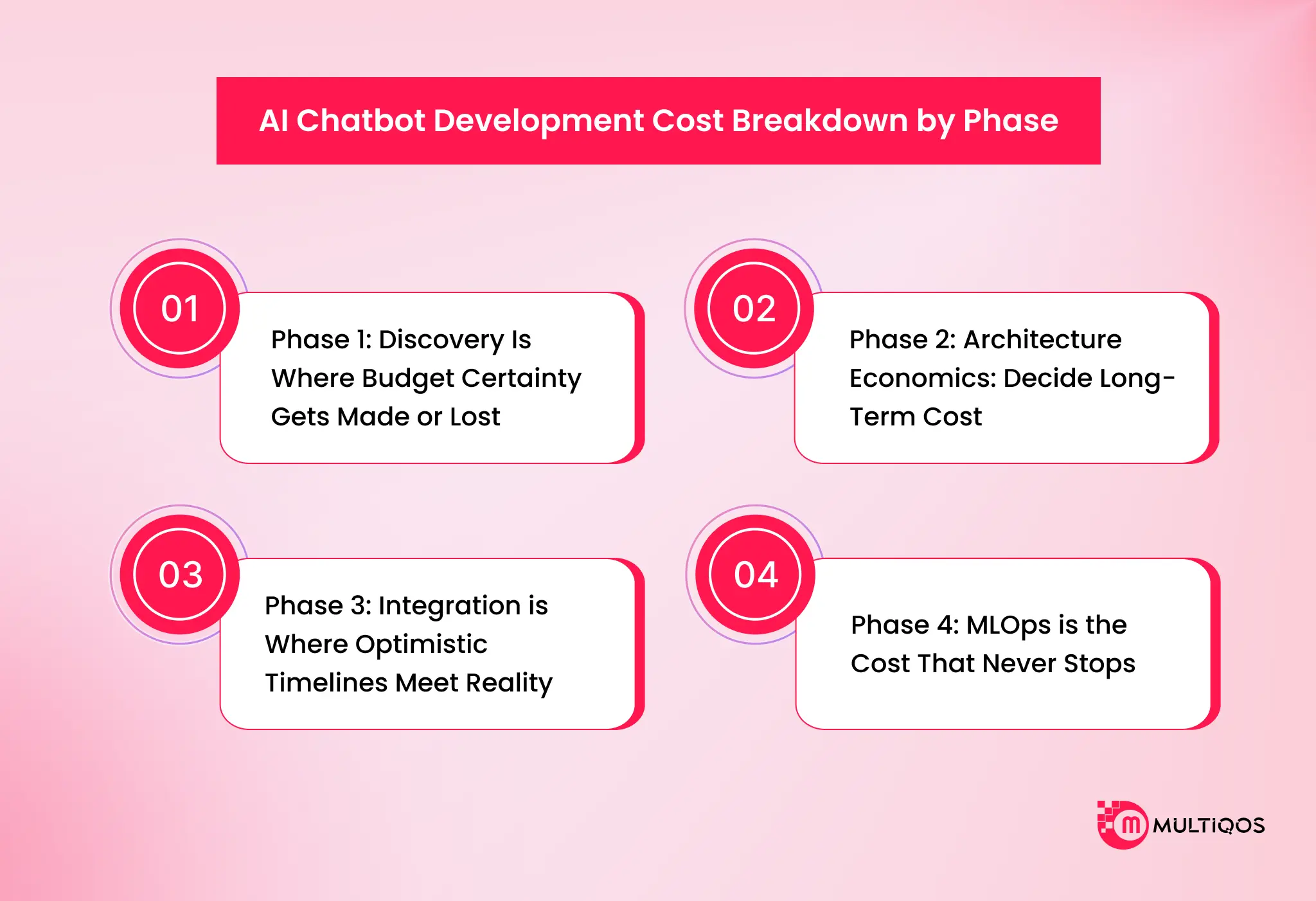
Phase 1: Discovery Is Where Budget Certainty Gets Made or Lost
A defined discovery cuts mid-project change orders by 60 to 80%. The number of integration surprises and gaps discovered in week ten will be five to ten times as many as were discovered in week one. The cost of addressing integration surprises and gaps identified in week ten will be five to ten times as expensive as in week one.
Discovery deliverables for the AI development project are a prioritized list of use cases, an intent map, a list of all data dependencies for integration, a data handling governance plan, an audit plan, and an escalation plan.
Phase 2: Architecture Economics: Decide Long-Term Cost
The RAG vs. fine-tune decision here determines maintenance cost for the system’s lifetime. RAG pipelines build faster, update more cheaply when knowledge bases change, and explain more cleanly to compliance teams.
When the knowledge domain changes, fine-tuned models will still be cheaper per token if they are used at scale, but will need to be fully retrained at $8,000 – $20,000 per cycle. By 2026, most enterprise teams will begin with RAG to reach fine-tuning only when retrieval quality is at its maximum.
Phase 3: Integration is Where Optimistic Timelines Meet Reality
A Salesforce API connector is a different project from embedding into a 15-year-old core banking system through custom middleware. Legacy APIs are underdocumented, rate-limited, and defended by security teams requiring six weeks of review before approving new service connections. Budget for the upper end of four to eight weeks if you’re touching ERP systems, legacy telephony, or on-premise identity infrastructure.
Phase 4: MLOps is the Cost That Never Stops
The language patterns of the conversation and the product catalog change, and this impacts conversion rates. The monthly MLOps cost depends on the volume, retraining frequency, and observability depth, and ranges from $2000 to $8000 per month, calculated based on the assessment done in a Google Study. The typical scenario of teams that take a reactive approach to MLOps usually results in a complete rebuild in 18 months or less.
GPT-Based vs. Proprietary vs. Hybrid Chatbots: Architecture Cost Comparison
Architecture choice creates order-of-magnitude cost differences that compound over three years. The decision made in week two of your project determines your operating economics at scale. Here is the comparison that most vendor proposals avoid showing you.
| Architecture | Build Cost | Per-Conversation Cost (at 100K/month) | Annual Infra Cost | Best For |
|---|---|---|---|---|
| GPT-5.5 (OpenAI API) | $300K–$400K | $0.025–$0.035 per conversation | $300K–$400K in token costs alone | Low-to-mid volume, rapid deployment |
| GPT-5.4-mini | $25K–$75K | $0.002–$0.006 | $25K–$75K in token costs alone | High volume, cost-sensitive workloads |
| Gemini 3.5 Flash | $35K–$100K | $0.001–$0.003 per conversation | $10K–$35K in token costs alone | Maximum token efficiency at scale |
| Self-hosted Llama 4 | $80K to $200K | $0.004 to $0.012 per conversation | $24K to $48K GPU hosting | Air-gapped, compliance-mandated environments |
| Hybrid (SaaS + custom RAG) | $60K to $150K | $0.02 to $0.08 blended | $15K to $35K blended | Most enterprise programs in 2026 |
Prompt caching changes the token math entirely. Across OpenAI, Anthropic, and Google APIs, cached prefixes run 50 to 90% cheaper than fresh token requests. For high-volume support workloads, that gap is the difference between a viable cost model and one that breaks at scale.
Hybrid architecture dominates roughly 70% of enterprise chatbot builds in 2026 for exactly this reason. Tier-1 traffic moves through cost-efficient SaaS. The proprietary model infrastructure handles workflows that need differentiation or compliance isolation. Neither layer carries costs it shouldn’t.
Teams connecting modern API architecture to legacy backends should account for one more variable: that combination creates integration debt. It shows up in Phase 4 and Phase 6 budgets, usually after the original estimate is already locked. How you handle legacy system modernization upstream determines how much of that debt you’re carrying into deployment.
Industry-Wise AI Chatbot Types and Pricing: What Your Vertical Actually Costs
Every industry has a different cost floor. Compliance requirements, system integration depth, and regulatory audit overhead create cost variations that make cross-industry comparisons meaningless without context. Here is the breakdown by vertical.
| Industry | Primary Use Cases | Typical Build Cost | Key Cost Drivers | ROI Window |
|---|---|---|---|---|
| FinTech / Banking | KYC bot, fraud triage, lending Q&A, agent assist | $200K to $1M+ | PCI-DSS, KYC, core banking integration, fraud rules | 12 to 18 months |
| Insurance | FNOL claims bot, policy Q&A, broker assist | $150K to $600K | ACORD, claims systems, underwriting rules, document AI | 9 to 15 months |
| Healthcare | Triage bot, EHR query, scheduling, patient Q&A | $40K to $350K | HIPAA, Epic/Cerner, HL7/FHIR, BAA scope | 12 to 18 months |
| Retail / eCommerce | Order status, product Q&A, returns, recommendations | $50K to $150K | Catalog scale, payment, shipping carriers, CRM | 6 to 12 months |
| Logistics / Supply Chain | Shipment tracking, exception handling, and carrier agent | $60K to $200K | TMS/WMS integration, multi-carrier APIs, EDI | 9 to 14 months |
| SaaS / B2B Tech | In-product onboarding, support deflection, sales assist | $40K to $180K | Product API depth, knowledge base size, and role-based context | 6 to 10 months |
FinTech: Most Expensive Category for a Reason
Banking chatbots aren’t chatbots. They’re compliance-governed, audit-logged, fraud-aware conversational systems with a chat interface. A KYC bot accessing core banking APIs with real-time fraud rules and full interaction logging requires dedicated hosting and integration with systems never designed for API access.
Build costs run $200,000 to $1M+. Compliance overhead adds $40,000 to $80,000 annually in hosting, auditing, and monitoring.
Healthcare: HIPAA Hosting Is the Cost Most Teams Miss
Compliance tax begins at the start of the first line of code. HIPAA mandates signing a Business Associate Agreement (BAA) with any vendor that handles PHI, end-to-end encrypted communications, and access logging. Currently, the monthly hosting costs are $2000 to $4000/month before deployment.
It takes 6-10 weeks to integrate Epic or Cerner via HL7/FHIR. The range of build costs ($40,000 to $350,000) is between a scheduling bot and a complete triage assistant. ROI assumes that there are 3,000 to 5,000 patient interactions per month.
Retail and SaaS: Fastest Payback in the Market
Use cases are well-defined, data is accessible, and volume is high. A retail order-status bot handling 10,000 monthly inquiries previously requiring human agents represents $60,000 to $120,000 in annual labor cost avoidance.
At a $50,000 to $150,000 build cost, payback lands in six to twelve months. SaaS onboarding bots reducing time-to-value in the first 90 days generate ROI that compounds across customer lifetime, not just the implementation window.
The Hidden Costs of AI Chatbot Development: No Proposal Shows You
Here are some of the hidden AI chatbot development costs that help you understand the real TCO. All enterprise chatbots come with two prices: One from the vendor and one from your production in years two and three. Many budgets tend to go over budget because of four hidden categories.
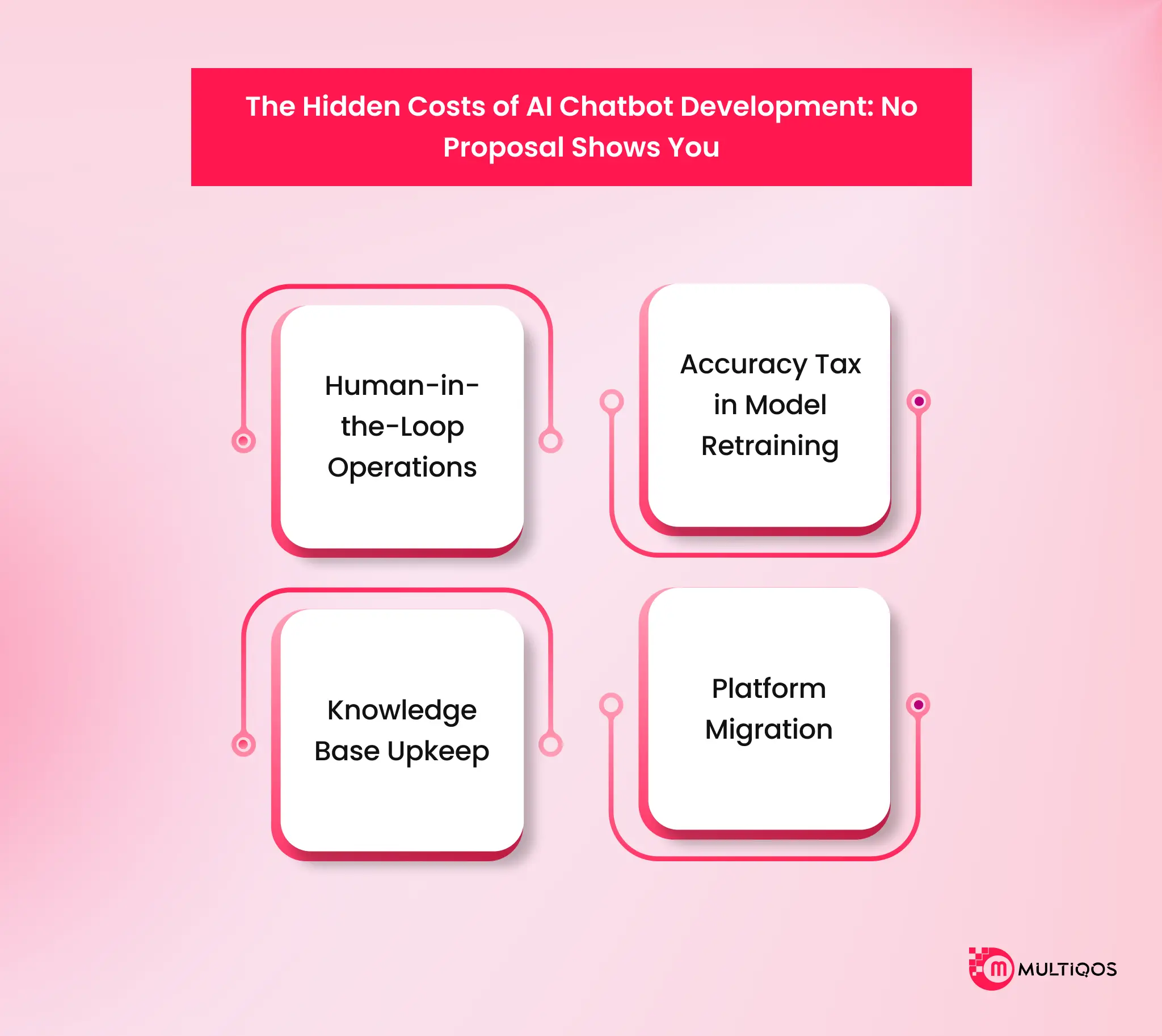
Human-in-the-Loop Operations
No chatbot out there can take care of 100% of all the enterprise interactions without a human check. Regulated industries call for agents to make high-stakes choices and handle edge cases that the model won’t confidently handle.
Depending on the number of escalations and agent costs, HITL operations will cost between $8,000 and $40,000 per year. The finance team that doesn’t see this line item in the original proposal discovers it in month 4 of production.
Accuracy Tax in Model Retraining.
Models decay. The further out of time the data is, the less accurate the system will be when it’s used to forecast Q1 2025. Up to 15-20% of the original build costs are being spent annually on retraining.
A $200,000 chatbot carries a $30,000 to $40,000 annual retraining commitment. If not, precise performance will fall by 12 to 25% within 12 months, and the deflection rate that made the investment worthwhile will be lost. The cost of drift monitoring is $500-$2000 per month.
Knowledge Base Upkeep
The accuracy of a RAG-based chatbot is as accurate as its retrieval from. Knowledge base updates, reindexing, and regression testing are necessary for every product update, policy change, and regulatory change. This is an ongoing editorial process for organizations that experience a lot of product changes.
Platform Migration
One of the worst effects on SaaS buyers. If the chatbot needs compliance capabilities beyond the capability ceiling of the platform it’s built on, or needs to be rebuilt with none of the greenfield efficiency, then it will require a custom rebuild at a considerable cost.
Migrating conversation flows, training data, integration configs, and analytics instrumentation are generally 60-80% of the original build. The amount of this risk that teams can take on when starting to implement DevOps and deployment practices that are modular from the start is much lower.
The Decision-Grade Cost Framework for Enterprise AI Chatbot Programs
AI chatbot development cost is a capital decision. The number that matters isn’t the vendor’s build quote. It’s the three-year TCO calculated across model costs, integration engineering, compliance hosting, HITL operations, retraining cycles, and platform migration risk. That’s the only number worth defending in a board conversation.
Organizations that get chatbot economics right in 2026 invest in discovery before committing to architecture from day one. The chatbot that pays back in 12 months is rarely the cheapest one built. It’s the one built correctly.
MultiQoS builds production-grade AI chatbot solutions for FinTech, Healthcare, Insurance, Retail, and Logistics enterprises with a governance-first architecture that eliminates the hidden cost surprises that derail most programs. Talk to our team to scope your AI chatbot development cost with a defensible three-year TCO model built around your compliance posture, integration requirements, and volume profile.
FAQs
The cost of Chatbots has been set to range from $15000 for a basic SaaS chatbot to $1M+ for an enterprise solution backed by Governance in Banking/Healthcare industries. The average mid-market chatbot will cost between $80,000-$350,000 and maintenance, and MLOps will be 15-20%. Final cost is subject to the selected LLM, the scope of integration, compliance, and the number of conversations.
SaaS starts cheaper. Custom scales are cheaper. SaaS solutions start at $2,000 to $10,000 per month, have a 4-8 week delivery time, but restrict the capability and control of the roadmap. Custom chatbots cost between $80,000-$350,000 and take 16 to 24 weeks to develop. But you still have 100% compliance control, and better economics at volume. Hybrid chatbots are becoming common in 2026. The SaaS manages Tier-1 chats, while the unique 30% is taken care of by custom.
16-28 weeks from discovery to production. One to two weeks to conduct discovery, two to four weeks for conversation design, four to six weeks to develop NLP, four to eight weeks for integration backend (the longest phase of development), and two to four weeks to perform QA. More complicated compliance requirements can lengthen timelines, as can more challenging integration scenarios.
The price of GPT-5.5 (100,000 conversations/month) depends on the company’s pricing, which is approximately $375,000 per year. Hosting a self-owned Llama 4 ranges from $ 4,800 to $ 14,400, while requiring $80,000 to $200,000 for initial hardware investment and $24,000 to $48,000 in GPU hosting costs annually. Open source is on the winning side when it comes to scale, while delivery time is open source’s challenge for GPT. The typical crossover point ranges from 200,000 to 500,000 conversations/month.
The cost of typical development is $40,000 – $350,000, and hosting costs for dedicated development are $2,000 – $4,000 per month. All vendors must have signed a BAA for HIPAA compliance. Teams that have underestimated costs typically exceed their budgets by 40-60% within the first 6 months.
Biggest model categories: HITL ($8,000-$40,000 per year), model re-training (15-20% of original development cost annually), knowledge base maintenance (one or two hours/FTE per week for RAG chatbots), migration costs (60-80% of original development cost to migrate from SaaS platforms).

Get In Touch

Get Stories in Your Inbox Thrice a Month.
A Comprehensive Guide on How Machine Learning is Transforming the Factory Floor
MultiQoS Technologies Named an OpenAI Select Partner