
Closed-Loop Agentic Vision: Moving Beyond Defect Detection to Autonomous Line Calibration
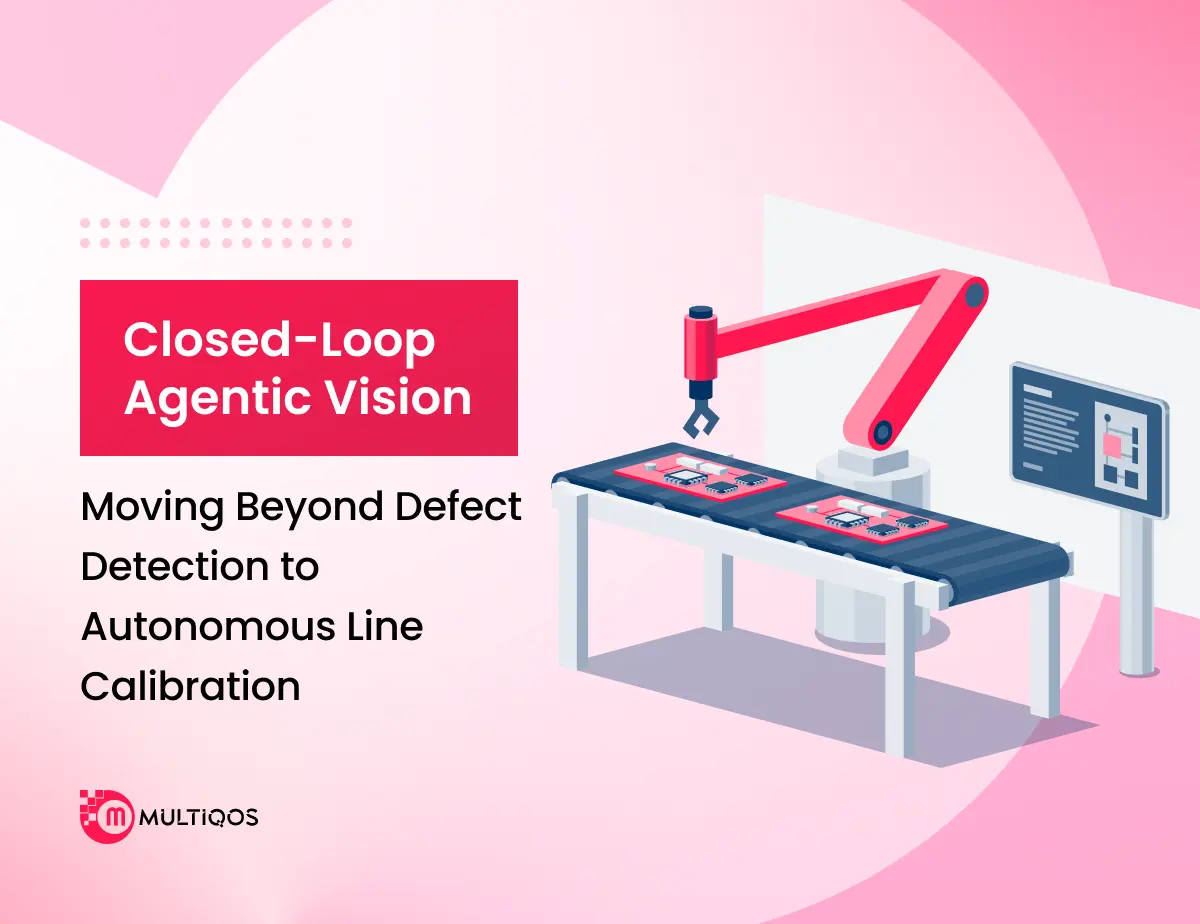
Table of Content
- The Gap Traditional Systems Never Closed
- How the Loop Actually Works
- Getting the AI to Actually Talk to the Machine
- The Problem Most Systems Miss: Process Drift
- What This Means for the Business
- What It Looks Like in Practice
- How to Actually Implement This
- A Secondary Benefit Worth Mentioning
- The Bigger Shift
Summary:
Agentic vision is not merely about detecting defects on the factory floor but also about identifying the cause of the defect using AI and sending corrective actions to the PLCs of the machines immediately to avoid process drift.
For decades, machine vision in manufacturing had one job: catch bad parts before they shipped. High-speed cameras scanned products as they moved down the line, flagging scratches, misalignments, and missing components. When a defect was found, an alarm fired, a robotic arm swept the part into the scrap bin, and the line kept running.
That last part is the problem. The line kept running, often continuing to produce defective parts until a human operator physically intervened and adjusted the machinery.
Traditional machine vision tells you a problem exists. It does nothing to solve it.
That’s changing. A new generation of manufacturing systems doesn’t just inspect; it acts. By pairing advanced computer vision with AI that has genuine decision-making authority, factories are turning passive inspection cameras into active process controllers. The system sees a defect forming, identifies the cause, calculates the correction, and adjusts the machine before the next part comes off the line flawed. This shift is increasingly powered by dedicated Agentic AI development services that build the reasoning and control layer on top of existing vision hardware.
This is closed-loop agentic vision. Here’s what it is, how it works, and what it takes to deploy it.
The Gap Traditional Systems Never Closed
In most manufacturing environments, quality control and process control live in separate worlds. Inspection catches bad output. Process control manages how the machine runs. They rarely talk to each other in real time.
Standard machine vision operates in an open-loop fashion. The camera checks a part, accepts or rejects it, and that’s the end of the data’s journey. Nothing feeds back to the machine. Nothing changes upstream. The system is passive by design.
Closed-loop control breaks that wall. The camera checks a part, detects a variance, figures out why it happened, and sends a correction directly to the production equipment, all before the next part is made. The data doesn’t stop at the inspection station; it completes a circuit.
The “agentic” part matters here. Agentic AI isn’t just generating information for a human to read and act on. It has a goal: in this case, maintaining production quality; and it has the authority to take actions toward that goal without waiting for a human to approve each one. When the system notices a drilled hole drifting off-center by a fraction of a millimeter across consecutive parts, it doesn’t wait for the hole to cross into defective territory. It calculates the offset and tells the machine to correct it now.
How the Loop Actually Works
Making this happen requires more than a smarter camera. It requires a full ecosystem of perception, reasoning, communication, and verification running fast enough to keep up with a production line.
Perception: High-resolution cameras capture sub-millimeter detail on parts immediately after each manufacturing step: after milling, after molding, after coating. Not at the end of the line, but in-process.
Analysis: The vision model measures critical dimensions and spots deviations from baseline. Not just “is this part good or bad,” but “how far off is it and in which direction.”
Reasoning: The AI agent determines whether the deviation is a one-off anomaly, such as a speck of dust or a lighting artifact, or a systemic trend. If it’s systemic, it calculates the exact adjustment needed to bring the process back into spec.
Action: The system sends a command to the machine, adjusting a setpoint, shifting an axis, changing a feed rate, modifying a temperature. The machine responds.
Verification: The next part is inspected. Did the adjustment work? The loop starts again.
Getting the AI to Actually Talk to the Machine
A computer vision system that can only display findings on a monitor is still an open-loop system. For the AI to control a machine, it needs to communicate with the equipment directly — and that means integrating with PLCs.
Programmable Logic Controllers are the ruggedized computers that run physical factory equipment. They’re built for reliability, not for receiving multidimensional AI outputs. Bridging the two requires translating visual insights into specific parameter changes, then writing those changes into the PLC’s memory registers using industrial protocols like OPC UA, Modbus TCP, or MQTT.
In practice: a vision system detects that a plastic seal is cooling unevenly. The AI calculates that the right side needs more heat. It writes a new temperature setpoint directly to the PLC controlling the heating element. The machine self-corrects. The operator sees nothing because there’s nothing to see — the problem was handled before it became a problem.
Speed is everything here: On a line running 300 parts per minute, sending images to a cloud server for processing isn’t viable. By the time the round-trip completes, dozens of flawed parts have already been made. Edge computing, which includes purpose-built AI hardware physically located on the factory floor and wired directly to cameras and PLCs, cuts that latency to milliseconds. Perception, reasoning, and correction happen locally, at line speed.
The Problem Most Systems Miss: Process Drift
Catastrophic machine failures are rare and obvious. What quietly kills production yield is drift.
Cutting tools wear down micron by micron. Factory temperatures rise through the day, causing metal to expand. Lubrication degrades. None of this happens all at once. It accumulates gradually, and traditional inspection systems don’t notice until a part actually fails the check — by which point many more have already been produced with the same flaw.
Agentic vision catches drift at the trend level, not the failure level. If a hole is meant to be 10.00mm and the system measures 10.01mm, then 10.02mm, then 10.03mm across consecutive parts, it recognizes what’s happening before it becomes a reject. It models the trajectory, predicts when the part will fall outside acceptable tolerance, and issues a micro-correction to bring the measurement back to exactly 10.00mm.
The line never stops. A defective part is never made. The correction happens invisibly, continuously, automatically.
What This Means for the Business
The operational impact shows up in a few distinct ways.
Scrap and rework drop significantly
Scrap is a total loss, including raw material, energy, and machine time, all wasted. Rework pulls labor off primary production to fix avoidable mistakes. When the system corrects the process before parameters drift out of tolerance, both problems largely disappear. You shift from catching bad parts to preventing them.
Manual calibration cycles shrink
In a standard facility, when a machine starts producing bad parts, a technician stops the line, takes manual measurements, makes an educated guess about the adjustment, enters new parameters, and runs a test batch. That whole sequence causes downtime and depends on experience that retires when experienced people do. Agentic vision handles this continuously, without downtime, without relying on any single person’s expertise.
Hidden throughput gets unlocked
Because the AI monitors the relationship between machine parameters and output quality in real time, it can discover operational windows that humans wouldn’t find through manual testing. It might determine that the conveyor can run 5% faster without compromising quality, provided the drying temperature is raised two degrees simultaneously. That kind of nuanced, multi-variable optimization rarely happens through manual calibration, as there are too many variables to hold in your head at once.
Compliance documentation comes for free
Every adjustment the AI makes is logged automatically — timestamp, parameter changed, measurement that triggered the correction. For aerospace, automotive, and pharmaceutical manufacturers where process traceability is a regulatory requirement, this is genuinely valuable. Auditors get a minute-by-minute record of exactly how the machine was operating and how the system maintained compliance throughout the run.
What It Looks Like in Practice
Automotive CNC machining
Engine cylinder bores require tight tolerances. Instead of scanning finished parts and scrapping those out of spec, a camera inspects the bore immediately after each cutting pass. If the surface finish is degrading, which is an early sign of tool wear, the AI slows the feed rate and adjusts the cutting angle to compensate. The engine block is saved. The tool life is extended.
Food and beverage packaging
A heat-sealing bar applies plastic film to yogurt containers at 500 cups per minute. A thermal camera monitors the heat signature of every seal milliseconds after application. If the right side of the seal is consistently cooler than the left, the AI identifies a mechanical imbalance and adjusts servo pressure on that side. The line never stops. Spoilage risk drops to near zero.
Metal 3D printing
In selective laser melting, thermal warping is a constant threat. Cameras monitor the laser’s melt pool in real time. If a specific corner is retaining too much heat and risks deforming, the AI reduces the laser power or accelerates movement at that coordinate. The part calibrates itself on a microsecond basis.
How to Actually Implement This
This isn’t a system you flip on overnight. Moving from passive inspection to autonomous calibration requires a staged approach and genuine coordination between IT and OT teams.
Start with an infrastructure audit
Do your cameras capture the resolution you need at line speed? Do your PLCs support external inputs via OPC UA or similar protocols? Legacy machines with only manual controls will need retrofitting before any AI can talk to them. Is your local network fast enough to handle the data volume that edge computing generates?
Collect data before you act
Run the vision system in passive mode first. Gather thousands of images — good parts, bad parts, parts showing early drift. During this phase, you’re building two things: the system’s ability to accurately measure physical characteristics, and a causality map that links machine parameters to quality outcomes. “A 1-degree drop in extruder temperature produces a 0.5mm thinning of the plastic wall.” That map is what makes autonomous correction possible.
Use human-in-the-loop before you close the loop
Before the AI sends commands directly to machines, have it display recommendations to operators. The screen shows: “Process drift detected on X-axis. Recommended adjustment: +0.05mm.” The operator reviews and approves. This builds trust, catches any flawed reasoning before it causes damage, and gives your engineering team time to verify that the AI’s logic holds up under real production conditions.
Define hard safety boundaries
AI agents don’t have common sense. A malfunctioning sensor could prompt the system to request a machine parameter that would cause physical damage. Lock absolute limits into the PLC before enabling autonomous control. The AI can request anything it wants — the PLC will only execute what falls within safe bounds, and anything outside those bounds triggers a human override.
Close the loop on one line first
Once the safety architecture is in place and the system has demonstrated reliable accuracy, enable the direct PLC connection on a single controlled production line. Prove it out. Then scale.
A Secondary Benefit Worth Mentioning
As a closed-loop system matures, something interesting happens. The AI accumulates a detailed record of how often and how hard it has had to work to keep a machine in spec. That data predicts mechanical failure.
If the system has been incrementally increasing pressure on a hydraulic press by 2% every day for a week just to maintain quality, something is physically wrong. The AI flags it: “Calibration limits approaching on Press 4. Possible hydraulic leak or seal failure. Recommend maintenance within 48 hours.”
That’s not a quality control alert. That’s AI predictive maintenance — driven not by a vibration sensor or a thermal reading, but by the pattern of corrections the AI has been making over time. The vision system becomes something more than a quality tool. It becomes a window into the mechanical health of the entire line.
The Bigger Shift
What closed-loop agentic vision represents, at its core, is a change in what a factory actually is. Traditional automation means machines doing the same thing repeatedly, exactly as programmed. Autonomous AI-powered automation systems mean machines that perceive, reason, and adapt — continuously, without waiting to be told.
The camera was never the limitation. The limitation was that camera data stopped at the inspection station and never went anywhere useful. Closing that loop, by connecting perception to action, vision to control, and observation to correction, is what makes the difference between a factory that catches problems and a factory that prevents them.
That’s the upgrade. Not to the cameras. To how the whole system thinks.

Get In Touch

Get Stories in Your Inbox Thrice a Month.
Enterprise AI Implementation Challenges: Common Roadblocks and How to Overcome Them

Computer Vision in Retail Explained: From Smart Shelves to Smart Stores
The Complete Guide to Machine Learning in Healthcare: Uses, Benefits & Challenges