
RevOps and AI Agents: The Post-CRM Era of Intelligent Revenue Operations
Need quick insights? Summarize with AI & save time
 ChatGPT
 Perplexity
 Claude
 Google AI Mode
Table of Content
- What Are RevOps and AI Agents, and Why Does the Distinction Matter?
- 5 Types of AI Agents Reshaping RevOps Workflows
- RevOps and AI Agents Across Industries: Real-World Use Cases
- How to Implement AI Agents in RevOps: A Step-by-Step Guide
- Core Benefits of AI Agents in Revenue Operations
- Future Trends in AI-Powered RevOps
- Conclusion
- FAQs
Summary:
RevOps and AI agents are the integration of autonomous AI agents into revenue operations, sales, marketing, and customer success to execute multi-step workflows across CRM, ERP, and data systems without human intervention. Unlike rule-based automation that follows a script, AI agents hold a goal and decide which actions achieve it: enriching contacts, scoring intent, routing leads, forecasting pipeline, and detecting churn in real time.
This guide covers 5 agent types reshaping revenue execution, real-world use cases across SaaS, healthcare, fintech, eCommerce, and manufacturing, an implementation roadmap, and ROI benchmarks.
The shift from conventional CRM systems to agentic operations is driven by the need to overcome reactive actions. Instead of static automation, which is human-triggered, organizations are now moving towards AI agents that evaluate data across systems such as CRM, ERP, and others to execute multi-step workflows.
Each of these systems has RevOps and AI agents executing entire workflows automatically. From data ingestion to using large language models to extract entities and orchestrate complex workflows, these agents can adapt to specific conditions and execute tasks.
RevOps and AI agents equip companies with the ability to leverage autonomous software agents and automate the workflow of their revenue operations in sales, marketing, and CS. The one thing that is keeping teams that are just beginning to move ahead is this change from passive record-keeping to active execution.
The guide explains how they apply, what the five agent types are that are transforming revenue teams, real-life examples in five industries, the ROI proof, and a six-step implementation process.
What Are RevOps and AI Agents, and Why Does the Distinction Matter?
RevOps is a single unified function based on common data, processes, and technology to deliver predictable revenue growth across sales, marketing, and customer success. AI agents use machine learning to understand context, make decisions, and complete complex tasks without being told what to do in a step-by-step manner.
Combine them, and you have a revenue operation, independent of other data, running in real time. The difference between an agent and the automation you already run lies in the execution. Rule-based automation follows a script. Lead fills a form, sends email three.
An AI agent holds a goal instead, something like booking a qualified meeting, and then decides for itself which actions get it there. It enriches the contact, scores intent, drafts the outreach, books the slot, and updates the record afterward.
According to Gartner’s revenue operations research, RevOps removes the friction between go-to-market functions. Agents are the first technology that removes that friction by doing the work, not by flagging it for someone else to do. And organizations can leverage this technology through custom AI development services, aligning agentic capabilities for improved revenue.
5 Types of AI Agents Reshaping RevOps Workflows
Five agent types now do the bulk of revenue execution: sales intelligence agents, forecasting and pipeline agents, customer success agents, workflow automation agents, and analytics agents. Each maps to a specific revenue function and a specific failure mode in the traditional stack.
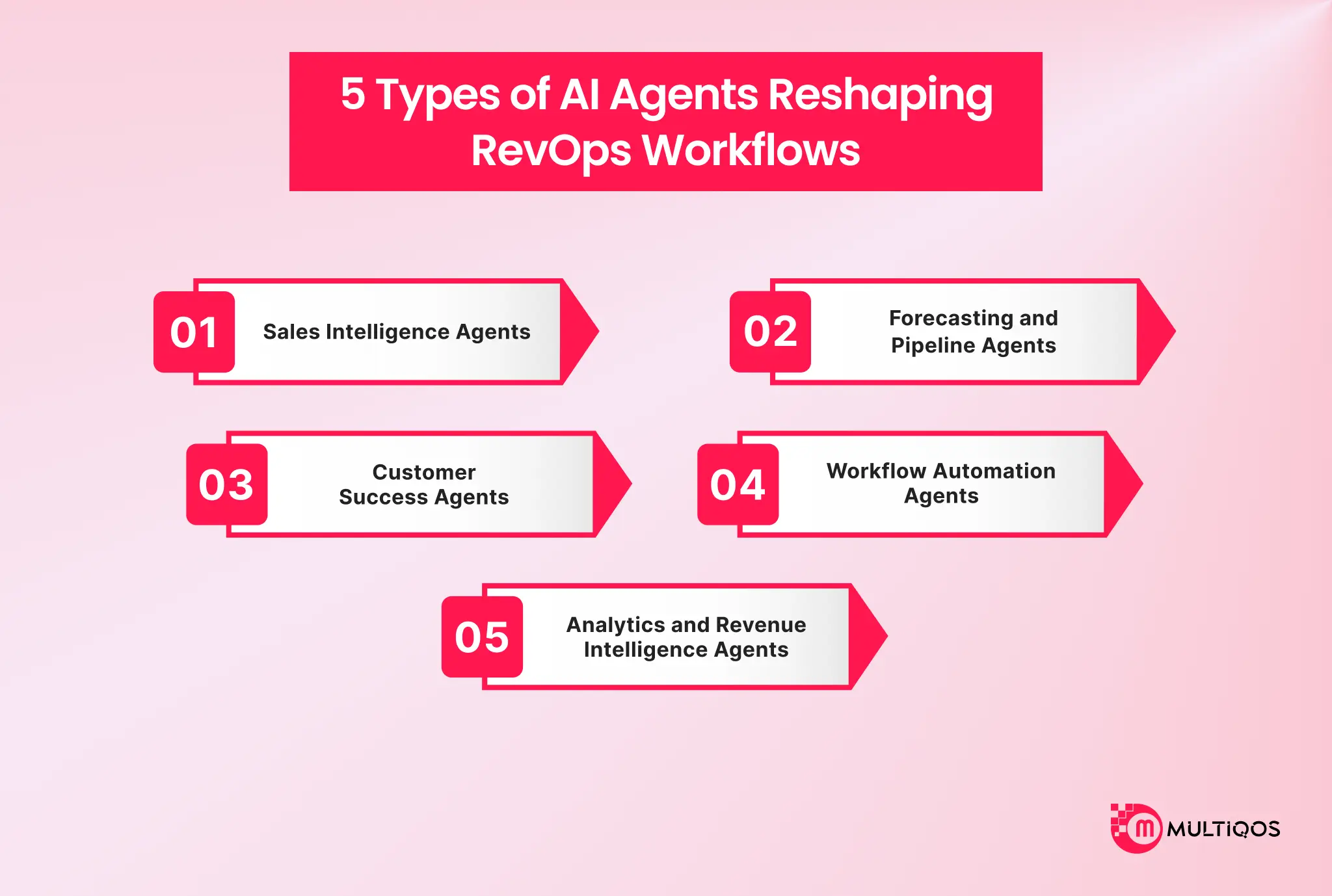
| Agent Type | Core Job | Replaces | Primary Outcome |
|---|---|---|---|
| Sales Intelligence | Research, enrich, score, prioritize accounts | Manual prospecting and list-building | More selling time, sharper targeting |
| Forecasting and Pipeline | Monitor deal health, flag risk, predict close | Spreadsheet forecasting | Forecast accuracy, fewer slipped deals |
| Customer Success | Detect churn signals, trigger retention plays | Reactive QBR scrambles | Lower churn, higher net revenue retention |
| Workflow Automation | Route leads, sync systems, and handle handoffs | Manual ops and CRM data entry | Faster cycle time, clean records |
| Analytics & Revenue Intelligence | Surface insights, answer revenue questions | Static BI dashboards | Decisions in minutes, not weeks |
Sales Intelligence Agents
Sales intelligence agents research accounts, enrich contact records, score intent, and hand reps a prioritized list before the rep opens a tab. The work that used to eat a third of an SDR’s week? It now runs continuously in the background, nobody touching it.
Reps spend only 28% of their week selling. This agent goes straight after the other 72%, the prospecting and list-building, and data entry that never once showed up on a quota.
Forecasting and Pipeline Agents
Forecasting and pipeline agents watch every deal in real time, score its health against historical patterns, and flag the ones about to slip while there is still time to act. A human forecast is a snapshot built on a Friday. An agent forecast is a live system that updates the moment a champion goes quiet or a deal stops progressing. The shift here is from explaining a missed number after the quarter to preventing the miss during it.
Customer Success Agents
Customer success agents monitor product usage, support tickets, and engagement signals to catch churn risk before the renewal conversation, not during it. Most CS teams find out an account is leaving when the account tells them.
By then, the play is a discount, not a save. A customer lifecycle agent watching usage decay can trigger an intervention weeks earlier, which is the difference between a retention motion and a goodbye email.
Workflow Automation Agents
Workflow automation agents route leads, sync data across systems, manage handoffs, and keep the CRM clean without a single manual touch. This is the closest thing RevOps has to a quick win. Lead routing delays, CRM data hygiene failures, and broken handoffs are the silent revenue killers in most go-to-market teams. An agent that fixes them removes friction the moment it goes live.
Analytics and Revenue Intelligence Agents
Analytics and revenue intelligence agents answer revenue questions in plain language and surface the insight that a static dashboard buries.
Ask why pipeline coverage dropped in the West region, and the agent investigates across sources and returns the answer. No analyst queue. No three-day wait. The dashboard told you what happened. The agent tells you why and what to do about it.
These five rarely work alone for long. The real leverage shows up when they coordinate, which is exactly where the next section, and the future of RevOps, is heading.
RevOps and AI Agents Across Industries: Real-World Use Cases
AI agent deployment patterns differ sharply by industry. The underlying technology stays the same. What changes are the integration points, the data sources, the compliance requirements, and the metrics that define success?
SaaS and Technology Companies
In SaaS, AI agents run the product-led growth motion that human teams cannot watch closely enough. An agent monitors product usage across thousands of free accounts, scores which ones show expansion signals, and routes the hot ones to sales the same hour.
For a massive go-to-market team managing a self-serve funnel, that is the difference between catching an upgrade window and missing it. Usage data is the richest signal SaaS owns, and agents are the only thing that can act on all of it at once.
Healthcare and HealthTech
In healthcare, AI agents accelerate revenue operations while operating inside strict compliance boundaries. Agents handle provider data enrichment, route inbound from health systems, and manage the long, multi-stakeholder sales cycles that define the vertical, all with scoped permissions that keep protected data locked down.
The constraint is real. The opportunity is bigger: regulated industries have the messiest manual processes, which means the most ground to recover.
Financial Services and Fintech
In financial services, AI agents compress the compliance-heavy revenue workflows that slow every deal. KYC checks, document validation, and audit-ready record-keeping move from manual queues to agent execution with a full trail attached.
Speed matters in fintech sales, but only inside the lines regulators draw. An agent that moves fast and logs everything is the rare combination that compliance and revenue both sign off on.
eCommerce and Retail
In eCommerce, AI agents personalize the revenue motion at a scale no merchandising team can match by hand. Agents segment customers in real time, trigger lifecycle campaigns, and adjust offers based on behavior as it happens.
This is where AI in retail starts being a revenue engine. The work of AI eCommerce personalization for customer experiences runs continuously, on every visitor, without a campaign manager pulling levers.
Manufacturing and Industrial B2B
In the B2B sector (for manufacturing and industry), AI agents are responsible for lengthy sales cycles, intricate quoting processes, and the overlooked service-revenue tail. Agents monitor the progress of deals over the course of months, identify issues in the quote-to-cash process, and link up equipment information with expansion prospects.
The same predictive logic that underlies AI predictive maintenance is true of revenue: be the first to act, before it’s too late. Industrial revenue is found in the service relationship, and that is also one of the use cases of AI Agents.
How to Implement AI Agents in RevOps: A Step-by-Step Guide
Most RevOps teams are stuck in tactical AI use cases like data enrichment and content generation, with minimal ROI to show for it. The teams getting real results follow a structured deployment sequence instead of scattering pilots across the stack. Here is the path that works.
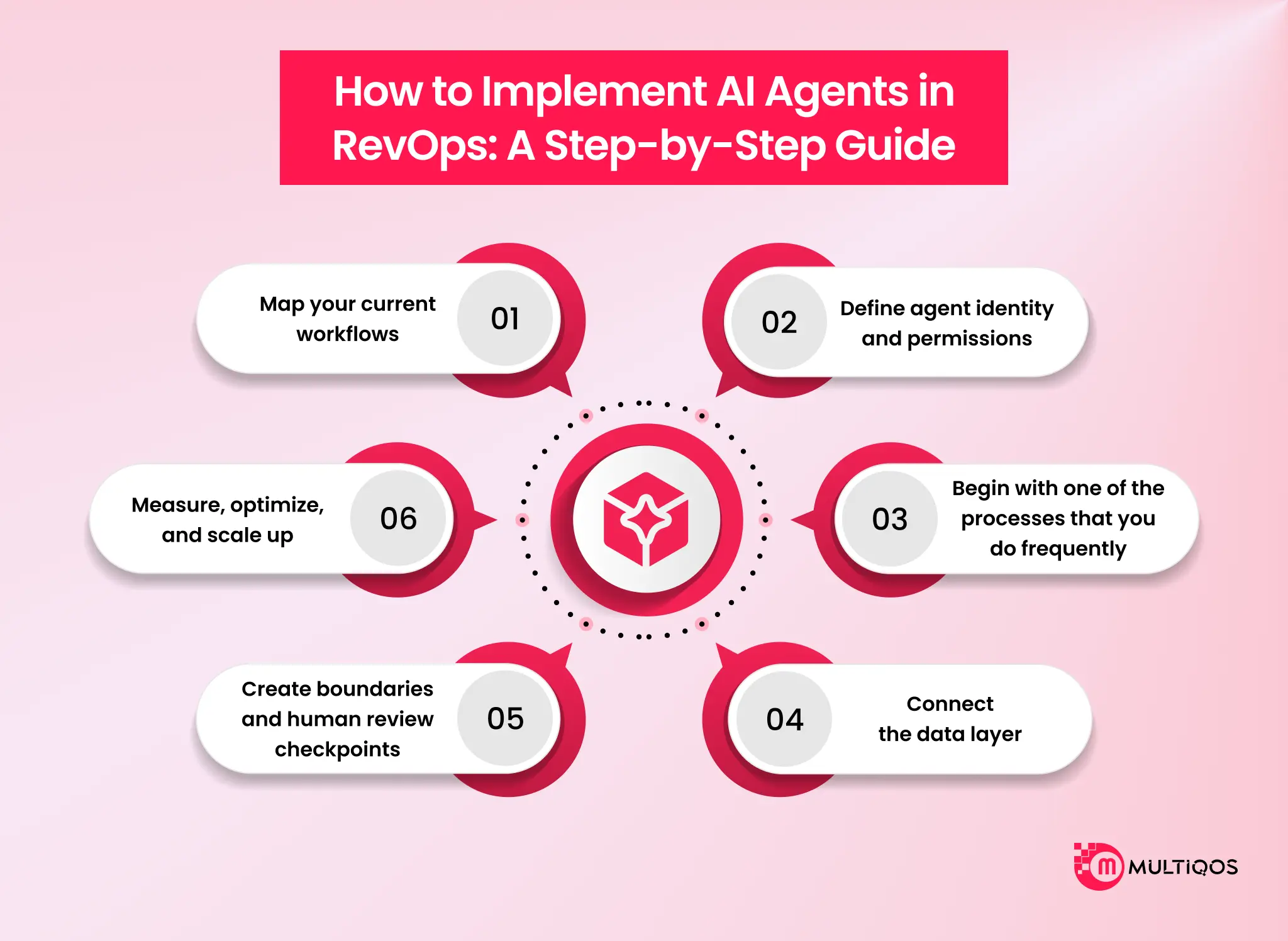
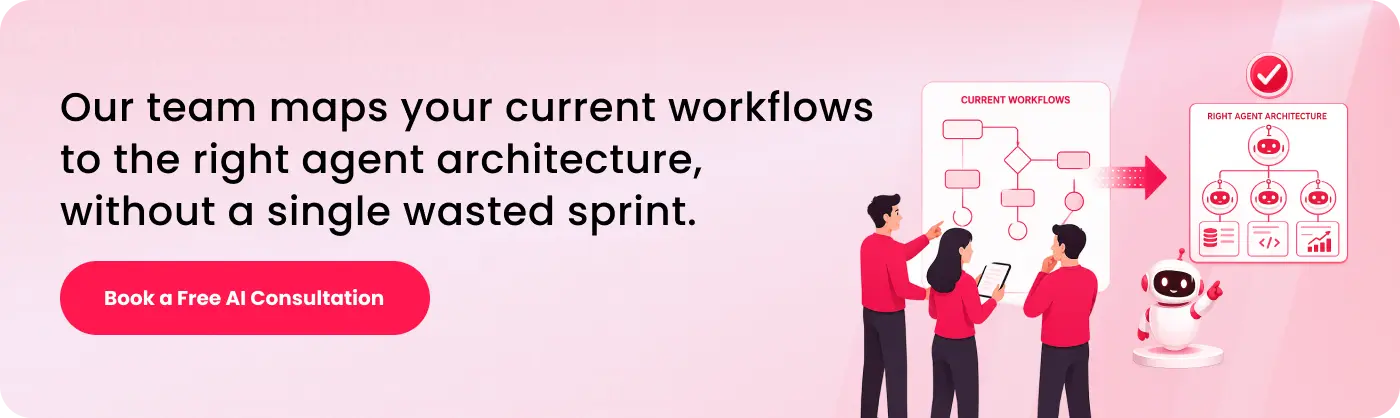
- Map your current workflows- document where revenue work actually happens, where it stalls, and which handoffs break. You cannot automate a process you have not mapped, and the highest-friction workflow is usually where the first agent earns its keep.
- Define agent identity and permissions- Decide exactly which systems and data fields each agent can touch before it touches anything. Scope access tightly. The more permissions the agent has without any guardrails, the more it is a liability, especially in regulated verticals.
- Begin with one of the processes that you do frequently- choose a task that is executed hundreds of times per day, such as routing leads to other departments or CRM enrichment, and run one agent in that task. High frequency equals quick feedback, quick learning, and an immediate signal of ROIs within weeks rather than quarters.
- Connect the data layer- wire the agent into clean, current data across your CRM, marketing platform, and CS tools. An agent running on stale or conflicting records will execute confidently and wrongly. Data readiness is not a prerequisite you can skip.
- Create boundaries and human review checkpoints- ensure that humans stay involved in the decision-making process when the stakes are too high for the agent to make decisions without intervention.
- Measure, optimize, and scale up- Monitor the performance of the agent with respect to the key performance indicator it was hired to influence, optimize the system, and hire the next agent.
The teams that follow this sequence avoid the single most common failure: deploying agents on top of broken data infrastructure and then blaming the agent. Building this correctly requires an AI agent development guide, especially when the stakes are high.
Core Benefits of AI Agents in Revenue Operations
The benefits of AI agents in RevOps map directly to P&L lines and operational KPIs, not vague promises. Companies with extensive AI adoption posted 9.5% higher sales growth over five years. That number is the headline. These five benefits are how it gets earned.
-
Automated CRM Data Hygiene
AI agents keep CRM records clean, current, and complete without a single rep typing a field. Unstructured data is the tax every revenue team pays and no one budgets for. Agents enrich contacts, dedupe records, and fill gaps continuously, which means the forecast, the routing, and the reporting all run on data you can actually trust.
-
Hyper-Accurate Revenue Forecasting
AI agents produce forecasts that update in real time and hold up under scrutiny. Manual forecasting is a guess dressed as a spreadsheet. An agent scoring every deal against historical close patterns turns the forecast from a quarterly ritual into a live instrument, which is what a CRO needs when the board asks why the number moved.
-
Faster Lead Response and Higher Conversion
AI agents respond to inbound leads in seconds, not hours, and conversion follows speed. The first vendor to reach a buyer wins a disproportionate share of deals. An agent that qualifies and routes the moment a form is submitted closes the response gap that quietly bleeds pipeline in nearly every funnel.
-
Personalization at Scale
AI agents can create one-to-one interactions with each and every customer on a scale that is impossible to achieve through a human team. One-to-one was defined as one representative-one account. But AIs create one-to-one interactions with all accounts in the whole book, customized to each and every agent, without adding extra people.
-
Revenue Leakage Detection
Silent unactioned expansion signals, missed renewals, and revenue opportunities are all grabbed by AI agents. Revenue leakage is invisible; that’s why it’s there. Revenue leakage is invisible by design, which is why it persists. An agent watching the full pipeline surfaces the leaks in time to plug them, and that recovered revenue often pays for the entire deployment.
Future Trends in AI-Powered RevOps
The future of AI-powered RevOps is already in motion. These are adoption curves underway, not theoretical futures, and four of them will define the next 18 months.
Multi-agent orchestration comes first. Single agents handle single tasks today, and that is useful but limited. The next phase connects them. A sales agent, a forecasting agent, and a CS agent coordinate on the same account, no human stitching the workflow together.
Salesforce’s 2026 AI agent trends point to orchestration as the dividing line between teams that automate tasks and teams that automate revenue. That line is closer than most planning cycles assume.
As agents take over execution, the CRM’s role keeps shrinking toward pure storage. Those teams that continue to operate the CRM as the revenue machine will feel the difference.
The revenue motion is no longer the differentiator; it’s hyper-personalized revenue motions. With all participants running agents, generic outreach becomes useless, and the expectation for the relevance level increases overall for the market.
The RevOps talent shift is the quiet one. The job stops being manual execution and becomes agent design, orchestration, and oversight. The RevOps leaders who win the next cycle will be the ones who learned to manage agents like a team, not a tool.
Conclusion
RevOps built on passive data systems is a liability in markets that move at agent speed. The CRM remembers; it does not act, and the gap between recording revenue work and executing it is where deals are won and lost. AI agents close that gap.
They are the active execution layer that turns RevOps from a coordination function into competitive revenue, with higher sales growth. The teams moving now are setting the pace. Build the execution layer above your CRM with MultiQoS AI agent development services before the market sets it for you.
FAQs
While AI agents are not just about recording revenue workflows, they are the hands-on execution that runs revenue workflows across the sales, marketing, and customer success teams, without needing human intervention. They can route leads with ease, enhance data, foresee churn, manage pipelines, and more in real-time, thus enabling revenue teams to focus on selling and strategy.
While traditional CRM automation adheres to a prescribed set of rules, for example, if a form is completed, an email should be sent, an AI agent can work to achieve a desired goal and make decisions about how to do so. An agent enriches, scores, drafts, routes, and updates independently and as such is an execution layer on top of the CRM and not a trigger inside the CRM.
With a clean data layer, a single high-frequency agent, like lead routing or CRM enrichment, can deliver ROI in weeks. Full-stack deployment requires additional time and requires readiness of the data, permission architecture, and the number of workflows to be sequenced; thus, a workflow rollout is better than a wide rollout.
SaaS, healthcare, financial services, eCommerce, and manufacturing are the industries that reap the greatest benefit from RevOps AI agents. The SaaS industry benefits from product-driven growth signals, messy manual processes are most beneficial for regulated industries, real-time personalization is a key benefit of eCommerce, and manufacturing generates hidden service revenue throughout the long sales cycle.

Get In Touch

Get Stories in Your Inbox Thrice a Month.
Move Beyond Pilot: How to Drive Optimum Value from AI Agents in Retail
A Comprehensive Guide on How Machine Learning is Transforming the Factory Floor