
Top 12 AI Agent Use Cases That Are Transforming Enterprises
Need quick insights? Summarize with AI & save time
 ChatGPT
 Perplexity
 Claude
 Google AI Mode
Table of Content:
- Introduction
- What are AI Agents?
- AI Agents for Enterprises: Top 12 Use Cases
- Real-World AI Agent Examples Across Industries
- Why AI Agents Matter for Enterprises
- Final Thoughts
- Frequently Asked Questions
Quick Summary:
AI agents are revolutionizing the way enterprises operate, offering significant improvements in efficiency and decision-making. In this blog, we’ll explore the top 12 AI agent use cases for businesses, real-world examples across industries, and why this matters for enterprises.
Introduction
Organizations across all industries implement AI agents to optimize business operations with stellar customer interactions and enhanced performance. Reflecting their growing adoption, Gartner predicts that by 2028, an average Global Fortune 500 enterprise will have over 150,000 AI agents in use, up from fewer than 15 in 2025. The extensive range of AI agent applications includes both automation of repetitive work and customized insight delivery.
Organizations seeking advanced business advantages choose AI agents as their essential competitive strategy. AI agents serve multiple purposes that help organizations reach their business targets through better customer care and supply chain optimization.
In this blog, we’ll list out the best AI agent use cases for businesses and why working with a reliable AI agent development company can help bring these solutions to life effectively and efficiently.
What are AI Agents?
AI agents refer to software programs that use AI to perform tasks for users or make decisions autonomously.
The system can process data while learning from predefined rules and machine learning insights so it can execute determined decisions or algorithms. Artificial intelligence agents duplicate cognitive capabilities for problem-solving, decision-making, and adaptive behavior because they do not need continuous human supervision.
AI agents gain knowledge and develop greater competence over time which lets businesses apply them to basic process automation and sophisticated analytical capabilities for strategic decision support.
AI Agents for Enterprises: Top 12 Use Cases
The rapid transformation of business procedures occurs throughout different industrial sectors through the implementation of AI agent. Through data processing capacity along with automation and decision-making capabilities AI agents deliver businesses operational efficiency improvements together with cost optimization and superior customer interactions.
The growing interest in AI technology by enterprises requires a clear comprehension of AI agent application domains in real-world business environments.
Here are the top AI agent use cases transforming enterprises:
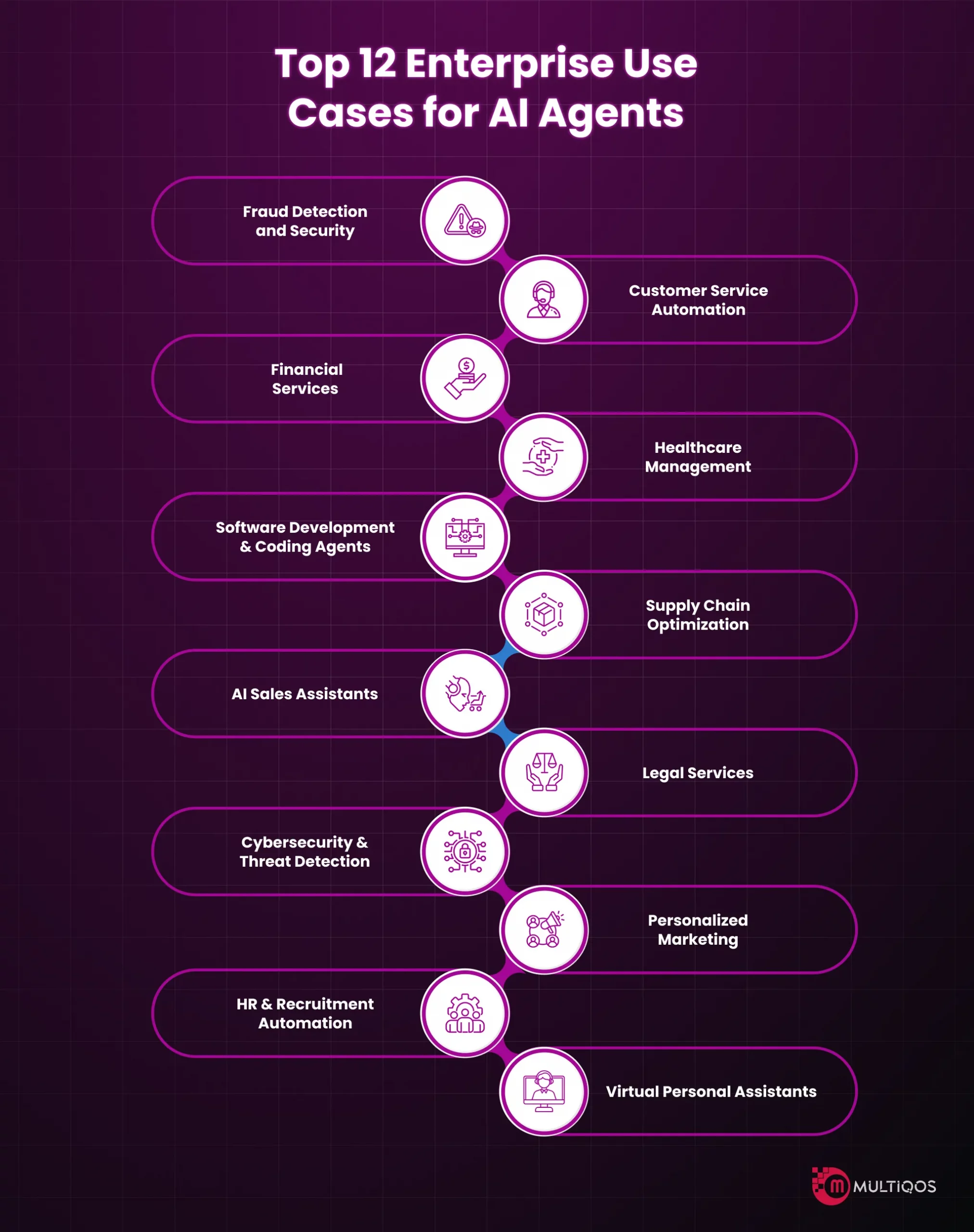
1. Customer Service Automation
The delivery of customer service represents a primary area where AI agents bring significant changes in customer interactions. Numerous customer interactions are handled through artificial intelligence across chatbots, virtual assistants, and voice agents who perform both basic support requests and complex troubleshooting assignments.
Through AI in customer services , AI agents deliver constant support while minimizing human errors and shortening response durations which creates an efficient system.
AI agents gain experience from customer interactions that lead to better AI response customization over time. Through their ability to learn customer interactions AI agent supplies progressively accurate solutions while better-predicting requirements which results in enhanced contentment.
Automating routine work enables AI agents to allow human agents additional time to handle complex assignments with high-value needs.
2. Healthcare Management
As we all know, the adoption of AI in the healthcare industry is increasing as it streamlines clinical and administrative operations. Healthcare organizations use AI agent to schedule patient appointments along with a range of administrative automations which are enhanced by patient data analysis capabilities that support diagnostic decisions.
Through artificial intelligence digital solutions healthcare providers can conduct virtual visits to diagnose conditions and tailor treatment approaches to patient clinical data.
AI agents now assist pharmaceutical research by analyzing medical content alongside clinical experiments and healthcare information to detect healing process possibilities. AI agent within hospitals supports management procedures which include resource planning and admission forecasting as well as ER management initiatives.
3. Supply Chain Optimization
The optimization of supply chain management works through AI agents who analyze demands while detecting operational weaknesses and cutting expensive inefficiencies.
Industries employing artificial intelligence systems to analyze historical patterns, market trends, and current metrics can now make precise demand predictions for better inventory and production planning. This can result in enhanced stock management, customer satisfaction, and reduced waste due to reliable delivery timelines.
Demand forecast prediction combined with AI route planning functions enhances delivery efficiency and leads to decreased expenses while reducing transportation interruptions.
AI agent supports predictive maintenance applications that enable enterprises to monitor equipment in real-time so they can prevent expensive machinery failures and unexpected downtimes.
4. Legal Services
AI agents help legal operations become more efficient while reducing operational spending to deliver better services. AI agents utilize their capabilities to simplify contract evaluation, execute legal searches, and manage documents in addition to producing case predictions.
AI-based legal assistants review extensive legal documents and court decisions to help law firms discover legal precedents and relevant cases which reduces extensive research time. Through AI agents law firms advance client engagement efficiency and automate document creation processes, scheduling, and billing operations, and basic legal documents.
Legal professionals who automate their routine work tasks can shift their attention toward strategic development and advanced case management requirements.
5. Personalized Marketing
Marketing strategies experience radical transformations through AI agent that deliver customized experiences that meet individual customer needs. AI development systems study user behavior coupled with individual preferences and prior transactions to produce campaign messages that match customers’ tastes alongside specialized recommendations along with adaptive content.
AI-powered automation systems operating through retail, e-commerce, and entertainment sectors use user-specific data to provide product and content suggestions that engage customers and boost sales numbers.
Marketing campaigns benefit greatly from AI agent that automatically processes data to transform messaging pricing and offers because of real-time customer input. The technological capabilities allow marketers to refine customer audience selection while maintaining campaign success.
6. Financial Services
The financial services industry is utilizing AI agents to help banks, investment firms, and insurance companies perform automation tasks and generate data-based decisions.
AI agents that operate robotic systems analyze the latest market trends, customer profiles, and risk tolerance levels to suggest customized investments. AI systems are deployed in financial applications such as risk management, predictive analytics and both credit scoring and portfolio optimization functions.
The use of AI tools through banking automation processes performs three main functions: customer onboarding, transaction monitoring, and customer support activities. Where transactions display irregular behavior the platform can identify potential cases of fraud by tracking patterns and alerting banking institutions immediately.
7. Fraud Detection and Security
AI agents operate as essential elements of modern cybersecurity security approaches because they help identify fraudulent activity and maintain the security of sensitive information. AI agents are capable in fraud detection through continuous real-time monitoring of network systems, transaction patterns, and security breach analysis.
This technology automatically detects abnormal behaviors which prompts security teams for notifications while allowing automatic protective action to stop attacks before further damage.
In the financial sector, AI agents track unusual patterns in transactions to identify fraudulent activities whereas in sectors such as banking and e-commerce, they can authenticate users and access control.
Businesses can stay compliant with regulatory requirements by making sure that personal and sensitive information is secured and managed effectively.
8. Software Development & Coding Agents
There is an increasing trend towards the use of AI in software development to facilitate different processes within the development lifecycle for software products. Coding agents offer assistance to developers by automating the tedious tasks in their routine work and making them more productive. From writing small pieces of code and evaluating pull requests to bug detection and documentation of code, agents play a crucial role in speeding up the process of coding while maintaining its quality.
Contrary to ordinary development software, AI agents are capable of understanding context, analyzing structures, and offering advice to programmers depending on specific needs in the development project. They also play an important role in assisting with testing, debugging, and optimizing code, which leaves space for developers to deal with more significant problems related to businesses.
Agents are beneficial to any enterprise that develops large-scale software products as their collaborative potential can prove valuable in improving the efficiency of the development process.
9. AI Sales Assistants
Salespeople usually waste a considerable amount of their working hours on administrative work like managing leads, keeping customer records up to date, arranging meetings with customers, and making follow-ups. With the use of an AI sales assistant, the problem can be eliminated, since these systems automate routine processes, allowing sales staff to focus solely on selling.
AI sales assistants can evaluate customer engagement, qualify leads according to specified criteria, suggest the best course of action to take, and even create messages for customers. Integrating with customer management platforms as well as other means of communication makes sure that all the data about customers is kept up to date.
Moreover, AI sales assistants are very helpful when it comes to analyzing customers’ behavior and thus discovering opportunities with the maximum chance of success. This shift is part of a broader move toward RevOps and AI agents working together to streamline the entire revenue cycle. The increasing number of companies trying to boost their revenues in an efficient way shows the growing importance of using AI sales assistants.
10. Cybersecurity & Threat Detection
With advanced cyberattacks cropping up, companies need ways to safeguard their important info. AI in cybersecurity helps by watching networks for weird stuff or threats that might hurt the biz. So, these smart tools are crucial for keeping things secure nowadays.
The agent is designed to collect massive amounts of security data that it will use to detect any anomalies that might be caused by a cyber attack. This process enables organizations to mitigate threats much faster since they have enough evidence about what happened and how to address the threat in real time.
Artificial intelligence cybersecurity agents can also support various security operations such as risk assessment and compliance reporting. They have the capability to process large amounts of data in a short period, making it possible for enterprises to improve their security status.
11. HR & Recruitment Automation
The recruitment and talent acquisition processes have tons of repetitive tasks that take lots of time and energy. AI can help HR departments by automating those steps such as sourcing candidates, filtering resumes, and scheduling interviews.
AI looks at resumes and job listings to spot the best fits, letting recruiters focus on talking to the top candidates instead of sifting through heaps of applications. This makes hiring quicker and way more effective; therefore, AI helps streamline things, letting HR folks do what they do best – find amazing new team members.
Furthermore, AI agents are used not only in recruiting new employees but also in onboarding procedures, managing internal knowledge, and engaging employees within the organization. They can give answers to frequently asked questions related to work, perform administrative tasks for employees, and provide necessary information about the policies of the company.
12. Virtual Personal Assistants
However, modern virtual personal assistants have developed into much more than scheduling tools; they are considered to be intelligent assistants that contribute to the productivity of individuals and businesses. Such AI systems enable the creation of appointments, scheduling meetings, arranging tasks, setting up reminders, and handling all sorts of routine administrative procedures almost without any assistance from humans.
With the help of their capability to understand preferences of users and the context of a situation, virtual personal assistants can sort out all pending issues and provide appropriate suggestions. Moreover, virtual assistants allow users to interact with email and other software systems, thus allowing one to handle several things at once.
In particular, virtual assistants are very helpful for business executives since they help them save time spent on such mundane activities as organizing schedules and tracking action items. Consequently, executives can devote more time to the achievement of their goals and objectives.
Real-World AI Agent Examples Across Industries
|
Industry |
AI Agent Application |
| Retail |
Product recommendation agents |
|
Banking |
Fraud detection agents |
| Healthcare |
Patient support agents |
|
Logistics |
Route optimization agents |
| HR |
Recruitment screening agents |
|
Manufacturing |
Predictive maintenance agents |
| Customer Service |
Virtual support agents |
| Cybersecurity |
Threat monitoring agents |
These AI Agent examples demonstrate how AI agent use cases are creating measurable business value across industries.
Why AI Agents Matter for Enterprises
Businesses today face increasing pressure to improve efficiency, reduce operational costs, and deliver exceptional customer experiences.
AI agents help organizations by:
- Automating repetitive tasks
- Improving response times
- Reducing operational expenses
- Enhancing employee productivity
- Supporting data-driven decisions
- Operating 24/7 without interruption
- Scaling business processes efficiently
As AI technology evolves, enterprises are moving beyond simple chatbots and adopting intelligent AI agents capable of handling increasingly sophisticated business functions.
Final Thoughts
The way enterprises operate today is undergoing revolutionary transformation through AI agents which enable extensive potential applications across business needs including automated support solutions and sophisticated workflow enhancements. The implementation of AI agents helps organizations compete better through operational efficiency together with better customer experiences and actionable growth insights.
To experience the potential, capabilities, and cost of AI agents, partnering with a top-notch provider of AI agent development services is crucial. Alignment with business requirements becomes possible through provider expertise, which combines with holistic system integration capabilities and adaptable scalability properties.
Businesses can not only streamline operations but also create opportunities for customer engagement and innovation in the digital age by embracing AI agents.
Frequently Asked Questions
Our excellent AI agent development services can benefit numerous industries such as healthcare, manufacturing, retail and e-commerce, finance and banking, legal services, and telecommunications.
We provide tailored AI agent solutions which include chatbots and virtual assistants along with machine learning alongside NLP and AI analytics designed specifically for your business requirements.
The development time depends on your project requirements and its complexities. It might take a few weeks for basic solutions and months for advanced AI agents.
Our system adopts encryption protocols together with safe data storage facilities and follows privacy regulations GDPR and CCPA for sensitive information protection.

Get In Touch

Get Stories in Your Inbox Thrice a Month.
A Comprehensive Guide on How Machine Learning is Transforming the Factory Floor
MultiQoS Technologies Named an OpenAI Select Partner
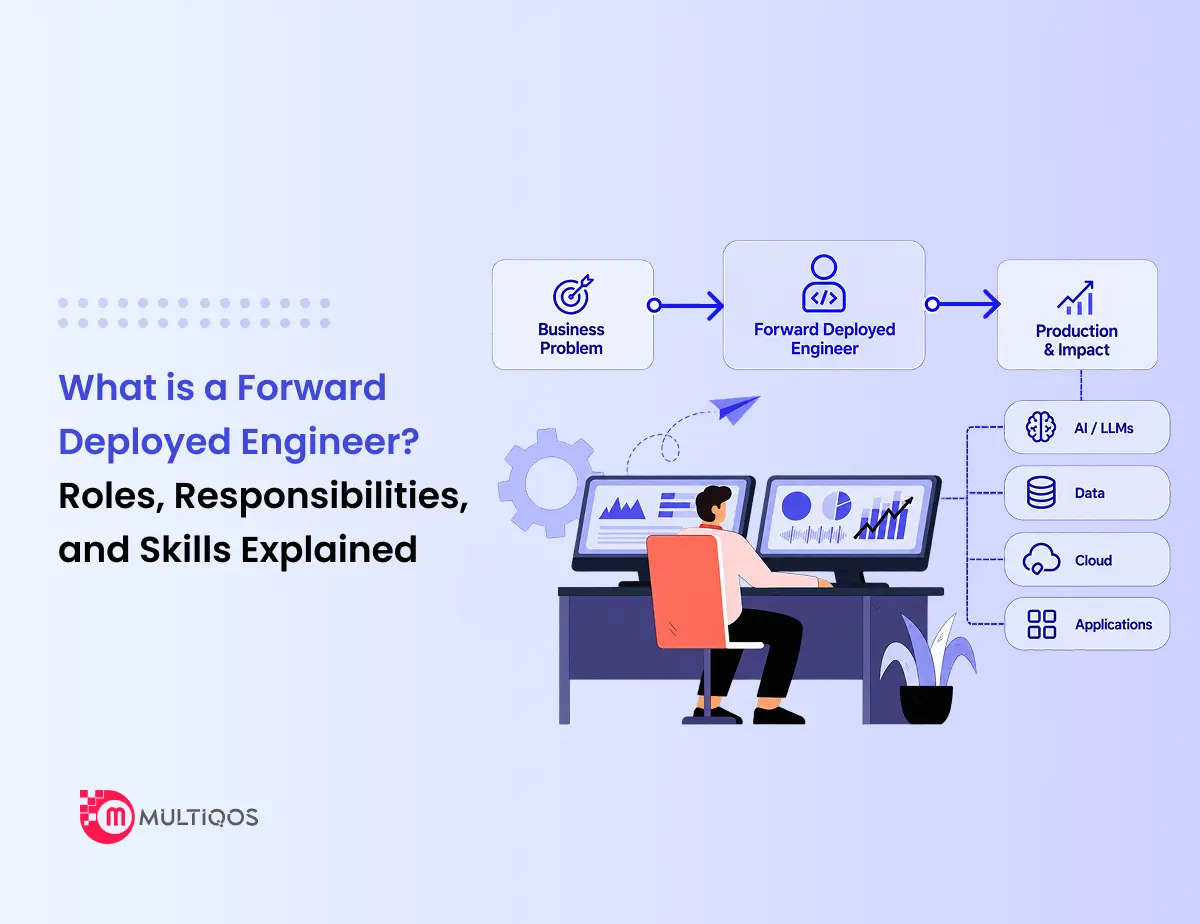
What is a Forward Deployed Engineer? Roles, Responsibilities, and Skills Explained