
Everything You Need to Know About AI Agent Development
Need quick insights? Summarize with AI & save time
 ChatGPT
 Perplexity
 Claude
 Google AI Mode
Table of Content:
- Introduction
- What is an AI Agent?
- What are the Benefits of AI Agents?
- Top AI Agent Tools and Frameworks
- How to Build an AI Agent?
- Future Trends in AI Agent Development
- How to Hire the Right AI Agent Development Partner?
- Conclusion
- Frequently Asked Questions
Summary:
This blog breaks down Everything You Need to Know About AI Agent Development—from what AI agents are to how they’re transforming industries with automation and intelligence. It addresses fundamental advantages, prominent tools and frameworks, tips for incremental skill advancement, and prognostications such as autonomous agents and multi-agent systems.
Practical guidance on selecting the appropriate development partner is also provided. This guide walks the reader through the planning stages of building an AI agent, or simply exploring the expanding frontier, in an organized, straightforward format.
Introduction
AI agent development stands at the core of digital innovation in an era when automation and intelligence blend together. From sophisticated aids that book your meetings to self-governing agents that improve supply chains, the surge of AI agents is revolutionizing business operations and human relationships with technology.
According to Gartner, by 2029, AI will autonomously resolve up to 80% of common customer service issues while reducing operational costs by 30%. Whether you’re a tech-savvy entrepreneur, a business leader, or just curious about the future, this guide breaks down everything you need to know, without the jargon.
The U.S. AI market generated $81 billion in revenue in 2025 and is projected to grow to nearly $484 billion by 2033, reflecting the rapid adoption of AI technologies across industries. AI agents are emerging as a key driver of this growth, helping organizations automate workflows, improve operational efficiency, and deliver highly personalized customer experiences at scale.
In this blog, we’ll explore how AI agent development works, the tools and technologies behind it, and why artificial intelligence agents are quickly becoming must-haves in every modern organization.
What is an AI Agent?
An AI agent is a digital system powered by artificial intelligence that can perceive its environment, make decisions, and perform tasks autonomously. These smart agents use a mix of technologies like machine learning, deep learning, and natural language processing to interact with users and data in real time.
According to recent research, over 80% of U.S. companies are either using or exploring AI agents to enhance operations and customer engagement. From virtual assistants like Siri and Alexa to self-driving vehicles and AI chatbots, these agents are reshaping how we work, live, and connect.
In the U.S. alone, the AI agent market is projected to grow by over $9 billion by 2027, driven by the demand for automation and intelligent decision-making. Businesses across industries—from healthcare to finance—are using AI agents to reduce operational costs, boost productivity, and deliver personalized experiences.
As AI agent development continues to advance, these systems are becoming more adaptable and capable of solving complex problems. If you’re looking to stay ahead in the age of digital transformation, understanding what an AI agent is and how it can elevate your business is more relevant than ever.
What are the Benefits of AI Agents?
Within the information era, the potential optimizations provided by AI agents appear to be limitless, going beyond simple automation. Indeed, if an organization is looking to create an AI agent for internal processes or deploy autonomous agents for customer interaction, they stand to benefit greatly. From results-focused businesses to those forward-oriented. Current trends show that enterprises are seeking AI Agent development services to integrate intelligent agent solutions that evolve and adapt in real time.
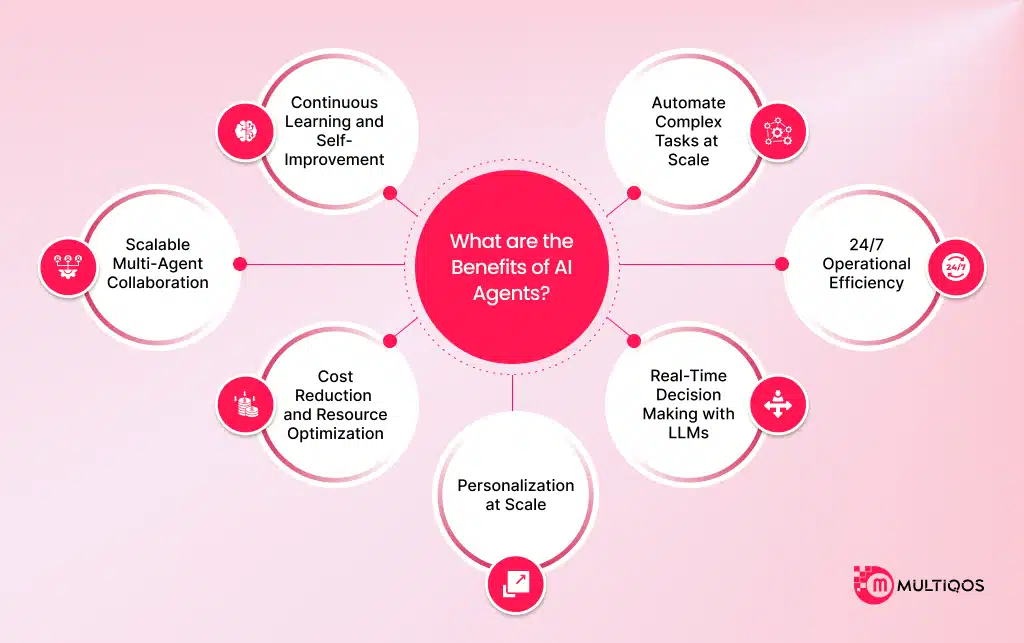
1. Automate Complex Tasks at Scale
AI agents excel at handling repetitive, logic-driven tasks that once required human oversight. From customer support workflows to logistics management, intelligent agents can manage these processes autonomously, reducing manual effort and minimizing errors. With the help of AI agent tools and best AI agent frameworks, businesses can now automate at a scale that was unthinkable just a few years ago.
2. 24/7 Operational Efficiency
Unlike human employees, AI agents don’t need sleep. Once deployed, they operate around the clock, boosting productivity and maintaining consistency across time zones. This makes them a game-changer for industries that rely on global operations and real-time responsiveness.
3. Real-Time Decision Making with LLMs
AI agents equipped with Large Language Models (LLMs) can analyze vast datasets and make intelligent decisions in real time. This means dynamic adaptation to user behavior, improved forecasting, and faster resolutions. Many AI development services now integrate LLMs to empower smarter automation and enhanced decision-making.

4. Personalization at Scale
The e-commerce sector has greatly benefited from the integration of AI, with automated chat systems offering intelligent interactions with hyper-personalized recommendations. The right AI agent development solutions enable real-time customer data analysis, offering targeted content, promotions, and assistance tailored to individual preferences.
5. Cost Reduction and Resource Optimization
Perhaps the singular outstanding benefit associated with AI agents is the cost-saving advantages for the productivity of a firm. Automating manual workflows allows for a reduction in costs and also allows the skills of personnel to be utilized in more beneficial areas. Organizations that collaborate with proficient AI agent programmers usually observe an ROI within a few months post-implementation.
6. Scalable Multi-Agent Collaboration
In systems with higher levels of complexity, multi-agent systems permit the interaction of various AI agents to achieve a common objective. This type of coalition intelligence is highly beneficial for domains such as logistics, robotics, and even financial trading, where per-microsecond synchronizations count.
7. Continuous Learning and Self-Improvement
AI agents do not remain stagnant– they advance. Due to machine learning and feedback loops, they improve their performance based on every interaction over time. When you hire AI agent developers who focus on adaptive systems, you are putting money into solutions that bifurcate in intelligence the longer they operate.
Types of AI Agents
There exist variations in terms of environmental perception, decision-making, and learning processes among different AI agents. Understanding the variations would assist in selecting an appropriate type that solves your business problem without overengineering. There are five types of AI agents, starting from the simplest one up to the most sophisticated one.
1. Simple Reflex Agents
Simple reflex agents make decisions based solely upon the current percept, using the “if-then” type of decision rule. They do not have any recollection of previous events.
How it works: if a condition is met, the agent triggers a fixed action.
Example: a rule-based email filter that routes messages containing “invoice” to the finance folder, or a thermostat that switches on heating below a set temperature.
Best for: predictable, stable environments with clear rules.
Limitation: they fail when the situation is new or when the right action depends on history.
2. Model-Based Reflex Agents
These agents maintain an internal representation of the world, which allows them to operate even when they cannot see everything in full. The changing nature of the environment is observed, and it is used to inform action choices.
How it works: the agent combines current input with stored knowledge of past states.
Example: a support bot that remembers earlier messages in a conversation, or a robot vacuum that maps rooms and remembers what it has already cleaned.
Best for: dynamic environments where information is often incomplete.
Limitation: they still follow rules and don’t pursue goals on their own.
3. Goal-Based Agents
Goal-based agents choose actions by asking, “Will this get me closer to my objective?” They evaluate possible action sequences and pick a path to the goal.
How it works: the agent uses search and planning to compare options against a defined target.
Example: a navigation agent that finds a route to a destination, or a scheduling agent that arranges meetings to meet a deadline.
Best for: tasks with clear objectives and several ways to reach them.
Limitation: they treat every successful path as equal, without weighing quality or trade-offs.
4. Utility-Based Agents
Utility-based agents aim for the best outcome, not just any outcome. They score each possible result with a “utility” value and choose the action with the highest expected benefit, balancing cost, speed, risk, and satisfaction.
How it works: the agent weighs trade-offs and maximizes overall value.
Example: a dynamic pricing agent that balances profit against sales volume, or a logistics agent that picks delivery routes balancing time, fuel cost, and reliability.
Best for: decisions with competing priorities and uncertainty.
Limitation: defining a good utility function takes careful design.
5. Learning Agents
Learning agents improve over time. They start with basic knowledge, learn from feedback and experience, and adjust their behavior without being reprogrammed. Most modern LLM-powered agents include learning or feedback loops.
How it works: four components work together: a learning element that improves the agent, a performance element that acts, a critic that gives feedback, and a problem generator that suggests new experiments.
Example: a recommendation engine that gets more accurate with every click, or a fraud detection agent that adapts to new attack patterns.
Best for: changing environments where rules can’t be fully defined in advance.
Limitation: they need quality data and monitoring to avoid learning wrong behavior.
6. Multi-Agent Systems (Advanced Type)
The multi-agent category indicates the way that many agents interact with one another. It is an ensemble of agents existing within the same environment and fulfilling certain roles in an effort to accomplish a common goal. In contrast to a lone agent, a multi-agent system is made up of specialist agents and a manager.
How it works:
- A complex goal is split into smaller subtasks.
- Each agent gets a role, tools, and instructions (for example, researcher, writer, reviewer).
- Agents share information through messages or a shared memory.
- An orchestrator, or the agents themselves, decides who acts next and resolves conflicts.
- Results are combined into one final output.
Common architectures:
- Collaborative: agents share a goal and combine their outputs, such as research, drafting, and editing agents in a content pipeline.
- Competitive: agents pursue their own goals, as in trading simulations, or a “critic” agent deliberately challenges another agent’s answer.
- Hierarchical: a manager agent delegates to worker agents and reviews results. This is the most common business design because control and accountability stay clear.
- Decentralized (swarm): no central controller; many simple agents follow local rules and produce intelligent group behavior, as in drone fleets.
- Sequential (pipeline): agents work in a fixed order, each passing output to the next.
Example: a customer support setup where a triage agent classifies tickets, a knowledge agent finds answers, and an escalation agent hands complex cases to a human. Teams exploring AI agents in revenue operations often use the same pattern, with separate agents for lead scoring, CRM updates, and forecasting.
Benefits:
- Specialization: each agent is tuned for one job, which improves accuracy.
- Scalability: add agents to handle more work without rebuilding the system.
- Parallel processing: agents work at the same time, so complex tasks finish faster.
- Reliability: review agents can catch errors before output reaches users.
- Modularity: you can update or replace one agent without affecting the rest.
Challenges:
- Coordination overhead: more agents means more communication and slower responses.
- Error propagation: one agent’s mistake can pass down the chain without a validation step.
- Higher cost: several agents calling LLMs adds token and compute expense.
- Debugging difficulty: tracing a decision across many agents is harder.
- Security: agents with tool access need clear permissions and human approval for sensitive actions.
Top AI Agent Tools and Frameworks
To successfully build an AI agent, you need the right tools and AI agent frameworks overview that support flexibility, scalability, and intelligent behavior. Below are some of the best AI agent frameworks and platforms that power today’s most advanced autonomous agents and multi-agent systems.
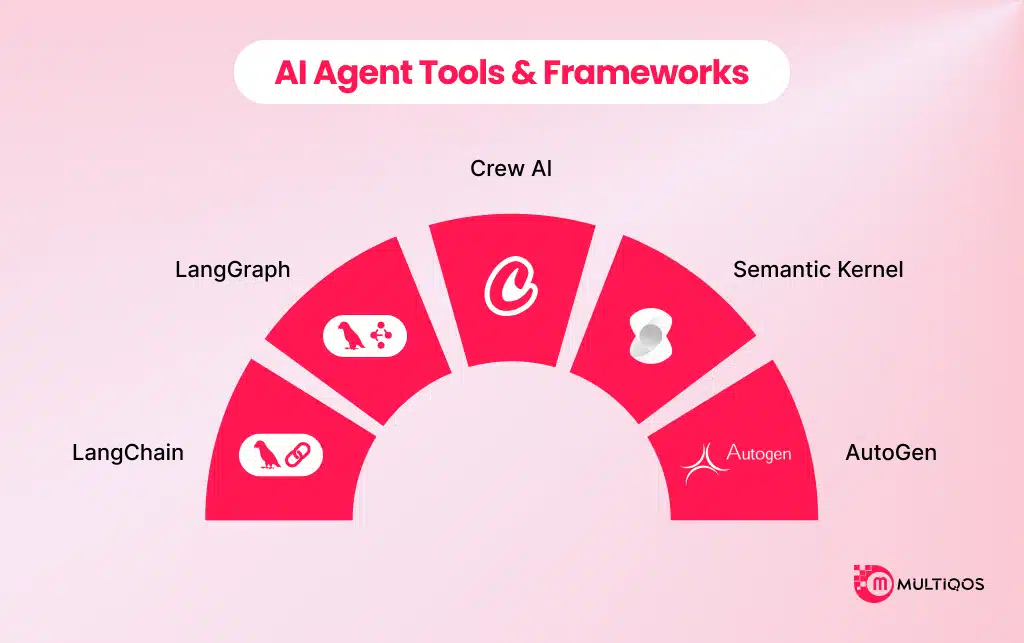
LangChain
LangChain is a popular choice in AI agent development, enabling agents to interact with data sources, tools, and APIs while managing context through chains of prompts.
LangGraph
LangGraph extends LangChain’s capabilities, making it ideal for building multi-agent systems where agents communicate and collaborate effectively.
Crew AI
Crew AI focuses on coordination, allowing multiple agents to function as a team. It’s widely used in complex workflows and collaborative AI Agent examples.
Semantic Kernel
Developed by Microsoft, Semantic Kernel lets developers integrate natural language understanding into AI agents. It’s a go-to for teams looking for enterprise-grade AI agent tools.
AutoGen
AutoGen supports customizable and reusable agent architectures. It’s excellent for those aiming to build an AI agent that can adapt and scale across various use cases of AI Agents.
Want to know more about the latest AI Agent tools and frameworks?
Check out our recent article about AI Agent framework comparison and learn everything in detail.
How to Build an AI Agent?
AI agent development starts with a clear vision and the right tech stack. Here’s a step-by-step overview to help you build an AI agent that delivers value from day one.
Choose a Use Case and Define Goals
The first step in AI agent development is identifying a specific problem your agent will solve—whether it’s customer support, data analysis, or automation.
Select Your Framework and Tools
Choose by comparing AI agent frameworks like LangChain or AutoGen. The right tools are critical to efficient AI agent development.
Set Up Data Inputs and APIs
Effective AI agent development requires seamless access to data. Integrate APIs and define input channels your agent will use.
Program Agent Logic or Use LLM Prompts
Use custom logic or LLM-based prompting strategies as part of your AI agent development process to enable smart decision-making.
Add Memory and Feedback Mechanisms
For dynamic behavior, AI agent development should include memory systems and feedback loops that support learning and adaptation.
Test, Fine-Tune, and Deploy
Thorough testing and iteration are key. Finalize your AI agent development by deploying it in real-world conditions and monitoring performance.
After understanding how to build an AI Agent and how an AI Agent works, are you concerned about the cost of AI Agent development? We’re just a click away!

Future Trends in AI Agent Development
As technology evolves, AI agent development is entering a new era—one defined by intelligence, autonomy, and deeper integration into our daily lives. Here are the key trends shaping the future:
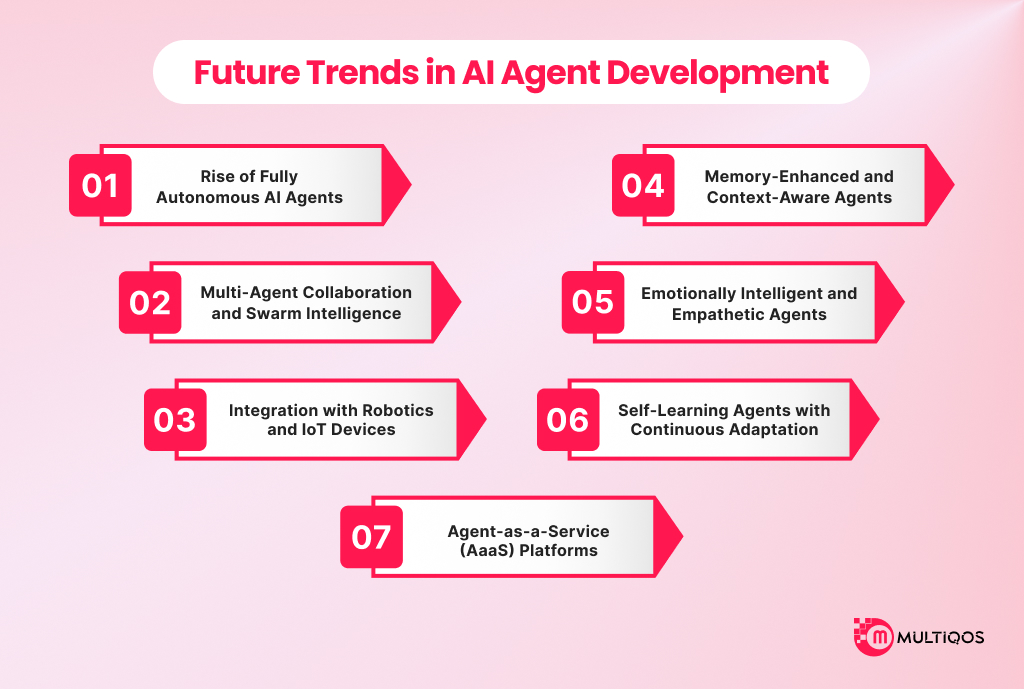
Rise of Fully Autonomous AI Agents
The next phase of AI agent development is focused on creating agents that can make complex decisions and act entirely on their own with minimal human input.
Multi-Agent Collaboration and Swarm Intelligence
AI agent development is moving toward systems where multiple agents work together, mimicking swarm intelligence to solve tasks more efficiently and at scale.
Integration with Robotics and IoT Devices
With the growth of smart devices, AI agent development is expanding into the physical world, enabling seamless integration with robotics and IoT environments.
Memory-Enhanced and Context-Aware Agents
Advanced AI agent development includes long-term memory and contextual awareness, allowing agents to personalize interactions and adapt over time.
Emotionally Intelligent and Empathetic Agents
Human-centric AI agent development is prioritizing emotional intelligence, building agents that understand tone, sentiment, and user intent on a deeper level.
Self-Learning Agents with Continuous Adaptation
Modern AI agent development focuses on self-learning models that continuously improve from feedback, ensuring agents evolve with user needs.
Agent-as-a-Service (AaaS) Platforms
The rise of AaaS is transforming AI agent development into a plug-and-play service model, allowing faster deployment and integration across industries.
How to Hire the Right AI Agent Development Partner?
Finding the right team for AI agent development can make or break your project. Whether you’re building from scratch or scaling existing agents, it’s essential to choose a partner who understands your industry, tech needs, and long-term goals. Here’s how:
- Look for hands-on experience with AI agent tools and frameworks like LangChain, AutoGen, or Semantic Kernel
- Review case studies or AI agent examples relevant to your use case
- Ask about their process for prototyping, testing, and deployment
- Ensure they offer post-launch support and ongoing optimization
- Check client testimonials and reviews for trustworthiness
- Prioritize partners who stay current with trends in autonomous and multi-agent systems
For a deeper checklist, wait for the upcoming blog: Tips for Hiring a Trusted AI/ML Development Company, where we’ll discuss in detail how to choose the right partner for business innovation and success.
Conclusion
AI agent development is reshaping the future of AI agents, automation, decision-making, and personalized experiences across industries. From selecting the right frameworks to deploying intelligent, adaptive systems, building effective AI agents requires both strategic vision and technical expertise. As businesses continue to embrace digital transformation, now is the time to explore how AI agents can drive growth, efficiency, and innovation in your organization.
Frequently Asked Questions
AI agent development process refers to designing, building, and deploying intelligent agents that can perceive, reason, and act autonomously. It involves using AI frameworks, tools, and machine learning techniques to create agents capable of solving tasks, making decisions, and learning from interactions.
Popular tools for AI agent development include LangChain, LangGraph, Crew AI, AutoGen, and Semantic Kernel. These platforms help developers build, manage, and scale intelligent agents efficiently.
Look for an AI agent development company with a proven track record, experience in your industry, expertise in modern frameworks, and solid post-launch support. They should also align with your goals and offer scalable, future-ready solutions.
An ideal AI agent developer should have a strong background in machine learning, Python, prompt engineering (for LLMs), API integration, and experience with frameworks used in AI agent development. Knowledge of multi-agent systems and autonomous behavior is a plus.

Get In Touch

Get Stories in Your Inbox Thrice a Month.
A Comprehensive Guide on How Machine Learning is Transforming the Factory Floor
MultiQoS Technologies Named an OpenAI Select Partner
What is a Forward Deployed Engineer? Roles, Responsibilities, and Skills Explained