
FDE vs. Solutions Engineer: What’s the Difference?
Need quick insights? Summarize with AI & save time
 ChatGPT
 Perplexity
 Claude
 Google AI Mode
Table of Content:
- What is a Forward Deployed Engineer?
- What is a Solutions Engineer?
- FDE vs. Solutions Engineer: Key Differences
- FDE vs. Solutions Engineer: Roles and Responsibilities
- FDE vs. Solutions Engineer: Skills and Expertise
- When is an FDE the Better Fit Than an SE?
- When Should You Choose a Solutions Engineer?
- How do FDEs and Solutions Engineers Work Together?
- How to Determine Which Role Your Business Needs?
- Conclusion
- FAQs
Summary :
A solutions engineer proves a product fits before the contract is signed. A forward-deployed engineer makes it work inside the customer’s environment after signature. This blog covers the difference between FDE vs. solutions engineer in terms of lifecycle stage, skills, code ownership, and success metrics. It also explains how they hand off to each other and gives a diagnostic framework for deciding whether your business needs an SE, an FDE, or both.
While every enterprise AI solution vendor would always blame the demo, the real issue behind such a stall is:
- lack of proper scope
- need for technical expertise
- legacy systems that block integration of modern AI systems
This is where the difference between a forward-deployed engineer and a solutions engineer comes into play. While this may sound like two different job titles, many recruiters view forward-deployed engineer and solutions engineer as interchangeable roles.
So what is the difference between FDE vs. solutions engineer?
A solutions engineer can help an organization understand if their product is even feasible before they sign a contract. At the same time, a forward-deployed engineer helps organizations make a product work even after they have signed the contract.
And if you’re still not convinced about the differentiation and you’re still confused, this piece helps you with all the details that you need to understand the difference between a forward-deployed engineer and a solution engineer, To understand the broader role and responsibilities of an FDE, explore our guide on what a forward deployed engineer does focusing on the roles that both play and which one you should pick for your project.
What is a Forward Deployed Engineer?
A forward-deployed engineer, or FDE, is a high-level software engineer who works directly with enterprise customers to design, customize, and deploy technical systems. These can be AI-based systems or data platforms that work in real-world production environments. Traditional software engineers help build generic products from inside a company’s internal team.
Where the Role Came From (Palantir)
Forward-deployed engineering models were first introduced by Palantir. It did something different from the traditional model of shipping a platform and letting the customers’ IT team figure out all the configurations.
Rather than that, Palantir sent its own engineers to sit with government and commercial customers so that they could embed with their existing teams, work inside their environments, and shape the software around the mission in front of them.
Why Enterprises and Consultancies are Building FDE Practices in 2026
Enterprise AI adoption has hit an integration wall. Research indicates that roughly 95% of enterprise generative AI pilots fail to generate measurable business value. There is also a deployment gap. Most of the foundation models do perform really well, but that happens in a sandbox environment. FDE solves this problem by offering end-to-end deployment support within the enterprise environment.
The biggest gap that enterprises face is post-sale support. The enterprise deployment stalls when these models encounter real-world environments. There are issues with strict security parameters, complex authentication stacks, and data infrastructure restrictions.
This is where the FDE vs Solutions Engineer debate becomes crucial. Enterprise AI implementation therefore needs post-sale engineers, and FDE offers that post-sale support. They ensure AI pilots reach production and meet outcomes as per organizational goals.
What is a Solutions Engineer?
In a typical technical sale, two people carry the deal on the vendor’s side. The account executive (AE) runs the commercial conversation. The solutions engineer, sometimes titled pre-sales engineer, runs the technical one.
What does the product mean for this particular buyer?
The SE has to answer that, and then back the answer up. Usually that happens over discovery calls and demos built around the buyer’s own data and workflows, plus a proof of concept (PoC) if the buyer wants evidence before they sign.
The split with the AE is fairly clean. The AE looks after the relationship and the commercial terms. The SE looks after credibility. When a security lead or chief architect on the buyer’s side starts poking at the awkward questions, it’s the SE they turn to, and they expect good answers.
Solutions Engineer vs. Sales Engineer vs. Solutions Architect
Solutions engineer and sales engineer get used for the same job at plenty of companies. The term “sales engineer” leans toward quota and “solutions engineer” toward advice.
Solutions architects are a separate case.
At a lot of organizations, they design the larger, complex deployments and stay on the account long after the deal is done.
Because titles drift from company to company, the title itself won’t tell you much. Two questions will. When in the deal does this person do their work, and what number are they held to?
What the Modern Buyer Expects From Technical Sellers
Buyers don’t want to spend much time with salespeople anymore. A 2025 Gartner survey of B2B buyers found that 61% prefer an overall rep-free buying experience. It also found that 69% had come across inconsistencies between a supplier’s website and what its sellers told them.
For the SE, that raises the bar. Someone who agrees to a technical call has probably done their research already, and they’re after straight answers on integration, security, and fit.
FDE vs. Solutions Engineer: Key Differences
Here is a side-by-side comparison of FDE vs. Solutions Engineer
| Dimension | Solutions Engineer (SE) | Forward Deployed Engineer (FDE) |
|---|---|---|
| Lifecycle stage | Pre-sale | Post-sale |
| Primary goal | Prove technical fit and win the deal | Ship the product into production and drive adoption |
| Code they write | Demos, prototypes, PoC scripts | Production integrations, pipelines, and customer-specific features |
| Typical engagement length | Days to weeks per account | Weeks to months per account |
| Usual reporting line | Sales or sales engineering | Engineering, deployment, or customer success |
| Success metric | Win rate, deal size, technical win | Time-to-value, adoption, retention |
| Main stakeholders | Buying committee, architects, security reviewers | End users, platform owners, data and IT teams |
| Handover output | Discovery notes, PoC results, commitments made | Running system, documentation, field feedback to product |
FDE vs. Solutions Engineer: Roles and Responsibilities
Forward Deployed Engineer Responsibilities
- Spend time with day-to-day users and capture what they actually need
- Build the integrations the customer needs and keep them running
- Fit the product to each customer’s workflows without forking the core codebase
- Deploy the solution in the customer’s production environment, then monitor it and debug it there
- Leave the customer’s internal teams able to run and extend the solution on their own
- Pass recurring field requirements back to the product team as candidates for core features
Solutions Engineer Responsibilities
- Run technical discovery so deals are qualified and blockers surface early
- Tailor each demo to the prospect’s own data and workflows
- Scope the PoC, agree on success criteria before it starts, and see it through
- Handle RFPs and security questionnaires, and sit in on architecture reviews
- Field technical objections as they come up
- Write up every commitment before the handoff
Where Responsibilities Overlap (and What Goes Wrong When They Blur)
Some overlap can’t be avoided. Both roles do discovery, and both write code, and both spend a good deal of time with the customer’s architects. At a smaller company, it’s often the same person doing both.
The damage comes from a blur nobody notices. Picture an SE who keeps extending a PoC. That’s unpaid delivery work, and meanwhile the next deal waits. Or an FDE who keeps getting dragged into pre-sales calls, so the shipping stops.
The worst version is when no one owns the handoff at all, and the customer hears one set of promises during the sale and then lives with something else during deployment.
This can be handled by giving each role a unique identity and path. There’s a client outcome lead who answers for business results, and a forward-deployed architect who sets technical direction. The forward-deployed engineers then pull AI assets, agents, and applications together into solutions that work.
FDE vs. Solutions Engineer: Skills and Expertise
| Skill area | Solutions Engineer (SE) | Forward Deployed Engineer (FDE) |
|---|---|---|
| Core technical skill | Deep product knowledge, demo environment design | Production-grade software engineering |
| Integration knowledge | APIs and integration patterns, enough to explain feasibility | APIs, data pipelines, authentication, and infrastructure, enough to build and run it |
| Security and compliance | Answering questionnaires and reviews accurately | Implementing controls inside the customer’s environment |
| Coding depth | Scripting and prototypes | Full ownership of code in production |
| Communication | Storytelling, objection handling, executive presentations | Requirement gathering, working sessions with end users |
| Business skill | Mapping capabilities to buyer outcomes | Judging when to customize and when to standardize |
| Working mode | Many accounts at once | Deep focus on one or a few accounts |
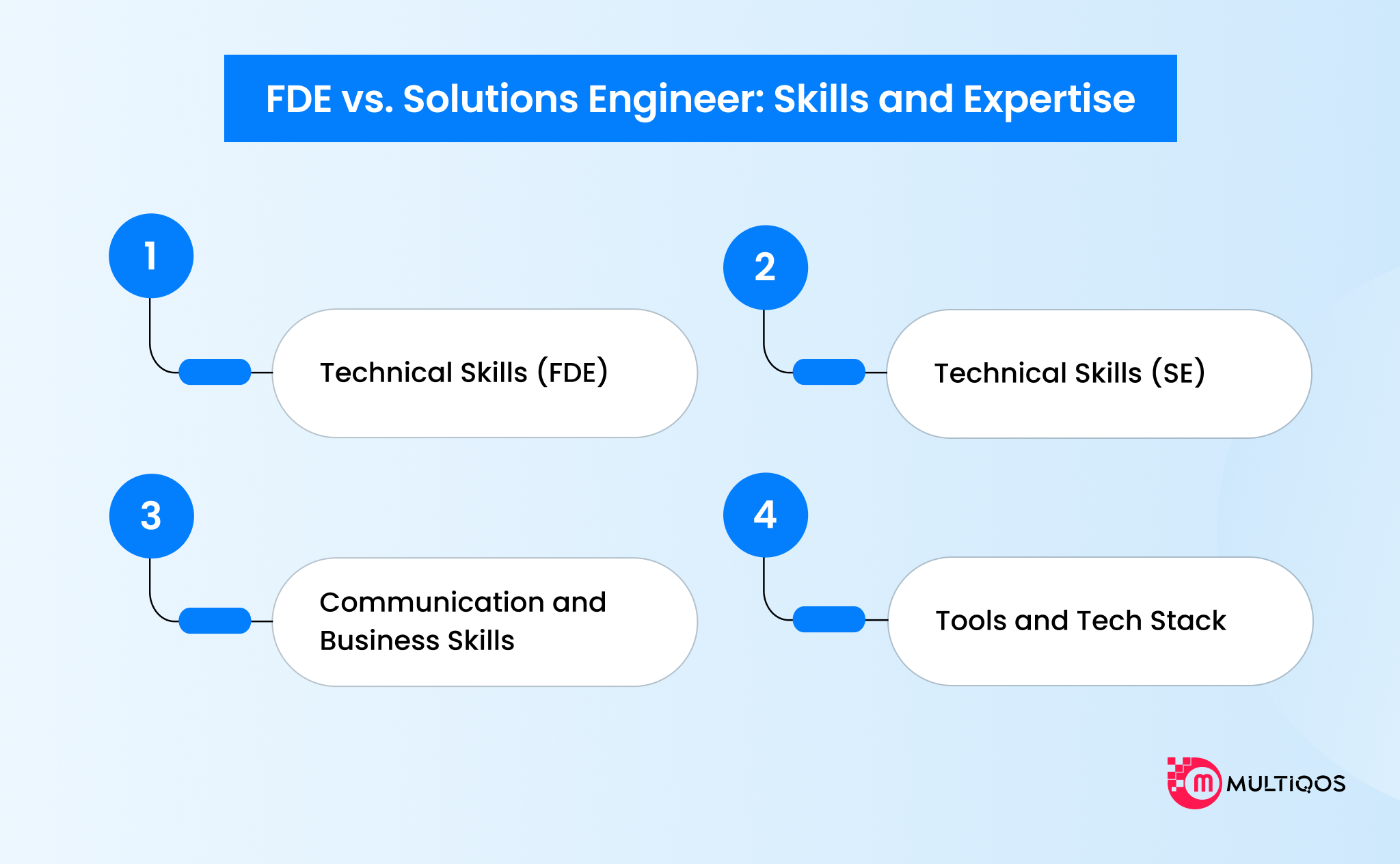
Technical Skills (FDE)
Forward deployed engineer skills begin with the basics of any good product engineer. On top of that, an FDE has to be at ease in somebody else’s stack. In practice, that’s production reliability, systems integration, and a working knowledge of data engineering.
Add the temperament to debug a live system when half the facts are missing, because that happens more than anyone would like.
With AI products, the list gets longer. Retrieval pipelines show up, then model evaluation, guardrails, and the orchestration of agents.
Technical Skills (SE)
For an SE, product knowledge comes first, and it has to go deep. They also need a decent instinct for how the buyer’s architecture is likely put together.
Other solutions engineer skills follow from that: a solid grasp of APIs and integration patterns, familiarity with the main security frameworks, and enough scripting ability to stand up a convincing PoC quickly.
An SE doesn’t run software in production. They do need to know what will survive once it gets there.
Communication and Business Skills
The less obvious split is in how each role talks to customers. An SE persuades. They read the room, link technical features to business outcomes, and keep a buying committee heading the same way.
An FDE translates. They sit with operators and process owners until they understand what the workflow really needs. If a request would saddle the customer with technical debt, a good FDE says so.
Tools and Tech Stack
On the SE side, the day runs through CRM platforms, demo and sandbox environments, call recording tools, and knowledge bases.
An FDE spends the day somewhere else, deeply integrated into the customer’s native architecture:
- Cloud Platforms: Navigating environments like AWS, GCP, or Azure.
- Source Control and CI/CD: Managing workflows in GitHub Actions, GitLab CI, or Jenkins.
- Observability: Monitoring systems via Datadog, Prometheus, or Grafana.
- Data and APIs: Querying and integrating with platforms like Snowflake, BigQuery, or Supabase.
When is an FDE the Better Fit Than an SE?
The sales team keeps closing, and the deployments keep slipping. That points to a delivery bottleneck. Adding demo capacity does nothing for it, because getting from proof of concept to production needs engineers who own the work after the contract is signed.
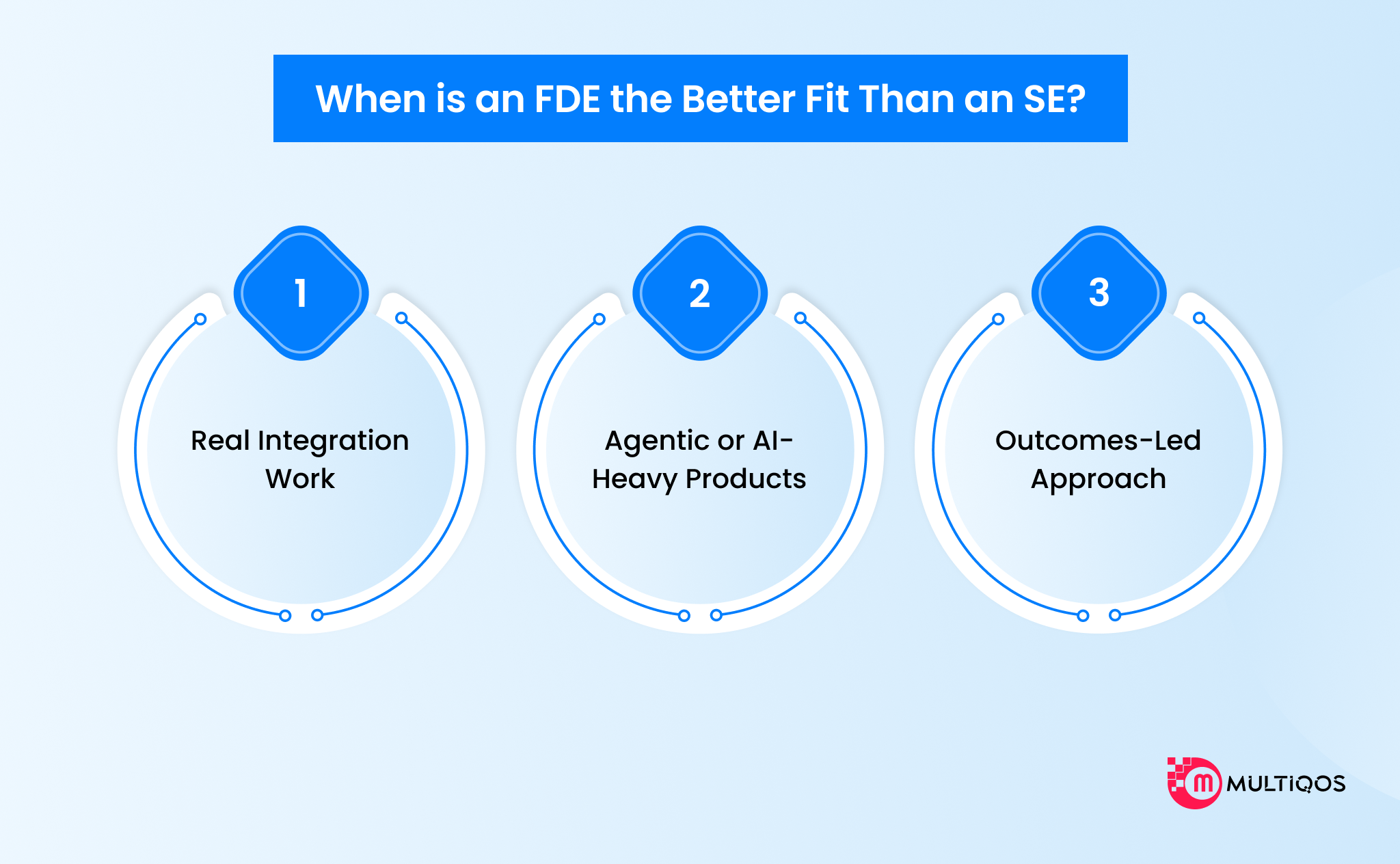
Real Integration Work
A few products install cleanly almost anywhere. Most enterprise software isn’t like that. There’s a legacy system to connect, a data pipeline to build from scratch, or an identity and access setup the security team won’t bend on. When that’s true at account after account, you need engineers who will build the work inside the customer’s environment and then stand behind it.
Agentic or AI-Heavy Products
AI systems don’t stay finished once they go live. Models drift. Data shifts underneath them. Agents, meanwhile, need regular tuning to keep up with the workflows they serve.
Deloitte says only 21% of companies have a mature model for agent governance. So during deployment, it’s usually the vendor’s people who end up carrying that load.
Outcomes-Led Approach
The market has moved from “What can be done with AI?” to “Show me the dividend of your AI investments.” Once your contracts are judged on business results, it’s the FDE who gets you there.
When Should You Choose a Solutions Engineer?
The prospect likes what they’ve seen. Their architects aren’t convinced, though, and so the deal sits. That’s a credibility problem, and an SE will solve it faster than another whitepaper ever could.
POC Before Committing
Many enterprise buyers now want to see the product working on their own data before they sign anything. Fair enough. A tightly scoped PoC, run by an SE against criteria both sides agreed on, gets them that evidence without the evaluation dragging on for months.
Security and Integration Questions
Security questionnaires can add weeks to a deal cycle. So can architecture reviews and integration feasibility checks. Having an SE who knows the product well means those answers are right the first time, and the buyer doesn’t have to come back with follow-up rounds.
Deployment Stall
Look at where your core engineers spent last week. If more and more of it went on sales calls, product velocity is going to suffer. That’s a fairly clear signal to add dedicated SE capacity, so engineering can get back to building the product.
How do FDEs and Solutions Engineers Work Together?
| Stage | Solutions Engineer (SE) | Forward Deployed Engineer (FDE) |
|---|---|---|
| Discovery | Leads technical discovery and maps the buyer’s environment | Gives input on deployment feasibility for complex accounts |
| Demo/PoC | Builds and runs the demo or PoC | Advises on what is realistic in production |
| Technical validation | Answers security, architecture, and integration reviews | Reviews commitments that affect delivery |
| Deal closed | Records scope, promises, and success criteria | Reviews that record before kickoff |
| Handoff | Briefs the FDE and introduces customer stakeholders | Takes ownership of the technical relationship |
| Integration | Available for context on earlier decisions | Builds integrations and customizations |
| Production | Moves on to new deals | Deploys, monitors, and stabilizes the solution |
| Customer feedback | Uses outcomes as references in future deals | Feeds recurring needs back to the product team |
How to Determine Which Role Your Business Needs?
Here is a framework that will help you determine what to choose between FDE vs. Solutions Engineer.
Five Diagnostic Questions
- Where do your deals slow down: before signature, or after it?
- How much custom integration does a typical enterprise customer need?
- Are your core engineers getting pulled into sales calls, or into customer deployments?
- Does the product need ongoing tuning after go-live, the way agentic and AI systems do?
- When customers renew, is it because of adoption and business outcomes, or because of features?
Scoring Table: SE, FDE, or Both
| Signal | Points to SE | Points to FDE | Points to both |
|---|---|---|---|
| Deals stall at technical validation | Yes | ✖ | ✖ |
| Signed accounts stall at go-live. | ✖ | Yes | ✖ |
| Heavy custom integration per customer | ✖ | Yes | ✖ |
| Buyers ask for PoCs on their own data | Yes | ✖ | ✖ |
| AI or agentic product needing post-launch tuning | ✖ | Yes | ✖ |
| Growing deal volume and a growing deployment backlog | ✖ | ✖ | Yes |
Questions to ask a Vendor Selling FDE Services
A few questions are worth putting to any vendor before you sign:
- Once the engagement ends, who owns the IP and the code?
- How will knowledge move across to our internal teams, and by when?
- Which executive sponsor answers for business outcomes, rather than just the implementation budget?
- What does your exit look like, and what will prove we can run this on our own?
Build, Hire, or Rent
An in-house FDE team gives you full control. The catch is finding the people. Hiring is slow, too. If you need to hire forward-deployed engineers sooner than recruiting allows, a staff augmentation partner can put experienced people into the customer environment.
While you build up your own bench. Plenty of organizations end up doing both, augmenting for the deployments in front of them and hiring for the long run.
Conclusion
Strip the forward-deployed engineer vs. solutions engineer debate down, and you’re left with one question.
Where’s your bottleneck? If deals stall before signature, hire a solutions engineer.
If signed customers stall before production, hire a forward-deployed engineer. And if you’re seeing both, you need both roles, joined by a handoff that’s actually managed.
Whichever route you take, make sure someone owns the path from proof to production. A deal that never gets there doesn’t stay a win for very long.
FAQs
Timing, to say the least. The SE’s work is done before signature; the FDE’s work starts after it. From that, everything else. What code they write, how they are measured, who they report to.
Yes. Owning production code is the heart of the role. The integrations, the data pipelines, and the features built for one particular customer all get written by the FDE, and all of them run in that customer’s live environment.
At most companies, yes. SEs usually sit in the sales organization, often in a sales engineering team, and they’re measured on technical wins and closed deals. That said, there’s nothing light about the technical side of the work.
No. Consultants tend to advise and design, whereas an FDE builds software and ships it. An FDE also keeps a direct line to the vendor’s product team, so lessons from the field make their way into the core product.
Look at where things are stuck today and hire for that. Start with a solutions engineer if deals are stalling during evaluation. If it’s signed customers who are struggling to reach production, start with a forward-deployed engineer.

Get In Touch

Get Stories in Your Inbox Thrice a Month.
A Comprehensive Guide on How Machine Learning is Transforming the Factory Floor

MultiQoS Technologies Named an OpenAI Select Partner
What is a Forward Deployed Engineer? Roles, Responsibilities, and Skills Explained