
Cloud-Native Modernization Strategy: A Practical 2026 Guide for Enterprise Teams
Need quick insights? Summarize with AI & save time
 ChatGPT
 Perplexity
 Claude
 Google AI Mode
Table of Content
- Why Most Cloud-Native Modernization Projects Miss Their ROI Targets
- Building Your Cloud-Native Modernization Roadmap: A Phased Approach
- Cloud-Native Architecture Best Practices That Drive Real Scalability
- FinOps and Observability: The Operational Backbone of Cloud-Native Success
- Conclusion
- FAQs
Summary:
This guide outlines how enterprises can successfully execute cloud-native modernization without disrupting ongoing operations. It moves beyond the “lift-and-shift” trap to explore the 7R framework, microservices decomposition, DevSecOps pipelines, and FinOps cost governance. By treating modernization as a comprehensive strategy rather than an IT project, organizations can scale AI workloads and achieve measurable ROI.
By the end of 2026, the market for enterprise cloud spend will exceed $500 billion. However, 27% of all this investment is lost or wasted.
AI’s heavy compute usage and the desire for speedy feature delivery have businesses sprinting towards cloud-native architectures, hoping to realize cost-cutting and increased resilience in a matter of seconds. However, this is not always the case, and the promise does not come standard.
Rather, the organizations end up in the middle of the migration. If you do not realize the need to account for technical debt, then cloud adoption won’t eradicate it. It just moves from on-prem servers to the cloud, where it exponentially grows.
This guide focuses on the fundamental aspects of cloud-native application modernization that not only provide measurable business benefits and ROI, but are also not a silent leak in your IT budget.
Why Most Cloud-Native Modernization Projects Miss Their ROI Targets
Cloud-native application modernization fails in predictable ways. Most enterprises encounter at least two of them before adjusting course.
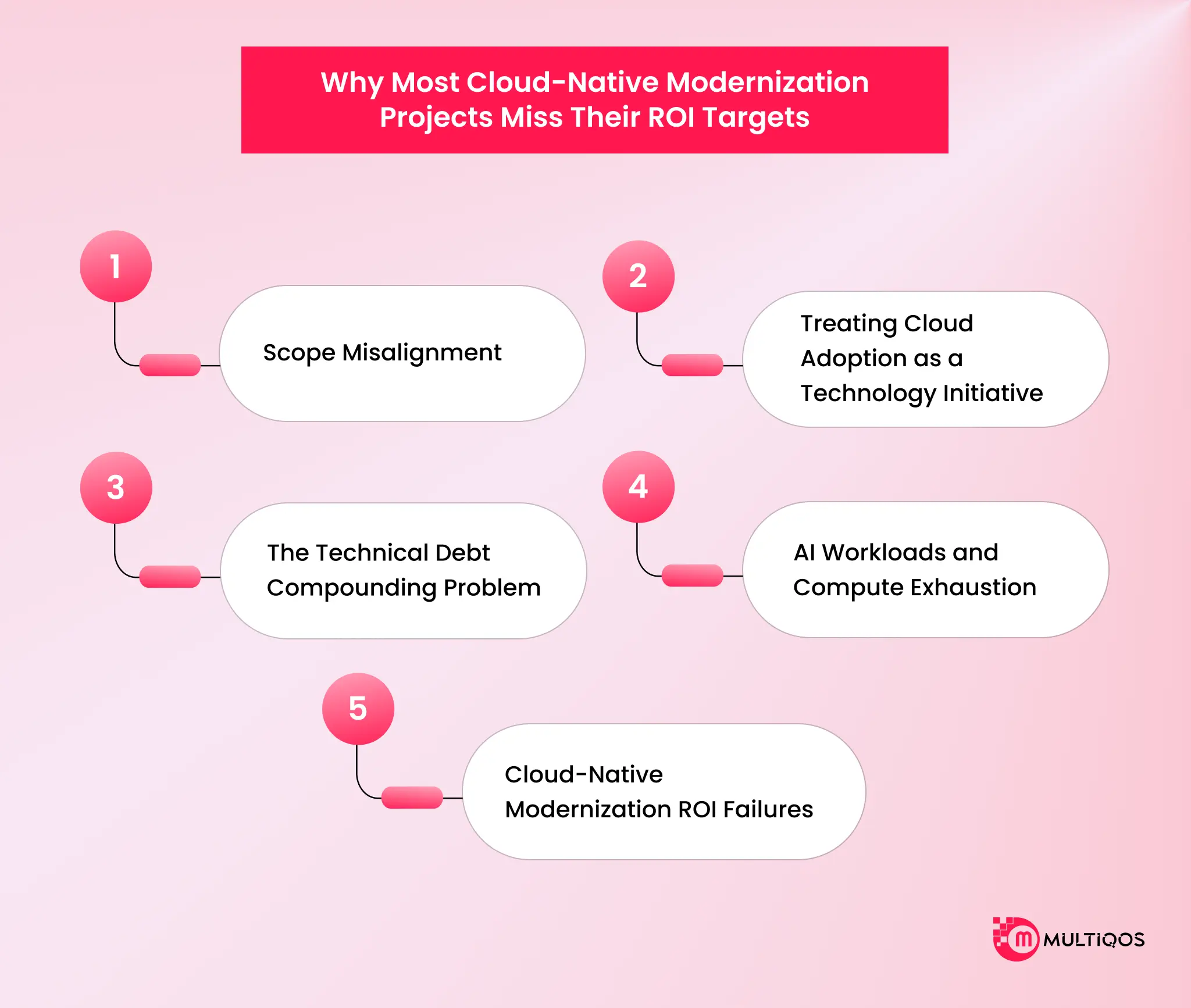
1. Scope Misalignment
Teams consider cloud-native application modernization as a lift-and-shift operation. It is more like moving monolithic applications onto Kubernetes without breaking down the underlying architecture.
Technical debt does not vanish in the cloud, it scales. You can think of it like the cost of past decisions that made the system more complex and more fragile.
2. Treating Cloud Adoption as a Technology Initiative
Organizations that define the cloud opportunity through siloed initiatives, rather than portfolio-wide transformation, see any gains from new deployments offset by ongoing run expenditures on unchanged systems.
3. The Technical Debt Compounding Problem
Technical debt compounds. The more a new capability is added to an outdated system, the more expensive the remediation will be in the future.
The more people that rely on the app, the further away the radius of the incident will spread, and the slower the engineering team’s velocity becomes, as they burn cycles on integration rather than feature delivery.
4. AI Workloads and Compute Exhaustion
The mandate to integrate Generative AI is actively exposing the cracks in legacy infrastructure. Running LLMs, training models, or querying vector databases requires massive, elastic compute. Forcing these AI workloads onto poorly optimized, tightly coupled systems doesn’t just degrade application performance; it causes cloud billing to spiral out of control overnight.
When data is trapped in monolithic silos, AI initiatives inevitably stall. In 2026, establishing genuine deployment independence and scalable microservices isn’t just an IT infrastructure goal. It is the absolute prerequisite for deploying enterprise AI without bankrupting your cloud budget.
5. Cloud-Native Modernization ROI Failures
The 7Rs framework (Retire, Retain, Rehost, Replatform, Repurchase, Refactor, Re-architect) was born due to the fact that every application does not have to be modernized in the same way.
Those that rush ahead and rehost at scale without an application portfolio assessment end up running a cloud system with on-premises operating expenses.
But deploying a microservices architecture using Domain-Driven Design principles, where service boundaries map to actual business domains rather than functional team silos, delivers the independent deployability that cloud-native architecture is supposed to provide.
Building Your Cloud-Native Modernization Roadmap: A Phased Approach
The most durable modernization programs do not start with technology selection. They start with portfolio assessment, and that distinction determines whether the program delivers ROI or simply moves complexity from one environment to another.
A phased cloud-native transformation roadmap runs across three horizons.
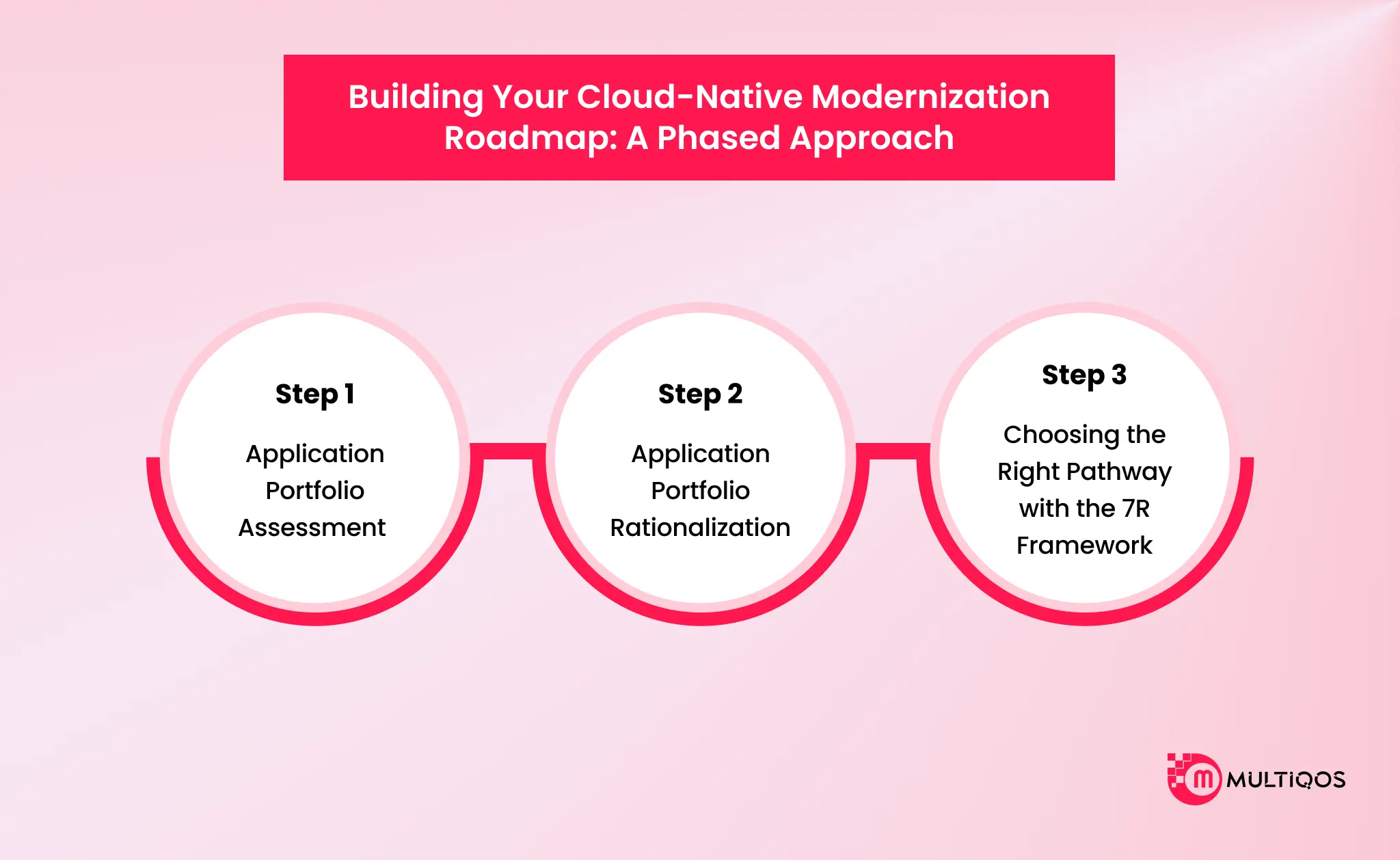
Step 1: Application Portfolio Assessment
Portfolio assessment is not a documentation exercise. It is a financial and risk prioritization exercise. Every application needs a TCO calculation that accounts for infrastructure costs, maintenance labor, integration overhead, and the risk of compliance posture from running unsupported runtime versions.
- Applications that are expensive to maintain but low in business criticality are retirement candidates.
- Applications that are complex, business-critical, and tightly coupled to adjacent systems are re-architecture candidates, and they should be sequenced later in the program.
Organizations that reverse this sequence spend their early program budget on the hardest problems and run out of runway before reaching the wins that sustain executive sponsorship.
Step 2: Application Portfolio Rationalization
Cataloging every application by business criticality, total cost of ownership, technical debt load, and modernization path. This phase produces the sequencing logic, which applications migrate first, which are candidates for retirement, and which require re-architecture before any migration begins.
Step 3: Choosing the Right Pathway with the 7R Framework
Relying on guesswork is a guaranteed path to bloated budgets. You must evaluate your application portfolio using the 7R framework. And if choosing the right pathway to cloud native application modernization seems like a hassle, the best practice is to consult with a cloud expert.
| Migration Strategy | Definition & Best Use Case | Decision Criteria |
| Rehost | Lift and shift to cloud infrastructure. | Low budget, rapid exit from on-prem data center needed. |
| Replatform | “Lift, tinker, and shift” ( moving to managed databases). | Need incremental gains without full code rewrites. |
| Refactor | Optimizing code to leverage cloud capabilities. | High business value applications need better performance. |
| Rearchitect | Full rebuild into cloud-native microservices. | Core strategic systems require maximum scalability and agility. |
| Replace | Moving to a SaaS alternative. | Commodity functions (HR, payroll) where custom code adds no value. |
| Retire | Decommissioning legacy applications. | Redundant systems with zero active users or business value. |
| Retain | Keeping the application as-is on-premises. | High compliance restrictions or latency-sensitive edge workloads. |
Cloud-Native Architecture Best Practices That Drive Real Scalability
Architecture decisions made in year one of a modernization program define the operational ceiling for the next five. Getting service decomposition wrong, drawing service boundaries along functional silos rather than bounded contexts, creates a distributed monolith.
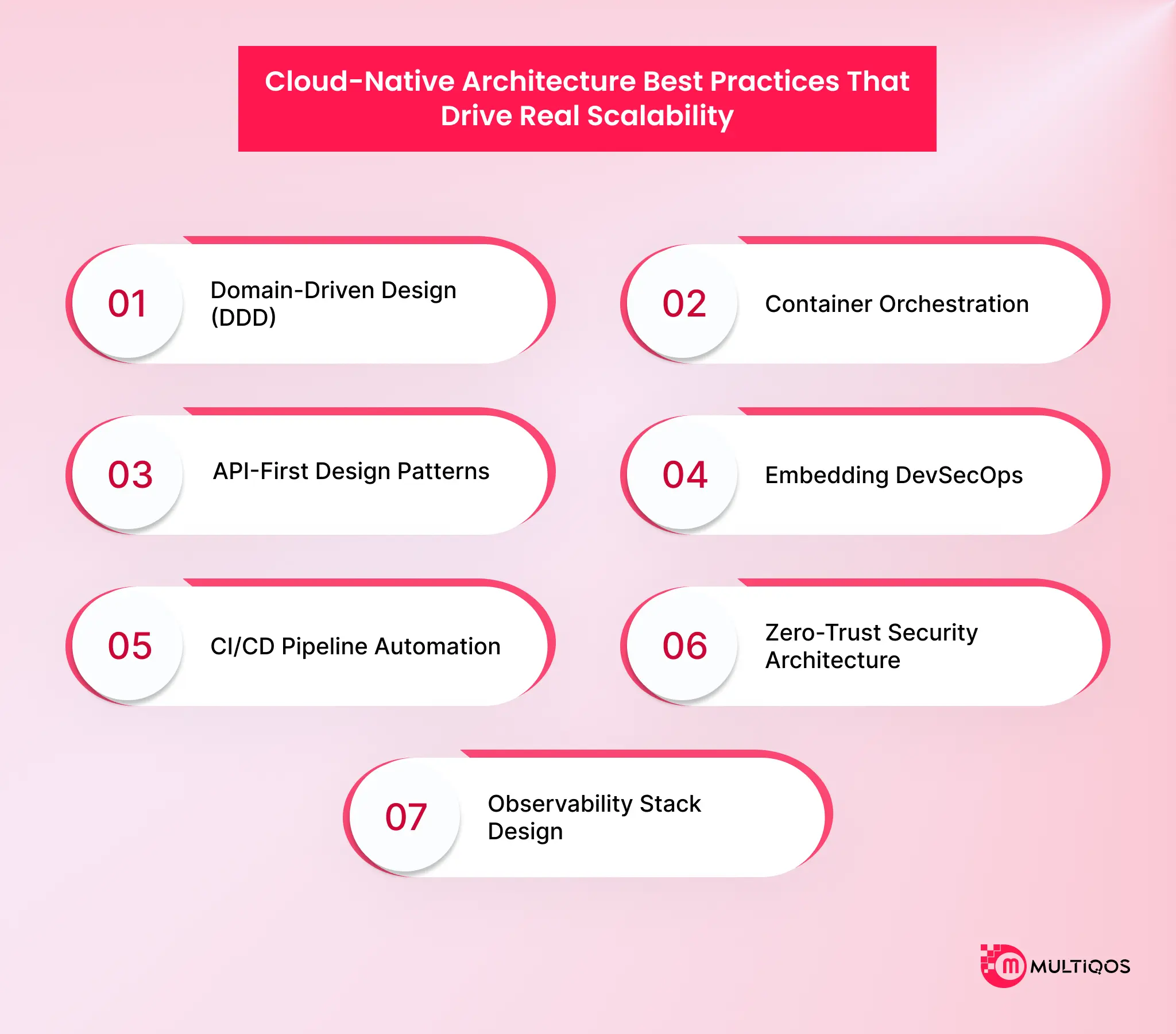
1. Domain-Driven Design (DDD)
It is a software design methodology. In this cloud native architecture best practice, the service boundaries are aligned to business domains and their data ownership, meaning that no other service depends on the deployment, scaling,g or replacement of a dependent service.
The services have their own data store, API versioning surface, and release schedule. Service decomposition naturally leads to the next critical challenge: orchestrating the containers.
2. Container Orchestration.
Kubernetes is a platform, not a solution. When the cluster lifecycle is not managed by a platform engineering team, the risk of running containerized workloads is another one to consider. Production incidents are caused by governance gaps in node auto-scaling, persistent volume management, cluster upgrade, and network policy enforcement.
Platform engineering functions eliminate that complexity from application teams and give them consistent, auditable infrastructure via dedicated teams focused on the internal developer platform.
3. API-First Design Patterns
API-first design is one of the key cloud-native architecture best practices. All interactions between services should be through documented and versioned APIs. Not a matter of style, it is the structural need to be deployable independently.
Once an application uses the direct database dependency of another service’s datastore, the service boundary is destroyed, and the distributed monolith pattern is restored.
4. Embedding DevSecOps
Cloud-native security can’t be a post-deployment checkpoint. The exposure window is open when a vulnerability assessment is made against a deployed container. And this is where you need to include DevSecOps into your cloud native modernization strategy.
DevSecOps is the idea of integrating security gates, such as static security, dependency scanning, container image scanning, and more, directly into CI/CD pipelines, so that security gates are applied before code is delivered to staging.
Network flows that are part of the native infrastructure, along with complete tooling and automation, are becoming standard practice for organizations with the most advanced DevSecOps orchestration.
5. CI/CD Pipeline Automation
Cloud-native workloads have a full-fledged CI/CD pipeline, but it is not simply about automation. Sets up quality gates: unit test coverage levels, integration test pass or fail, container vulnerability scan clean pass, and infrastructure-as-code linting.
Each gate is designed to identify problems in the pipeline, but not in production. However, it’s worth noting that, from the outset, Canary deployments and blue-green releases are included as an integral part of the CI/CD design.
Using a small proportion of production traffic to stress a new release prior to the full rollout minimizes the blast radius of incidents on each deployment. That risk reduction allows teams to move to deploy more often without adding to the team’s operational anxiety.
6. Zero-Trust Security Architecture
Zero trust is a concept in your cloud native modernization strategy where you believe there is no implicit trust between services, regardless of where they are located. Designing a zero-trust security architecture helps you overcome the lack of trust between services.
Service mesh-based deployments like Istio and Linkerd implement mTLS between services, offer fine-grained traffic policies, and allow for the observability data to be generated that is required to detect lateral movement.
When coupled with OPA (Open Policy Agent) for ‘policy-as-code’, you get an audit cycle with an enforcement layer that is auditable, version-controlled, and testable.
7. Observability Stack Design
Observability is different from monitoring. Monitoring will alert you to a service’s availability. Observability provides you with the reason, the first service boundary that failed, and the dependency chain between the failed services at the time of failure.
That picture is composed of the three pillars instrumented: metrics, log,s and distributed traces. OpenTelemetry is now a vendor-neutral approach to instrumenting cloud-native applications and workloads.
Integrated with a platform such as Grafana or Datadog, operations teams can now achieve the correlated signal they need to reduce MTTR from hours to minutes, while avoiding more incidents, and test each deployment with real production traffic data.
FinOps and Observability: The Operational Backbone of Cloud-Native Success
Cloud-native environments fail operationally in two specific ways.
- Cost- Teams provision resources without accountability structures, and the bill compounds month over month.
- Observability: Teams operate services that they cannot clearly see, which means they react to incidents rather than preventing them.
Both problems are solvable. Neither is solved by default.
Deloitte projects $21 billion in savings from FinOps adoption in 2025 alone, with some organizations cutting cloud costs by up to 40%. FinOps (Finance and DevOps) is a financial management discipline that assigns accountability for cloud spend at the team and workload level, replacing opaque billing with granular, actionable cost governance.
FinOps Implementation
At its operational core, using FinOps for cloud-native modernization cost governance requires three capabilities:
- Tagging governance (every resource tagged to a team, application, and cost center)
- Showback or chargeback mechanisms (each team sees its actual cloud cost)
- Reserved capacity optimization (committing to baseline usage at discounted rates while using on-demand capacity for variable workloads).
Half of cloud customers now operate a dedicated FinOps function. The 50% that do not are absorbing costs that are, by industry measurement, 27% higher than necessary. For a $10 million annual cloud budget, that is $2.7 million in waste with a name and an owner, and no accountability structure to close the gap.
Conclusion
In 2026, cloud-native application modernization is no longer a technology selection issue. Most enterprises already have access to Kubernetes, containerization tooling, and microservices frameworks. The weak part of the equation is the tools; the strong part is the execution.
You need to view the cloud as a way of doing business, not just a place to put your data. It requires strict assessments of the portfolio to prioritize migrations according to business value, not by the effort required.
This needs architectural discipline to be truly deployment independent and FinOps governance to be able to ensure every cloud dollar is held accountable. Those who recognize these dimensions as a cohesive business approach, rather than as individual IT projects, will be the ones to effectively scale AI workloads.
FAQs
Legacy Apps are “as-is” th; the cost is premium hourly charges for historically over-provisioned, idle compute. It does not reap the cost savings of the elastic and auto-scaling capabilities of the cloud.
Start slowly and selectively, for example, by re-platforming large, critical components such as databases to managed cloud services first, to achieve operational benefits. Only use full re-architecture to microservices for business-critical systems where maximum scalability is a requirement
“In the cloud” is just another way of saying that traditional applications running in a monolithic style are placed in the vendor’s data center. Cloud-native” is about designing in the cloud with microservices, containers, and automated CI/CD pipelines, to enable independent deployment and genuine elasticity.
AI requires massive, elastic compute that continually challenges tightly coupled legacy architectures, leading to increasingly out-of-control data transfer and compute costs. Modernizing and decouple architecture is a must to sustainably operate AI workloads.

Get In Touch

Get Stories in Your Inbox Thrice a Month.
The Future of Cloud-Native Development: Trends Shaping the Next Decade
The Benefits and Challenges of a Multi-Cloud Strategy
Multi-Cloud Vs Hybrid Cloud: The Main Difference Between Two Cloud Platform