
Agentic AI in Finance: How Autonomous Agents Cut Costs, Reduce Fraud, and Close Times
Need quick insights? Summarize with AI & save time
 ChatGPT
 Perplexity
 Claude
 Google AI Mode
Table of Content
- What is Agentic AI in Finance?
- Agentic AI vs. generative AI vs. traditional automation
- What are the Agentic AI use Cases in Finance?
- Business Impact of Agentic AI in Finance
- Key Challenges of Agentic AI in Finance
- Implementation Roadmap: How to Deploy Agentic AI in Finance
- Best Practices for Successful Enterprise Adoption
- The Window is Open, and it Closes on the Slow Movers
Summary:
Agentic AI in finance is moving the industry beyond basic generative chatbots by deploying autonomous agents that perceive, reason, and act to execute end-to-end financial workflows. Unlike brittle traditional automation, agentic AI dynamically integrates with legacy systems to dramatically cut operational costs, enhance real-time fraud detection, and enable a continuous accounting close. This comprehensive guide explores high-value use cases, the bottom-line business impact of autonomous operations, and a risk-ranked implementation roadmap to help financial institutions deploy governed, compliant AI solutions without falling into common deployment traps.
Most finance leaders are still stuck on a small question: can AI write a memo? The bigger, costlier one is already buried in their balance sheets. McKinsey puts global banking profit pools at roughly $1.2 trillion and figures $170 billion of that, about 9%, could vanish over the next decade if banks don’t rebuild around AI.
That’s not a chatbot number. It comes from agentic AI software that perceives, decides, and acts across finance systems without waiting for a prompt.
This is the shift that actually matters. Generative AI answers you. Agentic AI runs the whole workflow. It offers intelligent workflows with predictive capabilities, ensuring advanced fraud detection. However, understanding what it is, how it works, and what the use case for your finance business matters the most.
This guide covers what agentic AI in finance actually is, where it pays back in numbers you can measure, the business case underneath it, the quiet failure points that sink deployments, and a phased roadmap you can walk straight into your next architecture meeting.
What is Agentic AI in Finance?
Agentic AI in finance is software that runs multi-step financial workflows on its own. Large language models handle the reasoning, and built-in policy libraries.
It doesn’t sit around waiting for a prompt. It spots a trigger, plans out the steps, acts across your core systems, and then checks its own work against the rules you set.
That definition carries a business consequence most vendors skip. An agent that can act is an agent that can act wrongly. Which is why the governance conversation starts on day one, not after the pilot.
How agentic AI works: perceive, reason, act, validate
Agentic AI runs on a continuous execution loop, sometimes called an “observe-decide-act-evaluate” cycle, and it moves enterprise software past static scripts into actually owning the outcome. Here is how the four stages work:
- Perceive (Input / Observe): The agent never stops pulling in live data. Structured or unstructured, it doesn’t matter. Natural-language emails, PDFs, transaction logs, market feeds. It reads everything. And because it builds context as it goes, it slips past the strict formatting rules that make old automation bots seize up the second an input looks a little wrong.
- Reason (Plan / Decide): Hard-coded “if/then” trees are gone. Instead, the agent measures what it just saw against its goals, the business rules, and whatever happened before now. It carves the messy problem into smaller pieces, works through the exceptions one by one, then maps out how to get where it’s going.
- Act (Execute): Plan ready, the agent goes and does it. It reaches for external tools, databases, and APIs, and runs whole workflows right across the systems you already run on: your ERP, your CRM, the core banking stack. These are real moves, not recommendations. Posting ledger entries. Issuing refunds. Rebalancing a portfolio.
- Validate (Evaluate / Learn): After it acts, the system compares what actually happened against what it meant to do. People sleep on this part. The agent runs its own QA, logging feedback, updating memory, and tightening its approach so the next strange edge case goes smoother than the last.
Agentic AI vs. generative AI vs. traditional automation
The three get conflated constantly, and the difference decides where you deploy them.
| Dimension | Traditional RPA | Generative AI | Agentic AI |
| Trigger | Fixed rule/schedule | Human prompt | Event or goal, self-initiated |
| Handles change | Breaks on exceptions | Regenerates text only | Replans around new inputs |
| Acts on systems | Yes, brittle scripts | No, output only | Yes, via governed API calls |
| Best fit | High-volume, stable tasks | Drafting, summarizing | End-to-end workflows with edge cases |
Why Agentic AI Now: The Market and the Business Case
The spend is not speculative. Fortune Business Insights values the global agentic AI market at $7.29 billion in 2025, growing to $139.19 billion by 2034 at a 40.5% CAGR. Financial services sits at the front of that curve because the work is data-dense, rule-bound, and expensive to staff.
Here is what that looks like in real money. McKinsey finds agentic AI could cut banking operational costs by 20% or more, equal to 9% to 15% of operating profits. Early movers could open a 4-percentage-point gap in return on tangible equity over slow adopters before the advantage gets competed away.
The more revealing number is on the downside. The same McKinsey analysis warns that credit card lending and consumer deposit profit pools could fall 34% and 27% as customers let their own AI agents chase yield and cut inertia. Agentic AI is not just an efficiency play. It is a defensive one.
And the caution is real. Gartner expects over 40% of agentic AI projects to be canceled by the end of 2027 due to cost, unclear value, or weak risk controls, based on a poll of more than 3,400 organizations. Yet the same firm projects that by 2028, 15% of day-to-day work decisions will be made autonomously, up from 0% in 2024. The technology is arriving. The discipline to deploy it is the differentiator.
What are the Agentic AI use Cases in Finance?
Treating agentic AI as a set of targeted business solutions, rather than one big platform bet, is where financial institutions start pulling real operational leverage. The value shows up domain by domain, not all at once. Here’s how it plays out across six of them.
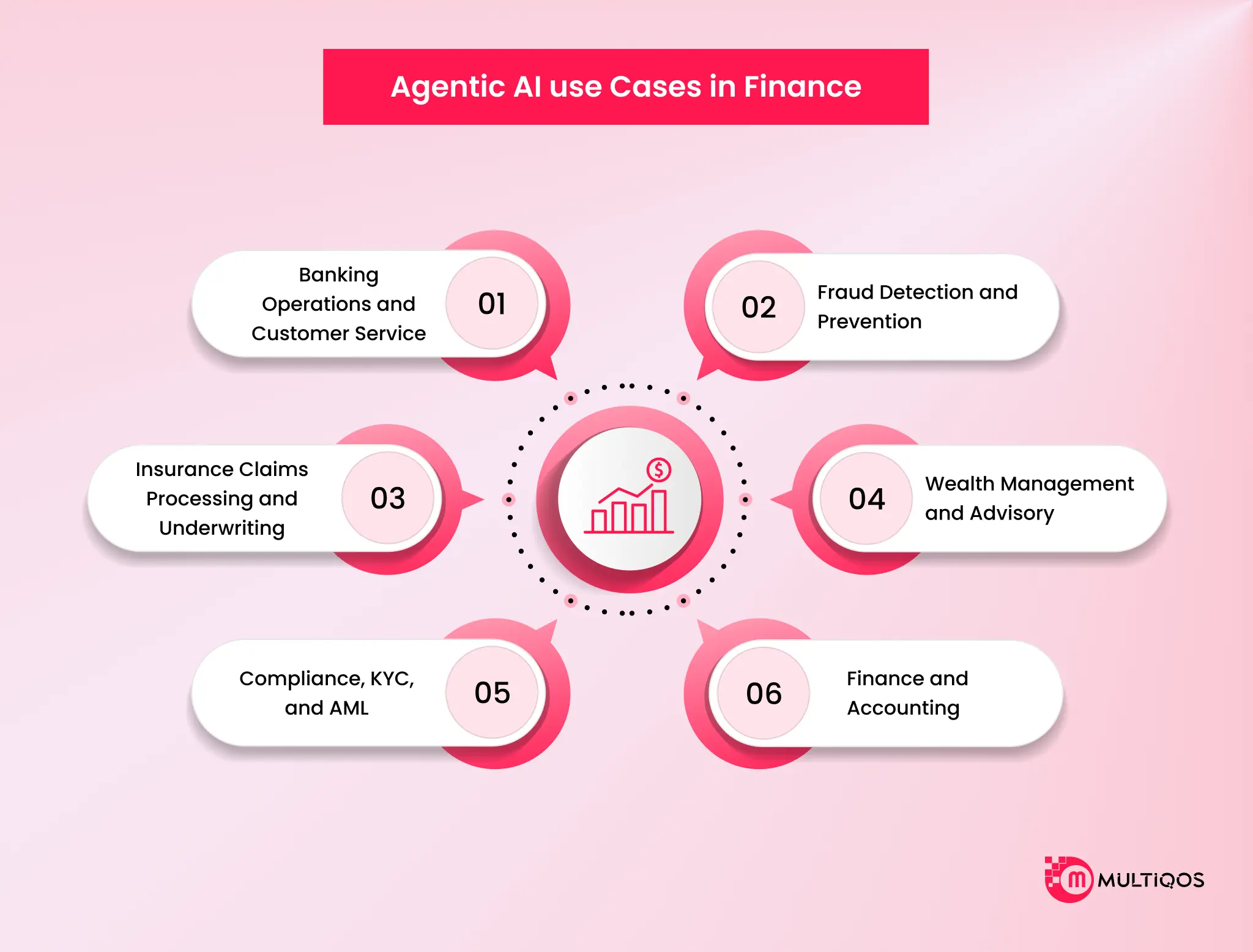
1. Banking Operations and Customer Service
This is the obvious first stop. Agents field routine account and card inquiries, check statuses, and route work on their own, which drains the queue depth that used to pile up behind human reps.
The old IVR hold time starts to disappear. Instead of a customer punching menu options and waiting, the agent understands the request, resolves the common stuff outright, and only hands off the genuinely tricky cases. Operational cost falls because the volume no longer requires a matching headcount.
2. Fraud Detection and Prevention
Fraud is where “reactive” quietly bleeds money. Traditional systems flag an alert, then a human works through it hours later. Agentic AI flips that order. It analyzes all incoming signals, constructs the forensic image, and filters out the noise, freeing up time for analysts to ignore false positives.
For a Fintech business, financial fraud is identified sooner, and legitimate customers are no longer falsely denied. This is why partnering with a Fintech app development service that can offer advanced fraud detection capabilities makes sense.
3. Insurance Claims Processing and Underwriting
Claims triage is a natural fit. The agent pulls policy details, confirms coverage, and assesses the uploaded evidence before an adjuster ever touches the file, which means the straightforward claims move straight through while humans focus on the ones that actually need judgment.
On the underwriting side, agents gather third-party data and apply consistent risk scoring, so the cycle time compresses, and underwriters stop losing hours to manual collection.
4. Wealth Management and Advisory
An agent runs a continuous loop over markets and portfolios. It watches for concentration risk, spots tax-loss harvesting openings, and keeps goal-based plans current, around the clock.
When something moves overnight, it can calculate the exposure and stage tax-optimized rebalancing before the market opens. The advisor keeps the judgment and the client relationship. The grind of portfolio construction and prospecting gets handed off.
5. Compliance, KYC, and AML
Alert fatigue is the real enemy in compliance, and it’s exactly what agents relieve. They triage AML alerts, build the audit trail as they go, and reconcile identity data continuously instead of waiting for a periodic review.
Risk scores update in real time. That turns a compliance practitioner from someone drowning in manual validation into someone supervising a fleet of agents by exception, with far less repeat re-verification aimed at customers who never needed it.
6. Finance and Accounting
Issues in finance ops live in the gaps between disconnected systems: the CRM, the billing platform, the ERP. Agents stitch those together into a “continuous close.”
They read the actual text of signed contracts, check them against billing schedules, and reconcile across ledgers day and night.
Accounts payable, forecasting, AR, all of it runs continuously rather than in a month-end scramble. By the time close arrives, it’s a confirmation, not a frantic hunt for what doesn’t tie out.
Business Impact of Agentic AI in Finance
Agentic AI is rewriting the economics of finance. Institutions are moving off reactive, manual execution and toward systems that run on their own. The payoff isn’t just saved time or trimmed costs. It reaches deeper, into strategy and the P&L, across a few areas that matter:
1. Revenue growth and ROI
Agentic systems hit the bottom line directly. They generate revenue by making hyper-personalized recommendations for services and products, based on the continuous data they have.
It’s the kind of proactive messaging that keeps customers around. The big bucks lie in retention. When you retain a client longer, the rewards of that relationship grow exponentially, which is not often the case with new clients.
2. Growth without the headcount
Here’s the structural shift. Agentic AI lets a bank take on more customers, more transactions, and more complex mandates without hiring in lockstep. Asset managers can absorb more AuM and hand out genuinely customized portfolios, a service that used to be locked away for ultra-high-net-worth clients, because the AI watches and rebalances on its own.
Boston Consulting Group estimates this could cut banks’ overall operational costs by 30% to 40% by 2030.
3. A widening gap between leaders and laggards
The sector is splitting in two. AI leaders and everyone else. Markets are rewarding the ones who moved first, and “fast follower” is starting to look like a losing bet. Wait too long, and you’re stuck with a cost structure you can’t defend while fintech businesses chip away at your customers.
4. Workforce transformation, not replacement
Agentic AI development doesn’t just swap out people. It amplifies them. Once the agents own the observe-decide-act loop for grinding through data, employees move up the ladder into advisory work, relationship-building, the human stuff.
Bank employees could go from spending most of their time on routine execution to focusing almost entirely on client interaction, hard problems, and new ideas.
5. Risk as an edge, not a cost center
Compliance and fraud are usually treated as expensive overhead. Agentic AI flips that. It watches transactions as they happen and adjusts risk models on the fly instead of reacting after the loss. Faster investigations, an audit trail on every decision, and suddenly the thing that used to drain the budget becomes something you can actually compete on.
Key Challenges of Agentic AI in Finance
This is the section that explains the 40% cancellation rate. Deployments fail for reasons that have little to do with the model and everything to do with control.
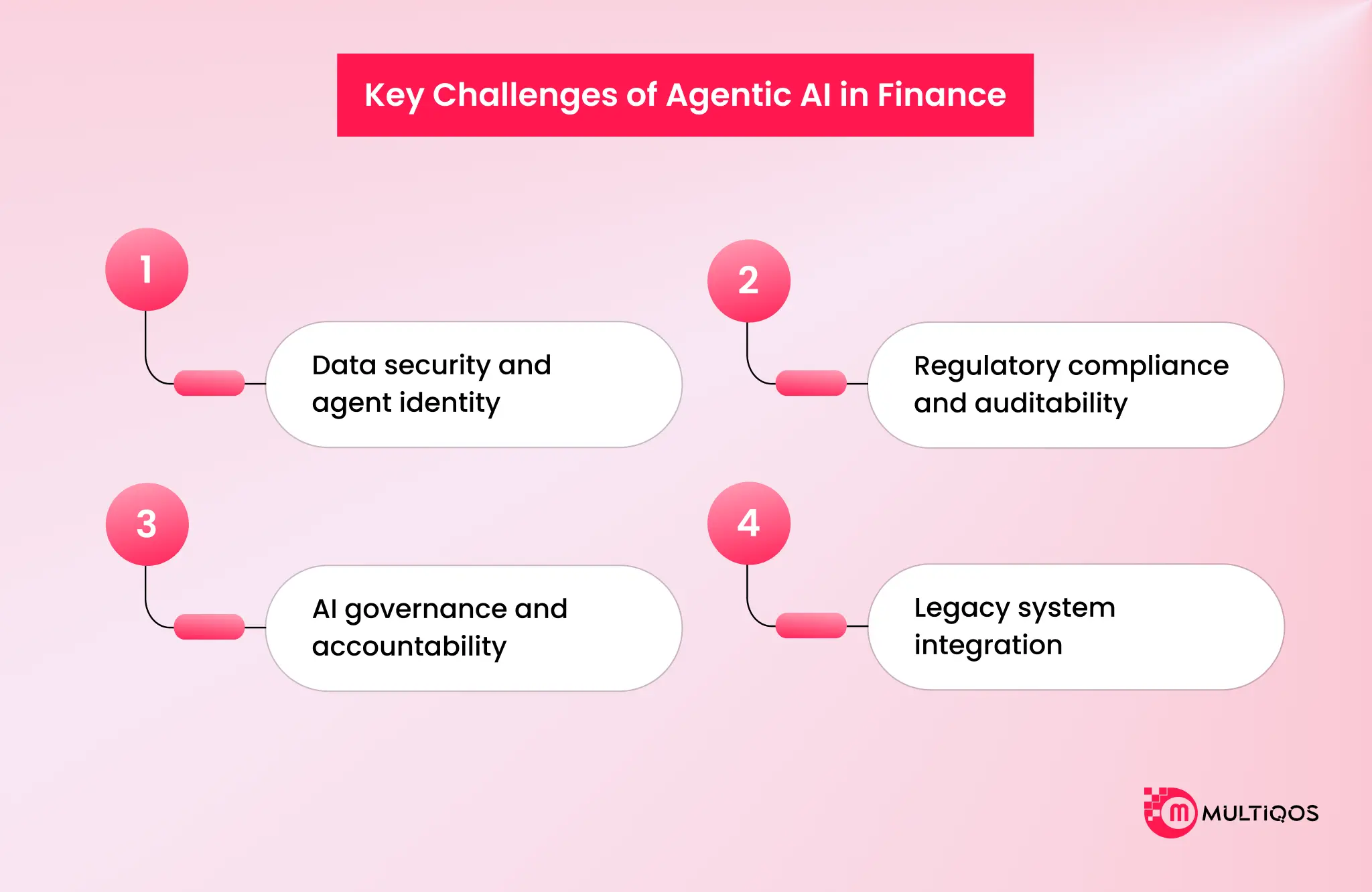
Data security and agent identity
An agent that acts needs credentials, and credentials are an attack surface. Treating an agent like a service account with an agent that has a standing API key is the key to an over-privileged bot that will move money. The enhancements are agent identity, scoped permissions, and short-lived credentials.
Regulatory compliance and auditability
Regulators do not accept ‘the model decided.’ Every autonomous action in a regulated finance workflow needs a logged, replayable trail showing what the agent saw, what rule it applied, and why it acted. Build the audit log before the agent, or you will rebuild the agent later.
AI governance and accountability
When an agent makes a wrong call, who owns it? Governance frameworks assign accountability, define escalation thresholds, and set the boundaries an agent cannot cross. You govern the agent’s authority the same way you govern a junior employee’s, with defined limits and a manager in the loop.
Legacy system integration
Core banking and insurance platforms were not built for autonomous agents to call them. Legacy integration is where most timelines slip. The realistic path is an AI integration layer that exposes governed APIs, not a rip-and-replace of the core.
Implementation Roadmap: How to Deploy Agentic AI in Finance
Deploy in sequence, not all at once. Each phase reduces the risk that kills the next one.
- Assess data, governance, and skills readiness. Map your data quality and access first; an agent inherits every gap in your data. Skipping this is why pilots stall.
- Pick high-pattern, low-risk first use cases. Reconciliation and AR before autonomous lending. Prove value where a mistake is cheap and reversible.
- Embed governance and audit trails from day one. Build the logging, permissions, and escalation logic into the first agent. Retrofitting controls costs more than building them.
- Design human-in-the-loop escalation thresholds. Define exactly which decisions an agent commits and which it routes to a person. This is your primary risk dial.
- Integrate with core and legacy systems. Expose governed APIs through an integration layer rather than touching the core directly. Plan for this to take longer than the model work.
- Scale by domain and measure ROI. Expand one function at a time, tracking cost, cycle time, and accuracy against a baseline you captured before launch.
Best Practices for Successful Enterprise Adoption
The challenges invert cleanly into a playbook. Each practice below closes a specific failure mode.
- Start narrow and patterned. One reconciliation workflow that works beats five ambitious agents that stall in review.
- Give every agent a scoped identity. Short-lived, least-privilege credentials over standing API keys, always.
- Instrument for audit before you instrument for scale. If it is not logged and replayable, it is not deployable in a regulated function.
- Set escalation thresholds with the business, not just engineering. Controllers and compliance own where the human line sits.
- Keep humans as the exception. The goal is supervision by exception, which is what lets a small team oversee a large volume of autonomous work.
The Window is Open, and it Closes on the Slow Movers
The strategic case of Agentic AI in finance does not rest on efficiency. It rests on timing. The firms that win will not be the ones that ran the most pilots. They will be the ones who shipped a governed agent into a real finance workflow, measured it, and scaled it by domain. That is an execution problem, and execution is where a partner comes into the picture.
MultiQoS builds, governs, and scales agentic AI for finance teams, from the first reconciliation agent to a full multi-agent close. So if you are looking for the right partner to integrate agentic AI capabilities for your finance business, book your consultation now.
Not blindly, and nobody serious pretends otherwise. The model is probabilistic, so it can hand you two different answers for the same input. That’s why agentic AI in finance works best on rigid, deterministic pipelines instead of loose “agentic freedom.”
Keep it on high-pattern tasks, set confidence thresholds, and route anything shaky to a human. One bad autonomous call in finance doesn’t just cost efficiency. It burns reputation.
This is the number one blocker on Reddit, and it’s fair. A rule engine gives a clean yes or no. An agent gives multi-step reasoning that’s hard to trace.
So you log everything the agent saw, the rule it applied, and why it acted, before you deploy it. Build the replayable audit trail first. “The model decided” is not an answer a regulator accepts.
You are. Or your compliance team is. That’s exactly why banks won’t hand agents the high-risk decisions like closing an investigation or approving a complex transaction.
Liability doesn’t transfer to the AI. Keep agents on preparatory work, define hard boundaries they can’t cross, and treat the agent’s authority like a junior employee’s, with a manager in the loop.
This is where most pilots die, and it has nothing to do with the model. Agents inherit every gap in your data, and stale ERP inputs lead to misallocated capital fast.
The realistic path is an integration layer exposing governed APIs, not ripping out the core. Fix data access first, or the agent stalls.
End-to-end automation by agentic AI in finance ensures the execution of specific high-friction jobs. KYC document verification, transaction monitoring for fraud, and routine service queries like balance checks and refunds. Agentic AI in finance and accounting, especially reconciliation and close, is the safest starting point. Cheap to fix when it’s wrong, easy to measure when it’s right.

Get In Touch

Get Stories in Your Inbox Thrice a Month.
Enterprise AI Implementation Challenges: Common Roadblocks and How to Overcome Them

Computer Vision in Retail Explained: From Smart Shelves to Smart Stores
The Complete Guide to Machine Learning in Healthcare: Uses, Benefits & Challenges