
Why Manual Data Pipelines Are a Silent Business Risk (And How Automation Fixes It)
Need quick insights? Summarize with AI & save time
 ChatGPT
 Perplexity
 Claude
 Google AI Mode
Table of Content
- What is a Manual Data Pipeline?
- 4 Silent Manual Data Pipeline Risks
- The Risk Nobody Budgets For: Compliance, Audit, and Regulatory Exposure
- Why Manual Pipelines Break AI and Agentic Initiatives
- How Does Data Pipeline Automation Fix This?
- What Modern Data Pipeline Architecture Looks Like?
- A Practical Roadmap to Automate Your Pipelines
- Conclusion
- FAQs
Summary:
A pipeline that crashes is the good outcome. The dangerous one keeps running while dropping rows, and nobody notices until finance corrects the numbers by hand. This piece breaks down the five silent risks of manual data pipelines schema drift, late insight, engineer burnout, compliance exposure, and broken AI initiatives then maps the automation architecture and rollout sequence that fixes each one.
Manual data pipelines are becoming relics of the past because the volume of information is increasing. Especially with the advent of AI, users now generate more data. Generative AI capabilities have led to businesses focusing on analyzing vast amounts of data generated by customers.
This intensifies the need for real-time insights, and traditional processes of manually maintaining data become inefficient. Data pipeline automation is the practice of running ingestion, transformation, and monitoring through managed, version-controlled systems instead of handwritten scripts. Using data engineering services, you can ensure end-to-end automation and real-time insights for your business.
But how does data pipeline automation fix the problem?
This piece focuses on the capabilities of data pipeline automation, manual data pipeline risks, and provides a breakdown of automation architecture.
What is a Manual Data Pipeline?
A manual data pipeline is a data infrastructure that relies heavily on human intervention, hand-written scripts, and ad-hoc workflows to move, transform, and validate data. Here’s where it actually breaks, why ETL makes it worse, and why the pipeline that never crashes is the one costing you the most.
One Script Becomes a Multi-Year Program Nobody Approved
A data pipeline consists of multiple sources, and as the business grows, these sources increase. Starting from a single script and API, enterprises gradually see more sources bolted on, and cron entries added one after another. And with each manual data pipeline source added, an engineer needs to open the terminal and check if there are discrepancies.
Large enterprises often run dozens to hundreds of connectors, which is less a pipeline problem than an enterprise integration problem nobody scoped. Staffing a multi-year integration program and using the workforce you hired to model data monitors infrastructure. At that volume, you are no longer writing scripts. You are running a big data platform without calling it one.
ETL Breaks on Every Upstream Change
ETL transforms your data before storage so every upstream schema change hits your transform layer directly. Adding new data becomes difficult because preprocessing of the information is not designed specifically for new information.
ETL automation flips the order. Load raw data first, transform inside the warehouse, where compute is cheap and the logic sits in a repository instead of memory. Under managed ELT, that same new data gets stored, gets flagged, and context is set.
The real cost of ETL was never the transform logic. It was building a system that treats every schema change as an emergency.
A Pipeline That Crashes is the Good Outcome
A pipeline that crashes is doing its job. You find out immediately, and you fix it immediately. A pipeline is riskier when it drops rows with no crash, no alert, and no ticket number attached to any of it.
That’s a business risk running quietly through your revenue reporting, and it survives quarter after quarter for the exact reason it should worry you: nothing about it looks broken. The question was never whether your pipeline runs. It’s whether you’d know the day it stopped running correctly.
4 Silent Manual Data Pipeline Risks
Your pipeline keeps running, dashboards keep loading, and nobody notices the numbers underneath have gone stale or wrong. That’s the real risk in manual data entry. Source systems accumulate their issues over time, like missing customer IDs, null transaction dates, and duplicate records.
A pipeline without automated validation checkpoints just processes everything and calls the run successful. Nothing crashes, so bad data keeps traveling, and the financial damage scales with the distance it travels.
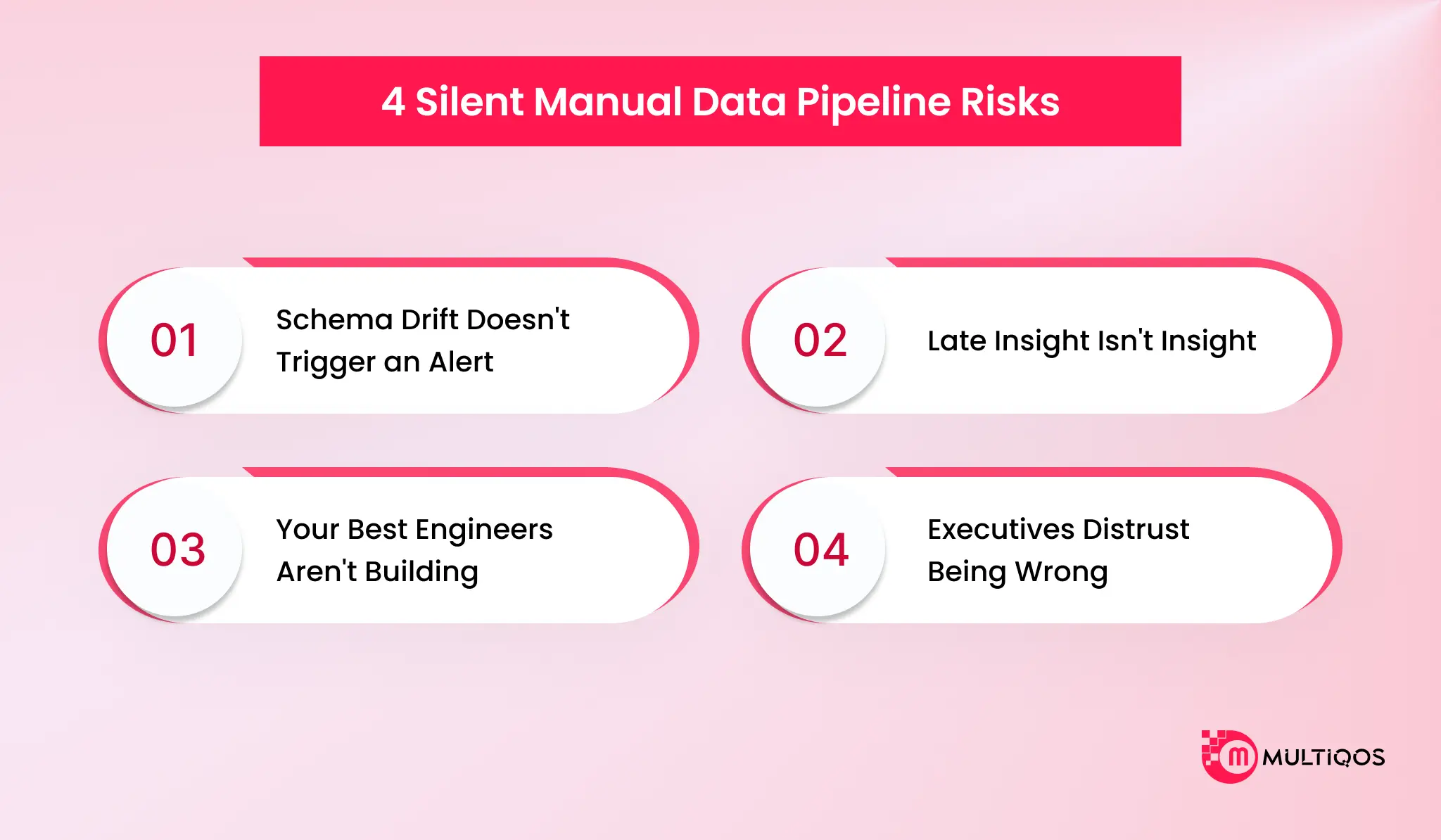
1. Schema Drift Doesn’t Trigger an Alert
Schema drift is the most common hidden cause of production failure precisely because it looks like success.
An upstream team adds a column, renames one, or drops one entirely, with zero coordination downstream. The manual pipeline runs to completion anyway. Instead of halting, it drops fields, misreads data types, or builds aggregations off an incomplete dataset, and nothing about the run looks abnormal.
Engineering teams monitor uptime, not correctness. So the dashboard stays green while finance manually corrects numbers that were already wrong days earlier. European SMBs lose an average of two to three business days per quarter just reconciling schema-related issues, time spent finding a problem no monitoring system was built to catch.
Uptime was never the metric that mattered. Correctness was, and almost nobody instruments for it.
2. Late Insight Isn’t Insight
A fragile data pipeline doesn’t just break. It drags everything downstream into unreliability. Resource contention hits hardest exactly when you need the pipeline most, during month-end close or quarterly reporting, slowing runs down, timing them out mid-execution, or handing back a partial dataset. Analysts either stall the decision to verify the numbers, or the business moves ahead on numbers that are already stale.
Insight delivered late is worth a fraction of insight delivered on time. A manual investigation into a data failure can stall an entire financial close for days, and by the time the numbers clear, the decision they were meant to inform has usually already been made some other way. A report that arrives after the decision isn’t a report. It’s documentation of a decision made without one.
3. Your Best Engineers Aren’t Building.
Manual pipelines rarely fail once, dramatically. They fail constantly, in small increments. An upstream schema change here, a failed overnight job there, and each one pulls a skilled data engineer off strategic work and into reactive cleanup. Data teams spend up to 50% of their time on remediation, and the average data engineer spends 44% of their time just maintaining pipelines that already exist.
That cycle costs organizations in wasted talent, and it consistently ranks as a top driver of engineer burnout and attrition. Nobody hired a data engineer to babysit cron jobs. That’s the job anyway, once the pipeline is manual. Burnout on a data team is rarely a culture problem. It’s a maintenance bill nobody put on the budget.
4. Executives Distrust Being Wrong.
Data only has value the moment leadership can act on it without a second look. The first time an executive gets burned by a dashboard that was confidently wrong, they start hedging. Manual double-checks return. Instinct creeps back in ahead of analytics, and the organization’s analytics function quietly downgrades from decision-making tool to something that gets second-guessed by default.
Rebuilding that trust takes more than a new dashboard. It takes business intelligence built on data someone can vouch for.
The Risk Nobody Budgets For: Compliance, Audit, and Regulatory Exposure
Manual pipelines are a governance liability, not only an engineering one. Short section. Blunt point.
When Broken Data Flows Become Misreporting
A pipeline that drops rows is a data quality issue. In a regulated environment, the identical defect is a misstatement. Financial services firms carry documented costs from data errors that run well past remediation into penalties and restatement work, which is why compliance in fintech starts upstream of the model.
Audit Trails and Lineage You Cannot Produce
An auditor asks one simple question. Where did this number come from, and who changed the logic that produced it?
With hand-written scripts on a shared box, the honest answer is usually a shrug plus a git history that never covered the transform layer. Automated pipelines emit lineage as a byproduct of running. Manual ones require archaeology.
The Regulated-Industry Multiplier
Insurance, healthcare, pharma, banking. Same defect, higher price. If you operate under SOX, HIPAA, Solvency II, or DORA, then your pipeline reliability posture already is a compliance posture, whether anyone has framed it that way internally or not.
Why Manual Pipelines Break AI and Agentic Initiatives
Every AI initiative inherits your pipeline quality. No model architecture repairs upstream data.
Garbage In, Hallucination Out
Feed an LLM inconsistent data, and it does not fail loudly. It returns something fluent, confident, and wrong. That is worse than a broken dashboard, because a broken dashboard at least looks broken.
What “AI-Ready Data” Actually Requires
Freshness on a known schedule, structural validation, traceable lineage, and permission governance are the crucial aspects of AI-ready data. Manual pipelines deliver none of them reliably. They can deliver fresh data sometimes, on days when nothing upstream moved.
Agents Amplify Pipeline Defects Instead of Absorbing Them
Most AI strategy decks skip this part. Agentic systems chain decisions together, so a defect at step one propagates through every step after it, with no human checkpoint sitting in the middle to catch it.
Gartner predicts over 40% of agentic AI projects will be canceled by the end of 2027, pointing to escalating costs, unclear business value, and weak risk controls. The failure point is governance and operational discipline, not model capability. Your data pipeline is where that discipline either exists or does not.
How Does Data Pipeline Automation Fix This?
Data pipeline Automation fixes the cause instead of the symptom. Manual teams patch each failed run, so the same break returns next week. When the fix goes into pipeline code, that failure cannot happen again. This turns data work from firefighting into building.
1. Reliability by Default: Monitoring, Alerting, Retries
You are going to have network timeouts; you’re going to have API changes; schema drift is going to occur. They’re expected to be used by automated pipelines. There are several data pipeline automation techniques available in modern architectures that can be implemented to be reliable.
- Observability and alerting: Alerts and notifications are sent based on service level objectives (SLOs) like data freshness, volume completeness, and error rates. The team is alerted if a metric deviates from its range. Issues are resolved prior to dashboards or models.
- Retry policies and circuit breakers: Identify transient from structural errors. A short timeout in the network is automatically retried. It is not a serious schema mismatch if bad data is placed in a quarantine table for review; circuit breakers are used to stop the pipeline when error rates exceed a threshold.
2. Validated, Repeatable, Version-Controlled Runs
Manual SQL checks depend on who is running them. Data pipeline automation replaces those checks with validation and version control, so data gets processed the same way every time.
- Version control and contracts: Transformation logic lives in a version-controlled repository. Data contracts enforce schema structure and validate formats before models are materialized. Breaking changes get caught in development, not in production.
- Idempotency: Automated data pipelines are built to be idempotent. This means a rerun does not create duplicate or inconsistent records. If a job dies halfway, it can resume or restart, and the end result is still correct.
3. Scalability Without Linear Headcount
Manual data entry and custom scripts need more people as volume grows. Ten sources need one engineer, so a hundred sources need ten. Data pipeline automation breaks that relationship. Data volume can grow while headcount and overhead stay flat. A well-built pipeline architecture handles 100 sources with the same logic, validation rules, and schedules it used for 10.
4. Engineers Redeployed to High-Value Work
Pipeline maintenance has historically consumed about half of a data team’s time. That is hundreds of thousands of dollars in engineering hours spent on yesterday’s broken plumbing. Remove the maintenance load and skilled engineers can work on things that matter:
- Building machine learning models and predictive analytics.
- Opening up data access so business users find their own answers without waiting on IT.
- Building internal applications that speed up business processes and shorten time-to-market.
- Laying AI foundations, so the enterprise data stack stays a real product instead of a permanent clean-up job.
What Modern Data Pipeline Architecture Looks Like?
A modern data pipeline architecture eliminates the need for coding pipelines and manual spot checks, and it automatically fixes itself. It is not a tube that carries the data from A to B. It’s a governed system built from multiple layers, each of which has a single objective.
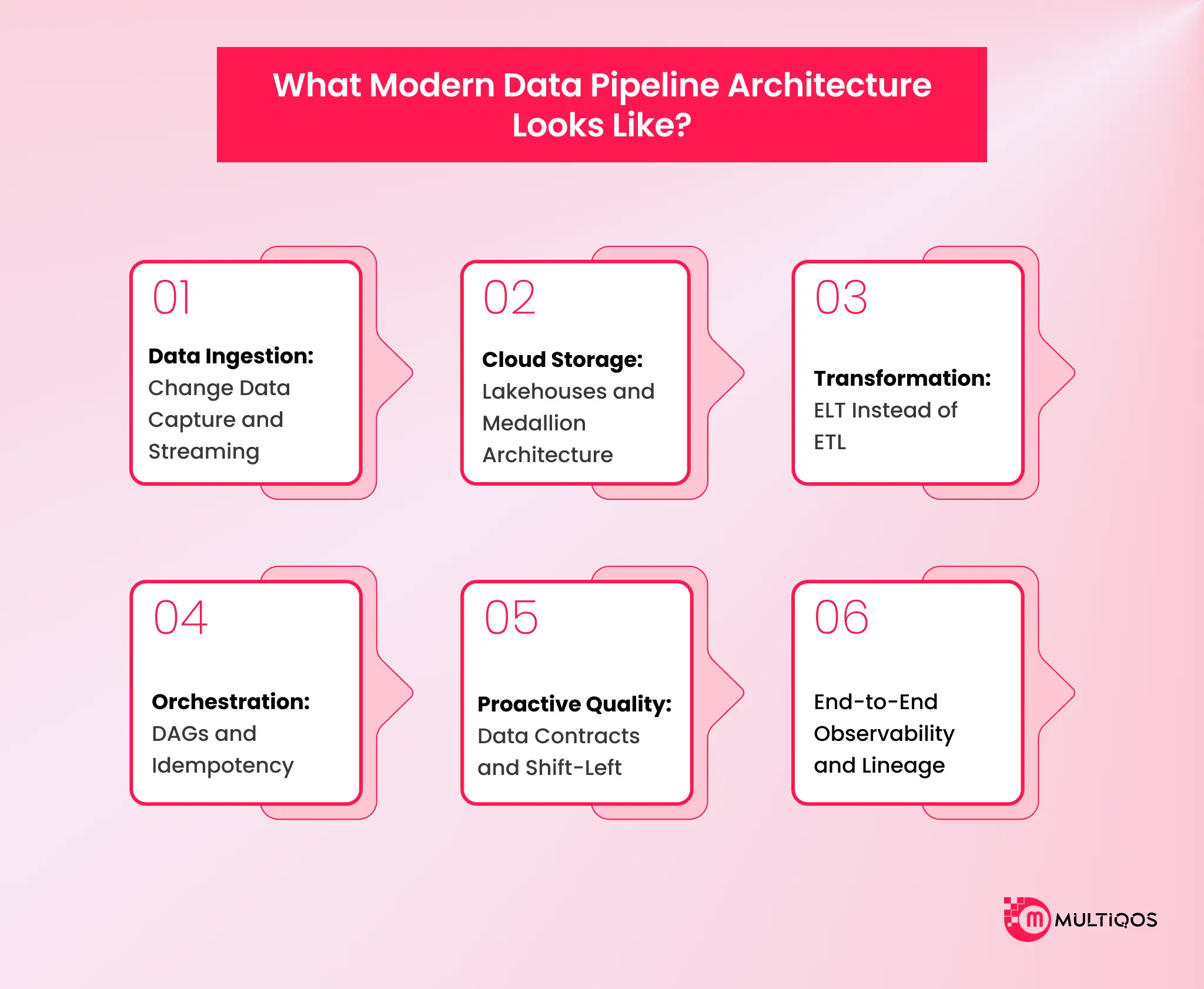
1. Data Ingestion: Change Data Capture and Streaming
Old pipelines pulled the whole dataset once a day. That is heavy and slow. Modern pipelines use connectors and APIs to bring data in through Change Data Capture (CDC).
- Log-based CDC is the best option available. It reads the source database’s own transaction logs and picks up only what changed, which means the INSERTs, UPDATEs, and DELETEs, as they happen.
- The source system barely feels the load. Compute costs drop too. And the same setup supports streaming and batch processing side by side.
2. Cloud Storage: Lakehouses and Medallion Architecture
Legacy databases are rigid, so modern pipelines land data in cloud warehouses, data lakes, or lakehouses instead. Storage usually follows a tiered layout called the medallion architecture. This keeps quality visible at every step.
- Bronze tier: raw data, stored as it arrived and kept for history.
- Silver tier: data gets cleaned, normalized, and validated here.
- Gold tier: refined data, shaped for a specific BI report or machine learning model.
3. Transformation: ELT Instead of ETL
Traditional systems used ETL, so data was transformed before loading. Modern architectures do the opposite and use ELT. Raw data lands in the warehouse first, then the cloud platform’s compute does the transformation work. The logic itself is treated like software. It is written in SQL or Python, kept under version control, and split into modules so other pipelines can reuse it.
4. Orchestration: DAGs and Idempotency
The orchestration layer decides when jobs run and how they depend on each other. It is the conductor of the pipeline. Apache Airflow, Prefect, and Dagster dominate pipeline orchestration in modern data pipeline deployments.
- Orchestrators use Directed Acyclic Graphs (DAGs) to map execution order and task dependencies. Airflow defines DAGs in Python. Prefect infers the flow graph at runtime from @flow and @task decorators. Dagster models DAGs around data assets and not just tasks. What this means is parallel task runs and sequential tasks never run out of order.
- Idempotency is a core design rule here. A pipeline can fail, restart, or run several times again without creating duplicate records or inconsistent data. Airflow enforces this via execution-date partitioning. Dagster executes it through asset materialization keys. Prefect leverages task caching and result persistence.
5. Proactive Quality: Data Contracts and Shift-Left
In modern architecture, validation is shifted to the left, which is the direction in which data is processed, and data is checked prior to it entering the warehouse. This is enforced through the use of data contracts. A contract is a machine-readable agreement between the data producers and the data consumers and fully specifies the schema, data types, and business logic.
If data comes in that fails the contract, like a schema change or a negative transaction value, circuit breakers either halt the process or quarantine the bad data for further examination in a quarantine table. AI Models and Dashboards never receive corrupted data.
6. End-to-End Observability and Lineage
A modern pipeline watches itself. Nobody has to wait for a user to complain about wrong numbers. The system tracks data freshness, volume completeness, error rates, and execution latency on a continuous basis. Automated lineage maps where the data traveled across every system it touched.
If something appears amiss, AI algorithms can detect those statistical outliers or data drift, and then track back to the source of the error. Minutes, not days, is the time involved in root cause analysis.
A Practical Roadmap to Automate Your Pipelines
Here is a step-by-step roadmap. Each step has one action point you can start this week.
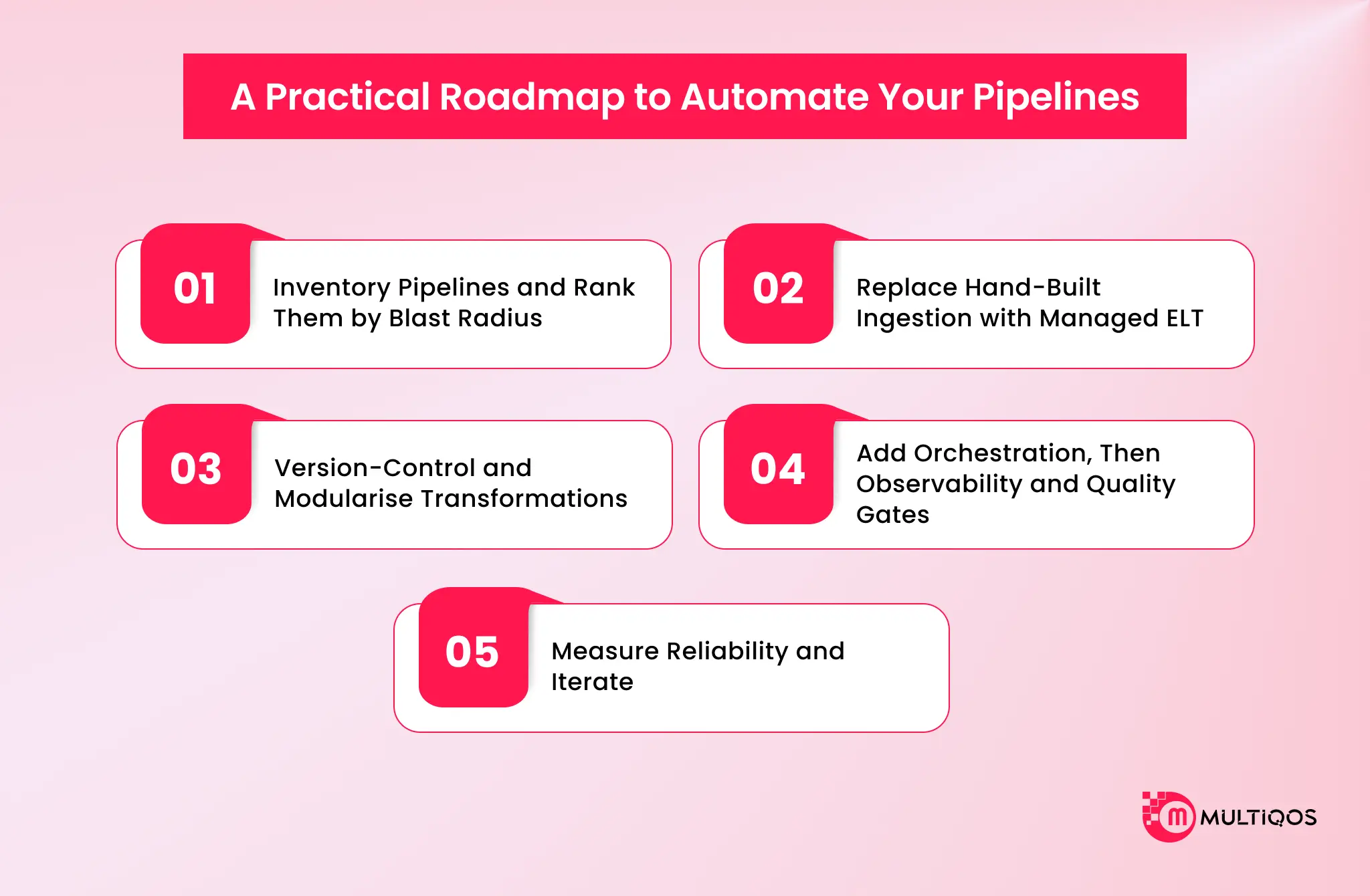
1. Inventory Pipelines and Rank Them by Blast Radius
List every pipeline you run. Then tag each one with what breaks downstream when it fails. Revenue reporting, a regulatory filing, a customer-facing feature, or internal curiosity. Rank the list by blast radius, not by how annoying the pipeline is to maintain. Those two lists look nothing alike.
Start here: pull your scheduled jobs and map each one to the dashboard or model that consumes it. Most teams find pipelines that nobody owns.
2. Replace Hand-Built Ingestion with Managed ELT
Start with your highest-drift sources. Third-party SaaS APIs are usually the worst, because they change without telling anyone. They also cut the most maintenance hours, and that matters when you need the budget to survive past quarter one.
Start here: find the connector your team has patched most often in the last six months. Replace that one.
3. Version-Control and Modularise Transformations
Move your transform logic into a repo with tests. Break the big monolithic queries into models that declare their own dependencies.
Start here: get your three most business-critical transformations into version control, with one test on row count and one on null rate. Nothing fancy.
4. Add Orchestration, Then Observability and Quality Gates
Orchestration comes first. Observability without dependency awareness only produces alerts nobody can act on, and alert fatigue will kill the initiative faster than any technical problem. Once the graph exists, add freshness and volume monitors. Then put contracts on your critical tables.
Start here: map the dependency graph for the top-ranked pipeline from step one.
5. Measure Reliability and Iterate
Track four metrics: freshness SLA adherence, incident count, mean time to detection, and MTTR. Baseline all four before you change anything. Otherwise, you cannot show the difference later when someone asks what the platform actually bought.
Start here: measure your current time to detection honestly. If the real answer is “when someone in finance emails us,” write that down. That is your baseline.
Conclusion
Manual pipelines are not a technical preference. They are a liability sitting on your balance sheet, paid down in engineering capacity, incident hours, executive trust, and AI initiatives that will never clear the data-readiness bar.
The real decision is which pipeline you fix first, and whether you fix it before or after the next silent failure turns up in a board deck. Not sure where your data pipelines actually stand? Book a data pipeline assessment, and we will map your live failure modes, quantify the maintenance load your team is carrying, and hand you a prioritized data pipeline automation sequence.
FAQs
Data engineers spend an average of 44% of their time maintaining pipelines. At an average company, that capacity runs about $520,000 a year. Nearly three in four engineers in the same study said their time and talent were being wasted on manual pipeline work.
Manual pipelines fail mostly because of schema drift, unhandled API changes, and no automated detection layer. Integrate.io found that production incidents rise roughly 27% for each percentage-point increase in schema drift frequency. The deeper issue is that most failures are silent, meaning the job succeeds and the data is wrong.
Gartner estimates poor data quality costs organizations an average of $12.9 million per year. On average, 31% of revenue sits exposed to data quality issues. Regulated industries carry a higher effective cost, because the same defect can become a reportable misstatement.
Yes. AI and agentic systems inherit whatever quality your pipelines produce, and agents compound defects across chained steps instead of catching them. Gartner predicts over 40% of agentic AI projects will be canceled by the end of 2027, attributing the failures to governance and operational discipline rather than model capability.

Get In Touch

Get Stories in Your Inbox Thrice a Month.

Why Ethical Use of User Data in Software Matters More Than Ever
Top Benefits of Implementing Real-Time Data Systems for Enterprises