
Implementing Enterprise LLMs: Fine-Tuning, Deployment, and Real-World Applications
Table of Content
- What is an Enterprise LLM?
- Fine-Tuning an Enterprise LLM and Deploying it
- What Are The Benefits of an Enterprise LLM?
- Use Cases of an Enterprise LLM
- What are the Challenges of an Enterprise LLM?
- Conclusion
- FAQs
Summary:
Most enterprise Large Language Model (LLM) initiatives stumble not because of model limitations, but due to poor scaling strategy, data readiness, and misunderstood training scopes. This comprehensive guide outlines the complete operational lifecycle of an enterprise LLM, moving past generic public applications to build secure, domain-specific intelligence within corporate compliance boundaries.
Shopify built an AI-based eCommerce assistant that merchants use to manage their stores through natural language. However, what the Shopify team got wrong was the lack of understanding of how they would maintain the AI assistant.
For example, the system prompt became a set of 50+ special cases that conflicted with each other in terms of edge handling and data governance. The only way out was to fine-tune the domain reasoning.
They did the fine-tuning, but when 1% of the production-grade sidekick was made live, merchants faced issues because the model was trained on data assumed by engineers, not real-world information.
This is what happens with most of the enterprise LLM projects. The reason for project failure is not the model itself,l but the scope of how you fine-tune and deploy it.
This guide walks the full lifecycle of an enterprise LLM: what it actually is, when to fine-tune versus lean on RAG, what deployment costs in real money, and where the returns show up..
What is an Enterprise LLM?
An enterprise LLM is a large language model adapted to run inside a company’s data, workflows, and compliance boundaries. Rather than functioning as a generic chatbot under the business interface, LLMs act as a secure, integrated internal copilot capable of reasoning over vast datasets.
Consumer models optimize for breadth. An enterprise LLM optimizes for a narrow job done reliably, on data the business owns, with an audit trail attached. So, if you are planning this transition, leveraging specialized AI development services ensures your infrastructure is secure from day one.
How an Enterprise LLM Differs From a General-Purpose LLM
A general-purpose model is trained to be plausible about everything. An enterprise LLM is engineered to be correct about your things. The distinction matters because plausibility, in a regulated workflow, is a liability.
Three levers separate the two. Data grounding comes first: the model answers from your systems, not a frozen snapshot of the web. Governance comes second because every response in a bank or hospital has to survive a compliance review.
Deployment comes third. A public model lives on someone else’s servers. Yours often has to live inside your firewall, or at least inside a private tenant where your data never trains someone else’s product. The fastest-moving teams treat these three as a single design problem, not three separate ones.
Prompt Engineering vs RAG vs Fine-Tuning: When Each Applies
Most teams reach for fine-tuning first. That’s usually the wrong instinct. The right order is cheapest-viable-method first, and you climb the ladder only when the cheaper rung fails.
Prompt engineering is the first rung.
You shape the model’s behavior through instructions and examples; no training required. It’s fast, it’s nearly free, and for a surprising number of tasks, it is enough.
Retrieval-augmented generation (RAG) is the second rung. RAG connects an enterprise LLM to a live database or document store, so answers get grounded in current proprietary data without retraining anything.
Change a policy PDF, and the next answer reflects it. That freshness is the entire point. IBM’s breakdown frames it well: RAG feeds the model knowledge, and fine-tuning changes the model’s behavior.
Fine-tuning is the third rung. Here, the model is trained straight-up on customized pairs of inputs and outputs, making it learn a stable and specific pattern, such as the pattern of writing a house, coding a claim, or a supportive attitude. Apply it if the problem is something routine and will not vary much from one week to another.
Fine-Tuning an Enterprise LLM and Deploying it
Fine-tuning gets romanticized. In practice, it is a budget decision wearing a technical costume, and the numbers decide it faster than any engineering debate.
When to Fine-Tune vs When RAG is Enough
Fine-tune when the pattern is fixed. RAG when the facts move. That single line resolves most arguments before they start.
If your support agents keep pasting the same policy document into every prompt, RAG solves it. Your model doesn’t seem to understand the prompts in terms of response formatting, tonality, or structuring?
Then you need fine-tuning. When both of these happen at once, like in any corporate implementation of an LLM, you combine the two: fine-tuning for behavior, layering RAG for freshness.
Cost Breakdown by Model Size and Method
There’s a massive range in cost, and most people overestimate the floor and underestimate the ceiling. The parameter-efficient technique fine-tunes a 7B-13B open model for about $50-$300 per training run, taking a few hours with a single GPU.
A full fine-tuning of a 70B+ model is a whole other story, costing from $5,000 to $30,000 per run and requiring a multi-GPU setup.
LoRA and QLoRA reach 95% to 99% of full fine-tuning’s task performance for most enterprise use cases. So the expensive path sometimes buys you a few percentage points. For most LLM programs, the parameter-efficient route is not the compromise. It’s the correct default.
| Method | Cost per Run | Data Freshness | Behavior Change | Best-Fit Task |
|---|---|---|---|---|
| Prompting | Near-zero, no training compute | Only as fresh as prompt | None, model weights untouched | Quick instruction shaping, one-off tasks |
| RAG | Low, indexing/retrieval infra | High, updates with source docs | None, reasons over context | Knowledge that moves: policies, product docs |
| LoRA / QLoRA | $50–$300 (7B-13B model) | Frozen at training | Strong, reshapes tone/format | Repetitive patterns: house style, claims-coding |
| Full Fine-Tune | $5,000–$30,000+ (70B+ model) | Frozen at training | Strongest, deep lock-in | Complex domain reasoning at scale |
Picking the wrong method costs you months and a five-figure GPU bill. You can hire AI developers from our team to help you pressure-test the decision before you spend a dollar on compute.
Cloud vs Private and On-Prem Deployment
Where your enterprise LLM runs is a data-gravity question, not a cost question. Follow the sensitivity of the data, and the deployment answer usually picks itself.
Cloud deployment wins on speed and elasticity. You get GPUs on demand, managed scaling, and no hardware to babysit. For teams whose data can legally sit in a private cloud tenant, this is the shortest path to production.
Private and on-prem deployment wins on control. When you’re in BFSI, healthcare, or defense, and the data cannot leave the building, an on-premise LLM stops being a preference and becomes a requirement. You pay for it in capital expense and ops overhead. You buy back regulatory certainty.
Multi-Model Serving Architecture
One model rarely serves a whole enterprise well. Mature LLM deployments route requests across several models, matching each job to the cheapest model that clears the quality bar.
A small fine-tuned model handles the high-volume, narrow tasks. A larger frontier model gets reserved for the hard, open-ended ones. A router sits in front and decides.
Done right, this cuts inference spend hard, because you stop paying frontier prices for questions a small model answers fine. Dashboards watch the cost per request. The router does the rest.
What Are The Benefits of an Enterprise LLM?
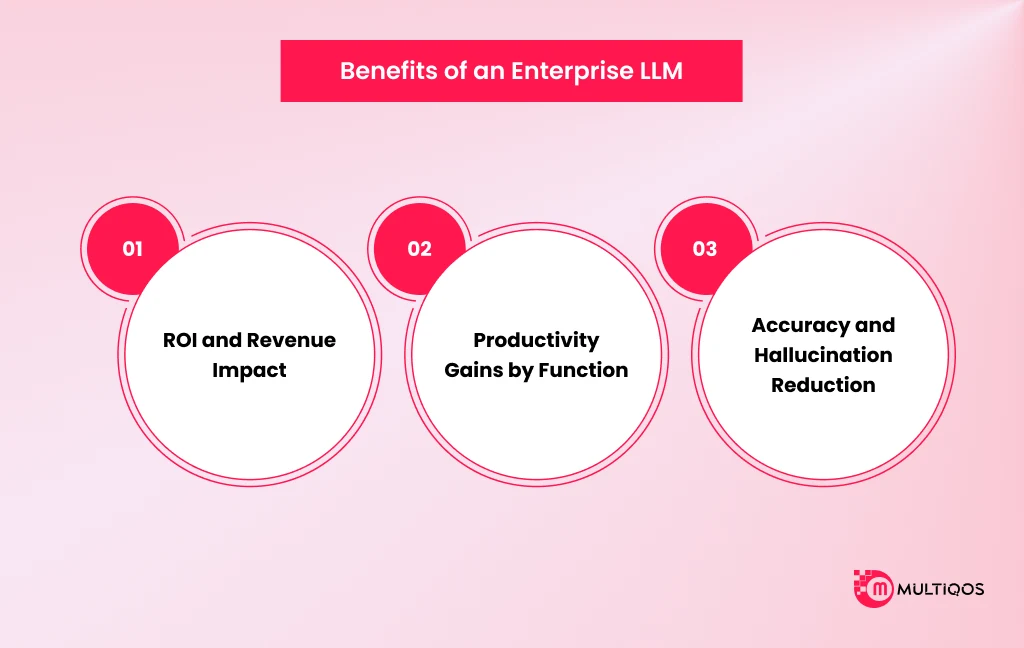
The benefit conversation gets abstract fast. Keep it concrete: an enterprise LLM has to move ROI, productivity, or accuracy, ideally all three, or it doesn’t ship.
ROI and Revenue Impact
The macro number is almost too big to be useful, so anchor to it once and move on. McKinsey estimates generative AI could add $2.6 trillion to $4.4 trillion annually across 63 use cases. Roughly 75% of that value clusters in four areas: customer operations, marketing and sales, software engineering, and R&D.
The instructive detail is not the trillions. It’s the concentration. If your investment in enterprise LLM development isn’t pointed at one of those four zones, you’re fishing outside where the fish are.
Productivity Gains by Function
Productivity is where an enterprise LLM pays rent monthly, not eventually. Support teams resolve tickets faster because the model drafts the answer and the agent edits. Engineers ship quicker because boilerplate writes itself. Analysts skip the blank page.
These improvements are legitimate, although not equal for everyone. The cases that really benefit from this technique are those where the function performed is already quite structured and documented.
Accuracy and Hallucination Reduction
Based on research that is consolidated in different fields, we can conclude that using RAG reduces the number of hallucinations by 30%-70%, while factual correctness increases by about 40% in comparison with the use of just a model.
Fine-tuning refines these results by forcing the model to stick to your terminology and structure. Combine grounding with fine-tuning, and you have a general model you can put in front of a regulated workflow.
Use Cases of an Enterprise LLM
Skip the hypotheticals. The enterprise LLM use cases that stick share one trait: a painful, repetitive, high-volume task that humans hated doing anyway.
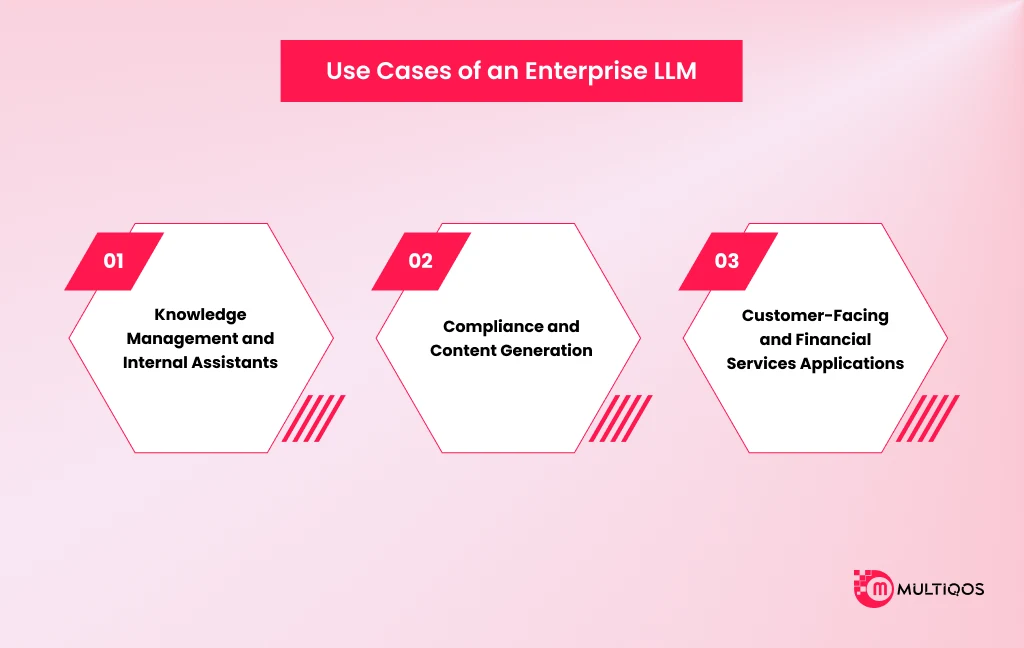
Knowledge Management and Internal Assistants
The problem is fragmentation. Company knowledge lives in wikis, tickets, PDFs, and three people’s heads. An internal assistant, wired to those sources through RAG, turns a two-hour search into a ten-second answer. New hires ramp faster. Senior staff, stop being human search engines.
Compliance and Content Generation
The issue here is volume with no tolerance for deviation. Regulated content, disclosures, policy summaries, first drafts of contracts- everything needs to be consistent and defensible. A finely tuned LLM generates to your standard, and a human reviews. The machine writes the first 80%. The human signs off on the 20% that contains the risk.
Customer-Facing and Financial Services Applications
The issue here is scale meeting sensitivity. In BFSI, an enterprise LLM can triage queries, summarize accounts, and suggest next-best actions, but every response needs to be grounded and logged.
This is precisely where the combination of a private, finely tuned, RAG-enabled enterprise LLM trumps the public version flat-out. The public version is smarter on trivia. Your LLM is correct about your customer.
What are the Challenges of an Enterprise LLM?
Any LLM project runs into three walls every time. Naming them early saves a lot of money later.
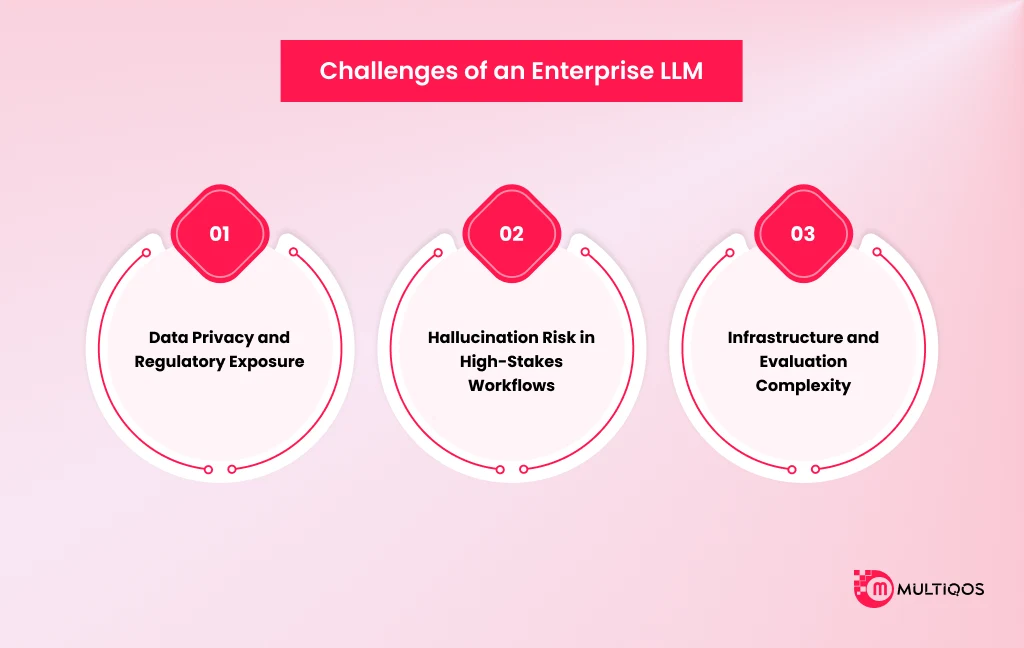
Data Privacy and Regulatory Exposure
One key risk, especially if it is open-source, is that your proprietary data will train someone else’s model or leak in a prompt. It is precisely why the CISOs stay away from public tools, and it’s a legitimate concern.
The solution is architecture-based: private deployment, strict tenant isolation, and contracts that ensure your data doesn’t go into the training set. Make this mistake once, and your entire project loses the social license.
Hallucination Risk in High-Stakes Workflows
The danger here is delivering an answer you know is wrong in a context where a wrong answer will cost you money or lives. RAG and fine-tuning reduce it; they don’t eliminate it. Hence, any high-stakes process needs a human in the loop by design, not as an afterthought.
The guidance provided by EY on hallucination risk management makes the same point: control the workflow, not the model.
Infrastructure and Evaluation Complexity
The danger here is quieter and more dangerous. You developed the enterprise LLM, and now you have GPUs, pipelines, monitoring, and a difficult question that nobody expected: how do you even evaluate it?
Evaluation is the unexciting effort that differentiates a demo from a production-grade tool. Those who budget for eval upfront succeed; those who leave it to phase two end up in pilot purgatory.
Conclusion
The old narrative claimed that adopting an enterprise LLM was an engineering decision. It isn’t anymore. The money, the compliance risk, and the competitive stakes are all at the board level now, and hence, so is the decision-making on how to customize, deploy, and manage the risk of an enterprise LLM.
The companies that make progress aren’t necessarily the ones with the largest models. They are the ones who made a fine-tune vs. RAG call early, deployed with their data sensitivity in mind, and budgeted for evaluation upfront. If you need expert guidance, our AI consulting services can help you map out this exact architecture.
FAQs
Fine-tuning changes model behavior by training on tailored input-output pairs, locking in a fixed pattern like tone or schema. RAG changes what the model knows by connecting it to a live database, so answers stay current without retraining.
Start with RAG when facts change often, since updating a document store beats retraining a model every time policy shifts. Fine-tune only when the pattern is fixed and repetitive, like a house writing style or claims-coding schema.
No. Fine-tuning teaches the model how to think and answer in a preprogrammed way; it does not teach new information to the model, meaning that using fine-tuning to address knowledge gaps requires you to pay training expenses to address a retrieval issue.
No, RAG reduces the chances of having hallucinations in LLMs by relying on up-to-date information but cannot fully remove them, meaning that there needs to be a person involved in high-stakes tasks from the beginning.
Cloud deployment wins on speed since GPUs are on-demand with managed scaling, right for data that can legally sit in a private cloud tenant. On-prem becomes mandatory in BFSI, healthcare, or defense, where data can’t leave the building, trading capex for regulatory certainty.

Get In Touch

Get Stories in Your Inbox Thrice a Month.

Computer Vision in Retail Explained: From Smart Shelves to Smart Stores
The Complete Guide to Machine Learning in Healthcare: Uses, Benefits & Challenges
Enterprise RAG Guide: Architecture, Key Benefits and Real-World Use Cases