Why Retailers Should Start with AI Agent Adoption NOW?
AI Agents Use Cases in Retail
How to Implement AI Agents in Retail: From Pilot to Scale
Benefits of AI Agents in Retail
Conclusion
FAQs
Summary:
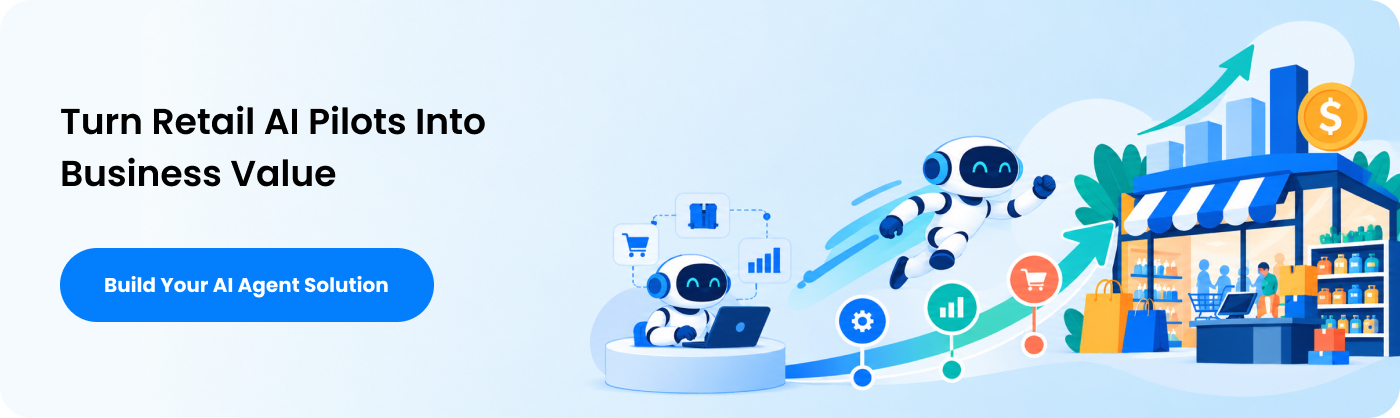
AI agents are initiating a wave of transformation for retailers and customers. From creating personalized shopping experiences to optimizing retail operations, AI agents are finding applications in every aspect. The intelligent agents surpass chatbot capabilities as they manage inventory and demand forecasting independently.
Retailers can get the best value from AI agents only when they pick the right use cases.
The guide covers all parameters that should be considered while picking a use case for AI agents in retail.
Key Statistics on AI Agents in Retail
60.43
The agentic AI in retail and ecommerce market size in 2026 is expected to be USD 60.43 billion, increasing from a value of USD 46.74 billion in 2025.
Retailers are not short on ambition when it comes to beginning their journey to roll out AI agents in retail. According to a Deloitte survey of 200 retail and CDG executives, 75% cited AI as a top priority but only 16.5% could quantify a return.
The gap is rarely about the performance of AI agents. More often it is because retailers find it challenging to select the correct use case. Without a clear strategy and starting point, pilots multiply, budget is wasted, and intended output is never achieved.
The pressure to drive successful results is immense. Consumers are using AI for product recommendations and comparisons. So it won’t be an exaggeration to say that AI agents in retail are redefining operations and experiences for customers and retailers.
A Quick Intro to AI Agents
An AI agent enables retailers to improve the accuracy of different operations such as marketing, sales, and customer service. With an AI agent, an intelligent software, retailers can improve shelf availability, enhance inventory management, and resolve customer queries as quickly as possible. It can suggest products, send low stock alerts, and trigger follow-up messages if required. The efficiency of AI agents improves over time, as they keep training and updating themselves continuously on the available data.
The adaptability of AI agents depends on how accurately and smoothly they can blend into existing processes. With an experienced AI agent development company, retailers are able to combine automation, efficiency, and intelligence and deliver customer-centric features.
Why Retailers Should Start with AI Agent Adoption NOW?
The retail industry is standing at a crossroads of rising customer expectations, tightening budgets, and complex operations. Even the systems built on the latest technologies are struggling to cope with the volume of decisions required today.
Customer journeys have gone nonlinear
A single shopper might discover your product on a Facebook story and then visit your website to check its pricing and features. The next step might be visiting your app to find any discount coupons. Interactions via numerous touchpoints generate a large amount of data. Also, legacy systems treat this data in isolation, making it difficult for retailers to make correct and timely use of the available information. AI agents can connect all the data in a single workflow and provide the required insights, promoting informed decisions.
Higher customer engagement
AI agents deliver personalized support at every step of the buyer journey. The agents remember customers’ purchase history and recommend products that match their preferences. Available 24/7, they keep customers engaged longer, which can lead to higher conversion rates and more repeat purchases.
Mitigating disintermediation
Modern shoppers are continuously turning to AI to discover, compare, and even buy on their behalf. If these assistants completely take over, then retailers will lose their connection with the customers. Retailers will lose brand loyalty and access to data that comes via conversations. Retailers who deploy AI agents and keep their product information accurate and easy for AI systems to read stay visible and keep ownership of the customer relationship.
Numerous manual operations
There are many manual tasks in retail that result in resource burnout. The solution is not replacing teams but amplifying them. Agentic AI can help you achieve this as it completes routine tasks with accuracy. As a result, the teams now have time to focus on building long-lasting customer relationships.
Legacy and fragmented systems are a hurdle
Many retailers still rely on outdated POS systems, traditional ERPs, and disparate e-commerce engines. These systems were never designed to support omnichannel transactions. Agentic AI offers a practical way to work intelligently with the old systems, coordinating data between them and enabling retailers to cater to the needs of modern customers.
AI Agents Use Cases in Retail
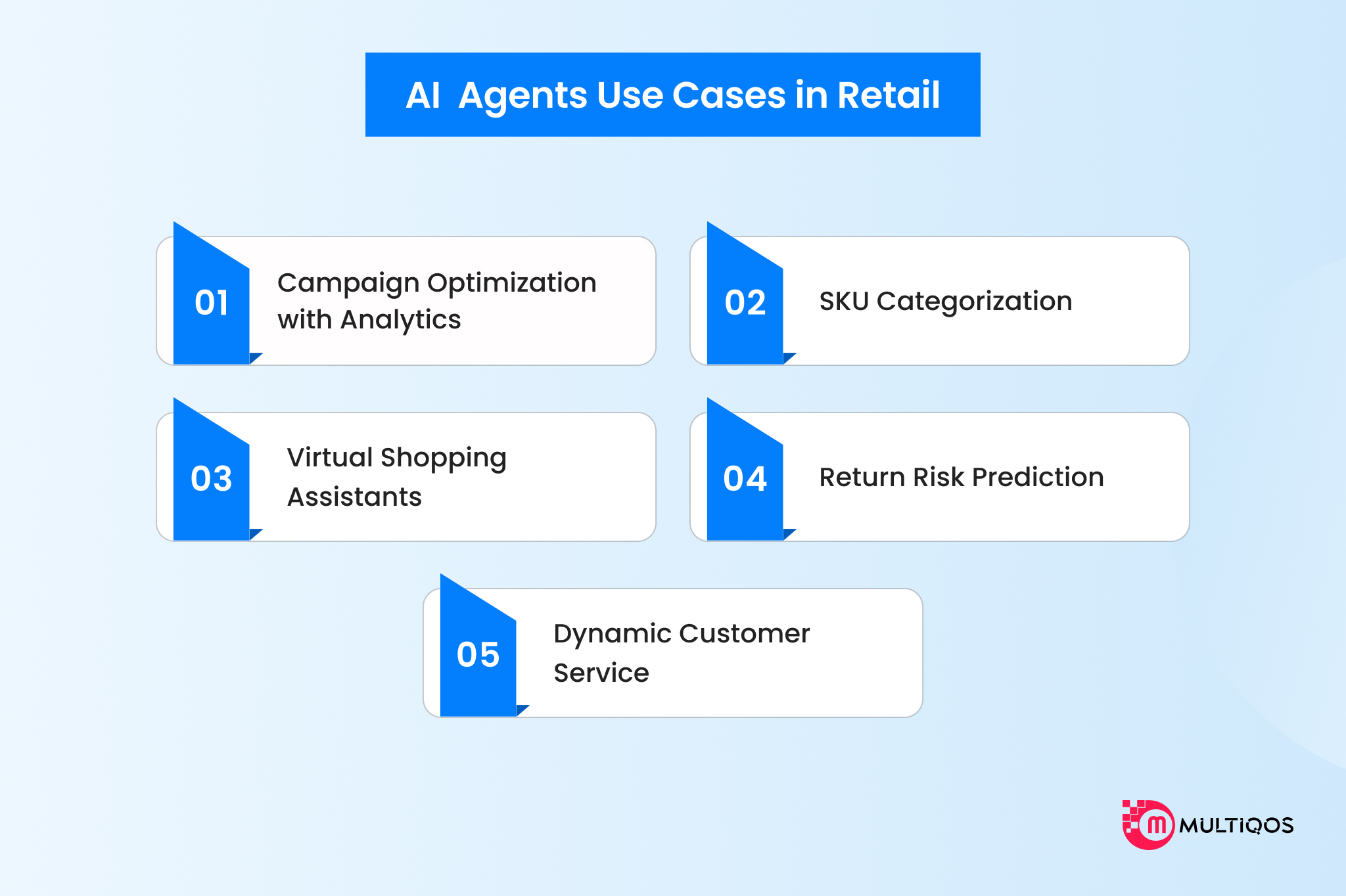
AI agents in retail open up a world of possibilities, if implemented properly. Below, we visit five business areas which can be considered the top use cases for AI Agents in Retail.
Campaign Optimization with Analytics
AI agents can alter pricing structures and launch targeted campaigns across different channels by using data collected through customer engagement signals and predefined margin thresholds. Agents can continuously learn from the outcomes and update themselves to deliver optimized results.
SKU Categorization
Automated SKU categorization is a good use case to start AI agent implementation in retail. Product details such as brand, colour, and price are already structured. The retailer also has a list ready and handy, which means that any error in placement can be fixed during catalog review. Letting AI agents handle the task of SKU categorization prevents merchandizing teams from doing manual tasks, giving them time to focus on strategic initiatives.
Virtual Shopping Assistants
By embedding AI agents in the website, kiosks, and mobile apps, retailers are able to create a dedicated AI agent for a customer. The agents can offer personalized suggestions to customers to improve their experience and enhance retention rates.
Return Risk Prediction
Predicting the orders that might be returned is another popular use case for AI agents in retail. The data needed, such as past orders, product categories, and customer buying patterns, is available in a user-readable format. The agent can determine every order’s return risk at the time of purchase and give an early warning to the concerned teams. The agent scores each order’s return risk at purchase and alerts teams only to high-risk orders.”
Dynamic Customer Service
AI agents can become the first point of contact for any new customer who contacts the retailer via email, social media post, or chat. As the AI agent has access to customer data, it can send a tailored reply instead of a generic one. In case a user is upset or a query is complex, the AI agent can hand over the conversation to human agents, so the team can focus on those cases that require empathy and judgment.
How to Implement AI Agents in Retail: From Pilot to Scale
Rolling out retail AI agents doesn’t have to be an overwhelming process. The key is to start small, define a clear business objective, and then scale from there. By choosing a workflow that delivers measurable value, you can test, refine, and learn from the initial findings.
If benchmarks are met, the same process can be replicated across other business processes. With the right approach, unlocking the right value of AI agents becomes achievable.
Here is a quick overview of the steps that work for both growing retailers and global chains.
Define clear business objectives
The first step is to choose the main goal for retail AI agents – whether it’s optimizing inventory, resolving customer queries, or streamlining supply chain and logistics. Clear business goals ensure that AI agents are designed to solve real business problems.
Gain a proper understanding of the retail processes
Take time to map your retail operations. A clear picture of the moving parts helps AI agents fit in smoothly.
Choose the right technology suite
Select an AI agent framework that complements your business processes. Evaluate the technology based on these parameters: scalability, ease of use, and integration compatibility with existing systems.
Train the AI agents with the right data
Give AI agents a strong foundation of data: sales history, customer interactions, supply chain, inventory, and more. With the correct data sets, AI agents can identify patterns, respond intelligently, and make proper decisions.
Integrate across retail systems
Ensure that all the core systems such as CRM, POS, inventory management, and more can interact easily with the AI agents. The connection with these systems allows AI agents in retail to have access to the right data in real-time.
Test, gather feedback, and refine
Put your AI agents to the test in real-world conditions, then refine them based on the results. After retraining, move on to rolling them out at scale.
Launch and scale gradually
Do the deployment in phases, monitor the results continuously, and if these match the required standards, scale them as per your business requirements.
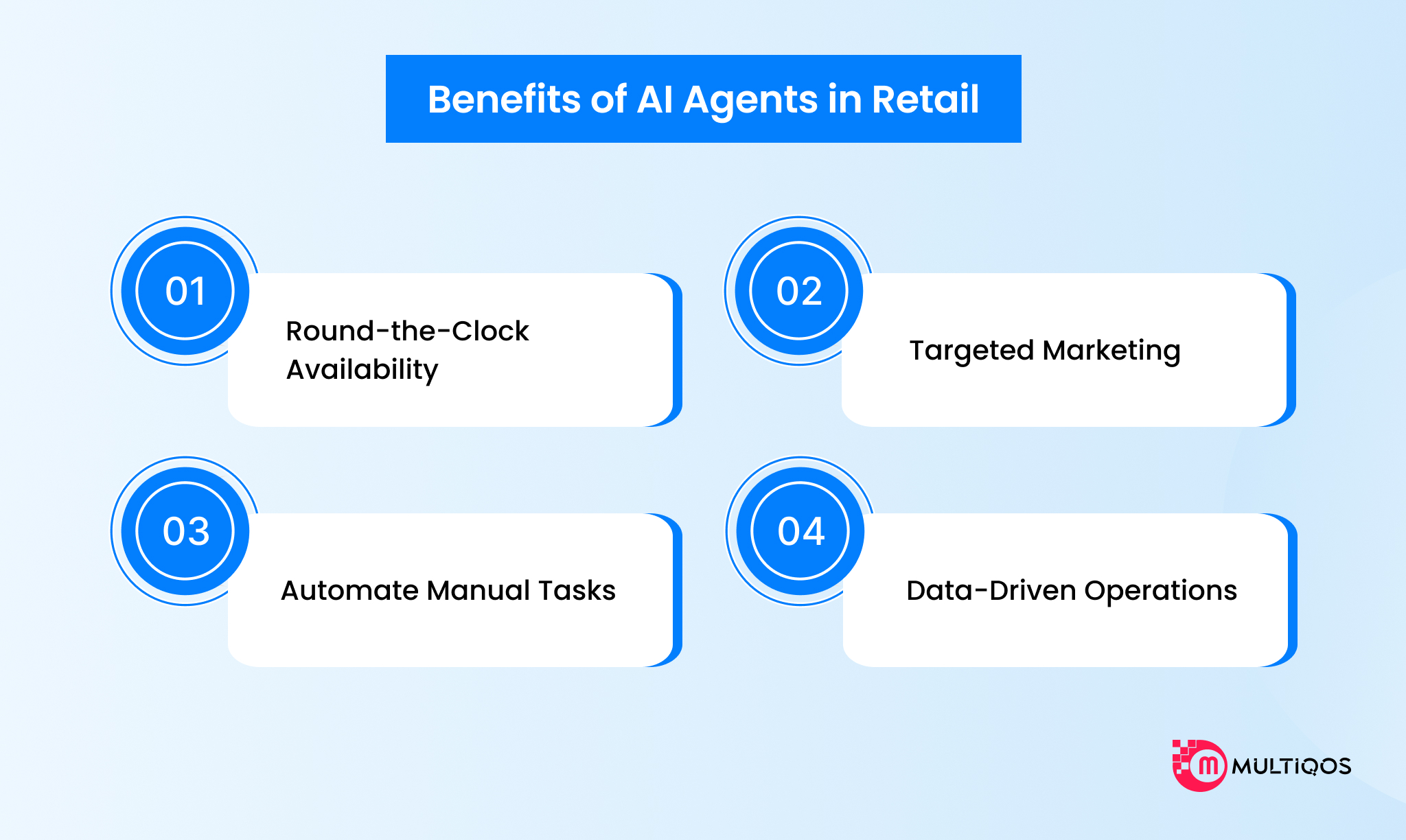
AI agents are delivering value across different functions in the retail industry. Some of the major benefits are listed below
Round-the-Clock Availability
AI agents are available 24/7, allowing customers to connect with the brand anytime. They are able to resolve issues, answer queries, and support customers, boosting satisfaction and loyalty.
Targeted Marketing
AI agents analyze customer data, recommend products, promotions, and offers, and thus create an engaging experience for customers.
Automate Manual Tasks
Routine operations such as inventory management, order fulfilment, and customer inquiries are handled by the AI agents, enabling the team to focus on strategic initiatives.
Data-driven Operations
AI agents have access to raw data, which can be turned into actionable insights that enable retailers to study customer behavior, sales patterns, and market trends.
Conclusion
AI agents are not a far-fetched idea for modern retailers. They serve as a practical way to improve customer interactions and make extensive use of the available data to promote informed decisions. The path to success is rarely a big-bang rollout. It is a phased approach starting from understanding the workflows, choosing a use case on the basis of business goals, training AI agents with the correct data, testing the agents under different conditions, and then scaling from there.
As agentic commerce grows, retailers whose agents can coordinate, share data, and act with precision will be best placed to meet customers wherever their shopping journeys begin. The sooner you start, the sooner you learn to use AI agents.
FAQs
The key is to identify which tasks can be automated without being disrupted and which operations require human intervention.
The teams should know how they can harness the full potential of AI agents. The retailers might need to arrange user training sessions to improve adoption. Also, it is necessary to ensure that AI governance and security standards are met.
With AI agents in retail, physical stores are able to function like a digital store. AI agents continuously adjust staffing, inventory, and promotions based on customer behavior and external conditions.
By studying customer behavior and external conditions, AI agents successfully adjust staffing, inventory, and promotions.
AI agents allow retailers to gain a better understanding of customers. The agents offer better business insights, enabling retailers to boost efficiency. As agents automate manual operations, teams have the time to focus on important tasks.
The retail AI agents transform shopping experiences for customers by offering personalized recommendations at every stage of the purchase cycle. The agents also power virtual assistants that are available to solve customer concerns 24/7.
Retailers can use AI agents in several ways. Some of the prominent ways are: virtual assistants that handle customer queries, smart inventory management, and personalized product recommendations. Agents also collect data from different customer touchpoints, summarize it, and offer reports on how the assets are performing.
Prashant Pujara is the CEO of MultiQoS, a leading software development company, helping global businesses grow with unique and engaging services for their business. With over 15+ years of experience, he is revered for his instrumental vision and sole stewardship in nurturing high-performing business strategies and pioneering future-focused technology trajectories.


 ChatGPT
 Perplexity
 Claude
 Google AI Mode