
Enterprise RAG Guide: Architecture, Key Benefits and Real-World Use Cases
Need quick insights? Summarize with AI & save time
 ChatGPT
 Perplexity
 Claude
 Google AI Mode
Table of Content
- What is Enterprise RAG?
- Why Enterprises Need RAG?
- How Does Enterprise RAG Work?
- Key Benefits of Enterprise RAG
- Enterprise RAG Use Cases
- Best Practices for Implementing Enterprise RAG
- Conclusion
- FAQs
Summary:
Enterprise RAG is production-grade retrieval-augmented generation built for scale, security, and governance, not a demo chatbot with a vector database attached. This guide covers the seven-stage enterprise RAG pipeline: ingestion, chunking, hybrid retrieval, reranking, permission filtering, generation, and audit logging. It explains why RAG costs less than fine-tuning, how document-level access control works at query time, and what real deployments look like at DoorDash, LinkedIn, Salesforce, Ramp, Oscar Health, Morgan Stanley, and RBC. It ends with implementation best practices for architecture, retrieval precision, multi-tenant governance, and evaluation. Written for CTOs, VPs of Engineering, and Chief Data Officers at regulated enterprises.
Enterprise RAG is production-grade retrieval-augmented generation built for scale, security, and governance. It allows large language models to use your private company knowledge but in a closed loop.
Most enterprise RAG pilots fail due to reasons like hallucinations. The model hallucinates the moment it touches real internal data.
Leadership will not approve rollout without data accuracy, especially when most RAG demos rely on naive vector search or k-nearest neighbors. What this means is if your customers have well-formed queries, the model will handle it, but for vague queries it will fail.
Plus, prototypes often use static document uploads, creating a snapshot of information that is only accurate at the time of creation. Basically, there is no real-time data integration. This is why your enterprise RAG must be based on event-driven architecture or Change Data Capture (CDC).
This guide shows the architecture, the benefits, and proven use cases. You will leave with a business case your security team accepts. Let’s start with an overview of enterprise RAG first.
What is Enterprise RAG?
Enterprise RAG retrieves trusted company data before the model writes anything. It isolates confidential files, databases, and records inside controlled environments. A basic RAG chatbot just bolts search onto a public model. Enterprise RAG treats retrieval as governed infrastructure, not a feature.
The distinction matters more than most project timelines assume. Consumer tools cannot enforce who reads which document. Your compliance team will ask that question first. Enterprise RAG answers it by design, at query time.
The market pressure behind this shift is not small. Statista projects the generative AI market near $394.66 billion in 2026. That spend now demands grounded answers, not confident guesses.
Why Enterprises Need RAG?
Enterprises don’t adopt Retrieval-Augmented Generation because it’s trendy. They adopt it because the alternative doesn’t work reliably. A standard LLM trains once on a fixed dataset, then goes frozen, with no access to your company’s private documents, no visibility into what changed this morning, and a well-documented habit of guessing when it doesn’t know.
Wire that same model into a production-grade RAG pipeline and hallucinations drop sharply, because the model is now grounded in something real instead of guessing. Adoption is wide, but value capture stays narrow. McKinsey reports most firms see no clear EBIT impact yet. Only a small share have scaled AI enterprise-wide.
Grounded retrieval is how you close that gap. The data foundation is where projects usually break. Accenture found many enterprises admit their data is not AI-ready. Fix the pipeline, and RAG finally earns its keep.
Here’s why that gap has turned RAG into a structural requirement rather than a nice-to-have.
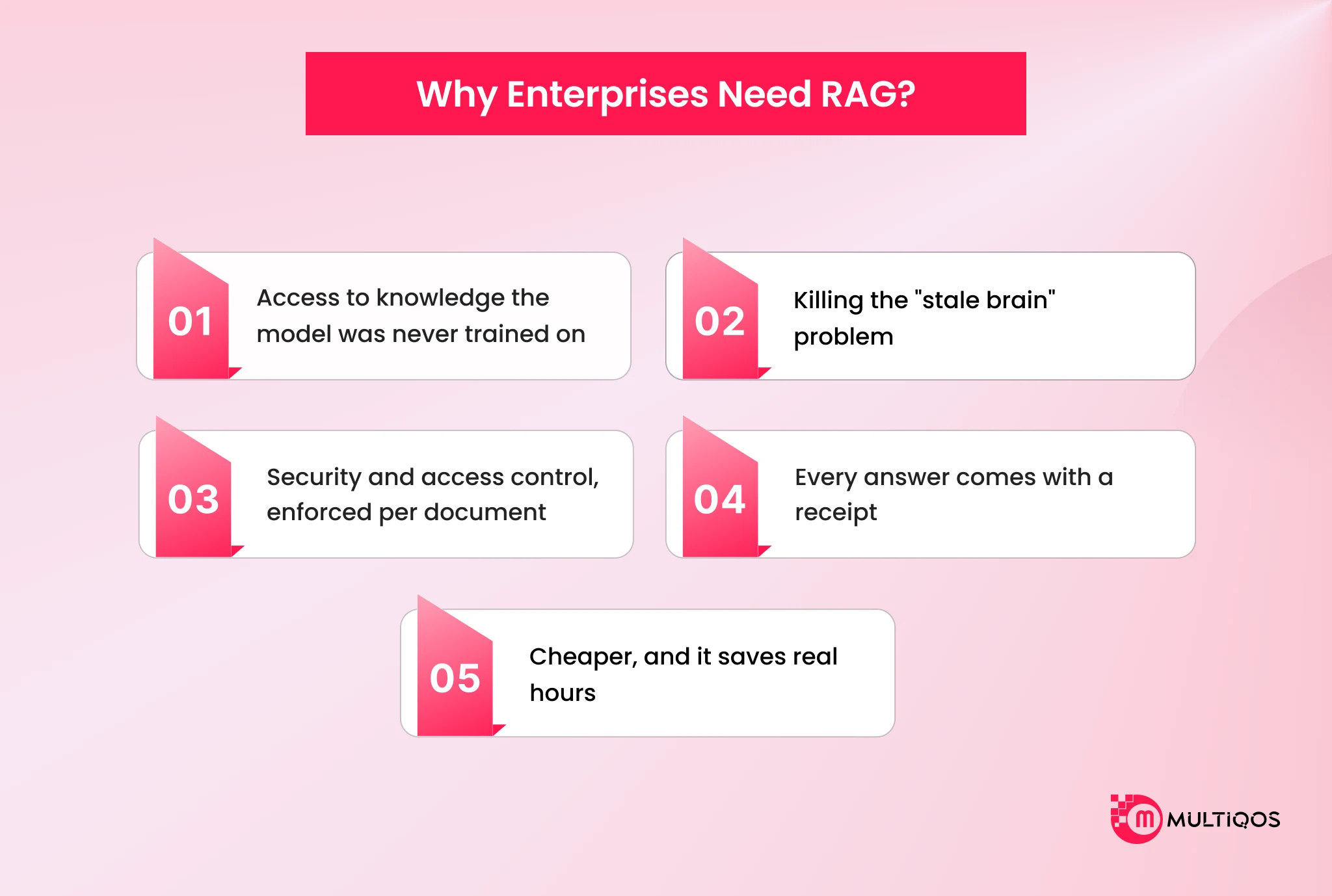
1. Access to knowledge the model was never trained on
No foundation model ships knowing your refund policy, your latest product changes, or the history on a specific customer account. That information lives in SharePoint, Confluence, internal wikis, ticketing systems, places a base model has never seen and never will, no matter how large it gets.
2. Killing the “stale brain” problem
Training data is a snapshot. The moment training ends, the clock starts on how wrong the model will eventually be. Meanwhile, actual engineering orgs push code and update docs constantly. Retraining a model every time something changes is neither fast nor cheap; nobody does that.
3. Security and access control, enforced per document
This is the one that keeps CISOs up at night. If an AI assistant can see everything in the knowledge base, it can also repeat everything, including a CEO’s confidential performance review to an employee with no business reading it. Raw LLMs have no concept of “who’s asking.”
4. Every answer comes with a receipt
In finance, healthcare, and law, “trust me” isn’t an acceptable answer. Compliance teams want to know where a claim came from. RAG attaches source citations to its output, so a user or an auditor can trace the answer back to the document it was pulled from.
5. Cheaper, and it saves real hours
Fine-tuning means retraining whenever facts shift, and that means GPU time- expensive, recurring GPU time. RAG updates the knowledge base instead of the model, at a fraction of the cost. The productivity side is arguably the bigger win.
How Does Enterprise RAG Work?
Enterprise RAG is not a script that skims a few PDFs. It’s a pipeline: seven stages, each one doing a specific job.
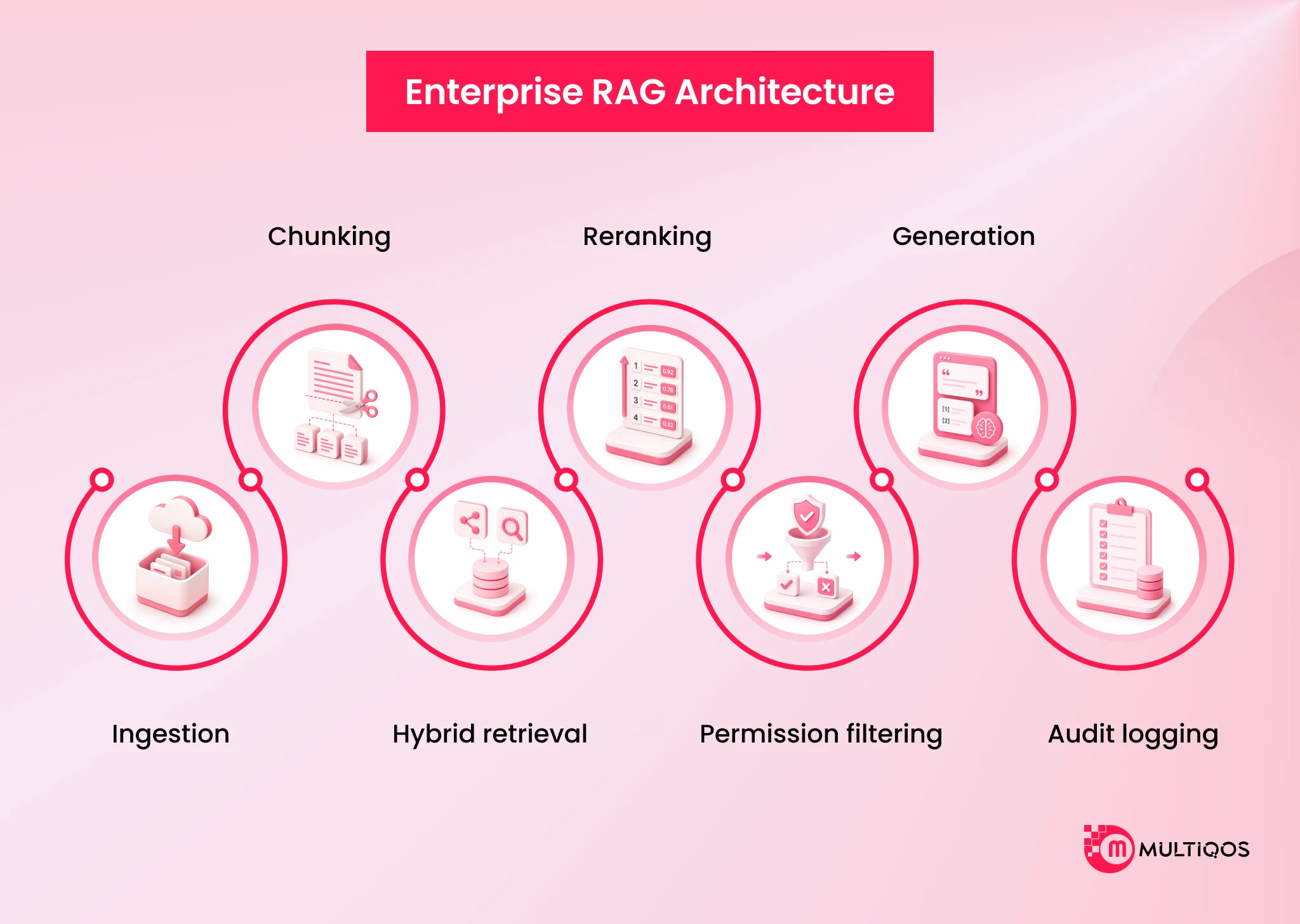
- Ingestion pulls from wikis, tickets, and internal docs near the moment they change, not in an overnight batch.
- Chunking splits those documents along meaning, so a single idea never gets sawed in half.
- Hybrid retrieval runs semantic and keyword search together. That matters. Pure semantic search will happily miss a product code like AX-4470.
- Reranking re-scores the top candidates, because the first pass optimizes for recall, not precision.
- Permission filtering drops anything the user isn’t cleared to see before it reaches the model, not after.
- Generation instructs the model to answer from retrieved material only, with a citation on every claim.
- Audit logging records the chain, so any answer can be traced back to why.
Key Benefits of Enterprise RAG
Enterprise RAG delivers what actually show up on a budget sheet: better accuracy, fresher answers, lower cost, and a clear paper trail. Here’s what each one actually means.
Higher Accuracy, Fewer Made-Up Answers
The model isn’t guessing. It pulls answers straight from real source documents and points to exactly where each fact came from. That’s the kind of proof compliance teams want to see before they’ll sign off on anything.
Fresh Information Without Retraining the Model
Enterprise RAG grabs live information from connected systems the moment someone asks a question. A fine-tuned model, by contrast, needs to be retrained every time the underlying data changes. Retrieval skips that cost entirely.
Cheaper Than Fine-Tuning
Instead of retraining an entire model, you just update an index of information. Smaller, purpose-built models are increasingly doing just as well as giant general ones, and retrieval is what keeps them accurate and current.
Governance, Auditability, and Compliance
Every answer traces back to a document the user was actually allowed to see. Permissions get checked before information is retrieved, not after. And there’s a record showing exactly why the model said what it said. That’s what separates something you can actually deploy from something that only works in a demo.
Security and Access Control
Enterprise RAG checks permissions the instant something is retrieved, syncing access rules from every connected system. Most demo versions skip this step entirely, which is exactly how restricted information ends up somewhere it shouldn’t.
Multiple Data Sources
Enterprise RAG keeps track of where every piece of information originated. Anything outdated or contradictory gets flagged instead of trusted blindly. Good governance is what turns a pile of scattered documents into answers people can actually rely on.
Scale and Infrastructure
A real enterprise LLM deployment handles millions of documents and plenty of simultaneous users. That takes monitoring, speed limits, and pipelines to keep everything updated
Enterprise RAG Use Cases
Most enterprise AI pilots stall at the proof-of-concept stage. Not because the model underperforms, but because it has no reliable memory of what the business actually knows. It fixes that specific failure: instead of asking a language model to guess from training data, RAG forces it to pull answers from a company’s own verified documents first, then generate a response grounded in what it retrieved.
1. Customer Support and Knowledge Management
Support teams sit on more institutional knowledge than any dashboard captures, scattered across Slack threads, Confluence pages, and closed tickets nobody re-reads. RAG turns that graveyard of past resolutions into a live retrieval layer, and the results are showing up in resolution-time metrics rather than press releases.
- DoorDash built a three-part system for its Dasher support chatbot: a RAG retrieval layer, an LLM Guardrail that screens every response before it ships, and an LLM Judge that scores quality on five dimensions after the fact. When a Dasher reports a problem, the system condenses the conversation, searches the knowledge base for the closest resolved cases, and drafts a response from that context.
- LinkedIn rebuilt its customer service retrieval around a knowledge graph instead of flat text search, preserving the relationships between historical tickets rather than treating each one as an isolated document. After roughly six months in production, the system cut median per-issue resolution time by 28.6%. That’s not a modest number for a metric most support orgs treat as fixed.
- Bell approached the problem from the infrastructure side: modular document embedding pipelines that support both batch and incremental updates, so an index refreshes the moment a policy document changes.
None of them treat retrieval accuracy as solved on day one. Every team layered on a second system, a guardrail, a judge, an incremental sync job, to catch what plain RAG gets wrong. That second layer is usually the actual product.
2. Revenue Intelligence and Sales
Sales teams don’t have a data problem. They have a re-discovery problem: the same account context gets rebuilt from scratch before every call because nobody can query last quarter’s notes in plain language. RAG closes that gap directly.
- Salesforce built retrieval directly into Agentforce’s architecture, so a rep can ask something like “list all open opportunities in healthcare for Q2” and get an answer grounded in governed CRM data rather than a guess, as Salesforce’s own architecture documentation lays out. Account Contextualization now runs natively inside CRM workflows instead of as a bolt-on search tool.
- Standardized Classification was Ramp’s problem to solve, and it’s a less glamorous use case than a chatbot but arguably a harder one. The fintech was running customer segmentation off a patchwork of third-party data, sales input, and self-reported categories, which made auditing next to impossible.
None of these examples chase a flashy customer-facing bot. They automate the internal grind, deal research, classification, and report writing that never gets budget until someone quantifies the hours it eats.
3. Healthcare and Insurance Operations
Every function on this list treats a wrong retrieval as embarrassing. Healthcare treats it as a liability. That one difference changes how RAG actually gets deployed here: less a chatbot bolted onto a knowledge base, more a retrieval system with a clinical or compliance layer standing over it before anything reaches a patient or a claim.
- Oscar Health built Oswell, an AI agent for its roughly 2 million members. Ask it something like “my doctor said something about high cholesterol, are my labs high?” and it answers by pulling from the member’s own medical records, plan benefit documents, and past conversations with Oscar’s care guides, not a generic medical database. Oscar backs those answers with published clinical and behavioral-safety research rather than shipping the model raw.
- Cohere Health built its utilization-management platform to retrieve the specific clinical evidence a payer’s policy requires before a prior authorization request ever goes out, instead of a reviewer hunting through a chart by hand. Geisinger Health Plan, which adopted the platform, reported a 63% drop in denial rates, 15% in incremental medical savings, and real-time decisions on the majority of submissions.
4. Finance and Compliance
Financial services is the largest RAG market by deployment count, and that’s not an accident. Few industries generate more proprietary, unstructured, legally sensitive documentation per employee, and few punish a wrong answer as fast as a regulator does.
- Morgan Stanley gave financial advisors an internal chatbot, AI @ Morgan Stanley Assistant, built on GPT-4 and grounded in the firm’s research corpus. What started as a system that could answer roughly 7,000 questions grew into one that handles queries across a 100,000-document corpus, and OpenAI’s account of the rollout puts adoption at over 98% of advisor teams, with document retrieval coverage jumping from 20% to 80%. That’s the kind of adoption number that should make any internal-tools team jealous.
- Royal Bank of Canada (RBC) built Arcane to solve a narrower but genuinely painful problem: its own investment policies were scattered across web platforms, PDFs, and spreadsheets that took trained specialists years to learn to navigate. A specialist now asks a question in a chat interface and gets a concise, sourced answer, as RBC demonstrated in a public technical session.
5. Manufacturing and Industrial Automation
Factory floors generate more real-time data than almost any other environment RAG touches, and static document retrieval alone can’t keep up with a sensor reading from ninety seconds ago. With the right manufacturing app development partner, you can ensure this data is optimally leveraged.
- Due Diligence Automation shows up furthest from the factory floor but runs on the same retrieval logic. Homebuilders evaluating land parcels used to spend weeks pulling zoning codes, topography data, and deed restrictions from a dozen disconnected sources before a single go or no-go call. Acres, an AI agent purpose-built for homebuilder land teams, now scores sites and flags constraints across all of that in minutes, compressing what used to be a sequential review into a parallel one.

Best Practices for Implementing Enterprise RAG
Implementing enterprise retrieval-augmented generation requires shifting from simple scripts to a distributed system architecture that prioritizes security, accuracy, and real-time data. To successfully move from a pilot to production, organizations should follow these best practices across the system’s lifecycle.
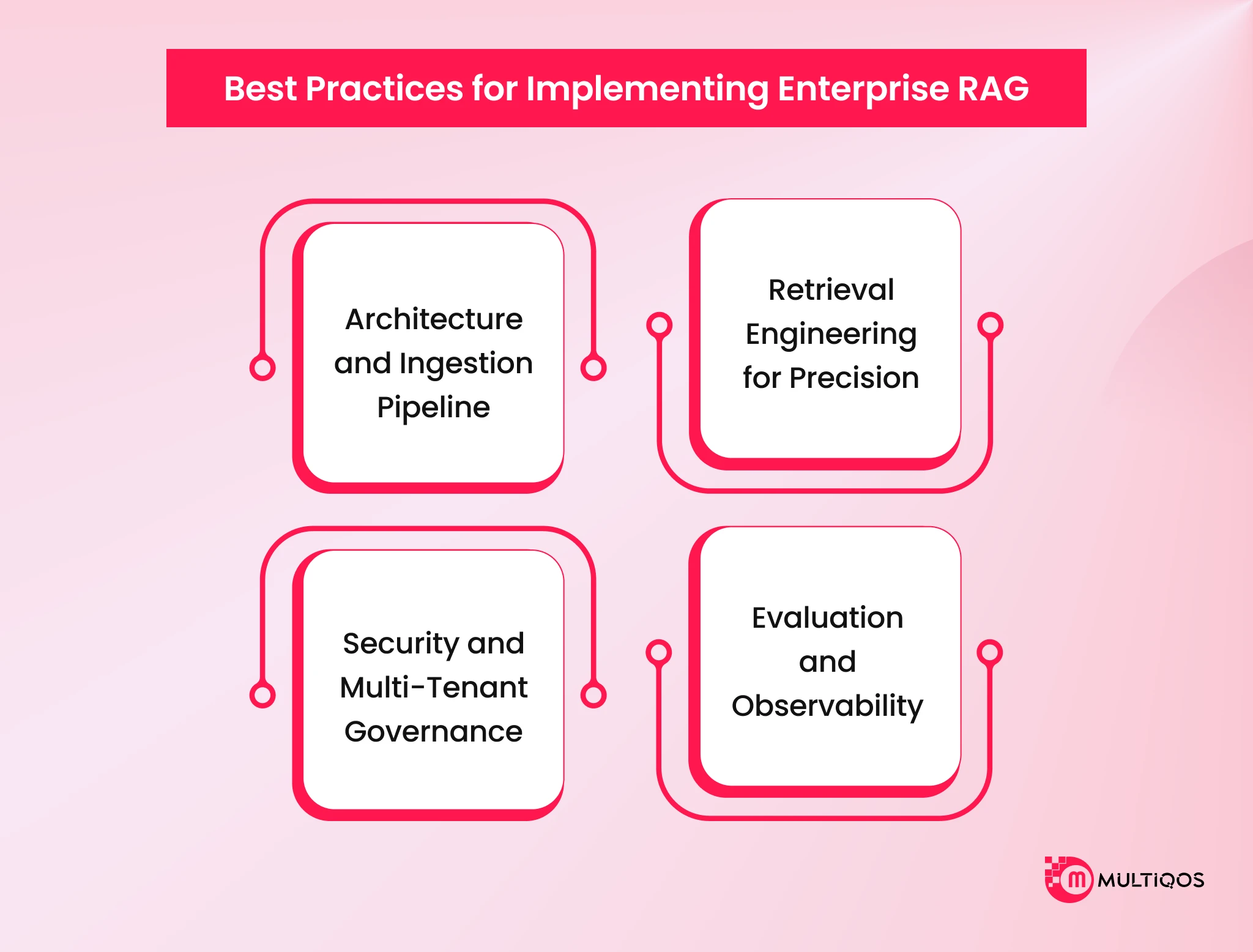
1. Architecture and Ingestion Pipeline
- Decouple Processing from Serving: Do the heavy lifting somewhere else. Reading files, pulling text out of scans, converting everything into a searchable format: all slow work. Run it on separate machines in the background. Otherwise, one giant scanned contract holds up somebody’s search and the whole thing feels broken.
- Implement Real-Time Sync: Most teams refresh their document library once, overnight. So a policy changes at 9 in the morning and the assistant keeps confidently repeating the old version until after midnight. There is a better option. CDC watches your source systems directly and pushes updates through within a second or two, ensuring real-time data integration. It costs more to run. Wrong answers cost more than that.
- Structure-Aware and Enriched Chunking: The system chops long documents into smaller pieces so they can be searched. Done carelessly, a table gets sliced down the middle, and a heading gets separated from the content it describes. Cut along the document’s own structure instead, at section breaks and around whole tables. Then attach a short label to each piece saying where it came from, when it was written, and which team owns it. Put that label inside the text, not off in a separate field, because that is what makes the search actually use it.
- Enforce Idempotency: Give every document a fingerprint based on its contents. Seen that fingerprint already? Skip it. Without this, running an import twice fills the library with duplicates and people start seeing the same paragraph three times in a single answer.
2. Retrieval Engineering for Precision
- Deploy Hybrid Search: Meaning-based search is good with concepts and hopeless with exact codes. Ask it for part number 4471-B, and you get something vaguely related and useless. Keyword search catches exact strings. Run both, combine the results, and product codes and abbreviations stop disappearing.
- Integrate Semantic Reranking: The first pass grabs maybe 50 to 100 possible matches quickly and roughly. A second, slower model then reads the question and each document side by side and reorders them properly. That second read is what catches the difference between “approved” and “not approved,” which the fast search treats as almost the same thing.
- Implement Overfetching: Pull three to five times the number of pieces you actually plan to use, because permission checks will throw a lot of them out. Ask for exactly ten, lose seven to access rules, and the AI is left guessing from three.
3. Security and Multi-Tenant Governance
- Document-Level RBAC: Check permissions at the moment someone searches. Pull the sharing rules from wherever the documents live, whether that is SharePoint or Google Drive or something else, and store them next to each piece of text. Filter on them before anything reaches the AI. Once the AI has read a document, you cannot instruct it to forget.
- Hybrid Filtering: First narrow the search to what this person is allowed to see. Then verify whatever survived against your permissions service. It sounds like doing the same job twice, and it isn’t. When someone’s access gets revoked, the change takes a moment to spread across every system, and that small gap is exactly where leaks happen.
- Physical Isolation for Multi-Tenancy: If you serve several client companies from one system, telling them apart with a label on each record works fine until one query gets written wrong. Give each client their own separate storage. Then a coding mistake still cannot expose one client’s files to another.
- Comprehensive Audit Logging: Write down every lookup. Who asked, what they asked, which documents came back, which ones were blocked. Months later, when someone in legal wants to know why the assistant said what it said, this record is the only answer you have.
4. Evaluation and Observability
- Measure the “RAG Triad”: Ask three questions, over and over. Is the answer actually based on the documents it found, or did the AI invent it? Does it address what was asked? Did the search find the right documents in the first place? Almost everything that goes wrong shows up in one of those.
- Layer the Evaluation Stack: Use different tools for different stages. One for quick experiments while you tune things. One wired into your testing setup, so a change that makes answers worse stops the release instead of shipping to users. One for watching the live system day to day. No single tool covers all three properly.
- Domain Calibration: An AI grading another AI cannot spot that a medical document is two revisions out of date. It reads well, so it scores well. Have people who know the subject mark a set of test questions by hand, then adjust your quality thresholds to match their judgment. In medicine or law, skipping this is asking for trouble.
Conclusion
Enterprise RAG is infrastructure, not a bolt-on feature. The real difference is governance and evaluation discipline here. It is not simply a bigger vector database. Assess your data readiness before you choose a stack. Decide where RAG fits and where fine-tuning wins. The decision is not whether to ground your models. That decision is already made by your accuracy bar. The decision is who engineers it to survive production.
FAQs
Enterprise RAG is production-grade retrieval-augmented generation built for security and scale. It grounds language models in your private, permissioned company data. Unlike a demo, it enforces governance at query time.
RAG works through two pipelines: offline indexing and online querying. Indexing chunks, embeds, and stores your documents as vectors. Querying retrieves relevant passages, then generates a cited answer.
Traditional RAG improves answers using external public knowledge sources. Enterprise RAG isolates confidential data inside private, access-controlled environments. The core gap is security, governance, and data pedigree.
RAG suits frequently changing knowledge without repeated retraining costs. Fine-tuning suits fixed behavior and stable domain patterns. Most enterprises combine both for accuracy and control.
Cost depends on data volume, sources, and latency requirements. RAG usually costs less than continual model retraining. A readiness assessment gives you a defensible budget range.

Get In Touch

Get Stories in Your Inbox Thrice a Month.
Enterprise AI Implementation Challenges: Common Roadblocks and How to Overcome Them

Computer Vision in Retail Explained: From Smart Shelves to Smart Stores
The Complete Guide to Machine Learning in Healthcare: Uses, Benefits & Challenges